Home » Posts tagged 'UK' (Page 79)
Tag Archives: UK

Brexit: The Trigger for a New Atlantic Alliance
by John Brian Shannon | October 4, 2016
Britain, more than any other Atlantic Ocean nation, would benefit from an Atlantic Alliance free trade zone precisely because it is an island nation, and as such it depends on free trade and movement of goods in order to thrive to it’s full potential.
Since the Roman era Britain has enjoyed a historic presence in the Atlantic Ocean for good reason — island nations need regional trade to survive and international trade to thrive.
For Britain, there is no way forward without enhanced international trade. In principle, islands should always be the strongest proponents of international trade and international law for the very reason that they profoundly need the world to function that way.
Japan set a wonderful example for all island nations in the postwar era, but never moreso since the Arab Oil Embargo of 1973 when U.S. consumers suddenly decided to switch their gas-guzzler cars for lower priced and more fuel efficient Japanese cars.
Not only were millions of cars imported from Japan over the following years, but because the necessary technology to build cars was transferable to home and personal electronics, Japan received a double boost to it’s economy every day since the Arab Oil Embargo.
From one of the worst performing economies in the world in 1946 to it’s peak as the #2 global economy in the 1990’s — the Japanese economic miracle rode its high quality manufacturing base that catered to the needs of billions of consumers. By any standard it remains an impressive accomplishment.
And now it’s Britain’s turn to shine as the world’s next booming economy.
Although much has changed since the oil supply shocks of 1973, the world economy continues to grow, with developing nation consumers seeing comparatively massive increases in their disposable income, presenting a wonderful opportunity for a Britain suddenly freed from an overly bureaucratic political union.
Therefore, let us count the ways that an Atlantic Ocean trading alliance (a free trade zone, that I propose be restricted to nations that front the Atlantic Ocean) could benefit Britain and the other Atlantic nations.
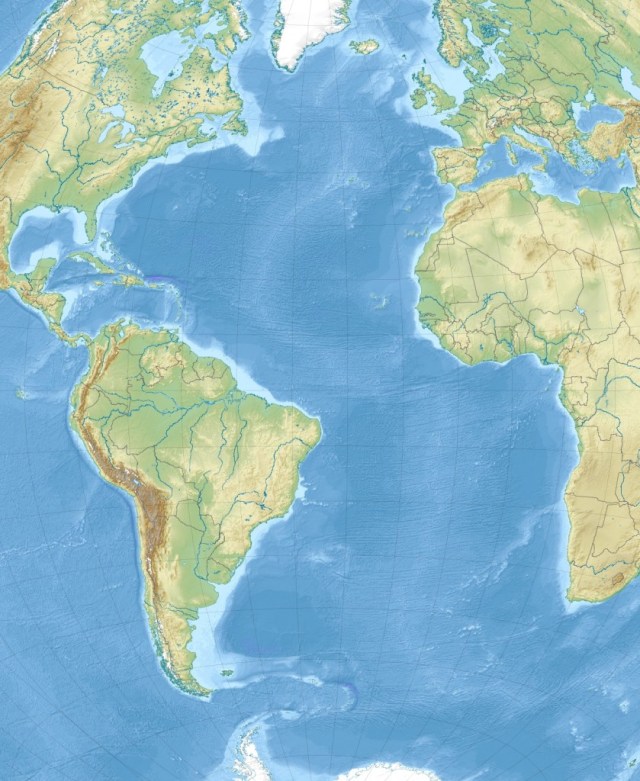
Britain, more than any other Atlantic Ocean nation, would benefit from an Atlantic Alliance free trade zone precisely because it is an island. Atlantic Ocean map. Image courtesy of Geography.name
In the North Atlantic, we have the United States, Canada, Greenland, Iceland, Ireland, the United Kingdom, Norway, France, Spain and Portugal.
In Africa; Morocco, Western Sahara, Mauritania, Senegal, Gambia, Guinea-Bissau, Sierra Leone, Liberia, Côte d’Ivoire, Ghana, Togo, Benin, Nigeria, Cameroon, Equatorial Guinea, São Tomé and Príncipe, Gabon, Central African Republic, Democratic Republic of the Congo, Angola, Namibia, and South Africa, front the Atlantic Ocean.
And in South America, we have the South Atlantic nations of Argentina, Uruguay, and Brazil fronting directly onto the Atlantic Ocean — while French Guiana, Suriname, Guyana, Venezuela, Columbia, Panama, Honduras, Nicaragua, Belize, and Mexico and many island nations reside within the Caribbean Sea — which is of course, easily navigable to the open Atlantic Ocean.
All of these nations should receive a warm invitation to join such a trading block.
It is perhaps the best matchup of nations since the Bretton Woods Agreement of 1944. In the list of Atlantic and Caribbean nations, exist the most developed nations to the least developed, from the most overbuilt tourist locations to vastly underbuilt tourism markets, to the astonishing per capita petroleum and mineral resource base. Such opportunity abounds for those who pursue economic interdependence between Atlantic nations! From the most highly skilled labour to the cheapest labour, and among the highest cost real estate to the cheapest agricultural land in the world, everything that a developed or still developing nation needs can be easily found within this trading area.
The economic opportunities are uncountable, and they are sitting there untapped. At the moment, it’s a criminal waste of opportunity that must rank as a negative for every Atlantic nation whether developed or developing.
The obvious move here is for British Prime Minister Theresa May to voice strong support for an Atlantic free trade zone, contacting representatives of each country to find out what Britain offers, that can mesh with the needs of each Atlantic Alliance trading partner. And vice-versa.
Once some activity generates and some new trade begins to take shape, it would be wise to meet regularly to discuss standardization of regulations, whether shipping or other modes of transportation, financial, tourism, and other ways to work together. Even the baby-steps of working together to protect maritime shipping from at-sea piracy, or to form mutual aid groups designed to streamline hurricane or other natural disaster relief would demonstrate ways that Atlantic nations can work together for mutual benefit.
If the NAFTA model is used as the trading template, some of it’s terms could be adjusted to better suit the preferences of all Atlantic Alliance members, or it could be seen as the eventual goal for all members to reach at some point. At the very least it could be used as a reference point, a place to begin discussions.
By leading such an effort Britain would be well-placed — not to own the Alliance — but to offer it’s expertise and experience, so that the end result is a Win-Win for every nation involved. That is what makes for strong partnerships, and strong partnerships always make economic sense.

Why Britain needs a dedicated Minister for Europe
by John Brian Shannon | September 21, 2016
It is a time of change and a time of renewal in old Europa.
Three countries are leaving or have already left the European Union. Greenland opted to leave in 2009, the residents of Switzerland voted in a countrywide referendum to leave the EU in 2014, and in 2016 Britons voted to Brexit.
Not only that, but Italy decides by countrywide referendum whether to stay in the EU this December, while the Netherlands, France, and Hungary have upcoming elections and strong anti-EU political parties pushing for referenda to exit from the European Union.
Norway never did join the EU, but co-exists with the EU via the EEA and EFTA models. And Norway’s economy and people are doing very well, to say the least.
It’s not WWII scale of change in Europe, thankfully. It’s not even Marshall Plan reconstruction of Europe scale of change. But Europe is changing, it’s a work-in-progress, and there is much that could still go right, or wrong, for the European project.
Creating a Minister for European Affairs
Which is why Prime Minister Theresa May should create a new position in her government of Minister for Europe which would cover everything Europe on behalf of the British government.
For the Foreign Secretary to try to cover all things Europe at this time of unprecedented change in Europe — and to build and nurture relationships between Britain and every other country in the world, is simply asking too much from one human being. The Foreign Secretary’s job is a full time job, and that’s under normal circumstances.
While a Minister for Europe would be a full time job with significant challenges involved as some of the 27 EU nations seek to delay, derail, or persuade Britain to remain in the EU (not because it will benefit the UK, but because that’s what will benefit their particular country) even as others seek to punish UK voters for choosing to Brexit.
The Minister for Brexit portfolio only deals with relations between the UK and the European Union, while a Minister for Europe would cover all socio-economic and military-security relations (and more) with every country from Iceland in the west to Ukraine in the east, from Norway in the north to Spain’s southern islands off the coast of Africa, in the south.
There is so much more going on in Europe these days beyond the mandate of Minister for Brexit, that it will take a full time and highly dedicated person to oversee all things Europe. It’s a big territory and it’s sure to be a big job.
Choosing the best Minister for European Affairs
And for that, you need someone larger than life — someone like Nigel Farage, who isn’t afraid of anyone, anywhere, for any reason. At no time would anyone ever think that Nigel wasn’t fully devoted to protecting Britain and helping her to grow to her best potential. Even his political opponents would attest to that.
Mr. Farage created and led the UKIP political party to great heights in a very few years, culminating in the Brexit vote, and Nigel Farage made it look easy every day of the year.
I couldn’t imagine anyone more suited to the job than Nigel Farage, nor could anyone approach his future success in all of the UK’s dealings with Europe, from Iceland to Ukraine and everything in between.
Thus far, PM Theresa May has made some smart moves, hiring Nigel Farage as Minister for Europe could prove to be the smartest move of all.
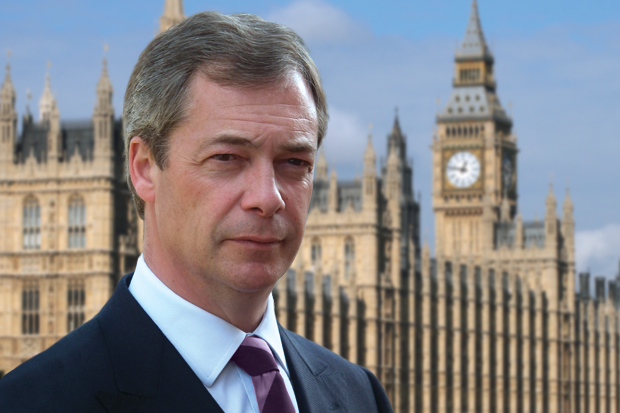
Britain – It’s a time of profound change in Europe which makes it the time for Theresa May to appoint a dedicated and energetic Minister for Europe. Nigel Farage at the UK Parliament Buildings. Image courtesy of The Spectator

Becoming the Great Meritocracy: The Rise of Education in Britain
by John Brian Shannon | September 15, 2016
Prime Minister Theresa May says she wants Great Britain to become the world’s Great Meritocracy and one of the ways she intends to accomplish it, is by raising the priority given to education.
Which is brilliant! Of all the ways to spend taxpayer money to Build a Better Britain, equipping young minds to become all they can and should be must rank highest of all.
Much has been vocalized via the anecdotes of those who attended Grammar schools in Britain in the 1950’s-1980’s era who had decidedly poor experiences. In that era, education (and other parts of society) weren’t all that they could and should’ve been, and some schools, whether Grammar, Comprehensive, Modern, Academy, Faith, or Private, were downright terrible. And that is a shame.
But because a minority of students were badly educated or badly treated (or both) in various locations across the country, does not mean that Britain should close all schools or demonize certain kinds of schools.
Rather, let’s roll up our sleeves, find out what needs to be fixed and how to fix it, and Build a Better Britain
On that note, Grammar schools must be doing something right as the current Prime Minister and three members of her cabinet were educated in Grammar schools. Other PM’s and cabinet ministers over the years have likewise attended Grammars.
Read: Theresa May may see off Tory grammar school rebels, but her plans won’t survive unscathed
Due to the focus put on Britain’s education system by PM Theresa May, the comment forms at several UK websites show many people railing against the so-called 11+ exams (that’s the age the children take the exam) saying that they put undue pressure on students and parents, and that the result of one series of exams can turn a student’s entire future for the worse.
Accordingly, any blame for the pressure felt by students and parents in regards to the 11+ gets transferred onto the Grammar schools which, not incidentally, are performing wonderfully.

Clearly, the problem is the 11+ exam system itself, where parents feel they must hire (perhaps expensive) tutors to prep their child for the exam, and where the cost of failure breeds fear among students.
Miserable and over-pressured students do not learn well
Some children are late-bloomers and might fail the 11+ exam, but those same kids could hit their stride by age 12 or 13. For some students, it just takes the ‘right teacher’ to make learning fun and and they begin to excel for no apparent reason.
Once you have that going for you, exams are just enough of a challenge to keep your interest but not knock you off the planet with dread.
Therefore, let’s keep the 11+ exam, but normalize it by requiring one every subsequent year. To ensure that children get the best chance in life, let them take a 12+, a 13+, a 14+ and so on, until they have completed their primary and secondary education. Students could move to a Grammar when they are ready, while other children could leave Grammar school, returning to their Comprehensive or other school if they find that a Grammar isn’t working for them.
In that way children will find the school that is most appropriate to them, at the time they’re ready for it
There’s room for improvement in the British educational system and a simple course correction might be all that’s needed.
Here are three ways to improve educational outcomes for students:
- Instead of 11+ exams taken at age 11 (and only age 11) that can determine a child’s entire educational future based on one exam, add 12+, 13+, 14+ and 15+ exams to the mix. In that way, children will find the most appropriate school for them.
- Increased funding for schools, particularly at the pre-school and early development stages.
- Vocational schools that teach the academic programme, but are geared to appeal to those kids who know they want to work with their hands; The future home builders and skyscraper constructors, the automotive, rail, and aircraft manufacturers and maintenance staff of the 21st century. And so much more.
Instead of shooting for a minimum standard, Britain’s government should be empowering all of Britain’s students to become all that they can and should be whether they choose to become an Accountant or a Zoologist, or anything in between.
But whatever path they choose, let’s give them the ability to be the very best Accountant or Zoologist they can be.
That’s what it will take for Great Britain to become the world’s Great Meritocracy.
 Letter to Britain