Home » Posts tagged 'UK' (Page 61)
Tag Archives: UK

UK PM in Brussels, OECD Barbs & the EU’s Rising Champagne Budget
What’s a UK Prime Minister to do who is away for meetings with EU officials to discuss Brexit terms and to solve practical matters and common problems, when the richly-funded-by-the-EU Organisation for Economic Co-operation and Development (OECD) seeks to undo the democratic will of the British people by claiming that undoing Brexit would bring more wealth to the UK?
It’s not like the OECD utterances on the UK economy have been accurate since Brexit was first discussed in the public arena, and it’s not like the OECD has a legitimate mandate to comment on political developments in any OECD member nation. In fact, it’s expressly forbidden in their charter.
Since Brexit was first suggested, the OECD have been the prophets of doom, telling anyone who would listen that economic Armageddon would occur were the UK to continue pursuing Brexit and yet, almost exactly the opposite has occurred. UK markets are booming, trade is flourishing, countries are lining up to sign free trade agreements with a post-Brexit UK, and Britons are looking forward to taking back control of their country.
Yes, the EU Parliament will miss the (net) £8 billion annual contribution from the UK taxpayer. Britons get that.
But the United Kingdom must do what’s best for its citizens not what’s best for a greedy and overly bureaucratic EU politburo that wants to spend its time passing arcane legislation and finding ways to get evermore money out of Britain (mainly) and other EU member states, to support its extravagant operations.
“Will it be Moët & Chandon Dom Perignon White Gold, Mr. Junckers, or a couple of Heineken?” — You know the answer to that question! ;)

Moet & Chandon Dom Perignon White Gold
On a related note: UKIP’s Nigel Farage said today on his wildly successful call-in talk show that the EU Parliament wine and spirits budget is in the tens of millions of dollars and that they are thinking of upping their annual alcohol purchase.
Summary
For as long as the UK remains a paid-up member of the European Union, it’s fair for the UK and other members of the union to comment on political, economic and social developments happening within the other EU member states.
However, the OECD should refrain from commenting on the politics of any nation.
Don’t forget that as a paid-up member of the EU until Brexit actually occurs, the UK (along with Germany) are paying the lion’s share of the OECD’s £85 million annual budget.
On top of that, the UK has its own (country) account with the OECD which costs the UK £11 million per year. You think the OECD would show the UK a little respect as it’s paying 2X its required dues there.
The Organisation for Economic Co-operation and Development needs to realign itself with its original charter to maintain its credibility and thereby maintain its present membership numbers. If the OECD can’t manage to do that, it’s time for the UK to leave the organization.
Related Articles:
- UK Treasury rejects OECD’s call for second Brexit referendum (The Guardian)
- At a glance: the big issues PM must confront tonight (The Times)
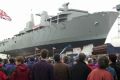
UK Warships Set For Early Retirement Could Serve Other Commonwealth Navies
UK Ministry of Defence bosses have announced their intention to retire seven ships and reduce the Royal Marines by 1000 personnel in a cost-saving effort necessitated by the acquisition of two world-class aircraft carriers, the HMS Queen Elizabeth and the HMS Prince of Wales.
It’s brilliant that the Royal Navy is stepping boldly into the 21st-century with two state-of-the-art aircraft carriers, yet many sailors will miss the still great but aging ships, which have a decade or two of service life left in them.
In fact, two of the soon-to-be retired vessels, the HMS Albion and the HMS Bulwark aren’t even halfway through their expected life-cycle but are excellent ships that could be sold to any Commonwealth nation.

UK Royal Navy ship HMS Albion was launched by Princess Anne on March 9, 2001. Image credit: Richard English
As an island nation and as the world’s oldest sea power, Britain should always command a first-rate navy, and good policy would dictate the sale of RN ships halfway through their normal life-cycle to help defer the costs of maintaining that world-class navy.
The helicopter carrier HMS Ocean was also marked out for retirement in an earlier press release along with four smaller Royal Navy ships, but they too could serve out the rest of their expected life in any Commonwealth nation.
Commonwealth Partner Canada – Needs Those Ships!
The Royal Canadian Navy depends heavily on its 12 naval frigate fleet and is desperately lacking in rescue capability (helicopter carrier) and littoral combat (close-to-shore) vessels — which gaps could be filled by the soon-to-be-retired HMS Ocean, HMS Albion, and HMS Bulwark, while saving the Canadian navy billions of dollars — and more importantly, the several years required for Canada to build new ships.
Although Canada has a great navy with proud tradition there are major credibility gaps in Canada’s fleet and purchasing these Royal Navy ships could partially alleviate that gap, thereby propelling the RCN forward by at least five years and at very reasonable cost compared to building new ships.
Canada should constantly drop hints to the Royal Navy to allow them be first to bid on ships and helicopters set for early retirement.
Commonwealth Partner India – Needs Those Ships!
The Indian Navy has a vast area to patrol in one of the busiest shipping regions of the world and it can’t get enough ships. Ever!
Modern naval vessels are very expensive to build, but expensive new ships don’t always suit the needs of the Indian Navy — a navy that requires huge numbers of vessels to patrol all those millions of square miles. Not all of them need to be world-class combat ships.
With thousands of cargo ships and cruise ships travelling through the region every day, and with piracy at an all-time high in the Indian Ocean having enough ships available to maintain a presence is far more important than how shiny the paint is on inspection day.
The level of shipping activity in the Indian Ocean region can only be described as frenetic and piracy is a common problem in the adjacent Arabian Sea and off the east coast of Africa where many Indian registered ships carry trillions of dollars of raw materials and manufactured goods every year.
Commonwealth Partner Australia
Australia fields a modern navy and (thankfully) it enjoys the strong support of the Australian government.
The country purchases build-to-suit ships and submarines from various countries and it occasionally sells its used ships to New Zealand — a good arrangement for both countries.
However, some early retirement Royal Navy ships could be valuable to the Royal Australian Navy in the future. Their navy is heavy with helicopter frigates and minesweepers and has a respectable number of submarines — yet there may be occasion when Britain’s navy could decide to part with ships that meet the needs of the Australian fleet.
The only thing lacking in the RAN fleet are destroyers. They could make-do with 6 as we are presently in peacetime; At the moment, the Royal Australian Navy has 1 destroyer.
Other Commonwealth Partner Navies
Many Commonwealth nations are maritime countries with various naval capabilities, yet purchasing new ships is an expensive proposition for rapidly developing nations.
For them, it’s difficult to justify a billion dollar warship when they need crucial infrastructure (yesterday!) to serve the needs of their citizens. Yet, having an effective naval presence to deter piracy and to protect national sovereignty becomes increasingly important as their GDP rises.
One way for them to accomplish two goals at once is to purchase used RN vessels that match their needs. Indeed, for the cost of one new frigate a small nation may be able to purchase five used, but still effective, former Royal Navy frigates or smaller coastal defence craft to provide security in nearby shipping lanes.
Summary
Until now it has been normal for navies to max-out the life of their ships and to pay massive sums to refit their navy ships at mid-point in their life-cycle (some refits cost more than the original ship!) and that’s an expensive way to outfit a navy when there is a better alternative.
In the 21st-century there are so many rapidly developing Commonwealth nations, UK shipyards could have a continuous frigate assembly line, a continuous destroyer assembly line and a continuous coastal patrol craft assembly line to keep up with total demand from a world-class Royal Navy that retires its ships early and sells them to allied nations.
But that’s only if the Royal Navy makes the historic decision to sell its ships at the 12-year mark, while they still have at least 18-years of life left in them.
It would be wise to continue to operate them as usual — but simply make it known to Commonwealth partners that any Royal Navy vessel over 6-years of age is automatically available for purchase to Commonwealth members.
As the Commonwealth’s rapidly developing nations continue to increase their wealth, they’ll have evermore reason to protect what’s theirs and to surveil and protect foreign ships travelling through their waters.
Instead of keeping ships for decades and running them into the ground along with one or two costly refits over the years, in the 21st-century the better way is to sell them to Commonwealth nations at the 6-12 year mark while the vessels still have plenty of useful service life remaining. And in that way, create a healthy UK shipbuilding industry geared towards Royal Navy needs, but also to the needs of Britain’s allies.
That’s how you build a better Royal Navy and help your Commonwealth partners at the same time!
Related Articles:

Bombardier: Tariff Row or Marketing Opportunity?
An increasingly protectionist United States has suddenly announced a 219% tariff on Bombardier passenger aircraft.
Bombardier Aerospace, headquartered in Montreal, Canada, also employs some 4000 people in Northern Ireland who produce a significant percentage of the components used in the C-Series passenger jets (CS 100 and CS 300) that have recently entered production.
Switzerland has already taken delivery of some of their C-Series jets, with others to be delivered in the coming months. Airlines from Germany, Finland and other European nations have indicated huge interest in these modern and fuel-efficient airliners, and China has told the company they will take as many planes as Bombardier can produce.

Bombardier CS100 passenger aircraft. Image courtesy of BombardierAerospace.
There isn’t a better commercial aircraft in the 100-150 seat market in the world today.
And if that sounds like advertising copy, it’s because the aircraft the C-Series competes against were originally designed in the 1970’s (Boeing 737) and 1990’s (Airbus) and early 2000’s (Embraer) and although those aircraft lines have received numerous upgrades over the decades, from an engineering point-of-view nothing beats starting with a clean sheet.
This allows designers a free hand to use the latest composite materials, fully digital electronics instead of digital-over-analog, and 100% CAD/CAM design and manufacturing instead of only part of the process being CAD/CAM (Computer Aided Design/Computer Aided Manufacturing) all of which means there are no engineering compromises.
When you have the best plane on the market in that particular segment, one that boasts the quietest takeoffs and landings (significantly quieter) and the best fuel mileage, and the lowest maintenance cost per mile — high tariffs in one country means you simply sell the same number of aircraft per year — but you sell them to different countries.
China can’t get enough commuter aircraft from all sources it seems, and its own fledgling passenger aircraft manufacturer is geared towards truly excellent jumbo jet airliners. The country needs almost 7000 new aircraft over the next 20-years.
Boeing Forecasts Demand in China for 6,810 Airplanes, Valued at $1 Trillion (Boeing)

All good news for Bombardier there! The company should easily score 1/3 of all single aisle passenger jet sales in China over the next 20-years. And if they can’t, the entire executive staff of Bombardier should be exiled to Antarctica for life. Yes folks, opportunities like this don’t come along once-per-decade, nor even once-per-century.
Just in case you’re counting along at home; If the company receives 1/3 of all single passenger jet sales in China over the next 20-years, it would need to deliver 6-jets per day to China.
(That’s China alone! India, the Middle East, Indonesia, and other nations all have rapidly growing markets for world-class single aisle passenger jets featuring low noise and exceptional fuel efficiency)
The future couldn’t be brighter for Bombardier and its clients. A missed deal with the United States might in retrospect turn out to be the best thing that ever happened to the company. Instead of thinking ‘regional’ — it’s now time to think ‘global’ — thanks to the U.S. Commerce Department.
Trade war, schmwade war! In the 21st-century, the name of the game isn’t getting into fights with your competitors, it’s about out-succeeding them.
Remember your pilot’s etiquette now; Always dip your wings ever-so-slightly (in respectful salute) every time you pass your competition! ;)
Related Articles:
- U.S. Department of Commerce Issues Affirmative Preliminary Countervailing Duty Determination on Imports of 100- to 150-Seat Large Civil Aircraft From Canada (Commerce.Gov)
- Britain’s Theresa May issues warning to Boeing over Bombardier trade dispute (The Globe and Mail)
- UK government threatens retaliation against Boeing in Bombardier tariff row (The Guardian)
- Boeing Super Hornet jet purchase likely to become 1st casualty in possible trade war (CBC)
- Bombardier flying high after handing over first C-Series jet to SWISS (Financial Post)
- On the book of Bombardier vs. Boeing, skip to Chapter 19 (The Globe and Mail)
- May Says Boeing Undermining Ties With U.K. Over Bombardier (Bloomberg)
- Bombardier Nears $1.25 Billion C Series Deal With Air Baltic (Bloomberg)
- Bombardier C-Series Marketing Brochure (BombardierAerospace)
- U.S. imposing 220% duty on Bombardier C-Series planes (CBC)
- How Canada’s fight with Boeing began in Washington (CTV)
- Bombardier BDRBF:US OTC (Bloomberg)
 Letter to Britain