Home » Posts tagged 'Theresa May' (Page 18)
Tag Archives: Theresa May

Salzburg: A Clearly-Laid Ambush for Theresa May
EU leaders had been heard praising Theresa May’s Chequers plan in recent days and no doubt, she was in fine spirits as she flew to meet EU leaders in Salzburg Austria… only to find that her well-intentioned plan was unexpectedly ripped to shreds by some of those attending.
For some observers this came as a complete surprise, but for others it seemed an obvious psychological trap for Ms. May that would undermine her credibility on the world stage and work to strengthen her rapacious cohorts in the UK House of Commons who (the EU hopes) would become more united in overthrowing her than working for the UK.
Here’s what The Times of London is saying:
“For the embattled UK government, the punishment beating meted out by the EU this week will be deeply dispiriting. Salzburg was supposed to be a moment of breakthrough, or at least progress, with the Brexit talks unlocked by Chequers. Instead, the prime minister faces the daunting task of having to reset her Brexit policy to counter an intransigent EU.” — Absurd Salzburg show proves we’re right to go
Here’s what Britons should be saying:
“Having been snookered into joining the EU in 1993 without a vote on membership, we’ve since voted to Leave (the first time we were allowed to vote on the matter) and as we’ve overpaid (subsidized) the EU budget since 1993 more than any EU country except Germany, would you mind treating us *about as well* as you treat any other significant market for your goods?”
Theresa May Keeps Jumping & the EU Says “Not High Enough”
Apparently, Theresa May jumping into the stratosphere every time the EU beckons isn’t good enough for the EU27 leaders.
The Prime Minister must be out of breath by now, Up, Down, Up, Down, Up, Down! Every two or three weeks she gets summoned before the EU Sanhedrin to explain why 17.4 million Britons decided to vote to Leave that august body — and why would she listen to British voters anyway?
Over the summer, it became something else when a number EU leaders believed they could browbeat Theresa May into delaying Brexit by telling her she should hold ‘another referendum to ensure that the British people are certain they want to Leave the illustrious EU.’
And now, it’s become something else again. It’s a game. They get Theresa May feeling hopeful that the EU has finally accepted her overly generous Chequers proposal… then they drop her off the edge of the world.
As far as negotiating tactics are concerned; Between enemies this is a perfectly legitimate machination. But for one EU country to employ it against a fellow EU country (albeit, one that’s soon to leave the EU) it is unseemly, at best. Lowbrow, at worst.
Were I Theresa May’s Chief of Staff, I would have said, “Get your stuff, we’re leaving” and flown her back to the UK myself if the pilots weren’t immediately available — without so much as informing the hotel front desk in Salzburg.
When people set you up to fail, they’re not your friends. So don’t be there.
A well-known quote: “Every day, we teach others how to treat us.” Therefore, if Theresa May continues to allow EU leaders to set her up for a fall and use tactics against her that are appropriate to use against the EU’s existential enemies only (certainly not to a fellow EU member and major contributor to the European project in the postwar era) without standing up for herself, she deserves everything she gets and I wouldn’t feel sorry for her in the least.
This *should be* the headline in today’s UK newspapers: “Theresa May shocks EU leaders by abruptly leaving Salzburg insults behind”
That’s the way you stand up for yourself. Whether I like or dislike Theresa May and her policies, we should expect EU leaders to treat the Prime Minister of the United Kingdom and British voters with a high level of respect if they want to receive the same in return.
“Every day, we teach others how to treat us.” — Remember?
Whether they realize it, or not, the EU is teaching the Prime Minister that no matter how hard she tries to create a polite Brexit, they will arbitrarily disregard her well-intentioned plans, eventually causing her to give up on the EU as an institution where goodwill and diplomacy between nation states matter.
The United States is Looking Better Every Day!
Although President Donald Trump has firm convictions and definite plans for America, he’s a person who believes in polite diplomacy (whenever that is possible) and free trade when it works for the United States.
And on that note, America enjoys a trade surplus with the UK and has done so for as long as anyone can remember — which means the UK won’t be getting hit with U.S. tariffs anytime soon as the trade balance is in America’s favour.
In a ‘No Deal’ Brexit, the EU may need to find other customers for the millions of cars they export to the UK every decade. Germany alone exports 770,000 vehicles to Britain annually.
If the UK, the United States, and Canada sign a zero tariff trade deal on March 30, 2019 Britons will have access to more products than they’ve ever seen in their lives. And the price of goods in the United States and Canada are downright reasonable when compared to EU goods which often seem overly expensive for no discernible reason.
India, Australia and New Zealand have already indicated they’ll sign trade agreements with the UK shortly thereafter.
Lift up your eyes Theresa May, better days are ahead!
Bonus Videos:
Theresa May: EU criticism of Chequers plan is a ‘negotiating tactic’
Theresa May demands respect from EU and says their behavior is ‘unacceptable’
Related Articles:
- Motor vehicle trade between the UK and its main EU partners — ACEA
- Everything you might want to know about the UK’s trade with the EU — FullFact.org
- Deloitte study finds that the German car industry would be severely hit by a ‘no deal’ Brexit — OpenEurope.org
Related Articles Since Salzburg:
- Jeremy Hunt: Don’t mistake politeness for weakness — BBC
- Theresa May’s withering riposte to the EU was the speech of her life — Telegraph
- Theresa May Brexit deal: Why has the EU rejected the Chequers plan? — Express
- Arlene Foster applauds Theresa May for STANDING FIRM against disgraceful EU — Express
- Theresa May speaks to the BBC in New York on September 25, 2018 — BBC

Preparing for a Post-Brexit UK: Transportation
So many people are caught up in the present Brexit moment they forget there will be life after the official Brexit date of March 29, 2019.
With that in mind, policymakers must begin to focus on the problems that will still be with us in the immediate post-Brexit timeframe.
Q: Why can’t they do that now?
A: Because their hands may be tied by present EU regulations, or everyone is waiting to see what kind of Brexit deal the UK gets, or they’re busy advising business groups and the government how to maximize their Brexit advantage.
So let’s begin the post-Brexit era by solving problems we know will still remain after Brexit day — and use solutions that aren’t presently viable due to EU regulations or norms.
Ask Any Londoner and They’ll Tell You their Worst Daily Problem is City Traffic
Actually, the worst problem Londoners face is the weather. But the City’s notorious traffic congestion starts early, the roads become increasingly packed with vehicles, air pollution levels skyrocket, life occasionally becomes dangerous for pedestrians, and it wastes millions of hours of time every year.
Not only London, but Manchester, Birmingham, Belfast, Edinburgh and other UK cities force drivers to spend countless hours stuck in traffic and millions of gallons of petrol are wasted annually as cars and lorries inch along the country’s congested roadways.
Of course nothing can be done about it — because if something could be done it would’ve already been done! Right?
Except there is a way to decrease traffic congestion: Theresa May’s first legislation following Brexit should be to ban all lorries from operating within cities of 1 million inhabitants or more — from 6:00am until 6:00pm every weekday.
Lorries could still cross from the continent on ferries or via the Chunnel, operate in the countryside, passing through towns and smaller cities and arrive at (for example) London’s Ring Road anytime after 6:00pm each weekday. Yes, they’d need to obtain ‘the key to the shop’ to unload the shipment at ‘Mom & Dad’s Deli’ or perhaps drop an appropriately sized (and electronically locked) crate full of goods on the loading dock.
It’s a scheduling issue for freight companies; As long as their large vehicles are parked or otherwise off the UK’s major city roads by 6:00am each weekday they won’t incur automatic/electronic fines and they’ll be able to go on with the rest of their day as normal.
Trash haulers, freight delivery, fuel trucks and other transporters will simply adjust their schedules to comply with the weekday hours ban.
List the of Benefits of Such a Plan!
Think of Britain’s major cities free of lorries within their city limits from 6:00am until 6:00pm every weekday:
- Less traffic, less traffic noise, less congestion and less gridlock.
- Increased parking availability.
- Better visibility for cars, cyclists and pedestrians equals fewer accidents and lower NHS spending.
- Lower air pollution levels on weekdays result in fewer respiratory emergencies, thereby saving the NHS budget millions annually and helping the UK to meet its international clean air commitments.
- Although lorry drivers would work different hours, they’d have far less traffic to deal with between the hours of 6:00pm and 6:00am, their big rigs would have acres of room to maneuver around in and they’d easily find parking to offload or load their goods.
- An automatic/electronic fine for lorries that enter the city during banned hours of the day could go towards building major lorry parking/queuing areas on the outskirts of major cities. Perhaps a great place to set up coffee shops and motels dedicated to truckers so they can grab a few hours sleep before their afternoon shift/night shift begins? And (while they sleep during the day) have their big rig repaired at a shop within the secure ‘Trucker Zone’ area. If so, I want to invest in those dedicated Trucker Zones — talk about having a captive audience! — the lorries can’t leave until 6:00pm and if they do they would automatically incur a £100 fine as soon as they pass the “City Limits” sign a few feet down the road!
- Trucking companies could arrange to have a fully loaded lorry parked and ready to roll at such ‘Trucker Zones’ for each night shift driver to pick up at the beginning of his/her shift and provide a safe place to drop it off in the morning.
- Lorry drivers should gain free and hassle-free parking anywhere in the city between 6:00pm and 6:00am and receive special consideration from police in case a lorry driver happens to park in front of a ‘No Parking Zone’ for the few minutes it takes to deliver the load. As hardly anyone is around in the middle of the night and there’s no traffic, why make an issue of minor parking rules?
- Lorries leaving major UK cities at 6:00am could pull into the ‘Trucker Zone’ nearest them at the end of their shift, leaving the lorry there for the daytime driver to carry on with the day shift’s rural deliveries/pick ups.
- National productivity could be enhanced by requiring lorries to remain outside city limits (or parked within the City) during the daytime hours, giving them free run in cities until 6:00am.
- Cities might notice more lorry traffic at the weekend. However, the vast majority of cars aren’t on city roads during the weekend so lorry traffic won’t be too onerous.
Certainly, traffic and congestion in the UK aren’t the fault of the EU, but in the post-Brexit timeframe UK regulators will have a freer hand to solve many issues. Traffic congestion is a problem that affects everyone whether you drive a car, ride a bus, pedal a bike, own a business, or are a tourist who wants to get from tourist site “A” to tourist site “B” and not spend the whole day at it.
Cities depend upon free movement of goods and people. Moving to a two-track plan to obtain better use from city roads could radically change how we use cities. And the day after Brexit is as good a time as any to begin making the best use of those valuable assets.
Image courtesy of motortransport.co.uk

Is There Enough Demand ‘Out There’ to Float a post-Brexit UK Economy?
The China Internet Network Information Center says the country recorded a jump in internet users of 30 million during the first half of 2018 alone
Excerpt from Bloomberg News: “Chinese internet users have crossed the 800 million mark for the first time ever as of June 2018, according to the 42nd China Statistical Report on the Internet Development issued by China Internet Network Information Center. With 802 million internet users, China’s user-base is larger than the combined populations for Japan, Russia, Mexico and the U.S., according to International Monetary Fund data.”
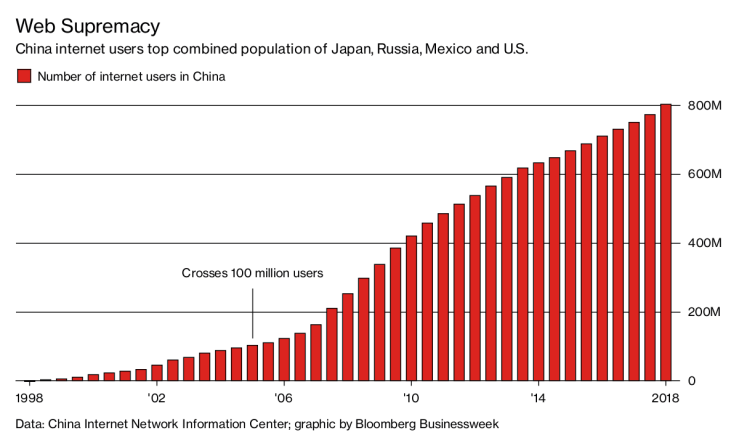
Some Britons wonder if there are enough business opportunities ‘out there’ in the wider world for the UK to thrive and prosper, post-Brexit.
As the graphic above shows, there are more internet users in China than there are citizens in all of the following countries combined: Japan, Russia, Mexico and the United States.
With internet use in China alone growing at an annual rate greater than the entire population of the United Kingdom you’d think that even the most inept exporters in the world would be lining up to trade with the huge moneypot called China.
Yet, because China isn’t selling itself as a huge marketplace for the world’s exporters and because Brexiteers haven’t ventured to research this part of the Brexit equation, it’s left to Bloomberg News (and me) to inform you of these astonishing developments.
Jacob Rees-Mogg’s European Research Group is a fine organization devoted to fleshing-out the political intricacies of Brexit, trade with the EU in the post-Brexit timeframe, and other Eurocentric matters. Yet, when we view charts like the one above it becomes startlingly clear that an Asian Research Group is needed to fully inform us about politics and trade with Asia in the post-Brexit era.
For example: How many Jaguar cars have been sold in the EU over the past 12 months?
And whatever that number is, it will be a static number for the simple reason that only so many EU citizens can afford a Jaguar motorcar and every one of them simply phones the local Jaguar dealership to order the Jag of their dreams and the car is delivered to their home a few days later.
Yet, I can only surmise that *isn’t* the case in China…
How many Jaguars *aren’t* being sold in China
How many Jaguar cars and SUV’s aren’t being sold in Asia because nobody bothered to research the full potential of the Asian market, or if they have, why aren’t Jaguar building three more factories in the UK to meet the demand of the rapidly growing Chinese middle class?
If internet users in China alone have risen from 22.5 million in year 2000 to 802 million partway through 2018, that demonstrates astonishing growth in their middle class. And if those people are ordering goods and services on the internet because their disposable income is rising fast, why isn’t there an entire department of HM government devoted to helping UK companies to get those online orders instead of just standing idly by and allowing other countries to snap up that business?
By 2030, there will be 1.6 billion internet users in China. How many Jaguar sales will have been lost by then?
It’s Not Only Cars…
Millions of pounds sterling are being lost every month since year 2000 because nobody in the UK government was put in charge of this.
Heads should roll over this shameful ‘oversight’ and not only in the government.
Heads also in the Bank of England, London School of Economics, London Stock Exchange and other organizations need to stop whatever they’re doing right this minute and phone whomever it is that can quickly address this stunning oversight.
Driving along the M4 on your way to the LSE right now? Have your driver pull the car over — you’ve got an important call to make — one that’s 18-years overdue.
With the right stewardship of the country, any good or service the UK produces should have seen the same kind of sales increases as the number of Chinese internet users since 2000. Disposable income is disposable income — and it’s better that UK business gets that disposable income rather than businesses from some other country.
From which, I can only assume that there *hasn’t* been proper stewardship of the UK economy since year 2000.
It goes without saying that nobody knew for certain how the internet was going to grow back in the early 2000’s, therefore, policymakers of that era are largely free of blame. But as each subsequent year passed, this should’ve been addressed with increasing urgency. Certainly, everyone on planet Earth knew by 2005 that the Internet of Things (IoT) was going to be a major part of our civilization in a few short years.
But the silence especially in the UK has been deafening.
“The global IoT market will grow from $157B in 2016 to $457B by 2020, attaining a Compound Annual Growth Rate (CAGR) of 28.5%.” — Forbes
Forget About Cars for a Moment – and Think About Everything Else the UK Produces
As noted earlier, it’s not all about the UK-built cars that aren’t being exported to Asia in huge numbers.
Everything that the UK produces or manufactures in a year could be sold to China and the lot of it wouldn’t register a tiny blip on the Chinese financial charts as demand in the country is massive and it continues to grow at a geometric rate.
If the UK tripled its entire annual GDP in goods, services and produce and then shipped all of it to China, it still wouldn’t produce a blip on the charts. And China continues to grow its economy at (artificially held to lower than) double-digit growth rates.
“GDP Annual Growth Rate in China averaged 9.61 percent from 1989 until 2018, reaching an all time high of 15.40 percent in the first quarter of 1993 and a record low of 3.80 percent in the fourth quarter of 1990.” — Trading Economics
Asia is the land of opportunity for all who have eyes to see and ears to hear. There isn’t a reason good enough for the UK government or British business to ignore it one more day.
Bonus Video:
 Letter to Britain