Home » Posts tagged 'The Commonwealth of Nations' (Page 2)
Tag Archives: The Commonwealth of Nations
A New Era for the Commonwealth of Nations
As the United Kingdom leaves the European Union over the next few months, the historical and ongoing ties Britain has with the Commonwealth of Nations organization are expected to dramatically increase in importance.
In the decades since 1972 when the UK joined the European Community (EC) Britain’s primary engagement was with its EC partners, while its Commonwealth partnerships dwindled.
But a dramatic reversal is in the making.
The acting Queen of the United Kingdom and head of the Commonwealth, Elizabeth II recently approved her son Prince Charles to soon succeed her as the head of the Commonwealth of Nations organization, and also approved Prince Harry to be a Commonwealth youth ambassador.
Both appointments were warmly received by Commonwealth leaders at the recent Commonwealth Heads of Government (GHOGM) meeting in London in April 2018.
It shows that the organization still values the contribution of the British Royal Family and seemingly wants to increase trade and political ties to the UK — almost as much as the UK wants to get cracking on trade matters with the 2.5 billion member bloc.
Rarely is there such a clear case of ‘Win-Win’ convergence in geopolitics, but this is a relationship that was born to succeed.
More on Commonwealth matters next week!
A Royal (and Fun for Everyone!) Wedding Today at Windsor Castle
In the meantime; Heartfelt congratulations to Prince Harry and Meghan Markle who were married today at Windsor Castle. Harry now becomes the Duke of Sussex, while Meghan is henceforth the Duchess of Sussex.
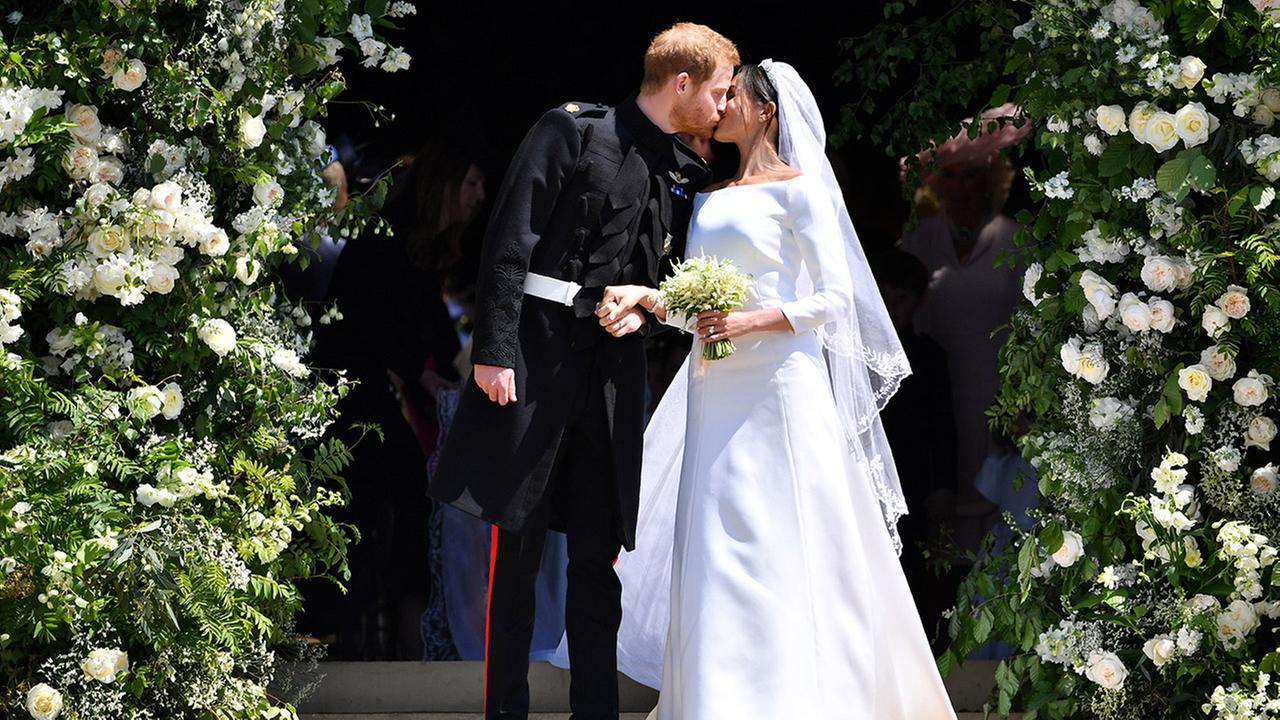
The Royal Wedding of Prince Harry and American actress Meghan Markle at Windsor Castle on May 19, 2018.
They are a fascinating couple who are certain to make their very positive mark on the Commonwealth of Nations, on the United Kingdom, and on the rest of the Royal Family. Godspeed and good wishes to Harry and Meghan!

Full Citizenship for the Windrush Generation: What’s the Delay?
In 1948 during a time of labour shortages in the immediate postwar era, 492 Jamaican citizens (many of them children travelling with their parents) were permitted to board the Royal Navy troop ship HMT Empire Windrush to travel to Britain for the purpose of employment and residency.
At the time, they were promised eventual citizenship if they chose to stay in Britain and contribute to British society, or they could work for a time and return to their home country with some cash in their pocket. Their choice.
Since 1948, hundreds of thousands of ‘Afro-Caribbean’ people travelled to Britain to work and to live, contributing much to the country it must be said.
Many found work in the Royal Navy, in the National Health Service (NHS) and in other sectors of the economy during a time of unprecedented GDP growth and record low unemployment.
The 1971 Immigration Act
In 1971, a new law was passed by the UK House of Commons that limited the ability of people from Commonwealth countries to live and work in the United Kingdom — therefore, those people who’ve relocated to the UK since 1971 have done so under very specific legal terms and conditions and are not considered part of the Windrush Generation.
The 1971 Immigration Act stipulated that those from Commonwealth countries already living in the United Kingdom were granted the right to continue living in the UK indefinitely, but henceforth, new immigrants from the Commonwealth were required to have 1) a work permit and 2) prove that a parent or grandparent had been born in the UK. — BBC News
Anyway, back to those who moved from Commonwealth countries to Britain during the 1948-1971 timeframe.
After contributing greatly to Britain in the postwar era and raising their British-born children and grandchildren in the UK and all of it done on the strength of a verbal promise by Britain’s government, some of them are having problems accessing government services, others have been threatened with deportation, (and yes, hard to believe) some have been incarcerated until their case was eventually adjudicated by faceless bureaucrats in the Home Office whose final decisions weren’t open to appeal.
Most of the Windrush Generation weren’t given any kind of documentation to prove their status in Britain in 1948-1971 and it seems that the Home Office won’t let them stay unless they can produce documentation to prove they’re legally in the country! Facepalm!
It almost seems like a spoof episode entitled, The Three Stooges: Bureaucrats on Acid.
How to Fix This Debacle?
Obviously, these people possess a birth certificate from their home country or they can access a copy of their birth certificate from their country of origin — and if they were born in a Commonwealth country and emigrated to Britain between 1948 and 1971 they should automatically qualify for British citizenship, have the same rights as any other British citizen, and be able to access the same government services as any British citizen.
Further, some might be owed an apology from the government for delays, arbitrary or wholly unfair Home Office decisions — and financial compensation should be paid in cases where disrespect or outright racism was displayed by Home Office employees.
Windrush people who have been seriously inconvenienced by Home Office staff (either deported or incarcerated for not being able to produce the paperwork that had never been issued by the Home Office in the first place) should expect to receive a payment from the government in the most egregious cases. But there needs to be a maximum cap on the amount paid per individual of £50,000 and the individual would need to sign documentation waiving any right to civil litigation on such matters against the Home Office or other departments of the government.
Children of Windrush
Any children born in Britain to the Windrush Generation are already British citizens, but if born outside the UK (obviously) are citizens of the country in which they were born — although their naturalized UK parents should be able to easily apply for them to become UK citizens at any future date.
Non-Windrush Generation Immigrants
Any non-UK citizen who wishes to live, work, go to school, or retire in the UK should be required to supply an up-to-date criminal records check from their home country with their initial application and pay £100 per year for the privilege of living in the UK, and supply their up-to-date phone number and home address to the Home Office via an easy-to-understand and easy-to-pay website that should take each individual less than 10-minutes per year to complete.
Windrush Generation people and their UK-born or UK-naturalized children would, of course, be completely exempt from such requirements and should henceforth be treated the same as any other British citizen.
Thank you again to the Windrush Generation for their work in building the United Kingdom that we see today. Well done!

If There Were Ever a Time for an Anglosphere Summit – it’s Now!
International summits are wonderful events. Heads of state, cabinet officers and their staffs, CEO’s, various think tanks and special guest speakers get together to discuss policies and innovative solutions to common problems faced by their group. Yet, in over two-hundred years of the modern political era, Anglosphere nations have never held a summit dedicated to Anglo nations. Inexplicable!
It’s time for the leaders of the United Kingdom and the United States to reach out to all English-speaking nations such as Canada, Australia, New Zealand and other primarily English-speaking nations to invite them to an Anglosphere Summit this year. (Yes! THIS year!)
Announcing the First Annual Anglosphere Summit: Anglosphere Summit 1.0 (Synergy)
A simple three-day format could be employed for the first annual Anglosphere Summit where the first day (1/3 of the programme) could help broaden the understanding of what the Anglosphere as a whole has contributed in the 20th-century (and more to the point, what it has accomplished in the 21st-century) via gigantic video projections and guest speakers on each topic, the second day (1/3 of the programme) could be devoted to present-day challenges for Anglosphere nations, while the final day could suggest conventional and innovative solutions to problems faced by Anglosphere nations, complete with photo opportunities, signing ceremonies, along with an award for the most-improved Anglo economy over the previous year.
And finally, the greatest strengths of Anglo nations have always been their respective economies, their combined economic power, and their per capita economic power, backed by their always-loyal military institutions. A deep commitment to international trade and a powerful but well-disciplined military are a world-beating combination that can’t ever be taken for granted by Anglo political leaders. That’s what made us who we are.
The Venue
Each year, one Anglosphere nation could offer to host the Anglosphere Summit and tailor the experience so that each attendee can learn about the host country’s successes and failures in governance, policies, social structures, and industry, allowing attendees to take home that knowledge and build a better country.
Such luminaries as Bill Gates (computing) Bill Ford Jr. (automotive industry) Richard Branson (airlines, tourism) Jim Rogers (energy) Arnold Schwarzenegger (governance, movie industry, renewable energy) Elon Musk (TESLA, Space-X, SolarCity, PayPal, Ebay) and other entrepreneurs could deliver compelling presentations to participants, bringing them up-to-the-minute information on their fields of expertise.
Such resources the Anglosphere has available to them(!!!) but the experience and reach of these stellar people are criminally underutilized by Anglosphere politicians and policymakers. Unforgivable!
After the summit concludes, everything could remain in place for two weeks to allow the public to hear the recorded speeches and see the exhibits at the venue, and to watch the same informational videos in the same setting as Anglosphere leaders.
Summary
Leaders of Anglosphere countries need to lead. They need to synergize their efforts to compete in the global marketplace. And they need the support of all English-speaking countries to confront common domestic and international problems. There has never been a better time to work together!
Related Articles:
- La Francophonie website — La Francophonie is a great organization dedicated to the betterment of all people living in French-speaking nations and it does incredible development work around the globe, much of it focused on poverty-stricken and up-and-coming French-speaking nations. Je salue la Francophonie!
- The Commonwealth of Nations website — an organization dedicated to the United Kingdom and its historical colonies that are now full-fledged nations, and some new member countries. (Some are English-speaking nations, while others aren’t) “The Commonwealth is an association of sovereign nations which support each other and work together towards international goals. With their common heritage in language, culture, law, education and democratic traditions, among other things, Commonwealth countries are able to work together in an atmosphere of greater trust and understanding than generally prevails among nations.”
- The CANZUK nations website — a group dedicated to increased cooperation between the ‘CANZUK’ countries — Canada, Australia, New Zealand and the United Kingdom (hence the abbreviation, CANZUK) that extends its membership to other like-minded nations. “CANZUK International (CI) is the leading group advocating closer ties between Canada, Australia, New Zealand and the United Kingdom, known amongst diplomats at the United Nations as the ‘CANZUK Group’. These four countries have shared commercial ties, geopolitical aspirations and a venerable constitutional tradition over centuries. Amongst CI’s aims is freedom of movement within the CANZUK Group for the citizens of Canada, Australia, New Zealand and the United Kingdom. In addition, it regards loyalty to the same monarch as an essential symbol of a common heritage and the cornerstone of constitutional democracy. More specifically, it is envisaged that the CANZUK Group would collaborate in the following areas: – Free Trade – Foreign Policy – Constitutional Affairs. The four leading Commonwealth realms could build upon existing economic, diplomatic and institutional ties to forge a cohesive alliance of nation-states with a truly global outlook.”
- Trump says he is working on ‘very big and exciting’ trade deal with UK (Sky News)
 Letter to Britain