Home » Posts tagged 'International Trade' (Page 7)
Tag Archives: International Trade

How Brexit Could Create a Better UK/EU Relationship
As European Union negotiators can’t see any reason to support Brexit, they will continue to keep the European Union’s best interests in mind — which is to say, they will try to stop, slow, obfuscate, or otherwise derail the Brexit process by almost any means possible.
And why shouldn’t they feel that way? The EU is a net beneficiary of £8.6 billion annually courtesy of the UK, so there’s little incentive to stop a contribution that is larger than that of all other EU-member countries except Germany.
If there are any Brexit benefits to the European Union, nobody has bothered to tell EU negotiators or EU media channels.
So how would anyone know if there will be Brexit benefits for the EU when the UK government hasn’t mentioned them once? And yet there are likely many Brexit benefits — for both sides — that just aren’t being discussed.
How to Sell a Product or Idea
When you’re trying to sell apples to a potential customer, giving them a nonstop spiel about how much *you* like apples won’t help you sell many apples!
But if you hand your potential customer a hot glass of mulled apple cider and walk them past appealing displays of fresh apples, followed by a pleasant tour through the on-site bakery bursting with the aroma of piping hot apple pies and offer them a tantalizing sample at the exact moment their interest in apples is high, you’ll sell more apples.
If you’re selling cars, you don’t spend your time telling the customer about the specifications of the car and how it can transport you here and there with ease. Any ol’ car can do that.
Instead, you answer their questions about the car, you offer a test drive so they can experience how much better it drives, sounds, and looks than their present car, all of which work together to help them fall in love with the car you’re selling.
If you’re a really smart salesperson, you’ll slap a dealer plate on the new car and let your customers take it home for the weekend so they can show it off to their comrades who will help convince them the new car is much better than their old jalopy.
And have you ever noticed that beer commercials don’t show you endless cans of beer and a quick snapshot of the brewery?
Breweries are highly experienced marketers and they want to show you good-looking people having a great time socializing with their friends and family in a picturesque setting or while engaged in enjoyable activities.
Look at that product placement! There’s the can of beer right beside those sizzling steaks on the barbecue while those great people in the background are enjoying their evening.
Considering a run to the beer store? Well yes you should — because you’re a good person, you work hard, you love spending quality time with your friends and family and you deserve a summer’s evening just like the people on that commercial. That’s the message.
Marketing types call this Feature/Benefit selling, ‘Selling the sizzle, not the steak’ which isn’t about what the product or service actually is, it’s about what it can do for you and how it can make you look or feel happier and better.
What Isn’t Theresa May Doing?
She isn’t selling the benefits of Brexit to the EU.
We know there are many benefits for Britons but even that has been under-sold.
In the early days following the Leave referendum it might’ve looked to Remainers as though Brexit could still go either way, so Theresa May was probably wise to move cautiously at first. But that time has passed. Almost every person and business in Britain wants to get beyond the present period of uncertainty and get on with creating a fresh start for the UK outside the European Union.
The right time to begin crafting a trade agreement that works even better than the present trading system has arrived. And now that we’re at this point in time, under-selling the benefits of Brexit to UK and EU citizens is not the way forward.
What Is The Way Forward?
In a word, Vision.
Theresa May needs to put on her ‘Steve Jobs hat’ and figure out what the best possible Brexit vision looks like from both the UK and EU perspectives.
Starting with a completely clean sheet; What would that look like in its entirety? What would it look like five years on?
If she doesn’t offer an inspiring vision that a majority of people on both sides of the English Channel can ‘buy-in’ to her government will be paddling upstream all day, every day, for as long as she remains Prime Minister. (And that’s definitely a no-fun lifestyle, even for a British PM)
Once the vision has been considered by Theresa May, only then should it be communicated to her Cabinet, while the Department for Exiting the European Union (DExEU) should oversee all other UK ministries and departments as they compile reports that describe what their best-case scenario would look like in practical terms.
Then it’s simply a matter of working to those ideals as much as is practicable to create a Vision Statement that can be released to the public, sans the excruciating detail required in government policy papers.
“This is the Vision we’re working toward…” (Giving UK and EU citizens a view of what a better Brexit looks like)
‘How do you like those apples?’ someone cheekily asked.
The Three Principles Common to all Organizations
- Vision (or Mission)
- Leadership
- Management
Without equal weight given to each of those three factors any organization or project will ultimately fail.
It can’t be emphasized enough; Endless discussion about the best Brexit from the UK standpoint are irrelevant to European Union citizens and businesses. Brexit must work for the EU too, or it will be increasingly uncomfortable and expensive for the UK as time rolls forward.
Theresa May needs to find what things will work better for the EU in a post-Brexit world and promote those items on every visit to the EU. If there aren’t any Brexit positives for the EU, she better create some as they negotiate forward to a final trade and financial services agreement.
Without an overarching vision even the best management and leadership will underperform. Perhaps severely.
But as soon as May gives the order to each of her 25 Ministerial Departments and 20 non-Ministerial Departments to submit their best-case scenario (their best hopes and aspirations showing what their jurisdiction could look like five years on from Brexit) and from that she will be able to write a one page vision for each of the 45 departments.
From there she will need to direct the Department for Exiting the European Union to create a list of items that could be seen as positives by EU governments, EU businesses and EU citizens. Those are the apples she needs to sell on every visit to the European Union. And then sell the ‘sizzle’ Theresa, not the steak.
Summary
Theresa May must ‘create’ and ‘sell’ (Vision + Leadership + Management + Marketing) a Brexit that will benefit both the UK and the EU and begin to disseminate that better vision throughout both blocs.
Throwing £40 billion at the EU now and (potentially) another £40 billion to obtain a trade and financial services agreement isn’t visionary — it’s ‘buying an agreement’ with taxpayer’s money — which is fine if that’s the only option. But it isn’t the only option.
Getting citizens, businesses, and governments on both sides of the English Channel to buy-in to a grand vision that works even better than the present paradigm without it costing another £40 billion, must be Theresa May’s Number One Priority before the October 2018 Brexit deal-making deadline arrives.
[P.S. to Michel Barnier, chief negotiator for the European Union] Jeez, Michel, for £40 billion shouldn’t the UK have received a bespoke customs deal, a bespoke trade deal, a bespoke financial services agreement *and* a chocolate mint on every UK pillow?

This Week in Brexit: Trump Promises a Trade Deal
On the sidelines of the G20 Hamburg summit, U.S. President Trump found time to meet with UK Prime Minister May and to offer welcome words that the United States will sign a bilateral trade deal with the UK as soon as Brexit is complete.
It’s very good news for the UK and also for PM Theresa May (who has had a rough time in domestic politics of late) and it was obvious that the U.S. president went out of his way to assure Ms. May that a reciprocal trade agreement — one that works for both America and for Britain — is one of his administration priorities.
So much of the UK’s post-Brexit success will hinge on bilateral trade accords because no matter how good the final Brexit agreement, there will be some amount of economic adjustment for Britain in the months following Brexit. A quick trade agreement with the United States will not only ease the Brexit transition, but also improve the UK (and America’s) economy indefinitely.
It was a classy thing for Mr. Trump to do for Theresa May knowing that her domestic political fortunes have taken a hit. Let’s hope the Prime Minister is able to return the favour at some point during the Trump administration. That sort of respect makes for strong allies.
During WWI, but especially during WWII the relationship between America and Britain was raised to a very high level by Prime Minister Winston Churchill and President Harry S. Truman, and in the postwar era during a time of unprecedented economic growth, President Ike Eisenhower continued the wise course set by his predecessor.
However, it could’ve so easily gone the other way if the leaders hadn’t gotten along.
Both sides would’ve missed geopolitical opportunities of huge importance such as the formation of NATO, the establishment of the Nuremberg trials and the creation of other institutions and agreements such as Bretton Woods and the IMF. Without the ambition of the UK and the power of the United States those things simply wouldn’t have occurred.
Millions of Americans and Britons prospered over the past 72 years because their postwar political leaders *didn’t drop the ball* and made a conscious decision to *make the best of the postwar relationship* for their respective people.
What Kind of Free Trade Agreement Should Prime Minister May and President Trump pursue?
Present-day Prime Minister of Canada Justin Trudeau was still in school when Canada first approached the European Union to ask about a bilateral trade deal, and that many years later it still hasn’t come into effect. (It’s about to, they say)
It will have taken eight years to hammer out and begin to abide by, the Comprehensive Economic and Trade Agreement (CETA) which arrives so late in the game and market conditions do change over time (remember way back to the 2008/09 financial crisis when the CETA agreement was first floated?) that some of the hard-won negotiating points are no longer relevant and may never be finalized.
Canada, EU to provisionally apply CETA in September (CBC)
I’m sure it’s a fine agreement and congratulations are due. However, with America and Britain at the controls of a mutually beneficial trade agreement between two friendly Anglophone nations, it should take less than a year from first discussion to signed agreement.
Though we don’t know what shape an Anglo-American trade agreement might look like from our vantage point in July of 2017, probably the best idea would be for both sides to embrace reciprocity and fair dealing in all trade matters as a way to enhance both economies, and as a way to later attract other Anglophone nations such as Canada, Australia and New Zealand to sign on to such an agreement.
Hitting the Right Note with Commonwealth of Nations member India
What a great thing it would be if all Commonwealth nations eventually agreed to sign on to a U.S. / UK trade agreement. Commonwealth of Nations member India has 1.5 billion consumers alone!
Both America and Britain could add 5% to their respective GDP just on the improved trade flows of doing business in the booming Indian economy.
“Although India’s rapid population growth is part of what accounts for the forecasted jump […] that is only part of the story. Drastic improvement in terms of per-person productivity due to capital investments and better technology will play an even more important role.
“PwC predicts that India’s economy will grow by about 4.9% per year from 2016 to 2050, with only 0.7% of that growth caused by population growth.
“India’s economy is currently the third-largest in the world, and is expanding at an estimated annual growth rate of 7.1% for the 2016-17 financial year. — India’s economy is forecast to surpass that of the US by 2040 (Quartz)
Both America and Britain just need to hit the right note with India — a respectful note — in order to profit from the massive growth that is available in that burgeoning country.
Working out an Anglo-American trade agreement with a view to adding all Commonwealth member nations within 24 months, guarantees that other powerful trade blocs don’t beat the Anglo-American alliance to supply the rocketing Indian economy with much-needed goods and services.
Projected growth for selected countries – As measured by Purchasing Power Parity (PPP)
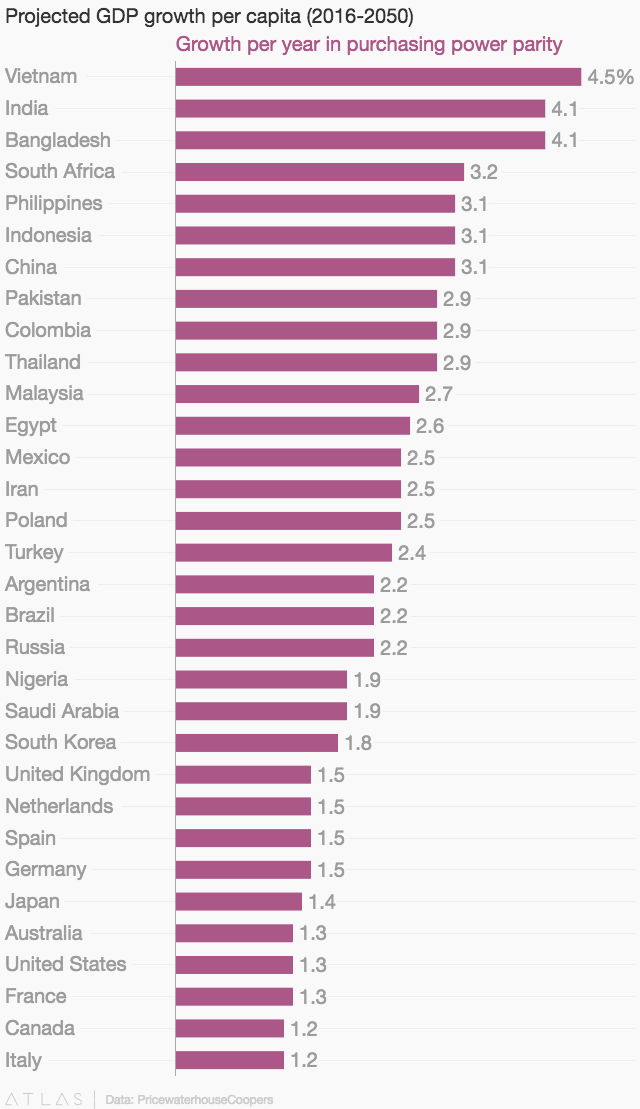
Projected GDP growth UK and other countries 2016-2050. Image courtesy of Quartz.com
It’s so obvious but still worth repeating; ‘Hitch your wagon to the fastest horses if you want to place well in the race.’
Britain has the Commonwealth of Nations connections, Britain needs a trade agreement with NATO ally America and with Commonwealth partner India, and the United States wants to increase mutually beneficial trade with Britain and its 2-billion-strong Commonwealth partners.
In all of human history, rarely has such a synergistic match-up suddenly appeared where different but extremely valuable benefits are available to all three parties.
Just as nobody predicted the massive Japanese economic boom which began to form the day after WWII ended, an Anglo-American trade agreement, followed by a Commonwealth trade agreement (before other trade blocs grab the low-hanging fruit!) could match or exceed the massive performance statistics of the postwar Japanese economy.
Dear United States and Commonwealth of Nations, Let’s not miss this rather obvious ‘Win-Win-Win’ opportunity!

Free Trade or Protectionism for a Strong UK Economy?
by John Brian Shannon | January 17, 2017
Prime Minister Theresa May says that Britain must be a free trading nation to boost the UK economy and to better serve the aspirations of millions of Britons.
And Britain’s leader is correct, as history has proven that free trading nations outperform non-free-trading nations. From the seafaring Phoenicians of classical antiquity to the former British colony that became a superpower called the United States of America; Free trade and hard work have built our shared civilization, and any country that withdrew from free trade or liberalized trade agreements, consequently declined.
READ: Between Free Trade and Protectionism: Strategic Trade Policy and a Theory of Corporate Trade Demands by Helen V. Milner and David B. Yoffie | Published by MIT Press
That’s not to say that other economic practices don’t have merit, because they do. However, a group of non-free-trade nations will always be surpassed by a comparable group of free trade nations — due to the symbiotic nature of free trading relationships which produce small but measurable amounts of synergy that accumulate over time.
It’s the easier access to raw materials, the lower labour costs, and the ability to access larger export markets that make free trade work so well, but the ‘icing on the cake’ is the synergy produced by the symbiotic relationships which aggregate and thereby increase corporate profits and investor dividends that are often reinvested in the growing corporation. Over time, all this synergistic activity results in far greater outcomes than otherwise would’ve been the case.

The British Empire in all it’s glory was built on free trade with many partners, but in 2017 it’s even more important for Britain to be a free trading nation.
A perceived problem occurs when vast disparities are present, such as when one nation is blessed with abundant raw resources allowing it to basically dig money out of the ground which eventually accumulates into billions or even trillions of dollars, while another country in the same trading bloc may have few natural resources.
As long as all partners within the trading bloc have equal access to those raw resources, such problems are likely to be nothing more than minor jealousies.
Countries like the United States, Canada, Norway, Saudi Arabia and the United Arab Emirates have vast petroleum reserves, and importantly, good economic stewardship — which allowed them both rapid growth for the economy and a high standard of living for their citizens. It’s telling to note they are free trading nations — while other countries blessed with large petroleum reserves but restrictive international trading arrangements, haven’t prospered. Venezuela (the country with the world’s largest proved oil reserves) along with Libya and Nigeria, have poorer development due to their historically somewhat less than free trade practices. For economists, those nations serve as a warning to politicians considering the adoption of less liberal trade policies or outright protectionism.
Such disparities between nations, unless handled carefully, can result in explosive economic and political consequences.
READ: What does Free Trade mean? | Investopedia
Globalization: Lower-priced goods, but fewer jobs
It’s easy for some to forget that free trade and globalization are two different things. Free trade relates to the removal of tariffs, or at least the standardization of low tariff rates between member nations of the same trading bloc, while globalization refers to a highly interconnected political and economic world of which trade of any kind, whether free or not, is merely part of a large picture.
Those who feel left behind by globalization (and there are millions) tend to blame free trade, when in fact it was free trade that created a booming global economy from 1982 through 2007 (and a somewhat less booming economy) from 2012 through 2016.
Led by global elites, the rush to create high growth and high GDP meant that quality of life fell steeply for millions of Westerners for the first time since WWII due to the offshoring of Western jobs to countries with lower labour costs and non-existent environmental regulations.

Britain must ensure that globalization and free trade work for every Commonwealth citizen.
READ: You Can’t Feed a Family With G.D.P. | New York Times
It’s Not All Bad
Westerners have enjoyed unprecedented low-cost, quality goods manufactured in other countries.
Two examples of this are; 1) the Apple iPhone, which, if manufactured in the United States would have cost $2800. each, instead of the typical $650.-$950. price range. The iPhone wouldn’t have ever seen production if it hadn’t been manufactured in Asia. Over one billion have been sold since the first iPhone hit the market. And; 2) almost every computer chip in the world was manufactured in Taiwan, an industrious country with a very diligent workforce, but few natural resources. Computer chips have cost an average of $40. since Taiwan’s entry into the semi-conductor business, but if manufactured in the United States those chips would’ve cost hundreds of dollars each.
While low-cost goods are welcome in the West, people in the bottom quintiles now wish for a return to high paying employment and would gladly forego low-priced goods.
Which is exactly what the election of Donald Trump is all about. ‘Cheap goods are great, but we’d rather have jobs!’ — seems to be the main message there.
It’s difficult to blame those who harbour such resentments when 3/5ths of the population are doing less well, while only 2/5ths feel they have progressed in recent years.
Yet to blame the very free trade agreements that brought wealth to Western nations displays a lack of understanding of how globalization works vs. how free trade agreements work.
Free trade creates additional economic activity (with many virtuous cycles, which are always a good thing) while unrestricted globalization (under existing personal tax laws) rewards the top-two quintiles at the expense of the bottom-three quintiles. And it’s this fundamental misunderstanding which have people in an anti-free-trade mood — when instead, they should be protesting against global elites, unfettered globalization, and crass-and-uncaring politicians.
Had the global elites applied as much effort to ensuring that globalization worked for every economic quintile instead of the top-two quintiles exclusively, movements such as Occupy Wall Street along with the general disenchantment voiced by the public against politicians and economists wouldn’t have materialized. Ever.
When it works for everyone, there’s no complaining.
READ: In Defense of Globalization | Project Syndicate
Free Trade with a Standardized and Reciprocal Tariff Regime – Instead of Unfettered Globalization
PM Theresa May and Chancellor Philip Hammond should work to obtain a mutually-beneficial free trade agreement between all Commonwealth countries as part of a Tier 1 trade accord.
Such an agreement should ensure there are no tariffs, levies, nor other trade impediments — save for a highly standardized and reciprocal 5% tariff on all goods — except books (in any form) or those medicines that actually save lives, because principles do matter. A more educated and healthier Commonwealth are desirable outcomes. No VAT taxes or tariffs should be levied on books or life-saving medicines, ever. Anywhere on the planet, IMHO.
Why the 5% Tariff?
What the 5% tariff would do for all signatory countries is to pay for upgraded port facilities and enhanced security at ports, railways, and for cargo ships at sea.
Why the 10% Tariff?
A Tier 2 trade accord should be negotiated with nations that aren’t Commonwealth members with a standardized and reciprocal tariff of 10% — except for books and life-saving medicines which should be tariff-free and VAT-free in every case. As long as the trade partners agree to standardized and reciprocal tariffs, such tariffs won’t break WTO tariff rules. And such revenue could enhance port security, of course, but could also be used to pay for additional infrastructure programmes to put millions of workers back on the job.
Why the 25% Tariff?
Finally, a Tier 3 trading scheme could be created for those nations that won’t agree to a standardized list of tariffable items at a standardized and reciprocal rate, and won’t agree to not tariff books and life-saving medicines, and that tariff could be 25% on all imported items until the day arrives that country begins to abide by the Tier 2 trading rules.
In all three scenarios it puts the UK government firmly in the drivers’ seat in regards to imported goods and guides UK trading partners towards Tier 2, or even Tier 1 status.
The goal is to arrive at a situation whereby every nation willingly decides to join The Commonwealth in order to gain free trading status with the Commonwealth and agrees to a nominal, standardized, and reciprocal 5% tariff regime on every good except books and life-saving medicines.
It is still free trade, but with a nominal, built-in tariff designed to enhance port facilities and streamline security in all partner nations.
What to do with the revenue generated by such tariffs?
The main point is to upgrade existing port facilities, to increase security at Britain’s ports, and at reciprocal trade partner ports to ensure the security of ships at sea and the thousands of kilometres of rail lines that carry freight.
Any remaining tariff revenue could be used to soften the economic blows to those in the bottom-two quintiles who have suffered quite enough over the past 16 years.
Whether used to boost social welfare rates (good) or to boost national infrastructure spending (better) or both (best) it will be money well spent, and it would be revenue that arrived in the government hand via imported goods.
Which seems fitting, doesn’t it?
READ: Interview with Theresa May, Prime Minister of the UK, from the World Economic Forum 2017 | CNBC
 Letter to Britain