Home » Posts tagged 'EU' (Page 29)
Tag Archives: EU
Leaning toward ‘Soft Brexit’?
Now that Brexit is beginning to sink-in for Britons and for UK politicians entrusted to carry out the will of ‘The People’ it seems that a so-called ‘Hard Brexit’ might be orders of magnitude more difficult than first imagined, while a so-called ‘Soft Brexit’ might be preferable to all parties, which appears to be an elegant solution at the point where the people’s interests intersect with the UK economy.
Because Philip Hammond’s economy is doing well considering everything that’s happened since 2008, PM Theresa May can relax about the economy and get on with her part of running the United Kingdom — namely, the political arrangements for a Soft Brexit now (let’s call that Brexit Stage I) and possibly a Hard Brexit later (let’s call that Brexit Stage II) if that part is approved by voters in the next UK election on May 7, 2020.

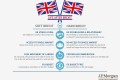
Soft Brexit vs. Hard Brexit. Image courtesy of J.P. Morgan Asset Management.
Soft Brexit probably equals mild uncertainty in the markets, while Hard Brexit might cause economic chaos
Since 1973 when Britain joined the European Community and it’s various and later governmental structures, the policies in all member nations have largely been set by common agreements forged with those organizations. There are literally hundreds of thousands of laws and regulations to replace in a post-Brexit UK. It will be a humongous task.
Even Greenland, with its total population of 56,196 took three years to exit the European Union. The UK with it’s $2.8 trillion (GDP) advanced economy has hundreds of thousands of EU laws, trade laws, tariff controls, manufacturing standards and immigration rules, that guide industry, the UK government, and Britons — all of which might take 5-10 years to replace with UK-centric legislation. Industry simply can’t function without proper regulations which leaves only one choice for many organizations; Leave Britain. That’s not in the best interests of Britons, the government, nor of UK industry itself.
A brilliant plan, is one that allows the UK to rejoin the EEA and the EFTA (as in the Norway or Swiss model) and it’s actually doable.
Have you seen Norwegian or Swiss economies? Let’s just say that on a per capita basis, they beat every European economy every year.
And, sure, some commenters will try to make things more complicated than they really are. But it isn’t complicated unless you desire it to be that.
With proper stewardship the UK economy can perform as well as any non-EU-member-nation noted in the links below. Check out their world-leading per capita income and low unemployment rates!
Norway Economic Outlook
Switzerland Economic Outlook
If Switzerland and Norway (for two examples) can have EEA and/or EFTA membership, and bilateral agreements with the EU, and booming economies — there’s no reason the UK can’t.
It’s not rocket science. Brexit does NOT mean the end of trade with the EU. That would cause long-term recession in the EU (likely leading to its dissolution) and a long-term case of the economic doldrums for the UK. The two blocs need each other whether some like it or not. So, get on with it!
UK Prime Minister Theresa May needs to stop everything(!) and get warm approval for EFTA membership accession from all four EFTA member nations.
Not to mention appointing a Minister for Scotland (a ‘Scot’) a Minister for Northern Ireland (a ‘Northern Irelander’) and a Minister for Wales (a Welsh resident) to shore-up relationships with the UK’s devolved regions, and also appoint a Minister for England.
And gain approval for Brexit among the remaining 27 EU member nations which must unanimously approve Britain’s exit from the European Union.
Accomplishing all of that would be five-years’ worth of dedicated work for any British Prime Minister! Even former Prime Minister extraordinaire Sir Winston Churchill, might’ve found a challenge in that.
UK Conservatives (with significant help from UKIP) have gained a mandate for Soft Brexit but I don’t think 52% is enough of a mandate for Hard Brexit. Which is why I support ‘Soft Brexit’ for now — and if approved by voters at the next election — ‘Hard Brexit’.
In the meantime, there’s an unimaginable amount of work left to secure a stable, fair, and expeditious Soft Brexit that solves some of the deficiencies of Britain’s EU membership, while leaving only free movement of labour and persons, and certain trade matters to negotiate, if it ever comes to Stage II Brexit.
Related Article:
- Philip Hammond becomes standard bearer of Soft Brexit (Financial Times)
- Hard Brexit would damage ‘almost every sector’ of UK economy (The Guardian)

The European Union’s Brexit Endgame
by John Brian Shannon | December 8, 2016
In the aftermath of a landmark Supreme Court ruling in the UK, British MP’s have proposed the Conservative government authour a Green Paper, a Blue Paper, or a White Paper (these are different levels of British government policy documents) to inform members of the Parliament and the public about the government’s Brexit plan.
Ranking even higher than such policy documents would be a Public Inquiry, or the highest ranking, a Royal Commission (which although quite costly) employs all the resources of Her Majesty’s government to find the best solutions to the most important problems of each era.
UK Prime Minister Theresa May has so far resisted such calls for transparency claiming that by showing their hand it could help the European Union thwart Britain’s advantage in upcoming Brexit negotiations. (And I think she was mostly right about that)
But presenting a secret Brexit plan to the EU also implies presenting a secret Brexit plan to UK citizens — and that’s undemocratic.
Yes. Britons voted for Brexit! And yes, Britons voted for a Conservative government!
But they didn’t vote for Theresa May as Prime Minister, they voted for David Cameron. Not only that, but Britons didn’t vote for a secret Brexit plan to be imposed on them — should the EU accept without changes, Theresa May’s secret version of Brexit.
Therefore, Theresa May has taken not one, but two, liberties with voters. They didn’t vote for Brexit plans that were to be kept secret, and all of it decided by a Prime Minister they didn’t vote into office. Yet, it’s probable she was pursuing such a path in order to obtain the best Brexit outcome for Britain.
For small and medium policy decisions that’s 100% acceptable, but it isn’t acceptable for top-level policy decisions resulting in major changes to the way the country operates — even though she has likely done so with the best of intentions and with the best Brexit result in mind, from the British-point-of-view.
To my mind, the government now needs to show a high level of transparency with voters. Had Theresa May been voted into office by voters and not by Conservative Party members she would’ve had more wiggle room on this.
But the simple fact is, she inherited David Cameron’s chair, voters didn’t select her. Had she won the Prime Minister’s chair from the outset, she could’ve gotten away with publishing a very generalised Green Paper at any time in 2016, and the electorate would have simply trusted her to finish the job.
That’s the problem with inheriting a sitting Prime Minister’s chair; You inherit the position, but not their political capital, nor their popularity, nor their credentials.
Which is why MP’s are now calling for a detailed policy statement. And there’s no doubt any such policy documents will become public, even if it gets marked ‘Sensitive’ or ‘Classified’. It’s just the way of things these days.
Which gives the European Union an edge that it wouldn’t have otherwise had in the Brexit negotiation process.
Thanks to the UK Supreme Court ruling, and thanks to British MP’s who now demand full transparency, PM Theresa May cannot now produce a ‘fait accompli’ Brexit document to the EU Parliament and use other, non-specified leverages to get that document quickly approved by the EU Parliament and approval by the 27 remaining EU member nations.
For Theresa May, that’s a big loss, because that’s obviously what she had planned.
But it’s all moot since the UK Supreme Court ruling, and since notable British MP’s have called for a policy paper to guide the government itself, the House of Commons, and the public, on matters Brexit.
For the sake of argument, let’s say that my argument in favour of PM Theresa May, is true.
It doesn’t matter anyway. Because powerful political and psychological forces are at work in the EU Parliament and in EU member states. They’re upset that Britain is leaving the EU. Plain and simple.
And, why not? Britain pays the largest NATO contribution, it’s a large net contributor to the European Union budget paying-in much more than it receives, and it has allowed Eastern European governments to offload millions of their unemployed citizens to Britain. Why wouldn’t they want that to continue when it’s so obviously in their own best interests?
Surely, the EU plan is to reject any and all Brexit proposals — believing it’s in their best interests to force either a so-called Hard Brexit or a No Brexit result.
It’s not that EU leaders are evil — it’s pure common sense from the European Union point-of-view.
“Nations have no permanent friends or allies, they only have permanent interests.” — former British Prime Minister and Foreign Secretary Henry John Temple, 3rd Viscount Palmerston (1784–1865) also known as Lord Palmerston
We’ll eventually see that no matter how well-intentioned any Theresa May Brexit plan is, no matter how many White Papers are produced, no matter how many warm and fuzzy photo opportunities with EU leaders, the answer is going to be a resounding ‘No’ to any Brexit plan produced by the UK government.
Which leaves only two options: Hard Brexit, or the option that the European Union governments prefer, reversal of Brexit.
‘See? It’s too hard to leave. So just stay.’
It’s so obviously the EU strategy, that the British strategy must now be all about countering the European Union strategy.
UK Supreme Court rulings, MP’s demanding policy documents and any other happenings, must now be seen as incredibly minor waypoints along the path the EU is driving the British people towards; Hard Brexit (which Europhiles hope to make as ‘scary’ as possible) or Just Stay.
We must drop the notion that the European Union is going to be ‘looking out for Britain’s best interests’ and realize that even the most well-intentioned Brexit plan will be rejected, for the express purpose of forcing a show trial in the UK court of public opinion where the only two options will be; Hard Brexit or Just Stay.
Why? Because EU politicians believe that’s in the EU’s best interests.
Reacting to any Brexit news in the meantime, is merely tilting at windmills. The real show hasn’t begun.

Brexit: The Trigger for a New Atlantic Alliance
by John Brian Shannon | October 4, 2016
Britain, more than any other Atlantic Ocean nation, would benefit from an Atlantic Alliance free trade zone precisely because it is an island nation, and as such it depends on free trade and movement of goods in order to thrive to it’s full potential.
Since the Roman era Britain has enjoyed a historic presence in the Atlantic Ocean for good reason — island nations need regional trade to survive and international trade to thrive.
For Britain, there is no way forward without enhanced international trade. In principle, islands should always be the strongest proponents of international trade and international law for the very reason that they profoundly need the world to function that way.
Japan set a wonderful example for all island nations in the postwar era, but never moreso since the Arab Oil Embargo of 1973 when U.S. consumers suddenly decided to switch their gas-guzzler cars for lower priced and more fuel efficient Japanese cars.
Not only were millions of cars imported from Japan over the following years, but because the necessary technology to build cars was transferable to home and personal electronics, Japan received a double boost to it’s economy every day since the Arab Oil Embargo.
From one of the worst performing economies in the world in 1946 to it’s peak as the #2 global economy in the 1990’s — the Japanese economic miracle rode its high quality manufacturing base that catered to the needs of billions of consumers. By any standard it remains an impressive accomplishment.
And now it’s Britain’s turn to shine as the world’s next booming economy.
Although much has changed since the oil supply shocks of 1973, the world economy continues to grow, with developing nation consumers seeing comparatively massive increases in their disposable income, presenting a wonderful opportunity for a Britain suddenly freed from an overly bureaucratic political union.
Therefore, let us count the ways that an Atlantic Ocean trading alliance (a free trade zone, that I propose be restricted to nations that front the Atlantic Ocean) could benefit Britain and the other Atlantic nations.
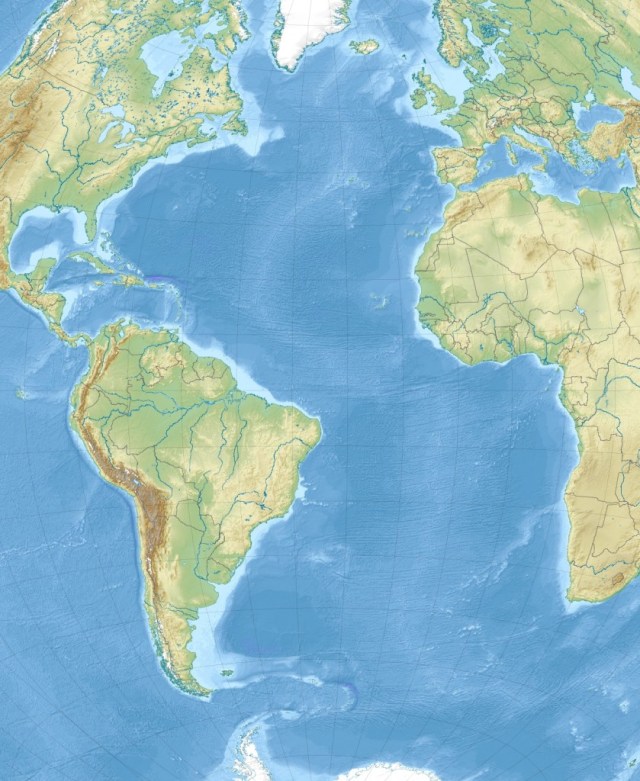
Britain, more than any other Atlantic Ocean nation, would benefit from an Atlantic Alliance free trade zone precisely because it is an island. Atlantic Ocean map. Image courtesy of Geography.name
In the North Atlantic, we have the United States, Canada, Greenland, Iceland, Ireland, the United Kingdom, Norway, France, Spain and Portugal.
In Africa; Morocco, Western Sahara, Mauritania, Senegal, Gambia, Guinea-Bissau, Sierra Leone, Liberia, Côte d’Ivoire, Ghana, Togo, Benin, Nigeria, Cameroon, Equatorial Guinea, São Tomé and Príncipe, Gabon, Central African Republic, Democratic Republic of the Congo, Angola, Namibia, and South Africa, front the Atlantic Ocean.
And in South America, we have the South Atlantic nations of Argentina, Uruguay, and Brazil fronting directly onto the Atlantic Ocean — while French Guiana, Suriname, Guyana, Venezuela, Columbia, Panama, Honduras, Nicaragua, Belize, and Mexico and many island nations reside within the Caribbean Sea — which is of course, easily navigable to the open Atlantic Ocean.
All of these nations should receive a warm invitation to join such a trading block.
It is perhaps the best matchup of nations since the Bretton Woods Agreement of 1944. In the list of Atlantic and Caribbean nations, exist the most developed nations to the least developed, from the most overbuilt tourist locations to vastly underbuilt tourism markets, to the astonishing per capita petroleum and mineral resource base. Such opportunity abounds for those who pursue economic interdependence between Atlantic nations! From the most highly skilled labour to the cheapest labour, and among the highest cost real estate to the cheapest agricultural land in the world, everything that a developed or still developing nation needs can be easily found within this trading area.
The economic opportunities are uncountable, and they are sitting there untapped. At the moment, it’s a criminal waste of opportunity that must rank as a negative for every Atlantic nation whether developed or developing.
The obvious move here is for British Prime Minister Theresa May to voice strong support for an Atlantic free trade zone, contacting representatives of each country to find out what Britain offers, that can mesh with the needs of each Atlantic Alliance trading partner. And vice-versa.
Once some activity generates and some new trade begins to take shape, it would be wise to meet regularly to discuss standardization of regulations, whether shipping or other modes of transportation, financial, tourism, and other ways to work together. Even the baby-steps of working together to protect maritime shipping from at-sea piracy, or to form mutual aid groups designed to streamline hurricane or other natural disaster relief would demonstrate ways that Atlantic nations can work together for mutual benefit.
If the NAFTA model is used as the trading template, some of it’s terms could be adjusted to better suit the preferences of all Atlantic Alliance members, or it could be seen as the eventual goal for all members to reach at some point. At the very least it could be used as a reference point, a place to begin discussions.
By leading such an effort Britain would be well-placed — not to own the Alliance — but to offer it’s expertise and experience, so that the end result is a Win-Win for every nation involved. That is what makes for strong partnerships, and strong partnerships always make economic sense.
 Letter to Britain