Home » Posts tagged 'Canada' (Page 2)
Tag Archives: Canada

What Would a WTO Brexit Look Like?
Assuming European politicians can’t get their act together enough to craft a reasonable Brexit deal that works for both sides by March 29, 2019 Europe will be faced with Brexit on WTO terms which is known colloquially as a ‘Hard Brexit’ where the UK would leave the European Single Market and Common Market mechanisms and other EU agreements and institutions without any subsequent deal in place.
Without further ado, and without boring you with statistics, let’s look at how a Hard Brexit would play-out in the months and years following a WTO-style Brexit.
Will There Be Famine in the Land?
Of all of the dubious claims by the Project Fear campaigners (and they’ve made many!) this must rank in first place.
No. There won’t be famine in the UK on account of Hard Brexit. However, you may notice your favorite brand of cheese may be unavailable for a time and you may find your prescription medications come from UK pharmaceutical companies or American pharmas instead of from continental Europe.
Saying the following words out loud will do you good, dear Britons — so repeat after me;
“The United States of America has come to Britain’s rescue in times past and will do so again in its hour of need.”
Regarding agriculture; The United States agricultural belt is unimaginably massive and its farmers and ranchers are just waiting to fulfill the UK’s orders. There are fields of crops in the United States larger than the entire United Kingdom. It takes 3-hours to overfly them in a jet aircraft flying at 500 miles per hour.
Regarding ranching; There are 93.5 million cattle in the United States (2017) and that number continues to rise at a little better than 1% per year, and significant capacity exists to raise it over a relatively short period of time.
Similar agricultural capacity is available in Canada for grains, corn, soybean, and other crops, and Canada boasts 4.6 million cattle at present (2018) and Canada has more arable land than the United States allowing it to exceed even the mighty U.S. in this regard if sufficient firm orders were placed.
To answer the question: “Where’s the beef?” It’s in the United States and Canada… Just pick up the phone and call us! North American farmers and ranchers would love to take your money — instead of the EU taking your money.
Britons might find their food costs plummet as the huge economies of scale that typify North American food production and the favorable growing conditions combine to produce bumper-crop after bumper-crop which lead inevitably to lower food prices.

Image courtesy of gov.uk | Figure 1: Origins of food consumed in the UK in 2016 — Department for Environment, Food and Rural Affairs, Agriculture in the United Kingdom data sets, Chapter 14 – the food chain (2017)
Aren’t All American Crops GMO?
Genetically Modified Organisms or GMO crops are grown on every continent, including Europe, which has about the same number of GMO crops as America.
Some Europeans fear that all crops grown in the United States are GMO crops, but except in the case of corn that isn’t true. All corn, no matter where it is grown in the world is GMO and that’s been true for a few decades now. Corn (and maize, which is a type of rough corn that is fed to cattle over the winter months) aren’t commercially viable crops unless the GMO component is added.
Some crops like ‘Yukon Gold’ potatoes, Canola (a seed grain) and every apple sold on the planet have been GMO for many decades.
To alleviate concerns about GMO foods being sold in the UK, Theresa May’s government could simply legislate that any produce or meat that *isn’t* GMO must be identified as non-GMO for UK consumers.
Explainer: Forcing producers to put GMO labels on their produce (if theirs is indeed a GMO variant) is seen as a negative by GMO food producers. But giving non-GMO farmers the right to advertise “Non-GMO produce” or “Non-GMO meat” on their labels would be seen as a positive for their non-GMO produce and meat.
See how easy it is?
Not only won’t there be famine in the land, UK consumers will enjoy a completely new supply chain from which to choose and sufficient labelling for them to make the best choices for their families.
What if the EU Decides to Punish the UK for Leaving?
If the EU wanted to drive the UK directly into America’s arms… the EU would ensure a Hard Brexit and not allow EU goods or produce to be shipped to the UK following Brexit, nor would it allow UK goods or produce to be sold into the EU following Brexit.
If that’s the EU plan, bring it on! Because that plan has a 100% chance of success should the EU choose to make it happen.
And Americans and Canadians are just waiting… “Please, oh God, please, cause the EU to drive the UK into our ever-loving arms!” said every North American farmer, rancher and manufacturer.
To say nothing about the even more fervent prayers being said by North American auto manufacturers in Detroit, U.S.A. and in Windsor, Canada.
For Britain, a WTO Brexit simply means changing suppliers — with a zero-tariff trade deal in effect with North America — combined with the opportunity to sell UK goods into the vast North American market.
The ball, as they say… is in your court, European Union!
Bonus Video
View the video where HM North American Trade Commissioner is interviewed by Bloomberg Television on March 26, 2018.
Clicking on the image takes you direct to the relevant Bloomberg webpage.
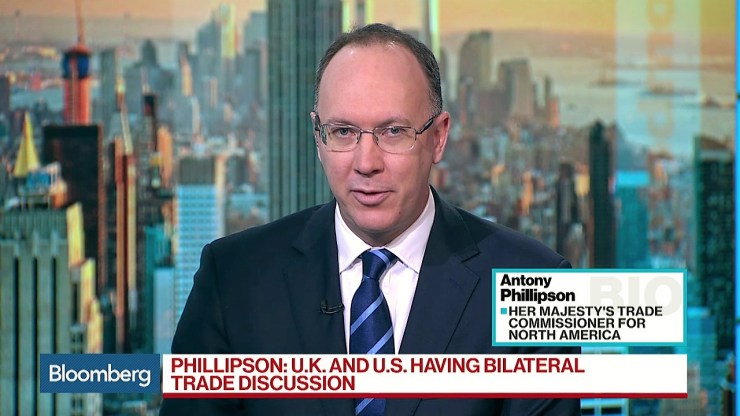
Antony Phillipson, HM Trade Commissioner for North America on Bloomberg TV.

UK Warships Set For Early Retirement Could Serve Other Commonwealth Navies
UK Ministry of Defence bosses have announced their intention to retire seven ships and reduce the Royal Marines by 1000 personnel in a cost-saving effort necessitated by the acquisition of two world-class aircraft carriers, the HMS Queen Elizabeth and the HMS Prince of Wales.
It’s brilliant that the Royal Navy is stepping boldly into the 21st-century with two state-of-the-art aircraft carriers, yet many sailors will miss the still great but aging ships, which have a decade or two of service life left in them.
In fact, two of the soon-to-be retired vessels, the HMS Albion and the HMS Bulwark aren’t even halfway through their expected life-cycle but are excellent ships that could be sold to any Commonwealth nation.

UK Royal Navy ship HMS Albion was launched by Princess Anne on March 9, 2001. Image credit: Richard English
As an island nation and as the world’s oldest sea power, Britain should always command a first-rate navy, and good policy would dictate the sale of RN ships halfway through their normal life-cycle to help defer the costs of maintaining that world-class navy.
The helicopter carrier HMS Ocean was also marked out for retirement in an earlier press release along with four smaller Royal Navy ships, but they too could serve out the rest of their expected life in any Commonwealth nation.
Commonwealth Partner Canada – Needs Those Ships!
The Royal Canadian Navy depends heavily on its 12 naval frigate fleet and is desperately lacking in rescue capability (helicopter carrier) and littoral combat (close-to-shore) vessels — which gaps could be filled by the soon-to-be-retired HMS Ocean, HMS Albion, and HMS Bulwark, while saving the Canadian navy billions of dollars — and more importantly, the several years required for Canada to build new ships.
Although Canada has a great navy with proud tradition there are major credibility gaps in Canada’s fleet and purchasing these Royal Navy ships could partially alleviate that gap, thereby propelling the RCN forward by at least five years and at very reasonable cost compared to building new ships.
Canada should constantly drop hints to the Royal Navy to allow them be first to bid on ships and helicopters set for early retirement.
Commonwealth Partner India – Needs Those Ships!
The Indian Navy has a vast area to patrol in one of the busiest shipping regions of the world and it can’t get enough ships. Ever!
Modern naval vessels are very expensive to build, but expensive new ships don’t always suit the needs of the Indian Navy — a navy that requires huge numbers of vessels to patrol all those millions of square miles. Not all of them need to be world-class combat ships.
With thousands of cargo ships and cruise ships travelling through the region every day, and with piracy at an all-time high in the Indian Ocean having enough ships available to maintain a presence is far more important than how shiny the paint is on inspection day.
The level of shipping activity in the Indian Ocean region can only be described as frenetic and piracy is a common problem in the adjacent Arabian Sea and off the east coast of Africa where many Indian registered ships carry trillions of dollars of raw materials and manufactured goods every year.
Commonwealth Partner Australia
Australia fields a modern navy and (thankfully) it enjoys the strong support of the Australian government.
The country purchases build-to-suit ships and submarines from various countries and it occasionally sells its used ships to New Zealand — a good arrangement for both countries.
However, some early retirement Royal Navy ships could be valuable to the Royal Australian Navy in the future. Their navy is heavy with helicopter frigates and minesweepers and has a respectable number of submarines — yet there may be occasion when Britain’s navy could decide to part with ships that meet the needs of the Australian fleet.
The only thing lacking in the RAN fleet are destroyers. They could make-do with 6 as we are presently in peacetime; At the moment, the Royal Australian Navy has 1 destroyer.
Other Commonwealth Partner Navies
Many Commonwealth nations are maritime countries with various naval capabilities, yet purchasing new ships is an expensive proposition for rapidly developing nations.
For them, it’s difficult to justify a billion dollar warship when they need crucial infrastructure (yesterday!) to serve the needs of their citizens. Yet, having an effective naval presence to deter piracy and to protect national sovereignty becomes increasingly important as their GDP rises.
One way for them to accomplish two goals at once is to purchase used RN vessels that match their needs. Indeed, for the cost of one new frigate a small nation may be able to purchase five used, but still effective, former Royal Navy frigates or smaller coastal defence craft to provide security in nearby shipping lanes.
Summary
Until now it has been normal for navies to max-out the life of their ships and to pay massive sums to refit their navy ships at mid-point in their life-cycle (some refits cost more than the original ship!) and that’s an expensive way to outfit a navy when there is a better alternative.
In the 21st-century there are so many rapidly developing Commonwealth nations, UK shipyards could have a continuous frigate assembly line, a continuous destroyer assembly line and a continuous coastal patrol craft assembly line to keep up with total demand from a world-class Royal Navy that retires its ships early and sells them to allied nations.
But that’s only if the Royal Navy makes the historic decision to sell its ships at the 12-year mark, while they still have at least 18-years of life left in them.
It would be wise to continue to operate them as usual — but simply make it known to Commonwealth partners that any Royal Navy vessel over 6-years of age is automatically available for purchase to Commonwealth members.
As the Commonwealth’s rapidly developing nations continue to increase their wealth, they’ll have evermore reason to protect what’s theirs and to surveil and protect foreign ships travelling through their waters.
Instead of keeping ships for decades and running them into the ground along with one or two costly refits over the years, in the 21st-century the better way is to sell them to Commonwealth nations at the 6-12 year mark while the vessels still have plenty of useful service life remaining. And in that way, create a healthy UK shipbuilding industry geared towards Royal Navy needs, but also to the needs of Britain’s allies.
That’s how you build a better Royal Navy and help your Commonwealth partners at the same time!
Related Articles:

Bombardier: Tariff Row or Marketing Opportunity?
An increasingly protectionist United States has suddenly announced a 219% tariff on Bombardier passenger aircraft.
Bombardier Aerospace, headquartered in Montreal, Canada, also employs some 4000 people in Northern Ireland who produce a significant percentage of the components used in the C-Series passenger jets (CS 100 and CS 300) that have recently entered production.
Switzerland has already taken delivery of some of their C-Series jets, with others to be delivered in the coming months. Airlines from Germany, Finland and other European nations have indicated huge interest in these modern and fuel-efficient airliners, and China has told the company they will take as many planes as Bombardier can produce.

Bombardier CS100 passenger aircraft. Image courtesy of BombardierAerospace.
There isn’t a better commercial aircraft in the 100-150 seat market in the world today.
And if that sounds like advertising copy, it’s because the aircraft the C-Series competes against were originally designed in the 1970’s (Boeing 737) and 1990’s (Airbus) and early 2000’s (Embraer) and although those aircraft lines have received numerous upgrades over the decades, from an engineering point-of-view nothing beats starting with a clean sheet.
This allows designers a free hand to use the latest composite materials, fully digital electronics instead of digital-over-analog, and 100% CAD/CAM design and manufacturing instead of only part of the process being CAD/CAM (Computer Aided Design/Computer Aided Manufacturing) all of which means there are no engineering compromises.
When you have the best plane on the market in that particular segment, one that boasts the quietest takeoffs and landings (significantly quieter) and the best fuel mileage, and the lowest maintenance cost per mile — high tariffs in one country means you simply sell the same number of aircraft per year — but you sell them to different countries.
China can’t get enough commuter aircraft from all sources it seems, and its own fledgling passenger aircraft manufacturer is geared towards truly excellent jumbo jet airliners. The country needs almost 7000 new aircraft over the next 20-years.
Boeing Forecasts Demand in China for 6,810 Airplanes, Valued at $1 Trillion (Boeing)

All good news for Bombardier there! The company should easily score 1/3 of all single aisle passenger jet sales in China over the next 20-years. And if they can’t, the entire executive staff of Bombardier should be exiled to Antarctica for life. Yes folks, opportunities like this don’t come along once-per-decade, nor even once-per-century.
Just in case you’re counting along at home; If the company receives 1/3 of all single passenger jet sales in China over the next 20-years, it would need to deliver 6-jets per day to China.
(That’s China alone! India, the Middle East, Indonesia, and other nations all have rapidly growing markets for world-class single aisle passenger jets featuring low noise and exceptional fuel efficiency)
The future couldn’t be brighter for Bombardier and its clients. A missed deal with the United States might in retrospect turn out to be the best thing that ever happened to the company. Instead of thinking ‘regional’ — it’s now time to think ‘global’ — thanks to the U.S. Commerce Department.
Trade war, schmwade war! In the 21st-century, the name of the game isn’t getting into fights with your competitors, it’s about out-succeeding them.
Remember your pilot’s etiquette now; Always dip your wings ever-so-slightly (in respectful salute) every time you pass your competition! ;)
Related Articles:
- U.S. Department of Commerce Issues Affirmative Preliminary Countervailing Duty Determination on Imports of 100- to 150-Seat Large Civil Aircraft From Canada (Commerce.Gov)
- Britain’s Theresa May issues warning to Boeing over Bombardier trade dispute (The Globe and Mail)
- UK government threatens retaliation against Boeing in Bombardier tariff row (The Guardian)
- Boeing Super Hornet jet purchase likely to become 1st casualty in possible trade war (CBC)
- Bombardier flying high after handing over first C-Series jet to SWISS (Financial Post)
- On the book of Bombardier vs. Boeing, skip to Chapter 19 (The Globe and Mail)
- May Says Boeing Undermining Ties With U.K. Over Bombardier (Bloomberg)
- Bombardier Nears $1.25 Billion C Series Deal With Air Baltic (Bloomberg)
- Bombardier C-Series Marketing Brochure (BombardierAerospace)
- U.S. imposing 220% duty on Bombardier C-Series planes (CBC)
- How Canada’s fight with Boeing began in Washington (CTV)
- Bombardier BDRBF:US OTC (Bloomberg)
 Letter to Britain