Home » Posts tagged 'Britain' (Page 5)
Tag Archives: Britain

This Week in Brexit: Trump Promises a Trade Deal
On the sidelines of the G20 Hamburg summit, U.S. President Trump found time to meet with UK Prime Minister May and to offer welcome words that the United States will sign a bilateral trade deal with the UK as soon as Brexit is complete.
It’s very good news for the UK and also for PM Theresa May (who has had a rough time in domestic politics of late) and it was obvious that the U.S. president went out of his way to assure Ms. May that a reciprocal trade agreement — one that works for both America and for Britain — is one of his administration priorities.
So much of the UK’s post-Brexit success will hinge on bilateral trade accords because no matter how good the final Brexit agreement, there will be some amount of economic adjustment for Britain in the months following Brexit. A quick trade agreement with the United States will not only ease the Brexit transition, but also improve the UK (and America’s) economy indefinitely.
It was a classy thing for Mr. Trump to do for Theresa May knowing that her domestic political fortunes have taken a hit. Let’s hope the Prime Minister is able to return the favour at some point during the Trump administration. That sort of respect makes for strong allies.
During WWI, but especially during WWII the relationship between America and Britain was raised to a very high level by Prime Minister Winston Churchill and President Harry S. Truman, and in the postwar era during a time of unprecedented economic growth, President Ike Eisenhower continued the wise course set by his predecessor.
However, it could’ve so easily gone the other way if the leaders hadn’t gotten along.
Both sides would’ve missed geopolitical opportunities of huge importance such as the formation of NATO, the establishment of the Nuremberg trials and the creation of other institutions and agreements such as Bretton Woods and the IMF. Without the ambition of the UK and the power of the United States those things simply wouldn’t have occurred.
Millions of Americans and Britons prospered over the past 72 years because their postwar political leaders *didn’t drop the ball* and made a conscious decision to *make the best of the postwar relationship* for their respective people.
What Kind of Free Trade Agreement Should Prime Minister May and President Trump pursue?
Present-day Prime Minister of Canada Justin Trudeau was still in school when Canada first approached the European Union to ask about a bilateral trade deal, and that many years later it still hasn’t come into effect. (It’s about to, they say)
It will have taken eight years to hammer out and begin to abide by, the Comprehensive Economic and Trade Agreement (CETA) which arrives so late in the game and market conditions do change over time (remember way back to the 2008/09 financial crisis when the CETA agreement was first floated?) that some of the hard-won negotiating points are no longer relevant and may never be finalized.
Canada, EU to provisionally apply CETA in September (CBC)
I’m sure it’s a fine agreement and congratulations are due. However, with America and Britain at the controls of a mutually beneficial trade agreement between two friendly Anglophone nations, it should take less than a year from first discussion to signed agreement.
Though we don’t know what shape an Anglo-American trade agreement might look like from our vantage point in July of 2017, probably the best idea would be for both sides to embrace reciprocity and fair dealing in all trade matters as a way to enhance both economies, and as a way to later attract other Anglophone nations such as Canada, Australia and New Zealand to sign on to such an agreement.
Hitting the Right Note with Commonwealth of Nations member India
What a great thing it would be if all Commonwealth nations eventually agreed to sign on to a U.S. / UK trade agreement. Commonwealth of Nations member India has 1.5 billion consumers alone!
Both America and Britain could add 5% to their respective GDP just on the improved trade flows of doing business in the booming Indian economy.
“Although India’s rapid population growth is part of what accounts for the forecasted jump […] that is only part of the story. Drastic improvement in terms of per-person productivity due to capital investments and better technology will play an even more important role.
“PwC predicts that India’s economy will grow by about 4.9% per year from 2016 to 2050, with only 0.7% of that growth caused by population growth.
“India’s economy is currently the third-largest in the world, and is expanding at an estimated annual growth rate of 7.1% for the 2016-17 financial year. — India’s economy is forecast to surpass that of the US by 2040 (Quartz)
Both America and Britain just need to hit the right note with India — a respectful note — in order to profit from the massive growth that is available in that burgeoning country.
Working out an Anglo-American trade agreement with a view to adding all Commonwealth member nations within 24 months, guarantees that other powerful trade blocs don’t beat the Anglo-American alliance to supply the rocketing Indian economy with much-needed goods and services.
Projected growth for selected countries – As measured by Purchasing Power Parity (PPP)
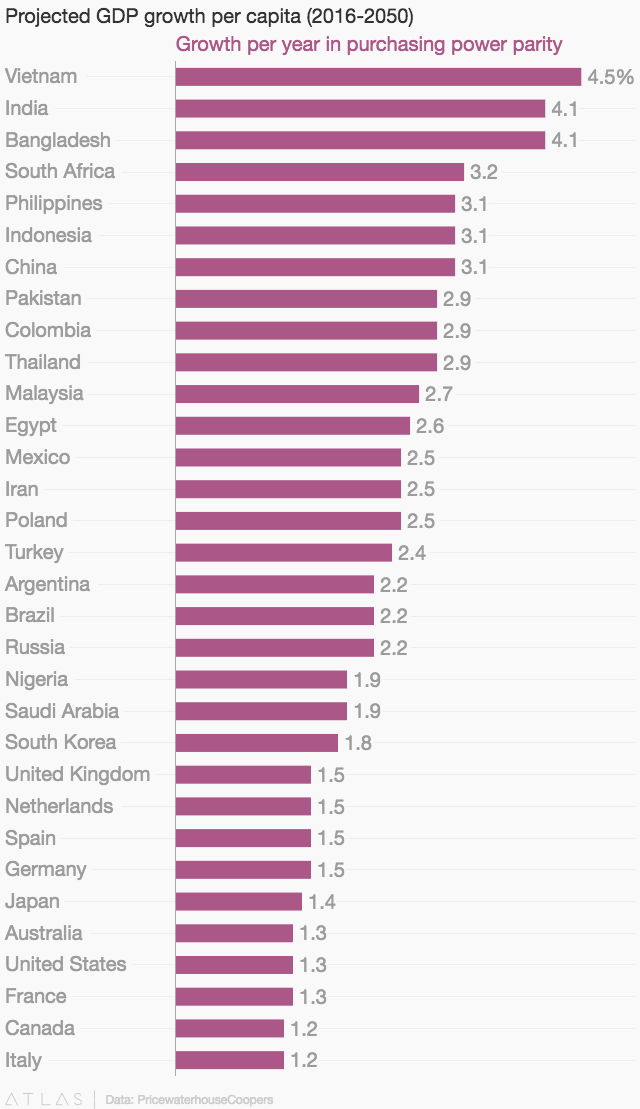
Projected GDP growth UK and other countries 2016-2050. Image courtesy of Quartz.com
It’s so obvious but still worth repeating; ‘Hitch your wagon to the fastest horses if you want to place well in the race.’
Britain has the Commonwealth of Nations connections, Britain needs a trade agreement with NATO ally America and with Commonwealth partner India, and the United States wants to increase mutually beneficial trade with Britain and its 2-billion-strong Commonwealth partners.
In all of human history, rarely has such a synergistic match-up suddenly appeared where different but extremely valuable benefits are available to all three parties.
Just as nobody predicted the massive Japanese economic boom which began to form the day after WWII ended, an Anglo-American trade agreement, followed by a Commonwealth trade agreement (before other trade blocs grab the low-hanging fruit!) could match or exceed the massive performance statistics of the postwar Japanese economy.
Dear United States and Commonwealth of Nations, Let’s not miss this rather obvious ‘Win-Win-Win’ opportunity!

This Week in Brexit: UK to leave London Fisheries Convention
Environment Secretary Micheal Gove has signaled that the UK intends to leave the London Fisheries Convention (LFC) as the first move towards an eventual Brexit completion within 24 months.
The original LFC was signed in 1964 and it allowed vessels from Belgium, France, Germany, Ireland and the Netherlands to fish in British waters in the 6 to 12 nautical mile range which was a significant upgrade for those fishers as UK coastal areas are abundant fishing grounds.
It was also a significant upgrade for those who ship any kind of contraband to the UK because it allows them to get much closer to British shores and drop their loads with less chance of being detected by police — and people wonder why London has the world’s highest cocaine concentrations in their wastewater treatment plants!
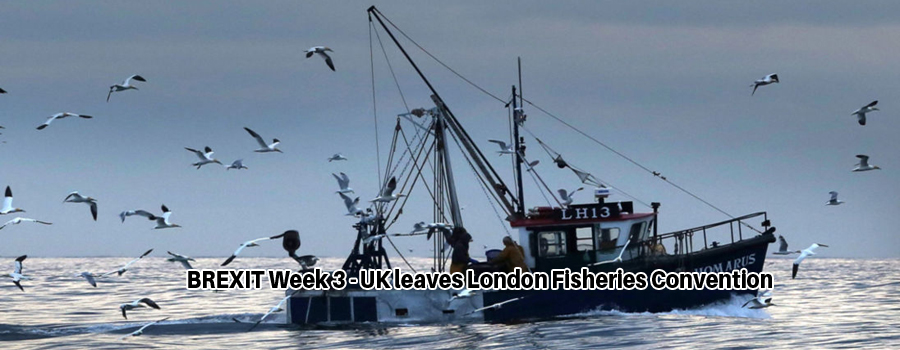
UK Environment Secretary Micheal Gove says Britain intends to cancel the London Fisheries Convention to stop countries fishing in British waters.
Once Brexit completes, UK fishers will obviously lose their right to fish in EU waters in the 6 to 12 nautical mile range.
The Tory government said the change will allow more direct control and better responsibility for fisheries management in the 0 to 12 nautical mile range.
“Leaving the London Fisheries Convention is an important moment as we take back control of our fishing policy. It means for the first time in more than 50 years we will be able to decide who can access our waters. This is an historic first step towards building a new domestic fishing policy as we leave the European Union – one which leads to a more competitive, profitable and sustainable industry for the whole of the UK.” — Michael Gove, UK Environment Secretary
“This is welcome news and an important part of establishing the UK as an independent coastal state with sovereignty over its own exclusive economic zone.” — Barrie Deas, National Federation of Fishermen’s Organizations
“For years, successive UK governments have blamed Brussels for their own failure to support the small-scale, sustainable fishers who are the backbone of our fishing fleet. If Brexit is to herald a better future for our fishers, the new Environment Secretary Michael Gove must keep the 2015 Conservative Party manifesto commitment to re-balance fishing quotas in favour of ‘small-scale, specific locally based fishing communities’.” — Will McCallum, Greenpeace UK
In 2015, the British fishing industry caught 708,000 tonnes of fish worth £775 million.
A claimed 10,000 tonnes of fish were caught by EU countries in Britain’s waters in the 6 to 12 nautical mile zone. (2015 statistics) It could be much higher than that, but nobody would know because nobody is policing it!
That’s a minimum of £17 million in fish that leaves Britain each year. Fish that will now be caught by UK fishers (and presumably) will be processed by UK fish processing and packaging plants, adding even more value to the British economy.
Scottish government says UK is right to leave fishing deal (BBC)
It’s true that since 1964 when the LFC came into existence the UK fishing industry lost millions of pounds sterling and hundreds of jobs every year for the privilege of belonging to the then-European Community / now European Union.
As so often happens in the postwar relationship between Britain and continental Europe, it is Britain that winds up subsidizing the continent.
How else can it be termed anything but ‘subsidizing the continent’ when millions of pounds sterling (in this example, raw fish) and hundreds of fish processing and packaging jobs were handed to the continent every year since 1964?
‘Here! Take our jobs! We’re British!’
Now that PM Theresa May has delegated this poignant case to Secretary Gove with instructions to effect a win for UK fishers, fish stocks will rebound, there will be more jobs for UK fishers, there will be more UK fish processing and packaging jobs, and anti-contraband efforts in UK waters will become more effective.
And that’s no fish story!

This Week in Brexit: What Scotland Lost
Congratulations to Prime Minister Theresa May for working out a ‘confidence and supply’ agreement with Northern Ireland’s Democratic Unionist Party (DUP) to allow the present minority Tory government to continue in office.
Theresa May strikes ‘confidence and supply’ deal with DUP
And congratulations to DUP leader Arlene Foster for negotiating so well on behalf of her jurisdiction, thereby gaining £1.5 billion in additional infrastructure and other funding.
That’s a ‘Win-Win’ for the Tories and for the Democratic Unionist Party — and more importantly (sorry, Theresa and Arlene!) it’s a ‘Win-Win’ for residents of Northern Ireland.
Theresa May signs ‘£1.5 billion’ deal with the DUP
Infrastructure in Northern Ireland is in bad shape and the funding appears at an opportune moment, as there comes a point when it becomes cheaper to tear down a bridge (for example) than to pay ever-increasing maintenance costs.
The same is true for all infrastructure. Whether roads, bridges, hospitals, schools, airports, or the underground infrastructure that carries water to homes and businesses, all of it has a ‘best before’ date where leaving vital infrastructure spending for too long can cost more than the savings of not doing the work.
The Conservative/DUP deal: what it says and what it means
Of course, £1.5 billion isn’t going to fix it all. But I wouldn’t be surprised if two years of successful DUP ‘confidence and supply’ support gets the residents of Northern Ireland additional infrastructure spending allocations, courtesy of DUP leader Arlene Foster and Prime Minister Theresa May.
And why not? Arlene Foster prevented a divisive and perhaps extended Parliamentary crisis — one that would’ve prevented much good from being done in the United Kingdom.
Speaking of which; See how infrastructure spending is increasing in Northern Ireland, and how it isn’t in Scotland? Not only additional spending, but PM May and DUP leader Foster also negotiated more devolved powers for Northern Ireland.
NOTE to Nicola: It’s great to have a particular ideology, but when it costs your jurisdiction £1.5 billion in the form of missed infrastructure funding, it’s time to review what you think you’re accomplishing!
Loss of opportunity is also a metric by which UK leaders must be measured — it certainly is for heads of government everywhere else — and not as much as it should be, but it’s still an important marker of successful leadership.
Nicola Sturgeon of Scotland’s SNP missed the boat. Arlene Foster of Northern Ireland’s DUP didn’t. And UK Prime Minister Theresa May begins to look like a bit of a deal-maker, which can only be viewed as a good thing as we head into Brexit. Well done, Theresa!
Related Articles:
- Confidence and Supply Agreement (Conservative and Unionist Party) (Theresa May statement)
- Agreement between the Conservative and Unionist Party and the Democratic Unionist Party on support for the government in Parliament (Conservative and Unionist Party) (full text – PDF)
 Letter to Britain