Home » Posts tagged 'Britain' (Page 21)
Tag Archives: Britain

Boosting Britain’s GDP 5% in three easy steps
by John Brian Shannon | October 18, 2016
Opportunities as big as the sky abound regarding UK exports to developing nations that need everything, and needed it yesterday.
India with 1.5 billion people now and 2.2 billion by 2025, need massive upgrades to their electrical grid. Although India has made great strides in recent years, some 400 million people living in rural areas of the country have never had electricity.
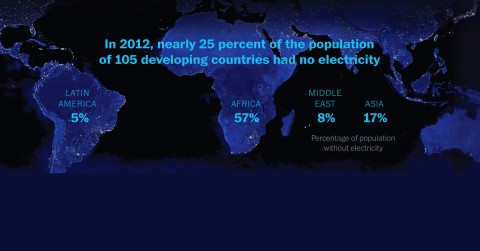
Is Britain ready to export electricity grid expertise and grid components to India’s 400 million citizens who have never had electricity in their homes? Such opportunity with real benefits for both nations!
Filling that need over the next two decades will cost hundreds of billions of dollars (if the Americans do it) but that begs the question Why leave it to the U.S.A. alone?
Such an opportunity represents hundreds of billions pounds sterling if the UK takes on part of that project — with significant opportunities to earn revenue by financing such projects — financing which are likely to be guaranteed via some combination of Indian government bonds, World Bank funding, and IMF loans.
Not only that, of course. India has a growing middle class with real purchasing power that want to purchase quality cars and trucks, housewares, electronics, and just about any product manufactured in the UK.
Further, Indian corporations need access to world class financing and market exposure afforded by the London financial sector, and some of the world’s preeminent legal and architectural firms have an obvious role in helping India to become all that it can and should be.
GCC kingdoms are always searching for evermore high-end warplanes and civilian jetliners, and they are always quick with the money. And, especially nice, no bickering when it comes time to pay the bill.
The GCC has transformed in recent years due to massive expansion in the formerly sleepy fishing villages of Dubai, Abu Dhabi, and Ras Al Khaimah — turning them into thriving financial centres, replete with stunning architecture and residential communities.
In fact, some of the most famous buildings in the world are located in those three cities and were designed by world class architects based in London, engineered by the most advanced engineering firms in the world, along with a host of other services such as project management, financing and property management, many London-based.
In the GCC, it isn’t about whether they have the money, because they sure do. It’s about having a presence and being there to meet opportunities as they arise.
In places like Dubai, major projects are envisioned, mooted, and completed in less than four years. Which is about the amount of time it takes to get just a simple development proposal permit approved in some cities. The message there is; Don’t nap, or you’ll miss it.
Brazil. The country’s formerly strong economy has taken some shocks in recent years. Both economic and political shocks have caused damage to the Brazilian economy, but that also presents many opportunities for investor groups. Huge Brazilian conglomerates that are barely holding together for now could be a real bargain for investors with sterling to spare.
What is great about commodity based economies is that when the price rises, it doesn’t get any sweeter. And when commodity prices are low, it’s almost always a good time to buy stock in those companies, or just buy the whole company.
Sugar from Sugarcane – and Biofuel Made from Sugarcane
Companies like Cosan and Raizen have the advantage of selling their sugarcane in two very different markets.
If the price of sugar is high, then the twice-yearly sugarcane crop gets sold as sugar commodity, or as finished sugar product at the retail level.
But when sugar prices drop, those same corporations simply sell their sugarcane to the huge biofuel market in Brazil, where 92.9% of Brazil’s cars run on a minimum 22% biofuel blend (E20) as mandated by Brazilian law, with many cars burning 100% biofuel (E100) which significantly lowers vehicle emissions and respiratory related healthcare spending across Brazil’s largest cities.
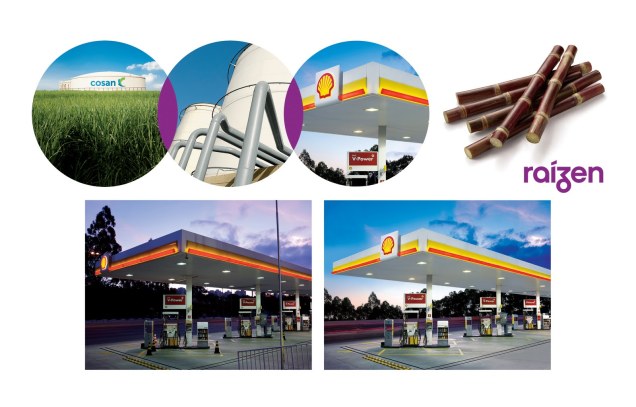
Raízen, the joint biofuel venture between Royal Dutch Shell and Cosan Ltd. is the 3rd-largest energy company in Brazil. Image courtesy of Raízen.
“A life cycle assessment by the Yale School of Forestry on jatropha, one source of potential biofuels, estimated using it could reduce greenhouse gas emissions by up to 85% if former agro-pastoral land is used — or increase emissions by up to 60% if natural woodland is converted to use.
In addition, biofuels do not contain sulfur compounds and thus do not emit sulfur dioxide.” — Wikipedia Aviation Biofuel
Aviation Biofuels
With global aviation accounting for 2% of total anthropogenic (human-caused) CO2 emissions, now is the time for Britain to legislate 50/50 blends of biofuel and conventionally sourced petroleum aviation fuel. Many airlines are already doing exactly that. Notably, the US Navy is doing the same as part of it’s Great Green Fleet programme. Biofuels can also help to moderate jet fuel costs when conventional fuels skyrocket due to wild price swings.
By switching commercial aircraft to 50% biofuel blends, aviation related CO2 emissions would drop by half and respiratory illness healthcare spending would drop by billions.
Summary
What makes these three opportunities so tantalizing are the sheer numbers; India with 2.2 billion consumers by 2025, the GCC nations with their unquenchable thirst for the trappings of a wealthy society, and Brazil for it’s commodities, especially the sugar/biofuel synergy with the opportunity to cut global aviation emissions by half.
With the right vision, the right approach by the British government, and some dedicated effort and follow-up by HM government, it should prove to be a cakewalk to grow the British economy 5% by 2021 (separate from already planned growth) on the strength of those three opportunities alone.
Related Articles:
Read: Sweetening The Biofuel Sector: The History of Sugarcane Ethanol in Brazil
Read: Sugar-Cane Fuel Wins in Brazil as Cheap Ethanol Beats Gasoline
Read: Shell and Cosan invest $1 billion to boost Brazilian biofuels

Brexit: The Trigger for a New Atlantic Alliance
by John Brian Shannon | October 4, 2016
Britain, more than any other Atlantic Ocean nation, would benefit from an Atlantic Alliance free trade zone precisely because it is an island nation, and as such it depends on free trade and movement of goods in order to thrive to it’s full potential.
Since the Roman era Britain has enjoyed a historic presence in the Atlantic Ocean for good reason — island nations need regional trade to survive and international trade to thrive.
For Britain, there is no way forward without enhanced international trade. In principle, islands should always be the strongest proponents of international trade and international law for the very reason that they profoundly need the world to function that way.
Japan set a wonderful example for all island nations in the postwar era, but never moreso since the Arab Oil Embargo of 1973 when U.S. consumers suddenly decided to switch their gas-guzzler cars for lower priced and more fuel efficient Japanese cars.
Not only were millions of cars imported from Japan over the following years, but because the necessary technology to build cars was transferable to home and personal electronics, Japan received a double boost to it’s economy every day since the Arab Oil Embargo.
From one of the worst performing economies in the world in 1946 to it’s peak as the #2 global economy in the 1990’s — the Japanese economic miracle rode its high quality manufacturing base that catered to the needs of billions of consumers. By any standard it remains an impressive accomplishment.
And now it’s Britain’s turn to shine as the world’s next booming economy.
Although much has changed since the oil supply shocks of 1973, the world economy continues to grow, with developing nation consumers seeing comparatively massive increases in their disposable income, presenting a wonderful opportunity for a Britain suddenly freed from an overly bureaucratic political union.
Therefore, let us count the ways that an Atlantic Ocean trading alliance (a free trade zone, that I propose be restricted to nations that front the Atlantic Ocean) could benefit Britain and the other Atlantic nations.
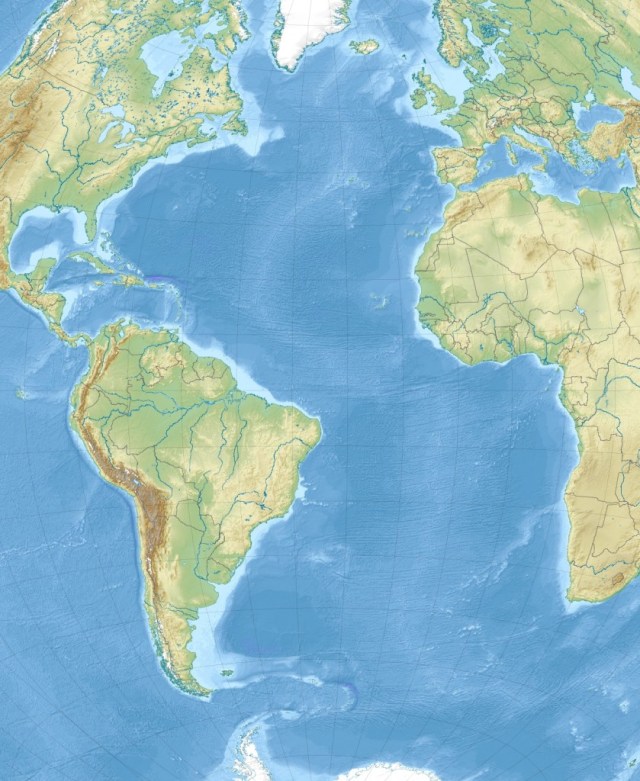
Britain, more than any other Atlantic Ocean nation, would benefit from an Atlantic Alliance free trade zone precisely because it is an island. Atlantic Ocean map. Image courtesy of Geography.name
In the North Atlantic, we have the United States, Canada, Greenland, Iceland, Ireland, the United Kingdom, Norway, France, Spain and Portugal.
In Africa; Morocco, Western Sahara, Mauritania, Senegal, Gambia, Guinea-Bissau, Sierra Leone, Liberia, Côte d’Ivoire, Ghana, Togo, Benin, Nigeria, Cameroon, Equatorial Guinea, São Tomé and Príncipe, Gabon, Central African Republic, Democratic Republic of the Congo, Angola, Namibia, and South Africa, front the Atlantic Ocean.
And in South America, we have the South Atlantic nations of Argentina, Uruguay, and Brazil fronting directly onto the Atlantic Ocean — while French Guiana, Suriname, Guyana, Venezuela, Columbia, Panama, Honduras, Nicaragua, Belize, and Mexico and many island nations reside within the Caribbean Sea — which is of course, easily navigable to the open Atlantic Ocean.
All of these nations should receive a warm invitation to join such a trading block.
It is perhaps the best matchup of nations since the Bretton Woods Agreement of 1944. In the list of Atlantic and Caribbean nations, exist the most developed nations to the least developed, from the most overbuilt tourist locations to vastly underbuilt tourism markets, to the astonishing per capita petroleum and mineral resource base. Such opportunity abounds for those who pursue economic interdependence between Atlantic nations! From the most highly skilled labour to the cheapest labour, and among the highest cost real estate to the cheapest agricultural land in the world, everything that a developed or still developing nation needs can be easily found within this trading area.
The economic opportunities are uncountable, and they are sitting there untapped. At the moment, it’s a criminal waste of opportunity that must rank as a negative for every Atlantic nation whether developed or developing.
The obvious move here is for British Prime Minister Theresa May to voice strong support for an Atlantic free trade zone, contacting representatives of each country to find out what Britain offers, that can mesh with the needs of each Atlantic Alliance trading partner. And vice-versa.
Once some activity generates and some new trade begins to take shape, it would be wise to meet regularly to discuss standardization of regulations, whether shipping or other modes of transportation, financial, tourism, and other ways to work together. Even the baby-steps of working together to protect maritime shipping from at-sea piracy, or to form mutual aid groups designed to streamline hurricane or other natural disaster relief would demonstrate ways that Atlantic nations can work together for mutual benefit.
If the NAFTA model is used as the trading template, some of it’s terms could be adjusted to better suit the preferences of all Atlantic Alliance members, or it could be seen as the eventual goal for all members to reach at some point. At the very least it could be used as a reference point, a place to begin discussions.
By leading such an effort Britain would be well-placed — not to own the Alliance — but to offer it’s expertise and experience, so that the end result is a Win-Win for every nation involved. That is what makes for strong partnerships, and strong partnerships always make economic sense.

Why Britain needs a dedicated Minister for Europe
by John Brian Shannon | September 21, 2016
It is a time of change and a time of renewal in old Europa.
Three countries are leaving or have already left the European Union. Greenland opted to leave in 2009, the residents of Switzerland voted in a countrywide referendum to leave the EU in 2014, and in 2016 Britons voted to Brexit.
Not only that, but Italy decides by countrywide referendum whether to stay in the EU this December, while the Netherlands, France, and Hungary have upcoming elections and strong anti-EU political parties pushing for referenda to exit from the European Union.
Norway never did join the EU, but co-exists with the EU via the EEA and EFTA models. And Norway’s economy and people are doing very well, to say the least.
It’s not WWII scale of change in Europe, thankfully. It’s not even Marshall Plan reconstruction of Europe scale of change. But Europe is changing, it’s a work-in-progress, and there is much that could still go right, or wrong, for the European project.
Creating a Minister for European Affairs
Which is why Prime Minister Theresa May should create a new position in her government of Minister for Europe which would cover everything Europe on behalf of the British government.
For the Foreign Secretary to try to cover all things Europe at this time of unprecedented change in Europe — and to build and nurture relationships between Britain and every other country in the world, is simply asking too much from one human being. The Foreign Secretary’s job is a full time job, and that’s under normal circumstances.
While a Minister for Europe would be a full time job with significant challenges involved as some of the 27 EU nations seek to delay, derail, or persuade Britain to remain in the EU (not because it will benefit the UK, but because that’s what will benefit their particular country) even as others seek to punish UK voters for choosing to Brexit.
The Minister for Brexit portfolio only deals with relations between the UK and the European Union, while a Minister for Europe would cover all socio-economic and military-security relations (and more) with every country from Iceland in the west to Ukraine in the east, from Norway in the north to Spain’s southern islands off the coast of Africa, in the south.
There is so much more going on in Europe these days beyond the mandate of Minister for Brexit, that it will take a full time and highly dedicated person to oversee all things Europe. It’s a big territory and it’s sure to be a big job.
Choosing the best Minister for European Affairs
And for that, you need someone larger than life — someone like Nigel Farage, who isn’t afraid of anyone, anywhere, for any reason. At no time would anyone ever think that Nigel wasn’t fully devoted to protecting Britain and helping her to grow to her best potential. Even his political opponents would attest to that.
Mr. Farage created and led the UKIP political party to great heights in a very few years, culminating in the Brexit vote, and Nigel Farage made it look easy every day of the year.
I couldn’t imagine anyone more suited to the job than Nigel Farage, nor could anyone approach his future success in all of the UK’s dealings with Europe, from Iceland to Ukraine and everything in between.
Thus far, PM Theresa May has made some smart moves, hiring Nigel Farage as Minister for Europe could prove to be the smartest move of all.

Britain – It’s a time of profound change in Europe which makes it the time for Theresa May to appoint a dedicated and energetic Minister for Europe. Nigel Farage at the UK Parliament Buildings. Image courtesy of The Spectator
 Letter to Britain