Home » United States (Page 2)
Category Archives: United States
How a Tiny Tariff Could Change America
As the debate heats up over President Trump’s 25 per cent steel tariffs and 10 per cent aluminum tariffs (some countries are exempted by Presidential Order) it’s interesting to look at other scenarios that might play out better for the United States — and for other countries too.
First, let’s look at the scale of the American trade deficit problem, then we can compare different methods to adjust trade flows to help the United States avoid a projected $880 billion trade deficit with the rest of the world by FY 2019. No country, not even the mighty United States of America can withstand annual trade deficits of that magnitude.
At the moment, America’s biggest trade deficit is with China ($215 billion/yr) followed by Japan ($68 billion/yr) and Mexico ($65 billion/yr) while many other countries run double-digit trade deficits against the United States. In totality, such trade deficits are simply unsustainable for the U.S. and President Trump is right to address the issue, however, there’s always more than one way to accomplish a thing.


U.S. Imports: The timeline shows the total value of international U.S. imports of goods and services from 2000 to 2017. In 2017, the total value of international U.S. imports of goods and services amounted to 2.9 trillion U.S. dollars. Image courtesy of Statista.

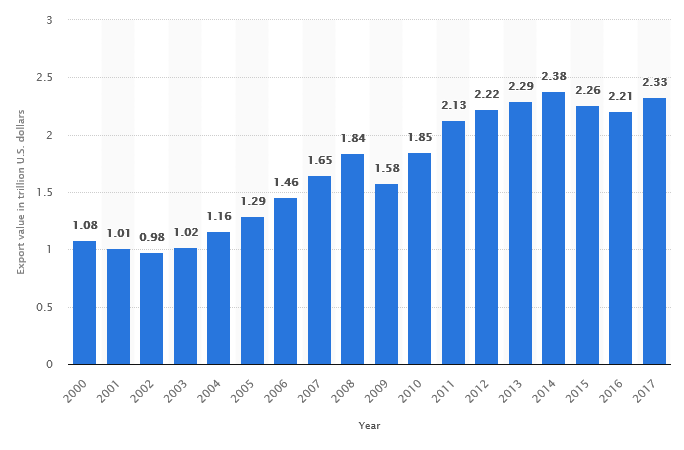
U.S. Exports: The timeline shows the total value of international U.S. exports of goods and services from 2000 to 2017. In 2017, the total value of international U.S. exports of goods and services amounted to 2.33 trillion U.S. dollars. Image courtesy of Statista
The Nature of the Problem
America’s trade deficit is an astonishingly simple problem that has developed over four decades — because when a thing evolves without proper guidance and oversight, eventually it becomes the thing that eats you — which is what’s happening to the United States in the 21st century.
Because policymakers allowed this monster to grow, it means the U.S. will import $557 billion more than it exports in 2017, instead of maintaining a normal balance of trade like other countries. And 2018 is projected to produce an $880 billion trade deficit for the United States, with a $1 trillion trade deficit sure to arrive by FY 2020 if action isn’t taken to address this catastrophe.
President Trump claims that the American trade negotiators of previous decades were ‘weak’ and got ‘out-negotiated’ by other countries and blames them for the present (uncomfortable) moment. But that isn’t accurate. However, it plays well with voters, and media outlets especially, thank Donald Trump for that characterization.
What happened is that America opened trade with China and other developing nations beginning in earnest in 1974, allowing generous trading terms to add impetus to America’s trade liberalisation goals. American policymakers assumed that once those developing nations got a real economy going, citizens of those countries would then purchase billions of dollars of American goods and the gamble would pay off handsomely. And therein lies the problem. Not every country reciprocated America’s largesse.
China, Japan, and other countries simply grabbed the Americans by their largesse and began exporting evermore billions of dollars worth of goods and services to America without buying much of anything from the United States.
Note: In Japan’s favour, the country’s carmakers aggressively lobbied Washington to be allowed to build factories throughout the United States and Canada which provided thousands of jobs across North America every year since 1987. Also, Japan bought hundreds of billions of dollars worth of U.S. Treasury Bills to help maintain the American economy. These wise actions ameliorated the concerns of U.S. legislators about Japan’s trade imbalance with the United States from 1987-2017.
Which should qualify Japan for a ‘Free Pass’ from all steel and aluminum tariffs IMHO, as Japan was led to believe by American legislators that their actions neatly covered any trade negatives in the U.S. / Japan relationship.
Asleep at the Switch?
If someone in America had been ‘on this’ it would have never gone this far. But someone in America was asleep at the switch and that’s why we are where we are, in 2018.
The problem, therefore, isn’t that America got ‘out-negotiated’. The problem is that certain countries took advantage of America’s generous trade terms but were reluctant to accept imports from the United States.
Whoever was in charge of international trade in the U.S. from 1990 until 2018 should have Fried in Hell for not raising the alarm and writing some appropriate ‘fair trade’ legislation that would serve as a check and balance against such one-sided trade flows.
The $10 Billion Tripwire Method
Countries that run trade surpluses of less than $10 billion/yr with the U.S. shouldn’t face American tariffs as those numbers typically go up and down many times over the course of a decade and can even reverse direction to America’s benefit, and in any case, rarely become double-digit or triple-digit trade imbalances.
But once a country hits the $10 billion trade deficit threshold with the United States, it should trigger alarm bells from Alaska to Maine and appropriate tariffs (like Donald Trump’s high-ish steel and aluminum tariffs) should automatically apply on exports to the U.S. from any country that surpasses the $10 billion tripwire.
It’s such a good idea that every country should do it.
The 5% Method
If the United States charged a truly nominal 5 per cent tariff on every foreign good and service it would raise $150 billion per year which is a substantial amount of money for any country, even a superpower.
The U.S. could use that money to subsidize American companies hit hard by low-priced imports since 1990 (maybe by providing financing assistance to allow them to build newer, more energy-efficient factories for example), to improve transportation corridors throughout the country (especially near America’s seaports), to upgrade the actual port facilities to allow for faster and more efficient throughputs of American products being shipped overseas, and to enhance security at every single U.S. port of entry.
This too, is such a good idea that every country should do it.
Balancing an Unbalanced Equation
If the United States adds a nominal 5% tariff to all foreign goods and services, and then on top of that tariff penalizes (with industry-specific tariffs) only the countries that run more than $10 billion trade deficits with the U.S., the entire problem will be solved within 5 years and the American economy will boom like never before.
Also, in a booming U.S. economy, countries like China will find that orders from America will increase and any losses felt now will be recovered within a year or two.
‘Corrective’ Tariffs Need to Replace ‘Punitive’ Tariffs
The only way to conduct international trade is with respect, with proper checks and balances, with mild tariffs designed to make corrections to uneven trade flows resulting from poor policy in previous decades, and none of it needs to be confrontational or nasty.
For the sake of its hard-working citizens, American policymakers must address these imbalances in a businesslike way — not to punish other countries — but rather, to ensure that every country that trades with the U.S. is doing so in a fair and transparent manner.
Is NAFTA a ‘Bad Deal’ for America?
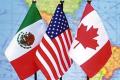
There seems to be only one man in all of America who thinks the NAFTA agreement between the three North American economies is a bad deal for the United States. Which would be a very ordinary thing except that man happens to be the president of the United States of America. At least for now.
The one great thing about the American electoral system is that U.S. presidents can serve only two concurrent terms in office, so no matter how bad or popular a U.S. president is, he or she can stay in office for a maximum of 8 years. Although nothing prevents them from running for their old job once another president has served, other than the fact that American voters have never returned a previous two-term president to office.
That law is a tiny part of what makes the United States exceptional in the world. The most meritorious or most popular presidential candidates rise to the top — but unlike other countries where leaders can serve several terms in office — the American system is refreshed by new leadership every 4 or 8 years. And that’s what makes America great.
‘New blood’, a ‘new vision’, a ‘breath of fresh air’, or however you wish to describe it, occurs at regular intervals. No wonder America is exceptional! It’s too bad they don’t do the same thing with members of the Senate and Congress — and yes, even the office of Mayor in every U.S. city. If they did, the United States would be twice as exceptional on account of all that new blood and fresh enthusiasm.
Alas, because only one office in the land is refreshed regularly, America is great from the top down only — not up and down and in the middle — at least where governance is concerned.
Where Donald Trump is Wrong
President Trump arrived on the scene 13 months ago and with no particular government experience behind him, declared that many things are wrong with America and he’s just the man to fix it. And he may be that man, but only time will tell.
Yet, we’re seeing a man who sees symptoms and sincerely wants to treat the symptoms instead of wanting to solve the underlying condition that created the symptoms in the first place.
Certainly no one can fault Donald Trump for being enthusiastic about America, about America’s history in the world, and no one can deny he’s a breath of fresh air to the Oval Office.
But we need to have a conversation about the present symptoms in order to ascertain what the underlying condition may be in present-day America, and for that, we must travel back in time to see how America lost its way.
When Henry Ford was right: Creating the American middle class by filling a transportation need
Henry thought that ‘everyman’ should own an automobile, instead of only railway barons with their obscene personal wealth able to afford motorized transportation. During a downturn in Ford company fortunes, Henry decided to increase the pay of his workers to $5.00 per day, and was thereafter able to cherry-pick whatever workers he wanted from Louis Chevrolet, Buick, General Motors, Cord, Packard, and others.
Once Henry had created a whole new economic classification which later came to be called ‘the American middle class’ so many people bought Ford vehicles that 16.5 million Model T’s were produced in less than 20 years of production.
The moral of this story? Paying higher wages created ‘the middle class’ — a growing cohort of workers earning good wages and able to afford a car, which catapulted Ford’s fortunes into the stratosphere.
The Post-war Boom
Early in the 20th-century, the U.S. became the most powerful manufacturing nation in the world and surpassed even longtime patent leader Germany as the country that received the most annual patent applications.
This occurred only because of strong patent law in the United States. Any inventor with a worthwhile invention brought their idea to America for one reason — because out of all the countries in the world only the U.S. offered the maximum level of legal protection for their idea, design, system, or machine.
Even German scientists brought their ideas to America to have them registered with the U.S. Patent Office!
For countries other than America, the existence of a strong U.S. Patent Office created a ‘brain drain’ in their own countries, meaning that all their scientists and inventors headed to America instead of registering their contraptions in their home country.
Having received their patent protection in the United States, it was a natural step to have their inventions manufactured in America. Although not its primary mandate, the U.S. Patent Office was often excellent at matching inventors with such suppliers or manufacturers as they required.
It was a clear case of the American government passing the right legislation at the right time to attract the best and brightest in the world.
The moral of this story? Not a tariff in sight!
Because the postwar economy was booming and expectations were high, the Baby Boom generation went on a buying spree that is unparalleled in history
All of which worked to make all those patent-holders and their manufacturing companies obscenely rich. And good for them! When you work hard, you should see a positive return for your effort.
The favourable consequence of powerful U.S. patent protection combined with a huge and growing manufacturing base, created a booming economy and concomitant high consumer confidence which provided an unexpected result — usually about 9 months later.
Yes, during the boom times when one family member earned enough to support an entire family, the birthrate in America skyrocketed, creating even more demand as Americans began to have more children per fertile woman.
The moral of this story? When one breadwinner could support a spouse and up to 4 children, afford a new car every 3 years, a couple could own their own home via a 10-year mortgage and enjoy a refreshing vacation every year, the American economy was operating at full output!
American Foreign Policy in the Postwar Era
In the 41 years leading up to 1974, the Saudi government had been selling their oil to America for only the price of production (sans profit) as their contribution to the Cold War effort.
Interestingly, they were allowed to reinvest their cost of production payments in crude oil deliveries and refined oil products — so although they made zero profit on the crude oil as it came out of the ground — they were able to amass considerable wealth by speculating on oil stocks.
But that ended when it was perceived by the Saudis in 1973 that America was favouring Israel, a country that had never delivered billions of barrels of free oil to America.
When America’s oil supplier felt slighted, they decided that they wanted to get paid for their oil after all. ‘Oh, and, we’re pulling back on our Cold War commitment too.’
Which is why the Soviets thought they could successfully invade Afghanistan and tone the world’s opium supply down to almost zero.
When the Saudis suddenly wanted to be paid for their oil and they simultaneously lowered their Cold War commitment to America, the U.S. economy slowed.
With 20/20 hindsight, the ensuing economic disaster was only a symptom of a bungled foreign policy that caused a dramatic increase in new car registrations of foreign cars (with their better gas mileage) moving from 4% of all U.S. new car registrations in 1970 to 65% of new car registrations by 2017. Not only that, but up to 75% of the parts used in today’s American cars are made in Asia.
Therefore, the problem clearly isn’t NAFTA which came into effect in January 1994.
Here’s how that looks expressed as a math equation:
America -10 trillion dollars ∴ Japan +10 trillion dollars
(If you’re not into math, the symbol ∴ means ‘therefore’)
It could be argued that the United States took a highly principled stand on account of the people of Israel, but it was America’s decision alone, and it cost America 10 trillion dollars and poisoned relations with their oil-producing and Cold War ally, Saudi Arabia.
The moral of this story? The problem of offshoring American manufacturing jobs began in 1973 due to an American foreign policy decision which took place long before NAFTA had been created. Blaming Japan for American capital flight since 1974, or blaming NAFTA (which wouldn’t be created for 20-years) is disingenuous.
Social problems in 1960’s and 1970’s America: Racism, weak civil rights for women, and the Vietnam War worked to reverse America’s earlier gains
A lost generation occurred in the 1960’s where The People lost faith in their elected representatives, but they didn’t lose faith in the institutions of government.
President Carter worked to restore the faith the American people felt toward the executive branch of government by working on some very noble causes and meeting with some success. President Reagan moved things forward by strengthening the U.S. economy, infusing Americans with newfound confidence by offering loan guarantees to struggling American automobile manufacturers and dramatically increasing military spending.
The moral of this story? President Carter and President Reagan didn’t fix America by blaming other countries — they did it by empowering American citizens with tax changes and supporting American industry with loan guarantees to at-risk corporations, with huge defense spending increases, and plenty of positive exhortations about what made America great in the first place.
Every American, Canadian, or Mexican captain of industry wanted NAFTA back in 1994
If NAFTA was so grievous to be borne, why did almost every CEO in North America want NAFTA?

GDP growth in NAFTA countries since 1993 – NAFTA enacted January 1, 1994. OECD.
But some American Congressmen and Senators were nervous on account of the many U.S. job losses since 1974 and were concerned that even NAFTA could go wrong. And let’s face it, some members created a negative stir so that new U.S. president Bill Clinton would feel compelled to direct more federal funding to their districts in case NAFTA failed.
In reality, the only U.S. and Canadian companies that lived in fear of NAFTA were ones that didn’t keep up with the times. In the booming 1980’s and 1990’s economy, some companies decided they wouldn’t modernize and consequently continued to spend millions per month on electricity costs (for example) instead of reinvesting their (then record) profits in newer, energy-efficient factories or foundries.
For other corporations in the mergers era, it seemed a time to slow capital spending in order to maintain high profit margins and pay record-high dividends to their shareholders. But when the bull market finally came to its end, many businesses were suddenly cash poor and couldn’t afford a new, energy-efficient factory or foundry. Which was brilliant tactical thinking, but abysmal strategic thinking.
So… the question is; If corporations employ poor strategic thinking, should taxpayers be forced to bail them out?
Why should U.S. taxpayers bail out industries that choose high shareholder returns over sound financial management?
In the 1970’s and 1980’s, some American automakers needed the federal government to subsidize them with billions of taxpayer dollars to save them from implosion. That’s only one example out of thousands of U.S. companies that accepted or have lobbied for federal subsidies. Canada is just as bad as the United States on this point. Governments in both countries spend more on corporate welfare than they do on citizen welfare — times two!
Now in 2018, President Trump wants American taxpayers to pay even more for their cars (and anything else made of steel or aluminum) via a 25% tariff on steel imports and a 10% tariff on aluminum.
For one example, Trans Canada Pipeline will be forced to pay the tariff on the steel pipe for the proposed Keystone XL pipeline. Although steel is a small part of the overall cost of building a pipeline, the cost of the multi-billion dollar project will now rise by 5% or more. Just for comparison, 5% on 10 dollars is 20 cents — but 5% on 5.4 billion dollars adds 270 million dollars to the overall project cost.
The moral of this story? While Donald Trump’s motives are obviously ultra-pure, tariffs are simply a de facto form of taxation that U.S. citizens will pay because a few American corporations preferred high profits/high shareholder returns over competitiveness
Is there ever a good case for tariffs?
In a word, yes. Everything that’s imported into the U.S. (or any country) should face a globally standardized 5% tariff because every government needs money to improve port facilities, to streamline customs, and to maintain the transportation corridors that are essential to trade flows.
Even countries with free trade agreements like the NAFTA countries should institute a standardized 5% tariff on every good that crosses their border — and be required by legislation to use that money to improve transportation corridors and border security.
Consumers would find that presently high tariff items would drop in price, and zero tariff items would rise by 5%, but the trade-off would be astonishingly better roads, bridges, tunnels, rail links, airports and seaports, complete with better security. Every citizen would like to spend fewer hours per week stuck on congested highways, in airports, and enjoy faster and more secure delivery of goods.
Suddenly we wouldn’t be talking about ‘trade wars’ we’d be talking about improved trade, improved infrastructure, and a complete standardization and levelization of tariffs between every country.
And instead of heated rhetoric from politicians, we’d become more efficient throughout our countries and less efficient corporations wouldn’t continue getting rewarded for not re-investing in their businesses.

If There Were Ever a Time for an Anglosphere Summit – it’s Now!
International summits are wonderful events. Heads of state, cabinet officers and their staffs, CEO’s, various think tanks and special guest speakers get together to discuss policies and innovative solutions to common problems faced by their group. Yet, in over two-hundred years of the modern political era, Anglosphere nations have never held a summit dedicated to Anglo nations. Inexplicable!
It’s time for the leaders of the United Kingdom and the United States to reach out to all English-speaking nations such as Canada, Australia, New Zealand and other primarily English-speaking nations to invite them to an Anglosphere Summit this year. (Yes! THIS year!)
Announcing the First Annual Anglosphere Summit: Anglosphere Summit 1.0 (Synergy)
A simple three-day format could be employed for the first annual Anglosphere Summit where the first day (1/3 of the programme) could help broaden the understanding of what the Anglosphere as a whole has contributed in the 20th-century (and more to the point, what it has accomplished in the 21st-century) via gigantic video projections and guest speakers on each topic, the second day (1/3 of the programme) could be devoted to present-day challenges for Anglosphere nations, while the final day could suggest conventional and innovative solutions to problems faced by Anglosphere nations, complete with photo opportunities, signing ceremonies, along with an award for the most-improved Anglo economy over the previous year.
And finally, the greatest strengths of Anglo nations have always been their respective economies, their combined economic power, and their per capita economic power, backed by their always-loyal military institutions. A deep commitment to international trade and a powerful but well-disciplined military are a world-beating combination that can’t ever be taken for granted by Anglo political leaders. That’s what made us who we are.
The Venue
Each year, one Anglosphere nation could offer to host the Anglosphere Summit and tailor the experience so that each attendee can learn about the host country’s successes and failures in governance, policies, social structures, and industry, allowing attendees to take home that knowledge and build a better country.
Such luminaries as Bill Gates (computing) Bill Ford Jr. (automotive industry) Richard Branson (airlines, tourism) Jim Rogers (energy) Arnold Schwarzenegger (governance, movie industry, renewable energy) Elon Musk (TESLA, Space-X, SolarCity, PayPal, Ebay) and other entrepreneurs could deliver compelling presentations to participants, bringing them up-to-the-minute information on their fields of expertise.
Such resources the Anglosphere has available to them(!!!) but the experience and reach of these stellar people are criminally underutilized by Anglosphere politicians and policymakers. Unforgivable!
After the summit concludes, everything could remain in place for two weeks to allow the public to hear the recorded speeches and see the exhibits at the venue, and to watch the same informational videos in the same setting as Anglosphere leaders.
Summary
Leaders of Anglosphere countries need to lead. They need to synergize their efforts to compete in the global marketplace. And they need the support of all English-speaking countries to confront common domestic and international problems. There has never been a better time to work together!
Related Articles:
- La Francophonie website — La Francophonie is a great organization dedicated to the betterment of all people living in French-speaking nations and it does incredible development work around the globe, much of it focused on poverty-stricken and up-and-coming French-speaking nations. Je salue la Francophonie!
- The Commonwealth of Nations website — an organization dedicated to the United Kingdom and its historical colonies that are now full-fledged nations, and some new member countries. (Some are English-speaking nations, while others aren’t) “The Commonwealth is an association of sovereign nations which support each other and work together towards international goals. With their common heritage in language, culture, law, education and democratic traditions, among other things, Commonwealth countries are able to work together in an atmosphere of greater trust and understanding than generally prevails among nations.”
- The CANZUK nations website — a group dedicated to increased cooperation between the ‘CANZUK’ countries — Canada, Australia, New Zealand and the United Kingdom (hence the abbreviation, CANZUK) that extends its membership to other like-minded nations. “CANZUK International (CI) is the leading group advocating closer ties between Canada, Australia, New Zealand and the United Kingdom, known amongst diplomats at the United Nations as the ‘CANZUK Group’. These four countries have shared commercial ties, geopolitical aspirations and a venerable constitutional tradition over centuries. Amongst CI’s aims is freedom of movement within the CANZUK Group for the citizens of Canada, Australia, New Zealand and the United Kingdom. In addition, it regards loyalty to the same monarch as an essential symbol of a common heritage and the cornerstone of constitutional democracy. More specifically, it is envisaged that the CANZUK Group would collaborate in the following areas: – Free Trade – Foreign Policy – Constitutional Affairs. The four leading Commonwealth realms could build upon existing economic, diplomatic and institutional ties to forge a cohesive alliance of nation-states with a truly global outlook.”
- Trump says he is working on ‘very big and exciting’ trade deal with UK (Sky News)
 Letter to Britain