Home » The Commonwealth of Nations (Page 5)
Category Archives: The Commonwealth of Nations

This Week in Brexit: Trump Promises a Trade Deal
On the sidelines of the G20 Hamburg summit, U.S. President Trump found time to meet with UK Prime Minister May and to offer welcome words that the United States will sign a bilateral trade deal with the UK as soon as Brexit is complete.
It’s very good news for the UK and also for PM Theresa May (who has had a rough time in domestic politics of late) and it was obvious that the U.S. president went out of his way to assure Ms. May that a reciprocal trade agreement — one that works for both America and for Britain — is one of his administration priorities.
So much of the UK’s post-Brexit success will hinge on bilateral trade accords because no matter how good the final Brexit agreement, there will be some amount of economic adjustment for Britain in the months following Brexit. A quick trade agreement with the United States will not only ease the Brexit transition, but also improve the UK (and America’s) economy indefinitely.
It was a classy thing for Mr. Trump to do for Theresa May knowing that her domestic political fortunes have taken a hit. Let’s hope the Prime Minister is able to return the favour at some point during the Trump administration. That sort of respect makes for strong allies.
During WWI, but especially during WWII the relationship between America and Britain was raised to a very high level by Prime Minister Winston Churchill and President Harry S. Truman, and in the postwar era during a time of unprecedented economic growth, President Ike Eisenhower continued the wise course set by his predecessor.
However, it could’ve so easily gone the other way if the leaders hadn’t gotten along.
Both sides would’ve missed geopolitical opportunities of huge importance such as the formation of NATO, the establishment of the Nuremberg trials and the creation of other institutions and agreements such as Bretton Woods and the IMF. Without the ambition of the UK and the power of the United States those things simply wouldn’t have occurred.
Millions of Americans and Britons prospered over the past 72 years because their postwar political leaders *didn’t drop the ball* and made a conscious decision to *make the best of the postwar relationship* for their respective people.
What Kind of Free Trade Agreement Should Prime Minister May and President Trump pursue?
Present-day Prime Minister of Canada Justin Trudeau was still in school when Canada first approached the European Union to ask about a bilateral trade deal, and that many years later it still hasn’t come into effect. (It’s about to, they say)
It will have taken eight years to hammer out and begin to abide by, the Comprehensive Economic and Trade Agreement (CETA) which arrives so late in the game and market conditions do change over time (remember way back to the 2008/09 financial crisis when the CETA agreement was first floated?) that some of the hard-won negotiating points are no longer relevant and may never be finalized.
Canada, EU to provisionally apply CETA in September (CBC)
I’m sure it’s a fine agreement and congratulations are due. However, with America and Britain at the controls of a mutually beneficial trade agreement between two friendly Anglophone nations, it should take less than a year from first discussion to signed agreement.
Though we don’t know what shape an Anglo-American trade agreement might look like from our vantage point in July of 2017, probably the best idea would be for both sides to embrace reciprocity and fair dealing in all trade matters as a way to enhance both economies, and as a way to later attract other Anglophone nations such as Canada, Australia and New Zealand to sign on to such an agreement.
Hitting the Right Note with Commonwealth of Nations member India
What a great thing it would be if all Commonwealth nations eventually agreed to sign on to a U.S. / UK trade agreement. Commonwealth of Nations member India has 1.5 billion consumers alone!
Both America and Britain could add 5% to their respective GDP just on the improved trade flows of doing business in the booming Indian economy.
“Although India’s rapid population growth is part of what accounts for the forecasted jump […] that is only part of the story. Drastic improvement in terms of per-person productivity due to capital investments and better technology will play an even more important role.
“PwC predicts that India’s economy will grow by about 4.9% per year from 2016 to 2050, with only 0.7% of that growth caused by population growth.
“India’s economy is currently the third-largest in the world, and is expanding at an estimated annual growth rate of 7.1% for the 2016-17 financial year. — India’s economy is forecast to surpass that of the US by 2040 (Quartz)
Both America and Britain just need to hit the right note with India — a respectful note — in order to profit from the massive growth that is available in that burgeoning country.
Working out an Anglo-American trade agreement with a view to adding all Commonwealth member nations within 24 months, guarantees that other powerful trade blocs don’t beat the Anglo-American alliance to supply the rocketing Indian economy with much-needed goods and services.
Projected growth for selected countries – As measured by Purchasing Power Parity (PPP)
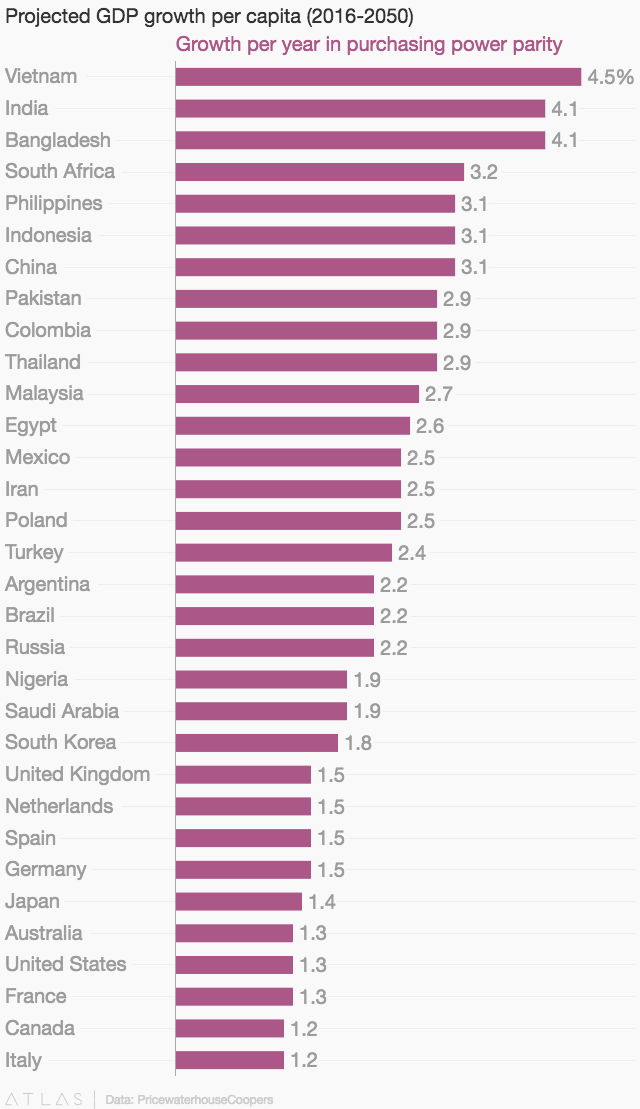
Projected GDP growth UK and other countries 2016-2050. Image courtesy of Quartz.com
It’s so obvious but still worth repeating; ‘Hitch your wagon to the fastest horses if you want to place well in the race.’
Britain has the Commonwealth of Nations connections, Britain needs a trade agreement with NATO ally America and with Commonwealth partner India, and the United States wants to increase mutually beneficial trade with Britain and its 2-billion-strong Commonwealth partners.
In all of human history, rarely has such a synergistic match-up suddenly appeared where different but extremely valuable benefits are available to all three parties.
Just as nobody predicted the massive Japanese economic boom which began to form the day after WWII ended, an Anglo-American trade agreement, followed by a Commonwealth trade agreement (before other trade blocs grab the low-hanging fruit!) could match or exceed the massive performance statistics of the postwar Japanese economy.
Dear United States and Commonwealth of Nations, Let’s not miss this rather obvious ‘Win-Win-Win’ opportunity!

A Development Bank for The Commonwealth
by John Brian Shannon | October 27, 2016
The World Bank, the International Monetary Fund, the Kuwait Fund, the African Development Bank Group, the Grameen Bank, and more recently, the Asian Infrastructure Investment Bank are all highly respected development banking institutions — but not one of them are dedicated to the improvement and well-being of the nation states that make up The Commonwealth of Nations.
And that’s a shame. The Commonwealth of Nations spans the globe, it encompasses nation states with tiny populations measured in thousands, to India with 2.2 billion citizens (consumers) by 2025, and nations that range from the 5th-largest economy in the world (Britain) to the tiniest economies in the world — and everything in between. Huge resource wealth, almost boundless agricultural opportunity, ocean access, tourism, and many other benefits await for development banks, corporate financial institutions, and private investors.
Wealthy Commonwealth nations can find much to like about investing in other nations that lie within the Commonwealth organization, in resources, in agriculture, in reasonable labour costs, in tourism, and more.
Such an institution could pool funds, create a bank, get some immediate projects rolling, and quickly generate some bank profits — profits that will simply be re-invested in the next project somewhere within the Commonwealth.
For a relatively small investment relative to the total Commonwealth GDP, come outsized gains in involvement by other members of that organization, a greater level of economic success among and between member nations, and much gain to offer banks, infrastructure construction companies and their supplier corporations.
Each development loan between Commonwealth nations further strengthens the Commonwealth and thereby, all of the nations in the group are strengthened.
If ever there were a textbook case upon which to base a successful development bank, The Commonwealth nations are it.
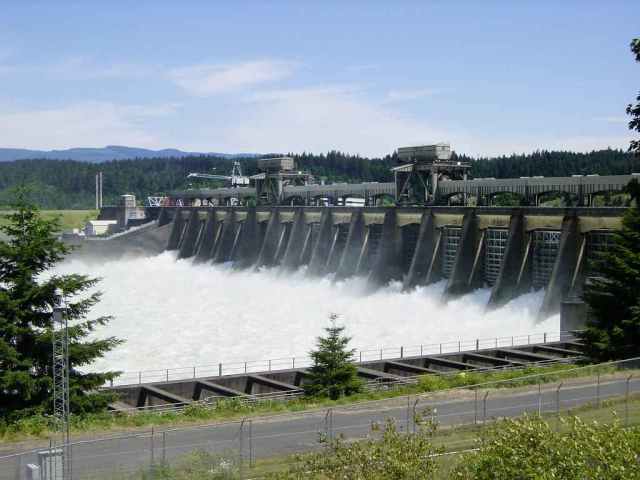
Hydro-electric dams in developing nations are highly valued by government, corporations, and citizens alike — and represent low risk and steady income for development banks and private investors. Image courtesy of pluginindia.com
Whether in the energy sector, agriculture, tourism, and in other segments of the developing economy, having a Commonwealth-only development bank distinctly geared towards financing and providing design and engineering expertise will benefit investor nations, commercial banks, and private investors — and provide a double benefit for those developing nations growing their economies while trying to provide better services for citizens.
How can Britain Afford This?
Britain is one of the most generous donor nations in the world, paying out some .71% of GDP in foreign aid annually. Few countries surpass this (Norway pays out 1% of GDP to foreign aid) but most fall well-short of Britain’s foreign aid commitment.
Canada, for instance pays .20% of GDP (and its total GDP is much smaller than the UK) and EU foreign aid spending averages .45% of GDP.
Instead of directing .71% of it’s GDP to non-Commonwealth nations, Britain should continue to pay .71% of GDP towards development aid, but spend it within the Commonwealth bloc exclusively.
In that way, billions of pounds sterling can immediately begin to strengthen Commonwealth economies, with two-way trade becoming dramatically enhanced between Britain and member nations.
Building a new hydro-electric dam, a major bridge, or a superhighway system in a Commonwealth nation?
Please source as much steel, hardware, and expertise, etc. as you can from the UK. And for developing nations without major construction firms large enough to take on megaprojects, please allow British firms to bid on your construction project.
Seems reasonable, doesn’t it?
Summary
By redirecting all of Britain’s foreign aid to Commonwealth of Nations countries exclusively, the UK will strengthen ties between Britain and all of those nations.
It will also serve to increase GDP of those nations, while British construction firms and their infrastructure hardware suppliers would get a welcome boost. As GDP growth leaps forward in member nations, demand for goods, skilled labour, and interim project financing from Britain will increase at a linear pace.
For developing nations within the Commonwealth, it’s the fast-track to developed nation status, higher GDP growth, better and sooner services for citizens, and (typically) a more stable economic and political situation.
And that’s better for everyone in this world, Commonwealth citizen, or not.

Hitting the Right Note with Russia
Renewing Economic Ties with Russia
It may surprise some that for hundreds of years Britain enjoyed a good working relationship with Russia mainly via their respective Royal Families, and that the Allied Powers received especially valuable cooperation from the Soviet Union during WWII. And after the breakup of the Soviet Union, Britain once more enjoyed a strong relationship with Russia and it’s leaders.
All of which means, there’s no reason good enough that the UK can’t enjoy a mutually beneficial relationship with Russia. All that’s required is to hit the right note to resume that formerly beneficial relationship.
Russia has much to offer Britain — especially in light of the Brexit vote. It’s a country rich in oil and gas, metallic ores and minerals, and in forestry and agriculture. In short, all the resources that a developed nation needs.
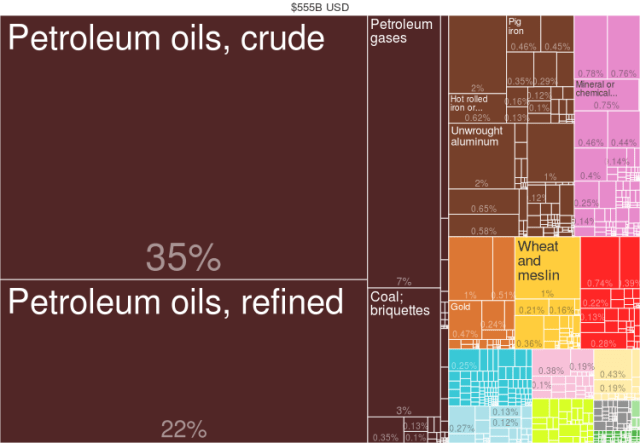
Britain needs all these things to grow its economy. Treemap of Russia exports (2014)
But more than that, Russia is a rapidly modernizing nation with 146 million consumers who have displayed a distinct appetite for travel and for European history.
Buying massive amounts of raw resources from Russia, adding value to them, then exporting them to the global marketplace is a natural for the United Kingdom. In this way, the future of Britain would be inexorably linked to Russia and in a mutually beneficial way. As demand for value-added goods rise, so will demand for Russia’s resources.
This is the kind of symbiotic relationship that Britain must advance with Russia, as it’s the only model that is a ‘Win-Win’ for both nations.
As we’ve seen in recent decades, setting up Win-Lose paradigms eventually leads to Lose-Lose outcomes.
Therefore, Win-Win is the only acceptable course for Britain in regards to Russia.
Renewing Strategic Ties with Russia
During WWII, the level of cooperation between the former Soviet Union and Britain was at an all-time high. The Soviets lost +20 million people during the war as the Soviet Army struggled against Hitler’s Operation Barbarossa “in the largest German military operation of World War II.”
But Soviet communications with Britain were of uniformly high quality and information content, and weren’t intercepted by the Nazis as had been feared by British commanders.
The ‘Lend-Lease’ programme, created by the United States and Great Britain to assist their ally, exported aircraft, navy ships, howitzers, and ammunition to the Soviet Union in an attempt to stop Hitler’s army from taking the entire country along with its unimaginable resources.
The cooperation between the three countries during WWII was unparalleled and it worked to benefit all three nations. Millions of lives were saved (especially in Britain) due to this unprecedented arrangement.
Opportunities as Big as the Sky, Where Economic and Strategic Links Meet
It makes sense that northern nations should work together to advance security in their hemisphere, particularly among those nations that own or claim part of the Arctic Ocean and its rich resources.
It would be interesting to locate some Scottish islands where the wind blows constantly (that would be all of them) and install a couple hundred wind turbines along with housing for +3000 presently unemployed blue-collar workers, so they might smelt aluminum ore for export.
But not only aluminum, refining crude oil or making steel uses obscene amounts of electricity too. With cheap wind power located right on-site — one of the biggest production costs for smelters and refiners (energy) is lowered by half — which translates into a pricing advantage for exporters.
Working together, hundreds of billions of pounds could be unlocked to invest in Russian oil and gas, and other resources, inside Russia proper or in the Arctic Ocean.
Hundreds of billions more could build new factories in Russia, taking advantage of the lower energy, labour and regulatory costs there, which could allow Russia to duplicate the astonishing manufacturing leap made by Japan in the 1970-2000 timeframe.
If British banks are financing these operations, and British companies are part-owners with their Russian counterparts, there will be plenty of incentive on all sides to make it work. The very definition of Win-Win.
Over the next 30 years Russia could match the incredible economic leap made by Japan while Britain’s banks get to earn profit on financing that transition, and both British and Russian workers enjoy a fast-paced and profitable economy.
Isn’t that a better future for British and Russian kids than sliding backwards toward a new Cold War?
Image credit: By Celinaqi – http://atlas.cid.harvard.edu/explore/tree_map/export/rus/all/show/2014/ CC BY-SA 4.0
 Letter to Britain