Home » post-Brexit (Page 8)
Category Archives: post-Brexit
Is There Enough Demand ‘Out There’ to Float a post-Brexit UK Economy?
The China Internet Network Information Center says the country recorded a jump in internet users of 30 million during the first half of 2018 alone
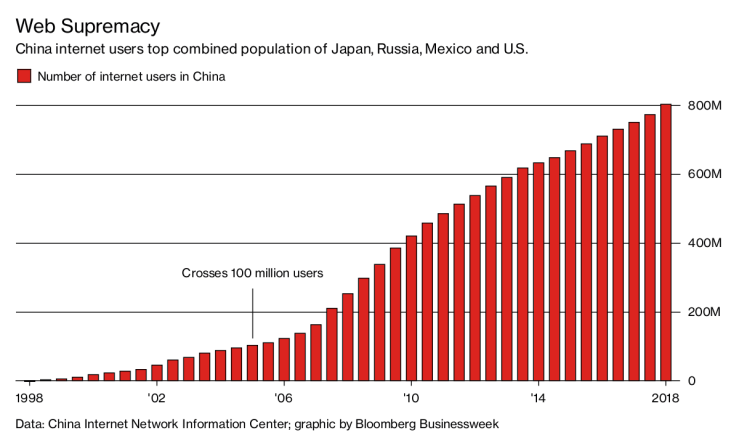
Excerpt from Bloomberg News: “Chinese internet users have crossed the 800 million mark for the first time ever as of June 2018, according to the 42nd China Statistical Report on the Internet Development issued by China Internet Network Information Center. With 802 million internet users, China’s user-base is larger than the combined populations for Japan, Russia, Mexico and the U.S., according to International Monetary Fund data.”
Some Britons wonder if there are enough business opportunities ‘out there’ in the wider world for the UK to thrive and prosper, post-Brexit.
As the graphic above shows, there are more internet users in China than there are citizens in all of the following countries combined: Japan, Russia, Mexico and the United States.
With internet use in China alone growing at an annual rate greater than the entire population of the United Kingdom you’d think that even the most inept exporters in the world would be lining up to trade with the huge moneypot called China.
Yet, because China isn’t selling itself as a huge marketplace for the world’s exporters and because Brexiteers haven’t ventured to research this part of the Brexit equation, it’s left to Bloomberg News (and me) to inform you of these astonishing developments.
Jacob Rees-Mogg’s European Research Group is a fine organization devoted to fleshing-out the political intricacies of Brexit, trade with the EU in the post-Brexit timeframe, and other Eurocentric matters. Yet, when we view charts like the one above it becomes startlingly clear that an Asian Research Group is needed to fully inform us about politics and trade with Asia in the post-Brexit era.
For example: How many Jaguar cars have been sold in the EU over the past 12 months?
And whatever that number is, it will be a static number for the simple reason that only so many EU citizens can afford a Jaguar motorcar and every one of them simply phones the local Jaguar dealership to order the Jag of their dreams and the car is delivered to their home a few days later.
Yet, I can only surmise that *isn’t* the case in China…
How many Jaguars *aren’t* being sold in China
How many Jaguar cars and SUV’s aren’t being sold in Asia because nobody bothered to research the full potential of the Asian market, or if they have, why aren’t Jaguar building three more factories in the UK to meet the demand of the rapidly growing Chinese middle class?
If internet users in China alone have risen from 22.5 million in year 2000 to 802 million partway through 2018, that demonstrates astonishing growth in their middle class. And if those people are ordering goods and services on the internet because their disposable income is rising fast, why isn’t there an entire department of HM government devoted to helping UK companies to get those online orders instead of just standing idly by and allowing other countries to snap up that business?
By 2030, there will be 1.6 billion internet users in China. How many Jaguar sales will have been lost by then?
It’s Not Only Cars…
Millions of pounds sterling are being lost every month since year 2000 because nobody in the UK government was put in charge of this.
Heads should roll over this shameful ‘oversight’ and not only in the government.
Heads also in the Bank of England, London School of Economics, London Stock Exchange and other organizations need to stop whatever they’re doing right this minute and phone whomever it is that can quickly address this stunning oversight.
Driving along the M4 on your way to the LSE right now? Have your driver pull the car over — you’ve got an important call to make — one that’s 18-years overdue.
With the right stewardship of the country, any good or service the UK produces should have seen the same kind of sales increases as the number of Chinese internet users since 2000. Disposable income is disposable income — and it’s better that UK business gets that disposable income rather than businesses from some other country.
From which, I can only assume that there *hasn’t* been proper stewardship of the UK economy since year 2000.
It goes without saying that nobody knew for certain how the internet was going to grow back in the early 2000’s, therefore, policymakers of that era are largely free of blame. But as each subsequent year passed, this should’ve been addressed with increasing urgency. Certainly, everyone on planet Earth knew by 2005 that the Internet of Things (IoT) was going to be a major part of our civilization in a few short years.
But the silence especially in the UK has been deafening.
“The global IoT market will grow from $157B in 2016 to $457B by 2020, attaining a Compound Annual Growth Rate (CAGR) of 28.5%.” — Forbes
Forget About Cars for a Moment – and Think About Everything Else the UK Produces
As noted earlier, it’s not all about the UK-built cars that aren’t being exported to Asia in huge numbers.
Everything that the UK produces or manufactures in a year could be sold to China and the lot of it wouldn’t register a tiny blip on the Chinese financial charts as demand in the country is massive and it continues to grow at a geometric rate.
If the UK tripled its entire annual GDP in goods, services and produce and then shipped all of it to China, it still wouldn’t produce a blip on the charts. And China continues to grow its economy at (artificially held to lower than) double-digit growth rates.
“GDP Annual Growth Rate in China averaged 9.61 percent from 1989 until 2018, reaching an all time high of 15.40 percent in the first quarter of 1993 and a record low of 3.80 percent in the fourth quarter of 1990.” — Trading Economics
Asia is the land of opportunity for all who have eyes to see and ears to hear. There isn’t a reason good enough for the UK government or British business to ignore it one more day.
Bonus Video:
What Would a WTO Brexit Look Like?
Assuming European politicians can’t get their act together enough to craft a reasonable Brexit deal that works for both sides by March 29, 2019 Europe will be faced with Brexit on WTO terms which is known colloquially as a ‘Hard Brexit’ where the UK would leave the European Single Market and Common Market mechanisms and other EU agreements and institutions without any subsequent deal in place.
Without further ado, and without boring you with statistics, let’s look at how a Hard Brexit would play-out in the months and years following a WTO-style Brexit.
Will There Be Famine in the Land?
Of all of the dubious claims by the Project Fear campaigners (and they’ve made many!) this must rank in first place.
No. There won’t be famine in the UK on account of Hard Brexit. However, you may notice your favorite brand of cheese may be unavailable for a time and you may find your prescription medications come from UK pharmaceutical companies or American pharmas instead of from continental Europe.
Saying the following words out loud will do you good, dear Britons — so repeat after me;
“The United States of America has come to Britain’s rescue in times past and will do so again in its hour of need.”
Regarding agriculture; The United States agricultural belt is unimaginably massive and its farmers and ranchers are just waiting to fulfill the UK’s orders. There are fields of crops in the United States larger than the entire United Kingdom. It takes 3-hours to overfly them in a jet aircraft flying at 500 miles per hour.
Regarding ranching; There are 93.5 million cattle in the United States (2017) and that number continues to rise at a little better than 1% per year, and significant capacity exists to raise it over a relatively short period of time.
Similar agricultural capacity is available in Canada for grains, corn, soybean, and other crops, and Canada boasts 4.6 million cattle at present (2018) and Canada has more arable land than the United States allowing it to exceed even the mighty U.S. in this regard if sufficient firm orders were placed.
To answer the question: “Where’s the beef?” It’s in the United States and Canada… Just pick up the phone and call us! North American farmers and ranchers would love to take your money — instead of the EU taking your money.
Britons might find their food costs plummet as the huge economies of scale that typify North American food production and the favorable growing conditions combine to produce bumper-crop after bumper-crop which lead inevitably to lower food prices.

Image courtesy of gov.uk | Figure 1: Origins of food consumed in the UK in 2016 — Department for Environment, Food and Rural Affairs, Agriculture in the United Kingdom data sets, Chapter 14 – the food chain (2017)
Aren’t All American Crops GMO?
Genetically Modified Organisms or GMO crops are grown on every continent, including Europe, which has about the same number of GMO crops as America.
Some Europeans fear that all crops grown in the United States are GMO crops, but except in the case of corn that isn’t true. All corn, no matter where it is grown in the world is GMO and that’s been true for a few decades now. Corn (and maize, which is a type of rough corn that is fed to cattle over the winter months) aren’t commercially viable crops unless the GMO component is added.
Some crops like ‘Yukon Gold’ potatoes, Canola (a seed grain) and every apple sold on the planet have been GMO for many decades.
To alleviate concerns about GMO foods being sold in the UK, Theresa May’s government could simply legislate that any produce or meat that *isn’t* GMO must be identified as non-GMO for UK consumers.
Explainer: Forcing producers to put GMO labels on their produce (if theirs is indeed a GMO variant) is seen as a negative by GMO food producers. But giving non-GMO farmers the right to advertise “Non-GMO produce” or “Non-GMO meat” on their labels would be seen as a positive for their non-GMO produce and meat.
See how easy it is?
Not only won’t there be famine in the land, UK consumers will enjoy a completely new supply chain from which to choose and sufficient labelling for them to make the best choices for their families.
What if the EU Decides to Punish the UK for Leaving?
If the EU wanted to drive the UK directly into America’s arms… the EU would ensure a Hard Brexit and not allow EU goods or produce to be shipped to the UK following Brexit, nor would it allow UK goods or produce to be sold into the EU following Brexit.
If that’s the EU plan, bring it on! Because that plan has a 100% chance of success should the EU choose to make it happen.
And Americans and Canadians are just waiting… “Please, oh God, please, cause the EU to drive the UK into our ever-loving arms!” said every North American farmer, rancher and manufacturer.
To say nothing about the even more fervent prayers being said by North American auto manufacturers in Detroit, U.S.A. and in Windsor, Canada.
For Britain, a WTO Brexit simply means changing suppliers — with a zero-tariff trade deal in effect with North America — combined with the opportunity to sell UK goods into the vast North American market.
The ball, as they say… is in your court, European Union!
Bonus Video
View the video where HM North American Trade Commissioner is interviewed by Bloomberg Television on March 26, 2018.
Clicking on the image takes you direct to the relevant Bloomberg webpage.
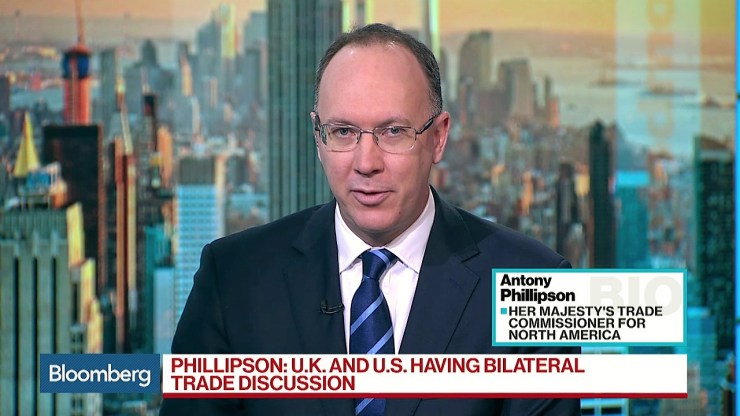
Antony Phillipson, HM Trade Commissioner for North America on Bloomberg TV.

The EU Relationship: After Brexit
Overcoming significant obstacles in the postwar era, continental Europe has grown into one of the world’s most developed and successful grouping of nations in every possible category.
From conflicted littoral states pre-1945, to a unified trading bloc in 1972 (the EC) to a full customs and trade union in 1993 (the EU) and with several future member states lined-up to join, the modern European Union continues to morph into all that it can and should be.
From its rich history, to its culture and its support for the rule of law, and by placing a high priority on governmental and non-governmental institutions, EU countries have set a global standard in the architecture of governance.
Yet, it isn’t for everyone. Greenland left the bloc in 2009, followed by Switzerland in 2014 which withdrew its application to become an EU member. The Swiss are like that anyway. Very Independent People!
The Swiss remain members of the EFTA, which is simply a group of four like-minded European nations who’ve agreed to streamlined trading arrangements. The EFTA serves to improve trade flows between its members.
Norway, for example (an EFTA member) chose to not join the EU, but participates in many European Union institutions on an al a carte basis, although it must pay a higher price than EU members to have the option to join or not join certain EU institutions and frameworks.
And finally, the UK voted to leave the European Union in the June 2016 referendum, but the Brits joined to leave anyway, it was just a matter of time before they left.
Even with those disappointments (as seen from the EU side) the European Union is still a stunning success with every opportunity to double its standing in the world. Viel Respekt!
Taking the High Road with the EU in the Post-Brexit Timeframe
As good as the European Union is for its continental partners, it just doesn’t work as well for the UK and its Commonwealth partners, which has resulted in the inevitable Brexit vote and all the subsequent steps the UK government has taken towards Brexiting the European Union.
Of course, the EU people may feel some hurt feelings when a country wants to leave its bloc — nobody likes a one-sided divorce. But there soon exists the possibility of creating a new and better relationship between the UK and the EU. And there is plenty of room to improve on that count.
For some, getting Brexit out-of-the-way is merely a necessary step towards getting on to the super-important work of creating the all-time best possible relationship between the UK and the European Union.
The potential for increased trade between the two blocs, for additional mutual aid in addition to their respective NATO commitments, for multi-lateral support at the UN (for example) and to have two powerful European voices registering their positions in the world media instead of one, are just the beginnings of helping the two main European blocs hold even more sway in international affairs.
Yes, the EU can seem a little bureaucratic and autocratic, but they are dedicated to creating a peaceful world order within a standardized regulatory environment centred around global trade. Unless you just arrived from Mars, you’ve got to like that.
For its part, the UK can seem a little disorganized and even frantic at times, but forced to become all it can and should be via the Brexit change-up, it should emerge as a calmer and more mature country that happens to be attached to a large Commonwealth bloc of 2.5 billion citizens.
If managed properly, Brexit will move the UK and the EU relationship one order of magnitude forward — instead of the present situation where the EU is holding the UK back from fulfilling its best destiny and the United Kingdom appears as a thorn in the side of continental European plans.
Time for the UK and the EU to Write Their ‘Best Possible Relationship’ List
Yes, let’s get Brexit over and done with as soon as possible so we can get onto the far more important work of deciding how to maximize European clout in the world and then working together within a permanent pan-European institution set-up for that purpose, figure out how to best work together for mutual economic benefit, and how best to share the overwhelming number of obligations that are owed by developed nations to developing nations.
Things evolve over time. But just because they evolve, doesn’t mean that those things are the best they can be. It simply means that evolution has occurred.
For example, no modern city planner would’ve located Athens where it is now. It’s impossible to defend militarily (in our modern era) it suffers from lack of rainfall+water shortages, it’s hellishly hot in the summer, and it sits atop a major earthquake fault system. Yet, the city evolved and both its residents and the city government have made the best of it.
But it would have been far better for everyone if Athens had been located near the cities of Ioannina or Arta in Greece, where the city of Athens could’ve prospered a 100-times more than it has in its present location.
Likewise, now is the time to draw up what could’ve been all along and work towards what it still could be with the right vision, leadership, and management.
Rather than a splintering Europe that is getting weaker and less goal-directed as time rolls forward, Brexit offers the opportunity to make Europe work better for all its citizens and to strengthen the pan-European worldview — starting with a clean sheet that allows the UK, the EU, Switzerland, Norway and Greenland to succeed as never before!
 Letter to Britain