Home » European Union (Page 10)
Category Archives: European Union

How a Pipeline From Iran to Syria Could Bring Peace
It’s no surprise the wheels are coming off in Syria, and in the absence of an agreement between the various parties regarding Syria at the upcoming Munich Security Conference, things are certain to deteriorate further and at an increased pace.
Therefore, the pressure is on all sides to arrive at a solution to prevent further bloodshed among the civilian population in Syria and to prevent an escalation between the various military groups operating in the region.
Good Intentions Gone Awry
There was at one time, a completely plausible plan for the region that has gone off the rails — not because any side opposed it — but because there was no oversight to bring the plan to fruition.
In between President Obama’s ‘Pivot to Asia’, the Arab Spring, and the U.S. elections that brought Donald Trump to the White House, the Syrian situation was left unguided and (no surprise!) it therefore deteriorated.
Major powers are now bombing each other’s troops and shooting down each other’s aircraft (and who knows what else is going on that isn’t reported) which makes escalation a foregone conclusion in the absence of leadership and implementation of the original plan.
The Forgotten Plan
Prior to the Syrian conflict the plan for the region was to bring Iranian #2 (sweet) crude oil and Iraqi #3 (semi-sweet) crude oil via a proposed pipeline across the northern part of those countries and across very northern Syria to the Mediterranean for export to Europe, Turkey, and Israel.
Not only would Iranian and Iraqi crude oil be transported by the proposed pipeline, pumping stations along the route would allow Syrian #3 (semi-sweet) crude to be carried by the new pipeline.
Iran’s #2 sweet is highly prized by refineries around the world because it requires much less refining than sour crude oil and it allows a relaxed maintenance schedule for refineries so they can operate continuously for many years before requiring a mandatory and hugely expensive maintenance protocol.
For example, Iran’s #2 sweet oil can be used to blend very sour oil (such as Canadian tar sands oil which is rated at #4.75 sour) to bring it up to a standard where it is acceptable to an oil refinery.
Further on the Canadian example which is very roughly comparable to the problem facing other refineries around the world, Canadian refineries presently purchase huge volumes of Saudi #3 semi-sweet in order to blend with Canada’s toxic #4.75 oil — but access to Iranian sweet would allow Canadian companies to meet refinery standards with much less foreign oil.
In rough terms, a certain refinery in eastern Canada receives one Saudi supertanker per week to blend with Canadian tar sands oil — otherwise the refinery would never agree to process that sour Canadian oil — but if they switched up from Saudi #3 semi-sweet to Iranian #2 sweet it would allow that same refinery to purchase only one supertanker per month to blend with the sour Canadian oil.
It would be a win for Canadian oil producers, a win for the refinery, and a win for consumers as purchasing fewer (expensive) foreign tanker loads leads to lower prices at the gas pump.
The situation is only slightly different in the United States.
Texas still has a small production of #3 sweet crude, while Pennsylvania (where the modern oil business began) has none left whatsoever. Refineries in Texas have for decades gladly accepted #3 Saudi semi-sweet to blend with their #4 sour so they can blend it to meet their target of #3.25 semi-sweet before it hits the refinery — thereby saving the refinery millions of maintenance dollars per year and saving American consumers money at the gas pump.
Even refineries in Europe and Russia benefit from blending sweet or semi-sweet with their oil allowing them to bring their most sour crude to a standard that is acceptable to refineries. Otherwise, all that sour crude would be left in the ground forever.
Enter ISIS and the Kurds
Prior to the Arab Spring, few had heard of the Kurds other than seeing 30-second video clips of their troops helping coalition forces during the Iraq War, and even fewer knew about ISIS.
Buoyed by their participation with the Americans during the Iraq War, the Kurds were also recipients of generous non-American foreign aid. The Kurds (who have some negative ‘history’ with Turkey) decided the proposed pipeline route should be ‘protected’ by their troops as the security situation in northern Iraq was then at an all-time low.
It’s completely logical from their perspective to want to secure those areas and make them part of their traditional Kurdish territory, and this was seen as a ‘minor good’ by Washington and its allies. No doubt the Kurds would have been recipients of even more foreign aid, many pipeline jobs, and they would have been in charge of security along the part of the proposed pipeline corridor that would run through their territory.
ISIS saw the opportunity to steal the default option from the Kurds and fired the first shot.
Hence we now have Americans fighting ISIS and sometimes using the Kurds to do it. We have Turkey and the Kurds fighting each other. We have the Russians helping Syria. And we have various other countries supporting those or other groups operating in the region. Finally, we have the long-term and largely stalemated situation that exists between Israel and Syria.
A recipe for disaster, if ever there were one.
Vision, Leadership and Management – the Only Solution to This Problem
Instead of a Munich Security Conference that degenerates into shouting match, all sides should return to the forgotten plan and concentrate on making that plan the new reality.
Bringing Iranian sweet crude oil, Iraqi semi-sweet crude oil and Syrian semi-sweet to the Mediterranean via a new pipeline system through traditional and newly created Kurdish territories across northern Iraq and very northern Syria while continuing to finish off ISIS and working to mitigate Turkish concerns about the Kurds is the only real way forward.

Internationally recognized Kurdish territories span northern Iraq and northern Syria which could allow a direct Iran, Iraq, Syrian oil pipeline to the Mediterranean to bring high quality Iranian #2 sweet crude oil to Europe, Turkey, Israel and even to North America. Image courtesy of Iran Review.
Whether the parties agree to redirect their energies now, or at a later date, it’s the only option that solves everyone’s problems in the region.
The plan depends on the extinction of ISIS and that seems as worthy a goal as ever while accommodating the Kurds is simply an extension of what’s already been happening.
Solving the security concerns of Turkey is paramount to bring the plan forward.
The world needs that high quality oil and it’s in the interest of the parties to get that pipeline system built and operational as soon as possible.
The UK government can play as honorable a part as any country to bring this ongoing political disaster to a successful conclusion by promoting the Iran / northern Iraq / northern Syria pipeline that would span old and newly created Kurdish territory to bring exceptionally high quality oil to Europe, Turkey, Israel and even North America.
It’s time to stop looking at the problem and begin working on the solution.
‘No-Deal’ Brexit scenario would cost both UK and EU billions
A new report by a prestigious polling firm says that a so-called ‘No-Deal’ WTO-style Brexit will cost one EU country €5.5 billion over the next two years, as opposed to a Brexit with a trade agreement where losses for that country would likely total €1.5 billion over the next two years.
That country is the Republic of Ireland.
“A hard Brexit could cost the Irish economy more than €5.5 billion over the next two years, a government-commissioned report has said.
A “soft” Brexit including a transition arrangement would cost less than €1.5 billion over the period, highlighting the importance to Ireland of the UK’s withdrawal talks with the EU.
The study by Copenhagen Economics, which examined four possible scenarios, also warns that the UK will probably take at least five years to implement new trade agreements, complicating Irish efforts at contingency planning.
[Ireland’s ‘Taoiseach’ which is the official title of the Irish Prime Minister] Leo Varadkar said last night that a comprehensive free-trade deal with the UK would be the best way to avoid a hard border. After a meeting with Theresa May, the UK prime minister, he said: “We both prefer [the option] by which we can avoid a hard border in Ireland, and that is through a comprehensive free trade and customs arrangement.
“That is the best way we can avoid any new barriers — north and south, and also east and west.”” — The Times
Other EU Nations Would Take a Hit in the ‘No-Deal’ Scenario
We can extrapolate that other EU countries would also take an economic hit in a ‘No-Deal’ scenario, but due to their much larger economies when compared to Ireland, such losses would amount to tens or even hundreds of billions over the same two-year period. Just think of all those German cars that wouldn’t be sold in the UK due to the higher tariffs that would automatically be imposed on EU countries in a ‘No-Deal’ Brexit!
Almost every country in the world uses WTO rules as the foundation of their trading relationship with other countries (but important to note) those same countries also diligently pursue bilateral trade deals with their important trading partners that allow both sides to legally sidestep the more costly WTO tariff ruleset in favour of something that works better for both partners. (And that trading relationship/tariff structure can be anything the two sides want in regards to any trade that happens between them)
So if country A and country B decide they want to trade, they’re completely free to build a better tariff structure than the comparatively expensive WTO ruleset, and that agreement will thenceforth supercede the WTO tariff structure. However, it only applies on trade between those two countries — the rest of their trade with the world would still be conducted under the auspices of the WTO.
It’s a pretty basic thing. Countries that do anything more than a smattering of trade between them negotiate bilateral free trade agreements to bypass the more onerous WTO trade rules and tariff regime.
There’s Still Time to Negotiate a Trade Deal with the EU
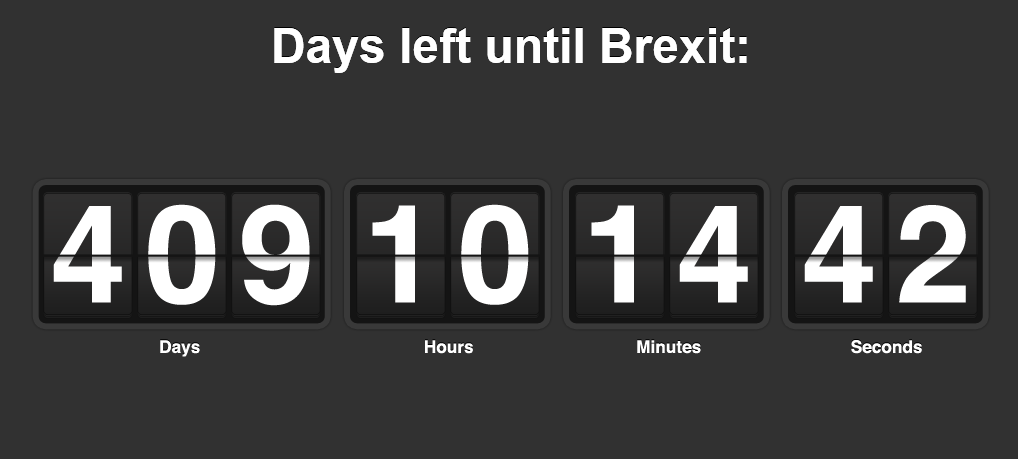
How many days until Brexit? Image courtesy of HowManyDaysStill.com
As of this writing there are 409 days remaining until Brexit and either we will have a trade agreement with the EU, or we won’t. If not, it will be costly for both sides, but more costly for the EU by one order of magnitude!
However, saying that there are 409 days remaining ’til Brexit — isn’t the same as saying there are 409 days left to negotiate a free trade agreement. Far from it!
The two sides have 258 days to arrange a free trade agreement. Let’s hope our politicians (and theirs) are up to the job (and if not, why are we paying them?) otherwise almost everything that citizens and businesses purchase will become much more expensive on both sides of the English Channel in the post-Brexit timeframe.
UK Prime Minister Theresa May has stressed that October 29, 2018 is the last date that both sides can agree a trade and customs deal before the UK must begin readying for the implementation of WTO trade rules. And on that point both sides agree. Even six months (during the period from October 29, 2018 to March 29, 2019) would barely suffice to put in place the necessary measures and standards to allow industry to prepare for life after Brexit.
UK and EU voters should remember who did, and who didn’t, get a free trade agreement signed when they head to the polling booth at the next election.
Related Articles:
- Day 548: Pass the Eggnog and Where Are We on Brexit?
- Theresa May + Customs Union = Conservative Coup?
- Theresa May’s New Year of Hope
- Brexit: An Opportunity to Create a Better UK / EU Relationship?
- UK Prime Minister Cuts a Deal With the EU
- Should the UK’s Theresa May Consider a 2nd Brexit Referendum?
- Irish border remains biggest barrier to orderly withdrawal from the EU

Theresa May’s New Year of Hope
As far as years go, UK Prime Minister Theresa May must be glad to see the end of 2017 as are many others in Britain and around the world. In matters Brexit, it was a year of low-level chaos and unfulfilled expectations — lots of ‘churn’ but not much actual progress.
Yet the Prime Minister did make some exceptional speeches and unexpectedly reached-out to EU citizens to assure them that while Britain was leaving the European Union, it wasn’t leaving Europe. Well done on both counts, Theresa.
She also told EU citizens living in the UK that their situation wouldn’t change, aside from having to register their residency with the Home Office and pay a nominal fee to retain their ‘settled status’. And while that didn’t seem to impress small numbers of EU negotiators, it brought great comfort to millions of expats living in Britain.
Of course, it’s all contingent upon reaching a final ‘Withdrawal Agreement’ between the United Kingdom and the European Union, but it’s not too much of a stretch to suggest that the UK would act unilaterally to guarantee the rights of EU citizens working or studying in Britain in the case of no agreement.
Theresa May also offered £40 billion of UK taxpayer money to the European Union; Everyone is unclear what this is for, as nobody from the government has bothered to explain it to citizens.
Many people think that the UK’s share in the EU Parliament buildings and in other EU properties and assets should be sold off to the other EU27 members and the £9.65 billion (estimated) value could be used to pay future UK liabilities to the EU and that there is no need to pay £40 billion. Which seems reasonable.
If there is an actual need for the UK to pay £40 billion to the EU, surely British taxpayers have the right to know what they’re paying for, and to whom.
But if Theresa May has agreed to continue paying the £8.6 billion annual net payment to the European Union until Brexit completes within 2 years (approximately) plus 2 more years to cover the transition period, then that seems pretty reasonable too. If that’s how the £40 billion is being arrived at, there’s not much to complain about there.
With all this reasonableness going ’round it’s no wonder that EU negotiators agreed to move to Phase II of the Brexit negotiations — trade — a hyper-important part of the post-Brexit relationship on both sides of the English Channel.
Negotiating a mutually beneficial trade agreement between the UK and the EU in 2018 is Job Number One for negotiators on both sides.
Trade between the United Kingdom and the EU27 ranks as one of the most robust trading relationships in the world
- 44% of UK exports are sold to the EU27, making them Britain’s most important trade partner.
- 16% of EU exports are sold to the UK, making Britain the EU27’s most important trade partner.
Which makes the whole ‘getting an agreement’ discussion largely academic — as there will be an agreement or hundreds CEO’s on both sides of the English Channel will be breathing fire down the necks of UK and EU negotiators every day until an agreement is reached. “Don’t even think about coming home without an agreement!” (Yes, just like that)
UK/EU Trade: Where do United Kingdom Exports Go?

UK/EU Trade: Where do European Union Exports Go?


Everything you want to know about the UK trade with the EU. Image courtesy of FullFact.org and the ONS.
So There We Have It: They Can’t Live With Each Other, But They Can’t Live Without Each Other!
Which is a very good thing.
And because companies on both sides need to keep their biggest export market open and flourishing, there absolutely will be a reasonable trade deal — one that both sides can live with. There is simply no alternative.
Which neatly explains the title of this blog post ‘Theresa May’s New Year of Hope’ because Job Number One for Brexit negotiators on both sides must be working a successful trade deal — and every CEO in Europe will be watching with keen interest, to put it very mildly.
You don’t want to be the trade negotiator coming home without a deal and having to tell the CEO of Volkswagen or BP that you were too incompetent to get a deal. Yikes!
There will be an excellent UK/EU trade deal in 2018, a trade accord that both sides will be rightly proud of — one that works for CEO’s, citizens and governments throughout Europe.
Trade As Saviour
As the focus will be on trade in 2018 (something that both sides must preserve if today’s politicians want to keep their jobs) the new year looks to be one of the better years for relations between the UK and the EU27.
Let’s hope that Phase II of the Brexit negotiations move smartly along and that (if a Phase III is required) the momentum that gets built throughout 2018 works to facilitate friendly and workable solutions to any remaining issues between the two blocs.
Politicians and negotiators on both sides of the Brexit divide have everything to gain by bringing home a fair and workable trading agreement and everything to lose if they don’t.
Therefore, let 2018 be ‘The Year of Hope’ as 512 million European citizens are counting on their politicians and negotiators to open windows of opportunity as big as the sky, and to create even more justice and fairness for all Europeans, no matter where in Europe they may live, work, or play.
No matter which side of Brexit you’re on, we at Letter to Britain wish you a Happy, Safe, and Prosperous New Year!
 Letter to Britain