Home » British Trade Policy (Page 4)
Category Archives: British Trade Policy

Brexit: The Trigger for a New Atlantic Alliance
by John Brian Shannon | October 4, 2016
Britain, more than any other Atlantic Ocean nation, would benefit from an Atlantic Alliance free trade zone precisely because it is an island nation, and as such it depends on free trade and movement of goods in order to thrive to it’s full potential.
Since the Roman era Britain has enjoyed a historic presence in the Atlantic Ocean for good reason — island nations need regional trade to survive and international trade to thrive.
For Britain, there is no way forward without enhanced international trade. In principle, islands should always be the strongest proponents of international trade and international law for the very reason that they profoundly need the world to function that way.
Japan set a wonderful example for all island nations in the postwar era, but never moreso since the Arab Oil Embargo of 1973 when U.S. consumers suddenly decided to switch their gas-guzzler cars for lower priced and more fuel efficient Japanese cars.
Not only were millions of cars imported from Japan over the following years, but because the necessary technology to build cars was transferable to home and personal electronics, Japan received a double boost to it’s economy every day since the Arab Oil Embargo.
From one of the worst performing economies in the world in 1946 to it’s peak as the #2 global economy in the 1990’s — the Japanese economic miracle rode its high quality manufacturing base that catered to the needs of billions of consumers. By any standard it remains an impressive accomplishment.
And now it’s Britain’s turn to shine as the world’s next booming economy.
Although much has changed since the oil supply shocks of 1973, the world economy continues to grow, with developing nation consumers seeing comparatively massive increases in their disposable income, presenting a wonderful opportunity for a Britain suddenly freed from an overly bureaucratic political union.
Therefore, let us count the ways that an Atlantic Ocean trading alliance (a free trade zone, that I propose be restricted to nations that front the Atlantic Ocean) could benefit Britain and the other Atlantic nations.
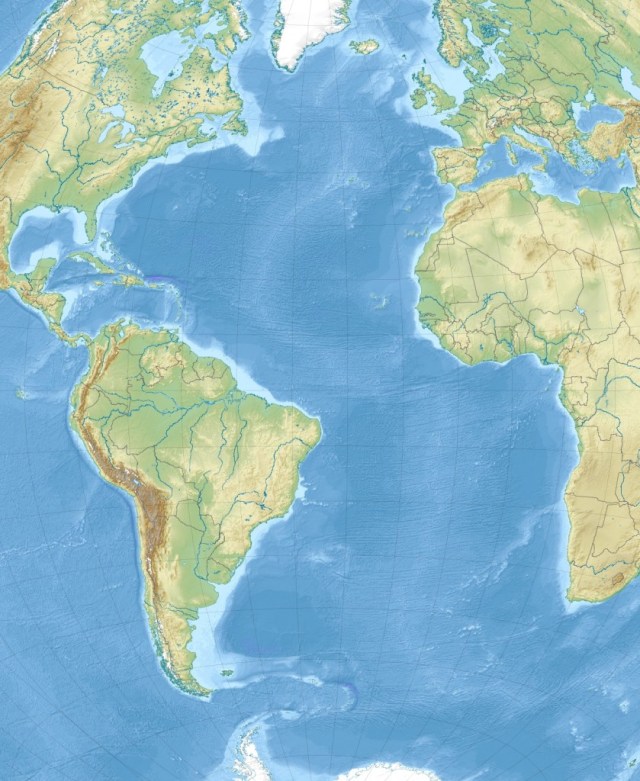
Britain, more than any other Atlantic Ocean nation, would benefit from an Atlantic Alliance free trade zone precisely because it is an island. Atlantic Ocean map. Image courtesy of Geography.name
In the North Atlantic, we have the United States, Canada, Greenland, Iceland, Ireland, the United Kingdom, Norway, France, Spain and Portugal.
In Africa; Morocco, Western Sahara, Mauritania, Senegal, Gambia, Guinea-Bissau, Sierra Leone, Liberia, Côte d’Ivoire, Ghana, Togo, Benin, Nigeria, Cameroon, Equatorial Guinea, São Tomé and Príncipe, Gabon, Central African Republic, Democratic Republic of the Congo, Angola, Namibia, and South Africa, front the Atlantic Ocean.
And in South America, we have the South Atlantic nations of Argentina, Uruguay, and Brazil fronting directly onto the Atlantic Ocean — while French Guiana, Suriname, Guyana, Venezuela, Columbia, Panama, Honduras, Nicaragua, Belize, and Mexico and many island nations reside within the Caribbean Sea — which is of course, easily navigable to the open Atlantic Ocean.
All of these nations should receive a warm invitation to join such a trading block.
It is perhaps the best matchup of nations since the Bretton Woods Agreement of 1944. In the list of Atlantic and Caribbean nations, exist the most developed nations to the least developed, from the most overbuilt tourist locations to vastly underbuilt tourism markets, to the astonishing per capita petroleum and mineral resource base. Such opportunity abounds for those who pursue economic interdependence between Atlantic nations! From the most highly skilled labour to the cheapest labour, and among the highest cost real estate to the cheapest agricultural land in the world, everything that a developed or still developing nation needs can be easily found within this trading area.
The economic opportunities are uncountable, and they are sitting there untapped. At the moment, it’s a criminal waste of opportunity that must rank as a negative for every Atlantic nation whether developed or developing.
The obvious move here is for British Prime Minister Theresa May to voice strong support for an Atlantic free trade zone, contacting representatives of each country to find out what Britain offers, that can mesh with the needs of each Atlantic Alliance trading partner. And vice-versa.
Once some activity generates and some new trade begins to take shape, it would be wise to meet regularly to discuss standardization of regulations, whether shipping or other modes of transportation, financial, tourism, and other ways to work together. Even the baby-steps of working together to protect maritime shipping from at-sea piracy, or to form mutual aid groups designed to streamline hurricane or other natural disaster relief would demonstrate ways that Atlantic nations can work together for mutual benefit.
If the NAFTA model is used as the trading template, some of it’s terms could be adjusted to better suit the preferences of all Atlantic Alliance members, or it could be seen as the eventual goal for all members to reach at some point. At the very least it could be used as a reference point, a place to begin discussions.
By leading such an effort Britain would be well-placed — not to own the Alliance — but to offer it’s expertise and experience, so that the end result is a Win-Win for every nation involved. That is what makes for strong partnerships, and strong partnerships always make economic sense.
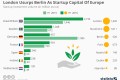
London Usurps Berlin As Startup Capital Of Europe
“Berlin has long been jewel in the crown of Europe’s startup scene. Startup investment has flowed into the German capital for years but according to research from Ernst & Young, other European cities are providing it with stiff competition.
Berlin saw a huge year on year decrease in startup investment volume from H1 2015 to H1 2016 to see its crown slip as startup capital of Europe.
In its place is now London, with 1,320 million euros of investment in the latest half year – an increase of 289 million over the same period in 2015.” — Niall McCarthy (Statista)

You will find more statistics at Statista
Related Article:

Brexit: The Path to UK Sovereignty
by John Brian Shannon | August 26 2016

As the UK government gears up to deal with the will of voters, four paths to trade in Europe appear that merit consideration
- EEA membership
- EFTA membership
- WTO rule-based membership, sans EEA or EFTA
- Negotiated trade deals that are none of the above
EEA membership would qualify Britain to trade with other EEA member nations, all of which are located in Europe, but not all are members of the European Union.
From the EEA website:
The EEA Agreement provides for the inclusion of EU legislation covering the four freedoms — the free movement of goods, services, persons and capital — throughout the 31 EEA States. In addition, the Agreement covers cooperation in other important areas such as research and development, education, social policy, the environment, consumer protection, tourism and culture, collectively known as “flanking and horizontal” policies. The Agreement guarantees equal rights and obligations within the Internal Market for citizens and economic operators in the EEA.
What is the EEA Not?
The EEA Agreement does not cover the following EU policies:
- Common Agriculture and Fisheries Policies (although the Agreement contains provisions on various aspects of trade in agricultural and fish products);
- Customs Union;
- Common Trade Policy;
- Common Foreign and Security Policy;
- Justice and Home Affairs (even though the EFTA countries are part of the Schengen area); or
- Monetary Union (EMU).
The Agreement on the European Economic Area, which entered into force on 1 January 1994, brings together the EU Member States and the three EEA EFTA States — Iceland, Liechtenstein and Norway — in a single market, referred to as the “Internal Market”.
Switzerland is not part of the EEA Agreement, but has a bilateral agreement with the EU. You can read more about this agreement on the European Commission website, and on the Swiss Federal Administration website.
EFTA membership governs free trade relations between EFTA States, which in 2016 are Iceland, Liechtenstein, Norway and Switzerland. Britain was a founding member of the EFTA in 1960 until 1973 when it joined the EC. It would need to apply to the EFTA in order to become a member.
From the EFTA website:
The European Free Trade Association (EFTA) is an intergovernmental organisation set up for the promotion of free trade and economic integration to the benefit of its four Member States.
The Association is responsible for the management of:
- The EFTA Convention, which forms the legal basis of the organisation and governs free trade relations between the EFTA States;
- EFTA’s worldwide network of free trade and partnership agreements; and
- The European Economic Area (EEA) Agreement, which enables three of the four EFTA Member States (Iceland, Liechtenstein and Norway) to participate in the EU’s Internal Market.
EFTA was founded in 1960 on the premise of free trade as a means of achieving growth and prosperity amongst its Member States as well as promoting closer economic cooperation between the Western European countries. Furthermore, the EFTA countries wished to contribute to the expansion of trade globally.
Based on these overall goals, EFTA today maintains the management of the EFTA Convention (intra-EFTA trade), the EEA Agreement (EFTA-EU relations), and the EFTA Free Trade Agreements (third country relations). The EFTA Convention and EFTA free trade agreements are managed by the Geneva office, and the EEA Agreement by the Brussels office.
EFTA was founded by the Stockholm Convention in 1960. The immediate aim of the Association was to provide a framework for the liberalisation of trade in goods amongst its Member States. At the same time, EFTA was established as an economic counterbalance to the more politically driven European Economic Community (EEC). Relations with the EEC, later the European Community (EC) and the European Union (EU), have been at the core of EFTA activities from the beginning. In the 1970s, the EFTA States concluded free trade agreements with the EC; in 1994 the EEA Agreement entered into force. Since the beginning of the 1990s, EFTA has actively pursued trade relations with third countries in and beyond Europe. The first partners were the Central and Eastern European countries, followed by the countries in the Mediterranean area. In recent years, EFTA’s network of free trade agreements has reached across the Atlantic as well as into Asia.
EFTA was founded by the following seven countries: Austria, Denmark, Norway, Portugal, Sweden, Switzerland and the United Kingdom. Finland joined in 1961, Iceland in 1970 and Liechtenstein in 1991. In 1973, the United Kingdom and Denmark left EFTA to join the EC. They were followed by Portugal in 1986 and by Austria, Finland and Sweden in 1995. Today the EFTA Member States are Iceland, Liechtenstein, Norway and Switzerland.
World Trade Organization (WTO) membership is perhaps the easiest way forward as Britain (and virtually all nations) are already members and the WTO is merely a standardized set of rules that govern trade between nations.
The present ruleset governing UK trade is the EU ruleset, meaning that who the UK trades with, tariff rates, and other rules and conditions have been decided by 28 EU nations — and not always in the interests of the UK — but in the combined interest of 504 million EU citizens.
The main thrust of this means that WTO rules would continue and that the UK would not be allowed to charge higher tariffs on EU-sourced imports, than what the EU charges on UK imports into the EU. Although the UK could certainly decide to charge lower tariffs than the EU charges. That could be a significant benefit for some UK industries.
There are other benefits to WTO membership. And as most nations are WTO members anyway, the ruleset is well-understood around the world.
In February 2014, the Swiss voted in a referendum to no longer pursue EU membership and left the bloc. The government of Switzerland has therefore negotiated a series of bilateral trade agreements with the European Union AND is a member of the EFTA, but not the EEA.
Of course, WTO rules still apply — unless both parties agree to abrogate or change some of the WTO rulesets.
Keep in mind that both the EFTA and EEA are European trading area agreements and don’t apply anywhere else in the world, while the WTO applies everywhere.
Therefore, non-EU trade will be largely governed by WTO rules (as is the case with most countries) while Britain’s trade with the EU could take several different paths.
Any combination of WTO, EFTA, or EEA, or bilateral agreements that supercede WTO rulesets could be negotiated between Britain and the EU.
At the end of it all, why did 17 million+ voters choose to Brexit?
Two main themes appeared to gain considerable traction during the campaign.
One, the democratic deficit in Brussels, and two, the wholly unregulated movement of people from eastern Europe and the Middle East/Levant and a complete breakdown of the Schengen Area border control system.
Brexit effectively solves the democratic deficit problem in Brussels by returning governance to the House of Commons and the House of Lords. While the mass migration problem is solved as Brexit returns sovereignty of Britain’s borders to the UK government.
The revised EFTA convention (the Vaduz Convention) extends beyond free trade in goods, and includes provisions on free trade in services and the free movement of capital and of persons. None of these should be problematical to the UK given that the Vaduz Convention only applies between its members and so would not act as a gateway for the free movement of persons from the r-EU or elsewhere. All four EFTA states have standards of living comparable to or even higher than the UK so do not present any mass migration risk. — Brexit and International Trade Treaties, The European Free Trade Association (EFTA)
Recommended Read Brexit and International Trade Treaties by Lawyers for Britain
None of this can occur until Article 50 is triggered and a 24 month clock begins ticking to end Britain’s membership in the European Union.
It would be quite wonderful if Prime Minister Theresa May would hold a press conference every six months to inform Britons of the various areas of progress and ongoing obstructions until the Brexit process is complete — a process that could take as long as 5-10 years from the June 23, 2016 start date.
We are in uncharted waters and Britons are excited to be getting their country back. They know it’s going to take time, resolve, and they know full well that there will be difficulties along the path to restoring Britain’s full sovereignty. But the payoff in 5-10 years will be brilliant.
Whatever Britain is now, it’s only going to get better.
 Letter to Britain