Home » British Foreign Policy (Page 2)
Category Archives: British Foreign Policy

The UK’s False Narrative on Hong Kong’s Protest Movement
Way back in the Colonial Era… it seemed a fine thing that a tiny cohort of middle-aged white men born in the United Kingdom could determine the fate of millions of people around the world… and the UK had plenty to offer the world at the time, bringing unheard-of mechanization to countries trying to improve the lives of their respective citizens. So it wasn’t all bad. But…
NEWSFLASH! Those days are over. The Royal Navy no longer rules the waves and the United Kingdom no longer consists of an Empire upon which the Sun never sets. And in no way should UK politicians be trying to roll the clock backward by empowering those who aren’t happy the world has changed.
Some History
In 1997, the UK government signed an agreement to return Hong Kong to China by the year 2000 — an agreement signed in good faith by both parties. And now that a small number of UK politicians, a tiny number of U.S. citizens (by the way, the U.S. was never a signatory of the treaty that returned Hong Kong to China) and several hundred thousand professional protesters from Hong Kong have decided they don’t like the deal, they think they have the right to overturn that good faith agreement.
Well, that just doesn’t cut it. So-called ‘seller’s remorse’ doesn’t present sufficient excuse to overturn a bilateral treaty signed between the UK and China. And that’s that. There’s no ambiguity in the treaty, therefore, there’s no room for debate, nor can there by any justification for failing to adhere to the terms and spirit of the treaty.
If you don’t like it that’s just too bad. Life isn’t fair and nobody ever said it was. So suck it up, people. An international treaty was signed in good faith — and both sides will keep their end of the bargain or chaos will ensue — as has been the case since time began. Check your Grade 12 history textbooks kids, because all the wars ever fought occurred because one side or the other didn’t adhere to the terms of an international treaty signed in good faith.
Thinking of Bringing Your HK Protest Movement to the UK?
Although I’m a supporter of Boris Johnson and his government, offering to host millions of Hong Kong residents in the United Kingdom wouldn’t be my first choice. It may be popular with certain American neocons specifically and China-haters around the world generally, it certainly isn’t the best thing for the average British citizen, the UK economy, future UK trade prospects in Asia, or for Britain’s reputation in the world as a country that abides by both the letter and spirit of international agreements.
Somebody should ask Nigel Farage what he thinks about the UK government offering UK citizenship to millions of Hong Kong protestors so they can simply relocate their violent protests to London. Stand well back, because you’re likely to receive a robust answer.
Not only Nigel Farage, of course. Millions of Britons might not want thousands of Hong Kong residents to suddenly appear in the UK, be granted UK citizenship, and be found protesting (perhaps violently) on behalf of HK issues every weekend in London, Brighton, Manchester or Glasgow.
Something to think about.

Should the UK Have an Opinion on Catalonia?
As the UK remains a fully paid-up member of the 28-member European Union, it seems fair that the government should have a position on Catalonia’s recent move toward greater autonomy. Which in recent weeks, has grown beyond simple autonomy within the Spanish federal government architecture to seeking full independence, but the attempt has since been knocked down by the Spanish authorities.
Had the UK passed the Brexit threshold by now, it would be difficult indeed for the British government to have any public opinion at all as it then becomes a very different thing. It’s fair comment to opine on the internal politics of a fellow EU member state, but it is quite another for a non-member to criticize the goings-on in a foreign country.
For that reason, it’s well within Theresa May’s purview as the Prime Minister of a paid-up member of the European Union to comment on issues Catalonia.
Nigel Farage MEP certainly didn’t hold back from informing his viewers about his opinions on the Catalonian situation and it’s difficult to find flaws in his argument.
Certainly, it was a tragedy that 900 mainly peaceful protesters were injured and/or arrested by Spanish federal police, although many of those charges against protesters may be dropped in exchange for the much more serious charges against the police being dropped. Look for this to happen on a case-by-case basis. Many of the police are reputed to have used excessive force against the (probably annoying, but otherwise peaceful) protesters.
Until such times as Britain is no longer an EU member state, the UK and its citizens have every right to comment on the unfortunate Catalonian situation, but after Brexit I hope the government feels constrained about commenting on what will then be, a comment on the internal affairs of a sovereign bloc (the EU) a sovereign nation within the EU (Spain) and a state within that nation (Catalonia)
“What Goes Around, Comes Around”
This has been true since the universe began and were the British government to attempt to unduly affect the outcome (either way) in Catalonia, eventually it could work against the United Kingdom and conceivably against the Commonwealth, as there are rumours from time to time about disaffection among jurisdictions of either entity.
Therefore, it’s best for the UK government to comment in good form only and avoid trying to make political hay against the EU bloc simply because we may have other frustrations with them. (Hey, they’re frustrated too. It isn’t a one-way street. Let’s just get the Brexit done and not unduly antagonize the EU Parliament or its individual member states in the meantime, because that works better for the UK in the long run)
As a Member of the European Parliament and as a citizen of the United Kingdom, Nigel Farage has much more leeway to comment than the government, and his recent talk show brings up some fascinating points about Catalonia. Take a few minutes and watch Nigel take calls from all over the world about the attempted Catalonian secession.

Instead of fighting for market share, it’s time to grow the global market!

A sea-change is upon the United Kingdom whether some have come to that full realization or not
The relationship between the UK and the rest of the world is beginning to change as the UK exits the European Union. Not only that, but the relationship between the UK and the other Commonwealth countries is changing. And while all of that is occurring, it is also a time of change in the postwar international order.
These changes are coming and we have no ability to stop them. What we do have though, is the ability to choose whether these changes are ultimately negative or positive for Britain.
The days of ‘Win-Lose’ politics are over
When every second country (seemingly) has WMD weapons, suddenly Win-Lose doesn’t work anymore. Do we really want to solve every issue between nations with nuclear weapons? Because eventually, that’s what it will come to.
It’s great if you ‘Win’. But then you ‘Lose’ because the fallout from large nuclear explosions travel around the Earth a few times per season and nuclear particles continue to exist in the environment for decades (some isotopes linger for 20,000 years) and as everyone needs to breathe the air, eventually you will inhale and, well, (do I really have to tell you this?) your lungs will filter the radioactive isotopes out of the air.
The ‘Winners’ of a WMD conflict will also become ‘Losers’ of that conflict within months. It’s nonsensical to consider nuclear war in the 21st-century.
All of which means, that in the final analysis, international hot points must henceforth be solved by the cool hand of diplomacy.
The days of fighting for Market Share are over
More than any other country, fighting for market share no longer makes economic sense for the UK, because every other country/corporation is likewise fighting for market share.
Larger countries with serious export expertise and fully developed and long-term foreign client relationships have a distinct advantage over a born-again United Kingdom re-entering the exporting world. Fighting for market share against far superior marketing superpowers like Germany and China is like paddling upriver in a hurricane, and good luck with that.
Rather than fighting for Britain’s slice of the pie, the UK should be the one country in the world that works to make the pie bigger for everyone! wherever free markets exist.
In that way, whatever global growth occurs will benefit all exporters equally — including Britain’s born-again export economy, because the UK will have as good a chance as any to capture some of that growing pie — as opposed to fighting companies well entrenched in foreign markets and trying to steal tiny percentages of their total market share. See the difference?
“Don’t fight a battle if you don’t gain anything by winning.” — Erwin Rommel
Rommel was right. And to adapt his truth to Britain’s new place in the world, fighting for market share in countries that are already well-served by European and Chinese exporters will gain British exporters very little and could create trade frictions between Britain and the European Union which is still the UK’s largest trading partner in the 21st-century. We don’t want that.
‘Win-Win and Growing the Market vs. ‘Win-Lose’ and fighting for Market Share
Win-Win political thinking and growing the global market is the best prescription for Britain’s economic future.
Countries with rapidly growing economies like the BRICS countries and many Commonwealth nations are the best places for Britain to concentrate its export efforts. By helping those countries to succeed more than they would have without the UK’s assistance, Britain can grow its export base by selling to people in rapidly growing developing nations enjoying their newfound discretionary income.
It’s all about rising Disposable Income in Developing Nations
The example of India is most poignant, because in that country the average discretionary income of citizens is doubling every five years; All Britain’s leaders must do now, is to work respectfully with Prime Minister Narendra Modi and his ministers to the end that British exports to India are welcome and that Indian exports to the UK are just as welcome. (It helps if both countries aren’t manufacturing and selling the same items, of course) If India sells toasters in both countries then Britain should sell kettles in both countries, if you take my meaning. The less overlap, the better.
A few years from now, when a larger percentage of India’s 1.5 billion population can afford to buy a new car, perhaps Indian companies will offer tuk-tuks, small cars and farm trucks for sale in India and the UK, while the UK sells family sedans and Landrovers in India and the UK.
Any other method of working to each country’s strengths — without stepping on each other’s toes — would also be profitable for companies of both countries. What matters is that whatever method is chosen works for companies in both countries.
With the right approach to rapidly growing countries and some standardized and respectful trade rules, the UK could help to grow the global pie, dramatically increase its own exports, keep good relations with exporting superpowers in Europe, China, and America, and be seen as a ‘White Knight’ to developing nations by playing a pivotal and ongoing role in helping them to build their economies.
That future is so much better than bickering over fractions of market share with other (and economically superior) exporting nations — the very countries that Britain depends upon in many ways.
Here’s to ‘Win-Win’ paradigms and growing the global economic pie; A plan that will work for the United Kingdom more than almost any other country — while preventing harm to Britain’s present and important trade relationships.
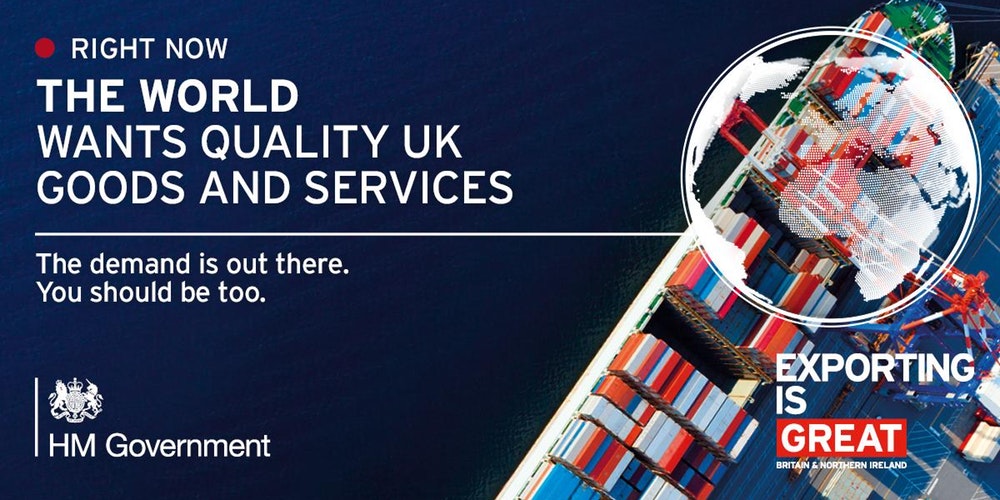
The world wants quality UK goods and services. The demand is out there. You should be too. Image courtesy of HM Government.
 Letter to Britain