Home » Brexit (Page 48)
Category Archives: Brexit

Four Ways That Will Measure Brexit Success
by John Brian Shannon | February 2, 2017
A brilliant group of academics and professionals have published a list of four questions that should be foremost in the minds of those wanting to negotiate a successful Brexit result as they navigate through the process of leaving the European Union.
These economists, lawyers, sociologists, and political scientists suggest that four important metrics need to be considered for any final Brexit agreement to be termed a “success” by a majority of Britons.
- Will Britain be better off, compared to staying in the EU?
- Will it create a fairer society?
- Will it make Britain’s economy and society more or less open?
- Will it give governance back to the electorate?
These seem utterly reasonable questions the public and policymakers can use to guide their thinking about Brexit over the coming months and years.
With so much focus on GDP growth and the export economy it was heartening to hear the Prime Minister speak about addressing inequality in the country, a problem not unique to Britain, but one which represents a gathering socio-economic catastrophe that rarely gets the attention it deserves. Kudos there, Mrs. May!
“As Mrs May has pointed out, judging Brexit is not just about GDP numbers, it’s also about creating a ‘fairer’ Britain – closing the wealth gap and expanding wealth and opportunity beyond London and the Southeast, as well as taking back control of borders and law-making.” — The Telegraph
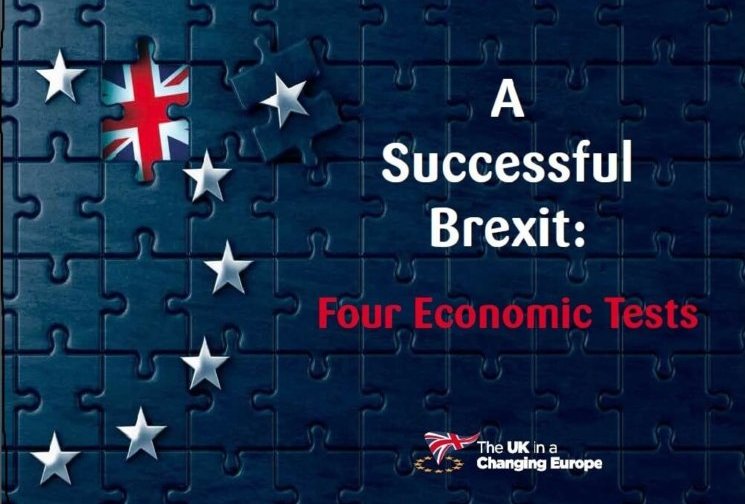
A Successful Brexit. Four Metrics to Guide UK Separation from the European Union. Image courtesy of The UK in a Changing Europe.
These are the right questions to be asking prior to the formal start of the Brexit process which Prime Minister Theresa May has said will commence March 2017 when the UK government triggers Article 50 of the EU constitution.
See: PM Theresa May’s Lancaster House speech

Key Brexit dates. Image courtesy of The Telegraph.
February 1, 2017: Supported by the Labour Party, House of Commons MP’s backed the government’s European Union Bill voting 498 votes to 114 (a majority of 384) to allow the Prime Minister to get Brexit negotiations underway. — Excellent BBC article here.
Next-up?
March 31, 2017: Self-imposed deadline set by the Prime Minister for informing the EU via the Article 50 clause that Britain wishes to exit the European Union.
After a long delay (which is typical in politics) things are going to get interesting, fast.
Once Prime Minister Theresa May triggers Article 50, the ball will be, as they say, in the European Union’s court.
Recommended Reading:
The UK in a Changing Europe is an impartial and independent organisation created to make the findings of the best academic research easily available to the widest possible audience. This report was written by the initiative’s director Anand Menon and senior fellows Angus Armstrong, Catherine Barnard, Iain Begg and Jonathan Portes. The report in its entirety is available for download here (PDF). [Worth the read. – Ed.]

Theresa May needs Parliamentary Approval for Brexit says Supreme Court
by John Brian Shannon | January 25, 2017
Britain’s Supreme Court ruled (8-3) today that the UK government must get parliamentary approval to begin the process of leaving the European Union.
Prime Minister Theresa May’s plans to trigger Article 50 of the Lisbon Accord in March 2017 to begin the Brexit process, could be delayed as a result of this ruling. However, the PM’s spokesman said that the plan to leave the EU remains unaffected and Brexit will proceed as planned.
Most Conservative MP’s have publicly stated they will support Brexit, and Labour Party leader Jeremy Corbyn said his party will vote to Brexit. (Read here)

List of Treaties and Acts signed without the benefit of a UK referendum, nor signed with any requirements set out by UK Supreme Court Judges.
The highest court in Britain also decided today (unanimously) that there’s no requirement to consult the governments of Northern Ireland, Scotland or Wales prior to invoking Article 50 because the United Kingdom entered the European Union as a single entity, therefore, the UK must leave the European Union as a single entity.
In defense of the high court, the Brexit referendum wasn’t a constitutional vote where the government was legally bound via a quid pro quo with voters to enforce Brexit, rather, it was a vote centered on finding the will of the public regarding continued EU membership.
British voters, after having voted in a referendum to tell the government of its wishes in regards to EU membership, are now informed by the UK Supreme Court that Parliamentary approval must also occur.
The bar keeps raising, but it’s only serving to make UK citizens more determined to have their voices heard and for Brexit to actually occur.
Although today’s ruling might be seen as a setback for the Prime Minister in some quarters, the Supreme Court ruling has caused Britons to demand even more vociferously for a ‘Hard Brexit’.
It seems the Supreme Court ruling requiring Parliamentary approval before Brexit might turn out to be good news after all for Prime Minister Theresa May and for millions of Brexiters.

Find more statistics at Statista – Click to enlarge the image
After Brexit: What Rights for EU migrants and British expats?
by John Brian Shannon | December 30, 2016
Neither the European Union nor the United Kingdom has any particular obligation to host the others’ citizens after Brexit.
For example, EU citizens living in the UK have no special status and the UK isn’t obligated to allow them to continue to live or work in a post-Brexit Britain. The same is true for Britons presently living in the EU whether they are working on the continent, attending university there, or have retired in the European Union.
One would like to think a standardized agreement for reciprocal expat rights can be signed between the two blocs in advance of Brexit. Prime Minister Theresa May attempted to gain such an agreement in November 2016 but was rebuffed by German Chancellor Angela Merkel and European Council president Donald Tusk.
It’s a situation where the benefits to politicians are relatively small as only tiny numbers of voters are involved out of Europe’s total population of 504 million, while the stakes for individuals are quite large. Which might not bode well for an agreement anytime soon.
At present, 1.3 million British citizens live in the EU, while 3.3 million EU citizens live in the United Kingdom
In the (hypothetical) worst-case scenario, three times as many EU citizens would be required to return to the EU — while only 1.3 million Britons would be required to leave the European Union following Brexit.

A post Brexit reciprocal expat policy is necessary for UK and EU expats living, working, studying, or retired, that provides them with proper legal status across Europe. Image courtesy of The Telegraph.
Wouldn’t it be great if politicians could agree on a standardized bill of rights for all European expats?
When factoring-in the gross total number of all EU citizens living in non-EU countries in Europe, almost 5 million EU expats would benefit from such a solution — and 2 million Norwegian, Swiss, Greenlanders, and Britons would benefit just as much and for the same reasons.
A Pan-European Agreement would lower angst between the EU and the UK
Instead of the usual tug-of-war where the only eventuality is a ‘Win-Lose’ outcome, Europe’s leaders should broaden their worldview and seek a pan-European ‘Win-Win’ agreement that works for all expats from Greenland to Finland and from Norway to Malta. And get it passed prior to Brexit.
Is that too much to ask from 21st-century politicians? Let’s hope not.
 Letter to Britain