Home » Articles posted by Letter to Britain (Page 75)
Author Archives: Letter to Britain

Northern Ireland and the ‘Soft Border’ Option
Thanks to the dedication of thousands of people, the problems that plagued Northern Ireland for decades have all but disappeared. While we mourn those lost during ‘The Troubles’ we must move forward and provide the best possible future for the people of Northern Ireland and the Republic of Ireland.
The best way to continue to move forward is for a ‘soft’ border between Northern Ireland and the Republic of Ireland so that free movement of people and unimpeded trade may continue along the 310 mile border.
Many people on both sides of the border meet for tea, travel across the border to shop, or are employed on the other side of the border and it would be unfair to require these people to face a regular border crossing twice daily. And a hard border would hinder trade, which trade is a vital part of the local economy along both sides of the divide.
A dedicated ‘Commonwealth and Ireland’ line at UK ports of entry
The smartest thing the Home Office UK Visas and Immigration department could do is to create a separate queue line at all UK ports of entry and mark it “Commonwealth and Ireland” so that people from Commonwealth countries or from the Republic of Ireland have a dedicated and streamlined entry into Britain.
In this way, goods and people can move much more efficiently between those jurisdictions.
If it sounds like I want to favour people from Commonwealth nations, you’re right. If it sounds like I want to favour people from Northern Ireland who may decide to fly to Britain from points overseas, you’d be right.
Special Treatment at UK ports of entry: A ‘Nexus Card’ for frequent travelers between Ireland and any UK port of entry
Here in North America, citizens who cross the U.S. / Canada border can apply for a Nexus Card or an Enhanced Driver’s Licence — either of which dramatically speed border crossing times for holders of those cards — and not incidentally, lowers wait times for the people in the non-Nexus lineups because fewer people (or vehicles) are traveling in that particular queue.
Such a streamlined customs experience should be extended to all Republic of Ireland citizens as a courtesy — and to the government of the Republic of Ireland in exchange for their help in patrolling and securing the border with Northern Ireland.
The UK Government (UK.gov) Paper on Northern Ireland and Ireland
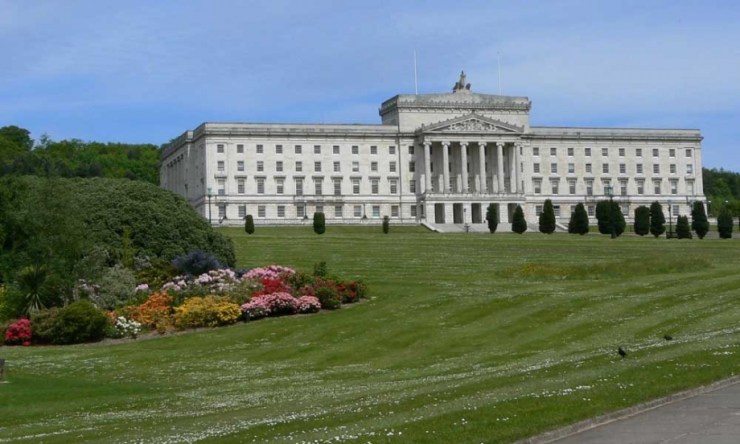
- Stormont is the seat of the Northern Ireland Assembly and is located in Belfast, Northern Ireland. Image courtesy of visitbelfast.com
“The UK government pledges to protect the Belfast Agreement and Common Travel Area in new position paper published August 16, 2017.
The Government has today published a comprehensive paper which outlines the UK’s position on addressing the unique circumstances of Northern Ireland and the land border with Ireland.
The position paper — which has been published ahead of the August negotiating round — states that the Government will protect the Common Travel Area (CTA) and associated rights for UK and Irish citizens, and put upholding the Belfast (‘Good Friday’) Agreement at the heart of its Exit negotiations.
The paper also puts forward proposals on avoiding a hard border on the movement of goods — making clear the UK’s position that there should be no physical infrastructure at the border — and plans to preserve the wide range of institutional cooperation between Northern Ireland, Ireland and Great Britain including for the energy market.” — From the UK.gov website
Trade Between the UK and the Republic of Ireland
Billions of pounds sterling in trade cross between the UK and the Republic of Ireland and a significant amount of it is spent in the small and medium-sized business (SME) trade. Keeping the border open, yet enhancing security will be a challenge for both the UK and the Republic of Ireland, but with good will and some visionary thinking it shouldn’t be too difficult to get an agreement that benefits the largest number of people.
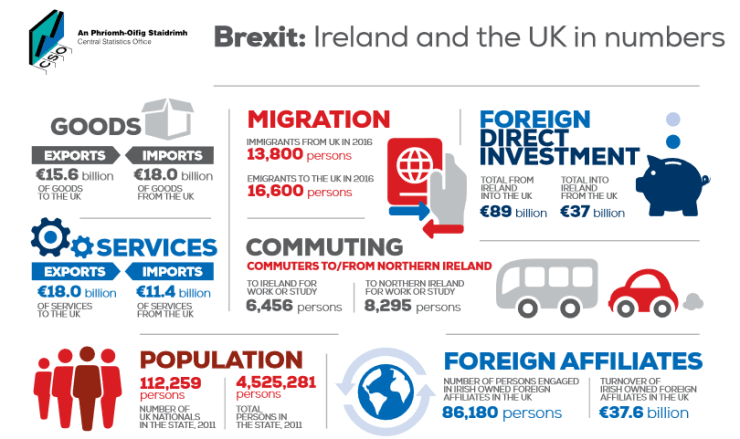
- Brexit – Ireland and UK trade in numbers. Image courtesy of cso.ie
A Soft Border between Northern Ireland and the Republic of Ireland is in everyone’s interest
For as long as the Republic of Ireland remains a member of the European Union it’s in everyone’s best interests to keep the soft border arrangement and to work together to enhance security on both sides of that soft border by any reasonable means.
If that means having facial recognition technology and vehicle license plate readers at all government buildings and properties, ferry terminals and international airports in Northern Ireland and the rest of the UK, it’s a small price to pay to preserve and enhance security for the EU, for the Republic of Ireland, and the UK including Northern Ireland.
The soft border between Northern Ireland and the Republic of Ireland must work for citizens of each country, for small (and large) business, and it must ensure a high level of security for both the UK and the EU. This is one Brexit negotiation that must succeed for the benefit of all.

Why it’s Time to Lower Immigration from non-Commonwealth Nations
Well, ‘Brexit is Brexit’ as they say, and it looks like it’s going to take a while to finalize details between the UK and the EU. But no need to panic. Brexit will happen and the two sides will be legally divorced within 12-months.
It might turn out to be a good agreement, it might turn out to be a bad agreement, or negotiations might go so awry that the UK leaves without any agreement; In which case WTO rules would automatically apply until superceded by bilateral agreement.
Which wouldn’t be too bad actually, because with no time constraints to worry about post-Brexit, and with no concern about loss of face for politicians (on account of missing the Brexit deadline) powerful industries on both sides of the English Channel could then push their respective governments to create a number of à la carte bilateral agreements pursuant to their sector. Secondary and tertiary industries would then follow the lead of the powerful primary industries.
Eventually, every CEO would be heard by their respective government, and elected representatives on both sides would be compelled by their own political self-interest to present their case to the other side — a very pure way of streamlining trade between Europe’s (by then) newly divorced economies.
Whichever way it goes, in approximately 12-months Britain will be alone in the world save for its Commonwealth partners which it hasn’t cherished enough over the past 86-years, but it’s not to late to change that.
In fact, now is the time for the UK to take huge strides forward with its Commonwealth partners and begin to deliberately favour them over non-Commonwealth nations, especially in regards to trade and immigration.
“The latest net migration statistics show that in the year ending December 2016, net migration to the UK was 248,000.” — Migration Watch UK
The majority of immigrants to the UK since 1999 came from eastern Europe and the benefit for British employers is that these workers accept low-paying jobs and (although it is unethical and in some cases illegal; regardless, it still happens) that a farm or factory could replace all UK-born workers and on the next week hire immigrants who work for far lower wages. This can save companies significant amounts of money especially in the case where the UK-born employees have years of seniority and full benefit plans.
(Want to save 25% on your annual labour expenditure? Fire everyone below the level of General Manager and fill those positions with immigrant workers. Sure, it may be hairy for a while until the newcomers learn their jobs, but think of the money you’ll save! Even with having to pay significant severance pay to UK-born workers that have seniority, and maybe a bit of ‘hush money’ — over time the company will show better profits. If you think this hasn’t been done, you’re naive in the extreme. Whether it’s legal or not, whether it’s ethical or not, or whether it’s the ‘right thing’ for Britons to do to their own countrymen and countrywomen is a completely different matter)
In the end it hurts the UK economy, although it helps UK businesses to earn higher profit, but much of the money earned by the immigrants is sent to their families in eastern Europe or wherever they migrated from.
The name for these kinds of transactions is ‘foreign remittances’ and billions of pounds sterling leave the UK economy for foreign nations every year. That money is gone and is never returning.
The amount of wealth leaving the UK every year via foreign remittances is astonishing and may total as much as £20 billion annually (or more) and as the accounting is imprecise it’s almost always found (years later) that the estimates were extremely low.
The UK is one of the Top-Ten foreign remitting countries in the world
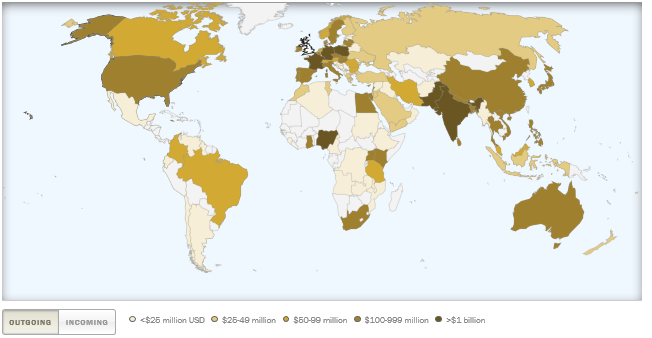
- Although foreign remittances are only estimates, at least $24,878,000,000 in remittances were sent from the UK to other countries in 2015. Image courtesy of Pew Research.
In some countries with heavy remittances from the UK, the amounts are so large that certain developing nations receive up to 6% of their GDP via foreign remittances, and the UK is one of the top-ten foreign remitting countries in the world.
Think how much money Britain’s governments (Labour and Conservative) have allowed to leave the UK via foreign remittances over the past quarter century…
Wouldn’t it be smarter to lower immigration from non-Commonwealth nations?
Why, yes it would. It would be much smarter.
Commonwealth nations have historic links with Britain and it looks better when former colonies (and new Commonwealth members that were never colonies of Britain) are faring well thanks to British largesse.
Following is a short list of UK benefits if immigration from non-Commonwealth nations is replaced by Commonwealth nation immigrants:
- Tens of billions of pounds sterling will no longer leave Britain annually to be used by non-Commonwealth countries
- Foreign remittances from the UK would go to Commonwealth nations instead of non-Commonwealth nations
- Commonwealth nations might choose to source more military equipment, machinery, etc. from the UK
- Commonwealth nations with boosted foreign remittances are more likely to stay within the Commonwealth
- Immigrants to the UK from Commonwealth nations are more likely to understand the British worldview
- Commonwealth immigrants are more likely to integrate well into British society
- Commonwealth nation citizens will have a better opinion of the UK and of Britons
- Commonwealth nation economies will see a corresponding economic benefit
- UK GDP would increase, as would GDP in the other Commonwealth nations
- Commonwealth nations would become politically strengthened
- Commonwealth links between businesses are likely to increase
- Links between Commonwealth citizens are certain to increase
And that’s just the short list.
Yes, billions of pounds sterling will still leave the UK but at least it will be going to Commonwealth member nations that have a similar worldview to Britons and are nations that are more likely to support British policies instead of opposing them.
If the money is going to leave anyway, the smart money would arrange to keep it ‘in the family’ with countries that don’t have adversarial relations with the UK.
Why should the UK be adding to the GDP of non-Commonwealth nations, when it could be adding to Commonwealth nations GDP?
The UK is a member of that august organization and membership itself implies that each member should favour other members.
Commonwealth governments, big business and consumers should always try to shop at Commonwealth businesses first, before trying anywhere else. If something can’t be found for sale in your own nation, then try to purchase it in another Commonwealth nation. If it can’t be found at all, then maybe it’s time for another Commonwealth member nation businesses to pool their resources and build/sell that product.
The UK should cut immigration from non-Commonwealth nations and simultaneously make it one order of magnitude easier for Commonwealth nation citizens to immigrate to Britain.
While the total immigration levels might stay the same, the definite bias should move quickly towards Commonwealth nations and NAFTA countries.
Commonwealth citizens should have UK visas fast-tracked after Brexit, MPs argue (The Telegraph)
Up to 200,000 immigration applications from Commonwealth and NAFTA nations should be accepted each year via a simple online form, a successful criminal records background check, and payment of an immigration fee of £100 per year.
One for all, and all for one!
Instead of strengthening people and nations that have no interest for or against the UK, Britain should quickly move to support Commonwealth members and NAFTA countries.
In this way, countries that are pulling for the Britain’s success will be rewarded by Britain — and vice versa.
The UK should respectfully request NAFTA associate membership the moment Britain formally leaves the EU. And within 5-years, all other Commonwealth nations should make the same request of NAFTA.
That’s how you Build a Better Britain, Build a Better Commonwealth and Build a Better NAFTA!

The Brexit Team: Swiss Watch or Contraption?
One of the most credible economic stewards to serve Britain in a long time is the inscrutable Philip Hammond who has done nothing but improve the UK economy since the day he was sworn in to the post. Which was merely an extension of him having been born for the job, it seems.
It’s not only that; Mr. Hammond’s word carries a lot of weight in foreign capitals, and in the EU his word is his bond. Soft-spoken, adroit and adept, Hammond is one of the darlings of financial capitals everywhere and it’s a great thing to see him in his element.
So began Prime Minister Theresa May’s summer vacation, where she and her husband (also named Philip) went off to Switzerland to take the mountain air and hold long and meaningful conversations at full stride up the Matterhorn.
Leaving the country in the capable hands of Philip Hammond must be a comforting thought for Theresa May as she and hubby blow past the tourists struggling to get to the top for a selfie. My advice: Just get out of their way or you’ll get run over. Seriously.
The Exchequer comments on post-Brexit Immigration
However wonderful it is having a powerful Exchequer, there is the temptation for them to overstep their bounds and cross over into the areas of responsibility reserved for the Prime Minister.
And just as predictably as that; Before Theresa May had gotten her first alpine air, Hammond told reporters, “there should be no immediate changes to immigration or trading rules when Britain leaves the EU in March 2019.” (Sky News)
It’s forgivable, and probably wise for Conservatives to be seen voicing the concerns of voters on both sides of Brexit. However, Exchequers should stick to their primary interest (the economy!) and let others, whose direct responsibility it is, to hold forth on immigration issues.
With Theresa away, the Remainers will play
While Theresa May gets some mountain air, the Remainers in the Prime Minister’s cabinet are clearing the air by presenting their side of Brexit — and that’s fine. But let’s make certain that fair play rules are enforced; Which means that cabinet officers publicly comment only on their primary area of responsibility. Only the Prime Minister has the authority to publicly comment on all matters, otherwise it looks like a circus.
Every misstep is celebrated in foreign capitals. People in the EU who may be opposed to Brexit are incredibly strengthened by each implied criticism directed towards the Prime Minister by members of her cabinet.
The entire period of Brexit is a highly unique time, a time where all Britons must pull together and come to the realization that many in the EU are fighting for a ‘Win-Lose’ outcome, an outcome where Britain loses vis-à-vis the European Union.
Meanwhile, the best of the Brexiters are fighting for a ‘Win-Win’ outcome where both Britain and the EU win. And those are the people I’m putting my money on.
Clear Lines + Clear Thinking = Positive Results
There’s nothing wrong with MP’s on both sides of Brexit informing the public about how they would proceed on any matter — as a sort of trial balloon to gauge public mood. That can be useful moving forward by keeping those who voted Remain interested and engaged with Brexit, and there is every opportunity that Remainers may come up with excellent ideas related to soft Brexit implementation within their field of expertise.
But greater care must be taken to avoid strengthening the hand of anti-Brexit forces in the EU, now that Britain has finally! asserted her rights.
Government ministers must draw the distinction between legitimate discussions about how Remainers (read: Soft Brexiters) or vocal Brexiters (read: Hard Brexiters) would handle any Brexit issue — and how the wrong sort of discussions or even the wrong tone of discussions could work against Britain in foreign capitals. The wrong public discourse works against both versions of Brexit.
Let’s not be naive. Each misstep by anyone in the UK government is celebrated at the EU Parliament and certain EU capitals. Whatever is going on behind the scenes within the UK government, a unified face must be presented to the world in order to obtain the best Brexit result.
Controlling the Narrative: Job #1 for Every Prime Minister
UK government ministers, and possibly even the Prime Minister herself may not yet realize the extent to which the world now sees the United Kingdom as a completely different entity. The UK no longer exists as only one of 28 EU members, and what the UK will eventually become, is unfolding every day like an onion being unpeeled.
Is the UK destined to become a nation of cross-talkers, mixed messages and unreliable partners? Or is Britain starting with a clean sheet to become all that she can and should become in the 21st-century?
Only the Prime Minister knows, as she’s the one holding the pen. Let’s see what script she writes.
 Letter to Britain