Home » Articles posted by Letter to Britain (Page 61)
Author Archives: Letter to Britain

Time to Begin Planning for Life After Brexit
It looks like the so-called ‘Project Fear’ campaign has failed in its quest to force referendum after referendum until they got the answer they wanted (which to observers, seemed they wanted to stay in the European Union at any cost) and that Brexit will occur on March 30, 2019 as planned.
All that remains to be decided between the UK and the EU is whether future relations will be based on World Trade Organisation rules, or on a bilateral trade agreement that allows both sides to prosper while maintaining a reasonable level of protection for national sovereignty, for their respective economies, and is able to shelter startups or other businesses that may require some form of special treatment or protection.
Either UK and EU leaders are up to the task, or they’re not. We’ll soon know.
And if they aren’t up to the task, every one of them deserves to get the boot at the next election.
First on the Agenda for the UK
Of paramount importance for the UK are free trade agreements with its Commonwealth partners — agreements that automatically come into effect within 24 hours of the official Brexit date.
It’s important to begin with Commonwealth trading partners because if Commonwealth nations aren’t willing to sign bilateral trade agreements with the UK, why would other countries want trade deals with the UK?
(If I represented a non-Commonwealth country and the UK couldn’t get its act together enough to sign worthwhile free trade agreements with its own Commonwealth partners, I wouldn’t be interested in signing with the UK either)
Yesterday, Australia’s Prime Minister generously indicated his country will sign a bilateral trade agreement to automatically come into effect the day after Brexit, and New Zealand, Canada, India, and other Commonwealth nations have indicated they’re open to bilateral trade agreements with the UK too.
Therefore, it isn’t a reach to suggest that such agreements be ready for a signing ceremony the day after Brexit and that UK foreign direct investment (FDI) in those countries will thenceforth take an instant leap forward.
The time to get such negotiations done is NOW so that a simultaneous signing ceremony can be televised across each of the Commonwealth’s 53 capital cities at 00:01 (in the UK timezone) on March 30, 2019.
What a tribute to enduring relations between Commonwealth members. Such a historic moment!
Second on the Agenda for the UK
No later than 24-hours after Brexit (which puts us at March 31, 2019) the UK should have free trade agreements automatically coming into effect with every economy in the world — agreements that work for each country just as well as they work for the UK.
‘Win-Lose’ thinking is no longer an option in the 21st century and anything less than ‘Win-Win’ isn’t worth spit. In fact, unless trade agreements are ‘Win-Win-Win’ these days, their value is questionable.
FOR EXAMPLE:
If the UK offers a ‘Win-Win’ trade agreement to China, but Japan offers a ‘Win-Win-Win’ trade agreement to China; Which of the two countries will be China’s most favoured trading partner?
Obviously, Japan’s offer would win, and the UK offer would simply gather dust as Japan’s relationship with China surged forward.
These negotiations must occur NOW and be led with a high level of urgency by Prime Minister Theresa May and Secretary of State for International Trade Dr. Liam Fox, so that by April 1, 2019 the UK will have bilateral trade deals with every country in the world — that automatically come into effect the day after the official Brexit date.
Anything less than that stellar achievement should be considered by UK voters to be a mediocre performance by the (then) ruling party in the UK House of Commons.

The world wants quality UK goods and services both now and in the post Brexit era.

Transferability – The Solution to Systemic Bottlenecks in the NHS
Unfortunately for large healthcare providers like the UK’s highly rated National Health Service (NHS) people don’t always get sick near their local hospital. Rather, people will become ill, get injured, or encounter long-term illness everywhere throughout the United Kingdom regardless of where hospitals are located. Which is why some UK hospitals are full to overflowing while others have spare capacity.
One way to improve healthcare outcomes in the NHS is to incorporate transferability of treatment to relieve bottlenecks in the system.
Patients who can’t be treated in their local hospital due to lack of available capacity could be transferred to other hospitals in the UK where some amount of spare capacity exists and receive their treatment sooner than waiting for treatment at their local hospital. And even accounting for airline or rail tickets, possibly an overnight stay in a reasonably priced hotel in cases where the airline vs. operating room schedules don’t match, and for other incidental patient costs the health service would be required to pay, it would save the NHS money and dramatically improve healthcare outcomes for patients.
Patients who desire an upgraded hotel room could pay the difference themselves between the (covered by the NHS) standard room rate and the upgraded room rate.
When a patient has cancer, heart problems or other serious health issues, nothing is gained by making the patient wait for a treatment date in a hospital close to their home, because almost 100 per cent of the time those conditions will worsen as the patient waits for treatment.
Delayed treatment significantly increases treatment costs — because during the days, weeks or months of delay, the patient’s disease is certain to worsen.
Even those with slipped discs or other musculoskeletal impairments find their condition worsens over the amount of time their treatment is delayed. To say nothing about the suffering of the individual and their families while the person remains in a precarious health situation.
But if patients with serious conditions receive treatment sooner, healthcare outcomes for patients will improve and NHS statistics would improve because the disease or condition won’t have progressed as far in the case of faster treatment vs. waiting extra weeks or months for treatment at a local hospital.
Increase in Productivity
Workers who can’t work, can’t contribute much to GDP.
What is also true is that with faster treatment workers can return to work sooner and contribute to their company and by extension to the GDP of the United Kingdom.
Unhealthy people cost the economy, while healthy people contribute more. It’s therefore in the best interests of the government to get everyone the treatment they need with the minimum of delay.
Little Room for Improvement in the NHS
For an idea of just how highly the NHS is ranked in the world, please view the following chart courtesy of The Commonwealth Fund, an organization which ranks global healthcare systems via a number of metrics.
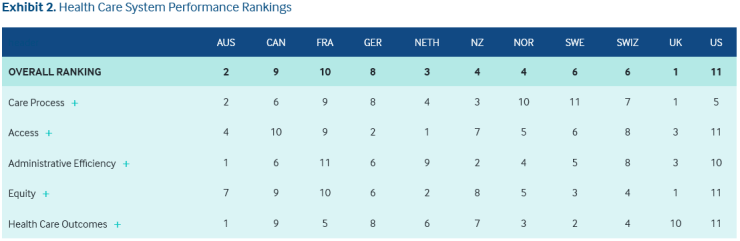
Health Care System Performance Rankings for the UK and 10 other countries. Image courtesy of The Commonwealth Fund.
It’s easy to see there is little room for improvement within the NHS, but Access (the ability to access treatment within a reasonable timeframe) and Health Care Outcomes (the success rate of treatment — which is often related to waiting times associated with treatment) could be significantly improved.
Scotland, Here I Come!
Some amount of transferability of treatment exists within the NHS at present, however, those in England tend to be treated or wait for treatment within England only. Scottish patients may be transferred to other hospitals in Scotland, and Welsh patients may be transferred to other hospitals in Wales. It’s likely a similar situation exists within Northern Ireland.
What would work to decrease bottlenecks in the NHS and thereby improve healthcare access and healthcare outcomes would be treatment transferability for patients throughout the entire United Kingdom.
Doctors could provide their patients with options for treatment when full transferability becomes the norm; (Example) “You can wait 6 weeks for treatment at your local hospital, or we can fly you to Scotland tomorrow, put you up in a reasonable hotel overnight and your operation will be scheduled for 7:00am the following day, and we’ll fly you home a day or two after the attending surgeon approves you for travel.”
For patients in severe musculoskeletal pain, or experiencing rapid cancer growth, or increasing difficulty in breathing or experiencing other serious symptoms, the sooner they can obtain treatment the happier and healthier they’re likely to be. That’s a win for patients, for doctors, for under-booked operating rooms in far-flung regions, for NHS statistics, and even for UK productivity stats and GDP.
There are so many ways to win with treatment transferability throughout the entire United Kingdom. It’s really the only systemic improvement left for the NHS.
Building more hospitals is expensive (and necessary in any case) but directing patients to underutilized hospitals (now, and even after more hospitals are built) can help patients towards sooner and better health while improving Access and Health Care Outcomes statistics for the NHS.

How a Tiny Tariff Could Change America
As the debate heats up over President Trump’s 25 per cent steel tariffs and 10 per cent aluminum tariffs (some countries are exempted by Presidential Order) it’s interesting to look at other scenarios that might play out better for the United States — and for other countries too.
First, let’s look at the scale of the American trade deficit problem, then we can compare different methods to adjust trade flows to help the United States avoid a projected $880 billion trade deficit with the rest of the world by FY 2019. No country, not even the mighty United States of America can withstand annual trade deficits of that magnitude.
At the moment, America’s biggest trade deficit is with China ($215 billion/yr) followed by Japan ($68 billion/yr) and Mexico ($65 billion/yr) while many other countries run double-digit trade deficits against the United States. In totality, such trade deficits are simply unsustainable for the U.S. and President Trump is right to address the issue, however, there’s always more than one way to accomplish a thing.


U.S. Imports: The timeline shows the total value of international U.S. imports of goods and services from 2000 to 2017. In 2017, the total value of international U.S. imports of goods and services amounted to 2.9 trillion U.S. dollars. Image courtesy of Statista.

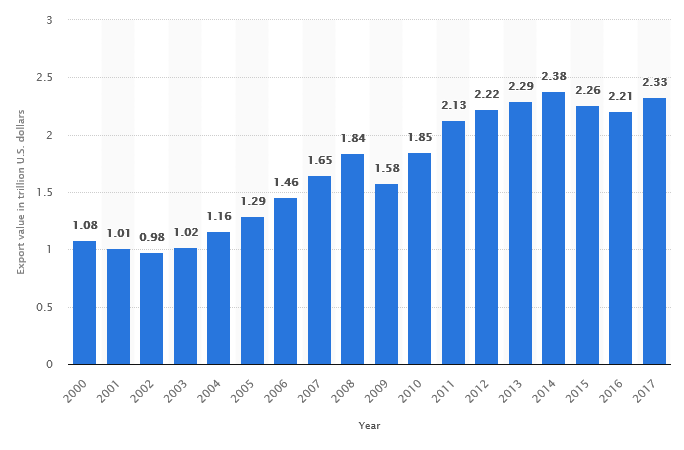
U.S. Exports: The timeline shows the total value of international U.S. exports of goods and services from 2000 to 2017. In 2017, the total value of international U.S. exports of goods and services amounted to 2.33 trillion U.S. dollars. Image courtesy of Statista
The Nature of the Problem
America’s trade deficit is an astonishingly simple problem that has developed over four decades — because when a thing evolves without proper guidance and oversight, eventually it becomes the thing that eats you — which is what’s happening to the United States in the 21st century.
Because policymakers allowed this monster to grow, it means the U.S. will import $557 billion more than it exports in 2017, instead of maintaining a normal balance of trade like other countries. And 2018 is projected to produce an $880 billion trade deficit for the United States, with a $1 trillion trade deficit sure to arrive by FY 2020 if action isn’t taken to address this catastrophe.
President Trump claims that the American trade negotiators of previous decades were ‘weak’ and got ‘out-negotiated’ by other countries and blames them for the present (uncomfortable) moment. But that isn’t accurate. However, it plays well with voters, and media outlets especially, thank Donald Trump for that characterization.
What happened is that America opened trade with China and other developing nations beginning in earnest in 1974, allowing generous trading terms to add impetus to America’s trade liberalisation goals. American policymakers assumed that once those developing nations got a real economy going, citizens of those countries would then purchase billions of dollars of American goods and the gamble would pay off handsomely. And therein lies the problem. Not every country reciprocated America’s largesse.
China, Japan, and other countries simply grabbed the Americans by their largesse and began exporting evermore billions of dollars worth of goods and services to America without buying much of anything from the United States.
Note: In Japan’s favour, the country’s carmakers aggressively lobbied Washington to be allowed to build factories throughout the United States and Canada which provided thousands of jobs across North America every year since 1987. Also, Japan bought hundreds of billions of dollars worth of U.S. Treasury Bills to help maintain the American economy. These wise actions ameliorated the concerns of U.S. legislators about Japan’s trade imbalance with the United States from 1987-2017.
Which should qualify Japan for a ‘Free Pass’ from all steel and aluminum tariffs IMHO, as Japan was led to believe by American legislators that their actions neatly covered any trade negatives in the U.S. / Japan relationship.
Asleep at the Switch?
If someone in America had been ‘on this’ it would have never gone this far. But someone in America was asleep at the switch and that’s why we are where we are, in 2018.
The problem, therefore, isn’t that America got ‘out-negotiated’. The problem is that certain countries took advantage of America’s generous trade terms but were reluctant to accept imports from the United States.
Whoever was in charge of international trade in the U.S. from 1990 until 2018 should have Fried in Hell for not raising the alarm and writing some appropriate ‘fair trade’ legislation that would serve as a check and balance against such one-sided trade flows.
The $10 Billion Tripwire Method
Countries that run trade surpluses of less than $10 billion/yr with the U.S. shouldn’t face American tariffs as those numbers typically go up and down many times over the course of a decade and can even reverse direction to America’s benefit, and in any case, rarely become double-digit or triple-digit trade imbalances.
But once a country hits the $10 billion trade deficit threshold with the United States, it should trigger alarm bells from Alaska to Maine and appropriate tariffs (like Donald Trump’s high-ish steel and aluminum tariffs) should automatically apply on exports to the U.S. from any country that surpasses the $10 billion tripwire.
It’s such a good idea that every country should do it.
The 5% Method
If the United States charged a truly nominal 5 per cent tariff on every foreign good and service it would raise $150 billion per year which is a substantial amount of money for any country, even a superpower.
The U.S. could use that money to subsidize American companies hit hard by low-priced imports since 1990 (maybe by providing financing assistance to allow them to build newer, more energy-efficient factories for example), to improve transportation corridors throughout the country (especially near America’s seaports), to upgrade the actual port facilities to allow for faster and more efficient throughputs of American products being shipped overseas, and to enhance security at every single U.S. port of entry.
This too, is such a good idea that every country should do it.
Balancing an Unbalanced Equation
If the United States adds a nominal 5% tariff to all foreign goods and services, and then on top of that tariff penalizes (with industry-specific tariffs) only the countries that run more than $10 billion trade deficits with the U.S., the entire problem will be solved within 5 years and the American economy will boom like never before.
Also, in a booming U.S. economy, countries like China will find that orders from America will increase and any losses felt now will be recovered within a year or two.
‘Corrective’ Tariffs Need to Replace ‘Punitive’ Tariffs
The only way to conduct international trade is with respect, with proper checks and balances, with mild tariffs designed to make corrections to uneven trade flows resulting from poor policy in previous decades, and none of it needs to be confrontational or nasty.
For the sake of its hard-working citizens, American policymakers must address these imbalances in a businesslike way — not to punish other countries — but rather, to ensure that every country that trades with the U.S. is doing so in a fair and transparent manner.
 Letter to Britain