Home » Posts tagged 'UK' (Page 69)
Tag Archives: UK

French Election: A de facto Referendum on Frexit?
French voters heading to the polls on Sunday may notice that public opinion has been shifting in recent days towards Frexit. Even Emmanuel Macron the ‘establishment’ candidate hints that Frexit might be in the cards if the EU doesn’t reform.
Emmanuel Macron warns EU it must change or France will make swift Frexit (The Sun)
Marine Le Pen continues to gain in the polls and with only days to go before the vote, one wonders what would happen if the vote were a month on? Probably a Le Pen victory if the present trend continues.
Alas, the vote will be held on May 7, not June 7, but it shows how voter preferences are changing as each day passes.
Latest French Election Polls: Le Pen Gains on Macron (Newsweek)
Still, a threat to leave the EU coming from an establishment candidate for the French presidency is shocking, as was the violence on the streets of Paris, a.k.a. the City of Love.
Could a new French president influence the Brexit process?
If Marine Le Pen is elected, the EU will face two nations with plans to leave the Union — Britain and France.
On the other hand, if Emmanuel Macron is elected (and if the EU won’t agree to the changes requested by Macron) it seems likely Frexit will occur anyway.
Back to the effects of the French election on the UK;
In the case where the United Kingdom (alone) leaves the EU, all of the hurt, anger and blame felt by the jilted party (the EU Parliament) will be focused on UK voters and their political leaders.
But in the case where both Britain and France decide to leave the EU, the Union may have no choice but to accept that the democratic deficit in Brussels is to blame — and all of the hurt, anger and blame will be directed at Brussels by the EU bloc leaders.
And if that occurs, some necessary changes might actually occur. Although two of their best horses (Britain and France) will have already left the stable.
As traumatic as it might be, that’s what it might take for the un-democrats in Brussels to change their ways.
My view is that Emmanuel Macron will win the French presidency in the May 7th election, that the EU will not offer the changes necessary for France to remain in the Union, and that Marine Le Pen will win the 2022 election and take France out of the European Union shortly thereafter.
‘The one constant in the cosmos is change’
Let’s hope EU leaders realize the profound truth of that truism and decide to make the changes necessary for France to stay in the European Union. Otherwise, even bigger changes are coming for continental Europe. Mon Dieu! Quoi de neuf?

UK Election: Strengthening Britain’s Brexit Hand
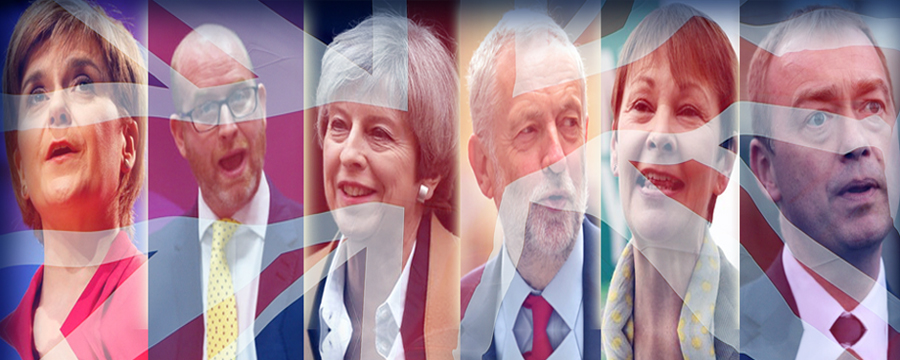
With a fresh mandate from UK voters, Prime Minister Theresa May’s negotiating hand should thereby be strengthened — allowing her to obtain the best Brexit deal for Britain. Image by Samankashwaha
Some very smart people a long time ago, decided to prevent another World War by working to unify European countries that share and haven’t always *shared well* the European continent.
To preclude another internecine war they created several brilliant Euro-centric political institutions such as the European Community, the European Economic Community, the European Union, the Eurozone, the European Court of Justice, and other political, economic, and judicial European institutions — and they enthusiastically embraced internationalism and multilateralism via institutions such as the United Nations and NATO.
It wasn’t all about preventing another war, of course. By 1972 it had become as much about improving the pan-European economy as it was about presenting a united bloc to the militarily powerful Soviet Union.
Britain’s decision to join the EC/EEC and later the EU was obviously part of that geopolitical master plan — and if you read the texts carefully enough with a little ‘reading between the lines’ — it becomes obvious to all but the most tone-deaf that senior British politicians of the era and their negotiators considered that Britain might not be married to the continent forever.
To put it forthrightly, Britain joined the European project to help Germany and other countries ‘gel together’ under a unifying organization to prevent another European war — and it’s possible to find internal texts proving that Britain planned for a possible exit from the EC and the EEC and (implied) from the EU, once the continent became permanently united under one political structure.
Therefore, only those too young to remember the history of the EC, the EEC, and the formation of the EU, don’t see that Brexit was always on once the continent had become irrevocably joined.
Not only did Great Britain pay more than it’s fair share in WWI and WWII, it also contributed more than asked during the Cold War, and it contributed more to the European project than any country with the notable exception of the United States.
Now is the time for Britain to leave the EU and make up for lost time. So said 17+ million British voters on June 23rd, 2016.
It is against this backdrop that a majority of Britons still want Brexit, a clean Brexit, and a fair Brexit.
And why shouldn’t they? The UK has paid more than it’s fair share towards the continent since 1914 and still contributes more than it receives from the EU. Britain, the cash cow.
Yet some in Britain can’t stop haranguing the government for having the audacity to try to deliver what the people voted for — Brexit.
Never since Prime Minister Winston Churchill called upon Britons to prevail no matter the hardship has a country needed the strong support of its citizens and all levels of government.
Brexit is going to be one of the biggest challenges the UK has seen in decades.
And instead of ‘All Hands on Deck’ with every person in the country coming together to strengthen the hand of the Prime Minister and her negotiating teams during what will undoubtedly be difficult negotiations complete with EU officials acting the part of the suddenly jilted lover, we have some British people doing everything in their power to derail Britain’s chances of getting a good deal!
It’s your future, people!
I know you lost the referendum, but for God’s sake don’t sabotage your country just because you don’t like the democratic result.
Of course, it’s the job of the loyal opposition parties to provide policy alternatives to the sitting government’s plans. Nobody can blame them for performing their noble calling which has roots going back hundreds of years.
But it seems that some are so upset they lost the democratic referendum that they actually want the government to fail, they want the Brexit that was approved by 17+ million voters to fail, and they want to demean anyone who supported Brexit.
Really, if you prefer the EU to the UK, why don’t you just move there and become a citizen? I’ll help you pack.
This is no time for un-democrats to undermine their own country’s democracy, and who believe in the superiority of an un-elected Brussels cabal that lives off the largesse of UK (and German!) taxpayers — both countries pay more per capita towards the EU than any other country.
All of whom conspired to convince the Prime Minister to call an election to prove to EU negotiators that Britain is united and moving forward with Brexit, and to quell the small number of UK-based naysayers in the Houses of Parliament and on the street — who get far too much airtime on slow news days.
With a fresh mandate from voters on June 8th Prime Minister Theresa May’s negotiating hand should be dramatically strengthened, thereby allowing her to obtain the best Brexit deal for the UK.
This Prime Minister has gotten stronger every month since being sworn into office, and calling an election to silence the outliers and to strengthen her hand in the Brexit negotiations that will determine Britain’s destiny for decades, may turn out to be a stroke of genius.
Voting to tie one hand behind Theresa May’s back at this point in time only serves to weaken the United Kingdom. Surely no true Briton would consider such a thing.
READ: What Mandate for Theresa May? (Project Syndicate)

Trident: Should the UK Employ Strategic Deterrence or Strategic Hope?
A conversation has begun in the post-Cold War era about whether Britain and other countries should continue their nuclear missile programmes.
In the United Kingdom, the Trident missile delivery system is up for discussion along with modernized warheads.
In case you haven’t heard, the Trident missile system is favoured by the government to replace the Royal Navy’s Cold War era nuclear-tipped missiles.
They don’t last forever. In fact, nuclear materials deteriorate at a steady rate and if you leave them for too many decades they can self-detonate. Yes, the Royal Navy stays on top of this, that’s why we’re having the discussion now as opposed to having it in Heaven…
If nuclear materials deteriorate beyond a certain point and detonate aboard a RN submarine in the middle of the Atlantic, it would be a very sad day indeed.
Which is why nuclear weapons aren’t something to play around with — and that includes playing politics.
Only properly informed people should be involved in this decision but it doesn’t hurt for members of the public to read about and understand the nuclear deterrence rationale, called ‘Mutually Assured Destruction’ or MAD. (Fitting, isn’t it?)
But no matter the name, the doctrine of Mutually Assured Destruction has worked to prevent nuclear confrontation since 1945.
Under the MAD terms, no sane leader would use nuclear weapons against another country as it would bring an equally devastating nuclear response from the attacked nation.
Although leaders of countries have become furious at each other in years past in regards to trade disputes, SR-71 overflights, or attempts at regime-change — their knowledge that a nuclear strike / counter-strike could occur if the dispute gets out of hand, such incidents are automatically self-governing due to the horrific consequences attached to nuclear weapons use.
And it works! Nuclear deterrence has performed flawlessly since 1945 to prevent major conflict between nation-states.
Why Would We Need MAD in a post-Cold War World?
This rationale is a cobra snake disguised as a dove, for it says; ‘The Cold War is over, everything is fine, we live in a largely stable and peaceful world — so why do we need nuclear weapons as a deterrent?’
Just as the people who said prior to World War I; ‘We live in a largely stable and peaceful world, why bother having a national military that costs millions to maintain?’
Those words were barely uttered before World War I arrived.
And similar occurred in the interwar period between 1919 and 1939. People thought there could never be another World War as the consequences of the First World War (‘The War to End All Wars’) were still too horrible to contemplate.
But World War II did arrive and in many ways it was more horrific than WWI due to the advanced firepower of the era.
Then came the Korean War, the Vietnam War, the Soviet/Afghan War, then the 1990 Gulf War in Iraq, and in 2003 the second war in Iraq which we call the Iraq War, along with the 2003 Afghan War. Not to mention the almost countless brushfire wars that have occurred in Africa, Asia, the Middle East and South America and Central America during the postwar era.
In every case, the public consensus was that the previous war ‘had to be the last war’ because ‘war is too horrible to do’ and thenceforth only peace would reign on Earth.
We see how wrong they were…
Prepare for War, but Always Plan for Peace
Every combat-experienced Admiral will tell you; ‘Prepare for War, but Always Plan for Peace’ for they know better than anyone that war is simply an extension of human psychology.
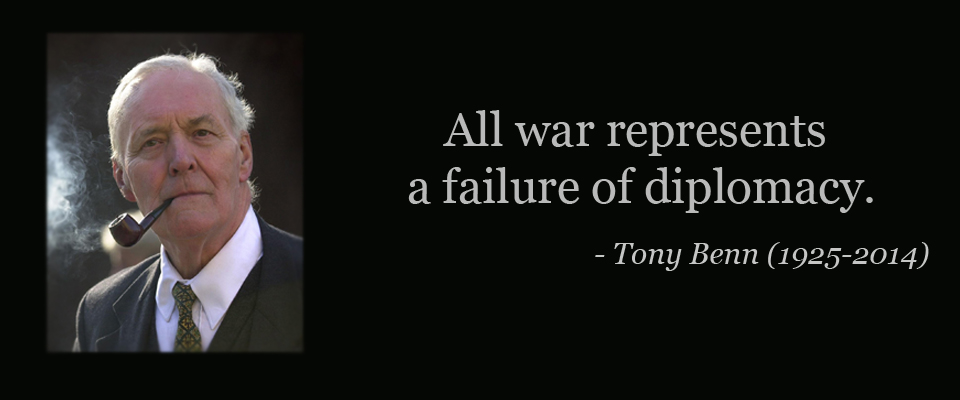
Image created by Samankashwaha
Eventually, diplomacy will fail and the military had better be up to the task of defending the country — or they and their fellow citizens won’t have a country.
It’s no Coincidence the Best-armed Countries have Fewer Wars Thrust on Them
With a strong military a country can decide to take part in a ‘Coalition of the Willing’ for example.
But very few countries with a powerful military get invaded. Not that invasion is the only type of warfare, but that’s the primary reason nations divert precious resources to fund a viable military.
Certainly, nuclear-armed nations aren’t subject to invasion, nor will any potential conflict go far, as the world’s nuclear powers police not only the world but each other as well.
The UN Security Council permanent members are all nuclear powers and each of them has an outsized say in world affairs. It would be naive in the extreme to think that the UK could stay in the UNSC should it decide to give up its advanced nuclear weapons programme.
Having a viable nuclear weapons system is one thing, but having a say in global affairs at the highest level is on the shortlist of things that identify the United Kingdom as a Top Ten political power.
It isn’t always about GDP and Productivity
Sometimes it’s about defending the interests of your country and like-minded countries, even if that means continuing with an expensive Cold War programme that was designed from the outset to make war far too costly to contemplate.
And, the most important point of all? It has worked perfectly, every day, since 1945.
In the discussion between Strategic Hope vs. Strategic Deterrence, my heart is with those who believe that one day the human race will mature to a point where war is left behind in the dustbin of history (as it should be!) but in the meantime, my mind favours what has actually worked over the past 72 years. Poseidon’s trident must remain.
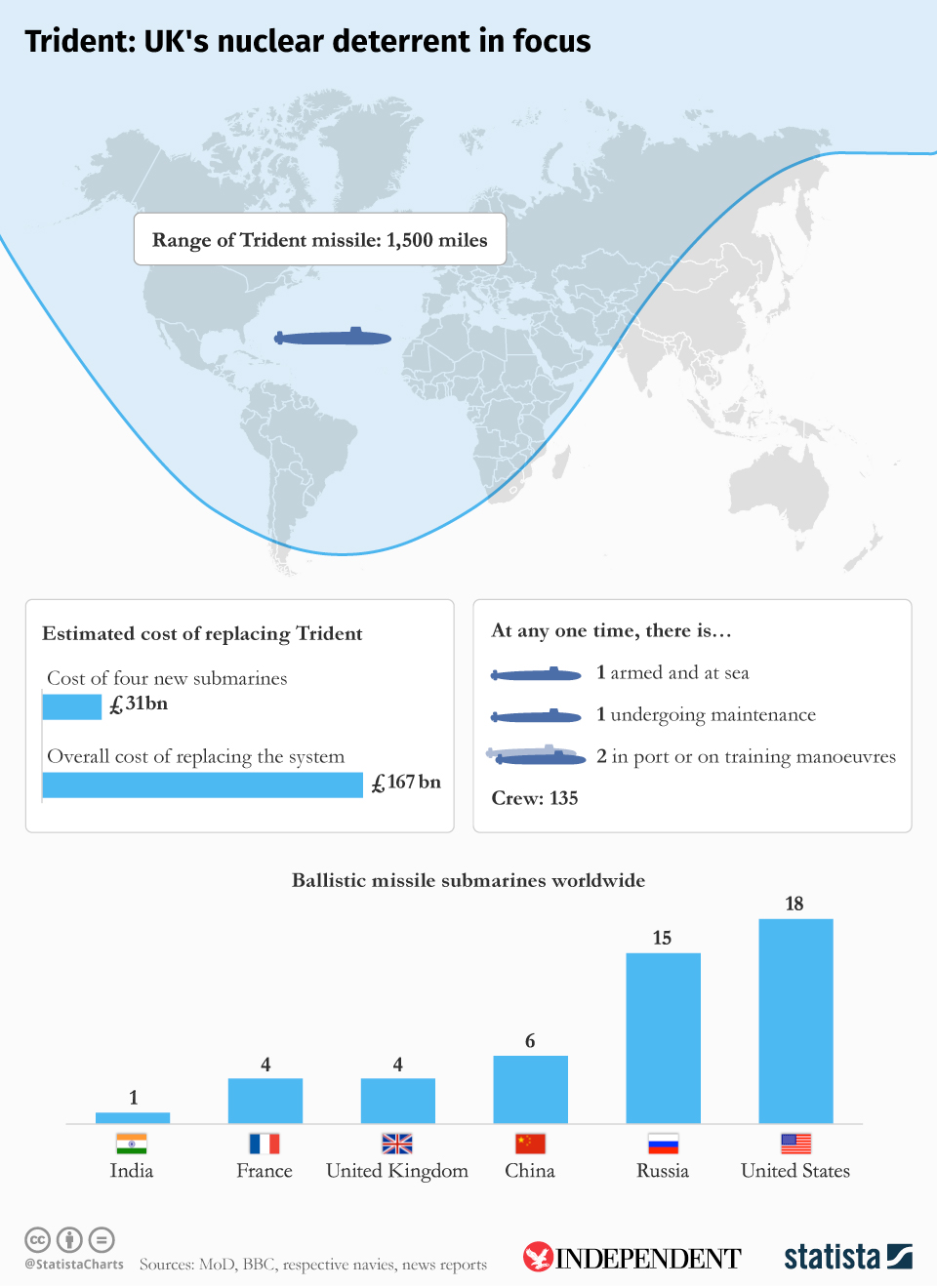
Since 1969, the United Kingdom has had a Continuous At Sea Deterrence (CASD) tasked with protecting the UK in case of nuclear attack. 1 submarine is constantly armed and at sea while another 1 is undergoing maintenance. A further 2 are in port or training. The submarines around which the system is based are obsolete and need replacement. UK submarine and missile system replacement costs could reach an estimated £167 billion. Image courtesy of Statista.
 Letter to Britain