Home » Posts tagged 'UK' (Page 15)
Tag Archives: UK

UK Election 2019: The People Have Spoken & Brexit It Will Be!
It was an historic night in the UK where a formerly weak Conservative government led by Prime Minister Boris Johnson swept to power in a massive majority.
Every party in the United Kingdom has lost ground to the Conservatives — except for the Scottish National Party (SNP) which won 48-seats giving them a grand total of 4% of the UK vote — but that pales in comparison to Boris Johnson’s Conservative and Unionist Party’s 45% of the votes cast in the UK Election 2019. The Brexit Party (a brand-new party only weeks old) gained 2% of the vote, but didn’t win any seats.
Here are the percentage of votes cast in the UK General Election 2019
Conservatives = 45%
Labour = 33%
Liberal Democrats = 12%
SNP = 4%
Green = 3%
Brexit = 2%
Other = 1%
Which translates into this many seats by party affiliation
Conservatives = 365
Labour = 203
SNP = 48
Liberal Democrats = 11
DUP = 8
Sinn Fein = 7
Plaid Cymru = 4
SDLP = 2
APNI = 1
Green = 1
Brexit = 0
UUP = 0
IND = 0
Winners and Losers in the UK General Election 2019
WINNERS
UK VOTERS: The biggest winners in this election are UK voters, as every person who wanted to vote was able to vote, unlike in some countries where armed thugs try to prevent people from voting unless they’re voting for the ‘approved’ thug party. Further, a situation no longer exists where a paralyzed UK House of Commons is unable to do the work of the UK people. Following this clear election result, the UK government can now move smartly to get The People’s business done. And Number One on that list is Brexit.
LOSERS
REMAIN VOTERS: The biggest losers in UK General Election 2019 are so-called ‘Remain’ voters — those who wanted to ignore or overturn the democratic result of the 2016 EU referendum. The UK people spoke clearly in the 2016 referendum, in the UK General Election 2017, and now in the UK General Election 2019, with thousands of traditional Labour, Liberal Democrat and even SNP voters changing their traditional voting patterns (this time) to empower the leave-supporting Conservative and Unionist Party, and some people casting votes for the new-ish Brexit Party to reward their ongoing commitment for leaving the European Union.
WINNERS
THE BREXIT PARTY: Brexit Party members and their leaders should be leaping for joy, because, although they didn’t elect one MP to the UK House of Commons, they’ve dramatically changed the political landscape in the United Kingdom by capturing hundreds of thousands of votes from traditional Labour voters who disagreed with Labour leader Jeremy Corbyn’s Remain Brexit position, and from other Remain-supporting parties across the UK. Strange as it may seem, the Brexit Party like the UKIP Party before it have influenced the UK and continental Europe for generations to come. I’m not sure that Brexit Party candidates and supporters have realized this profound point just yet… But in the meantime, ‘Hats Off’ to Brexit Party leader Nigel Farage and his Brexit Party!
LOSERS
FORMER LIBERAL DEMOCRAT LEADER JO SWINSON: Jo Swinson lost her Dumbarton seat and (thereby) her position as Lib Dem leader — and for no other reason than she cut across the popular mood of the country which was and still is to leave the EU. A polished, responsible, and committed member of Parliament, her defeat can only be seen as a loss for the Lib Dems and the House of Commons in general. But when you’re the leader of a major political party, you must be able to read the mood of the people in a democratic system, otherwise you’re soon gone.
WINNERS
THE EU: Because for the first time, the European Union now has a reliable partner across the English Channel with which to negotiate Brexit and a follow-on trade deal with the UK. Unfortunately, in the former ‘hung parliament’ situation it was very much a case of ‘mixed-messages’ coming from the UK House of Commons over the past 3-years.
LOSERS
THE UK LABOUR PARTY: As votes are still being counted, it looks like the Labour Party has lost 59-seats, but only because they supported ‘Remain’ instead of properly reading the mood of voters (who, with increasing resolve week-by-week) wanted to ‘just get Brexit done’ and get-on with whatever paradigm that will exist post-Brexit. Labour leader Jeremy Corbyn is a principled, hard-working, and committed MP and the long-serving leader of HM official opposition. Again, being able to read the mood of the public and represent their preferences is a prerequisite for the leader of a major political party. Having retained his own seat, I hope Mr. Corbyn will continue as leader of the Labour Party until an appropriate time can be found for a proper leadership contest within the Labour Party.
WINNERS
EACH MP WHO WON A SEAT IN THE UK GENERAL ELECTION 2019: Congratulations to each and every MP who won or retained their seat in the UK House of Commons. These are the people who will act on the valid and important concerns of UK citizens, such as Brexit, the NHS, the environment, industry, social care, transportation and international trade. And so much more.
Finally, a big Thank You! to the UK journalists who stayed-up all night to cover the most important UK election in decades, doing so with style, grace, and neutrality. Well Done!

How Westminster Politicians Could Help the UK Environment, post-Brexit
Bet You Didn’t Know that Half the World’s Oxygen is Produced by Microscopic Phytoplankton that Live in the Top 6-feet of the World’s Oceans…
It’s true. A simple Google search provides hundreds of reputable sources to prove that assertion.
Anyway, the phytoplankton eat tonnes of CO2 every day and release tonnes of oxygen into the atmosphere 24/7/365. More oxygen is produced during warm and sunny days when the plankton can better utilize the heat and light from the Sun to turn CO2 into life-giving oxygen.
But what’s that got to do with the UK environment you ask?
Not much really — other than half of the oxygen in the air you breathe is produced by trillions of tiny organisms living in the sea, and without them, life as we know it on planet Earth couldn’t exist.
We need oxygen; The plankton need CO2. See how it’s all woven together?
And somehow, even with humans definitely NOT HELPING the phytoplankton and the zooplankton by dumping billions of tonnes of liquid and solid pollution into the seas in recent decades, an almost perfect balance has continued on the planet for billions of years — although the total number of square miles of plankton in the world’s oceans has decreased correspondingly over the past century.
So, we might not be able to do much about the number of microscopic organisms in the world’s oceans that eat CO2 and thereby produce 50% of the world’s oxygen, but we can do something about the non-plankton oxygen producers (trees and grasses) in the UK.
Where Does the Other Half of the World’s Oxygen Come From?
The other half of the Earth’s oxygen is produced by trees and grasses, along with relatively small amounts of oxygen released during volcanic eruptions.
Think about it. If all the plankton in the world’s oceans were to suddenly die from excessive pollution — all the land-based oxygen producing plant life in the world plus all oxygen releasing volcanoes in the world — wouldn’t be enough to sustain life on Earth for very long.
A sobering thought.
However, that shouldn’t stop UK politicians from creating the necessary legislation to require planting 100-million trees per year in the UK to help cleanse CO2 from the air, nor should it stop them from creating legislation that requires ships heavier than 20-tonnes to run on battery or hydrogen power whenever they’re operating within the UK’s 12-mile maritime zone.
Indeed, some jurisdictions already have such legislation, while some require ships to shut off their engines and hook-up to (much cleaner) shore power while tied-up at dock.
It’s not that hard to write and pass sensible environmental legislation, and the proof is that some jurisdictions already have such legislation.
Planting 1-Billion Trees over 10-Years & Legislating Clean Propulsion Use Within UK Maritime Areas & Mandatory ‘Shore Power’ for Ships in Port is the Morally Right Thing to Do
Yes, it sounds a bit hard. But if the UK doesn’t do it, human health and the environment will suffer as compared to not doing those things.
Would it solve 100% of the UK’s air quality problems? Not even close.
But it would make a measurable difference in UK air quality and work to lower the personal cost of respiratory illness, reduce the cost of lost productivity to businesses due to employee respiratory illness, and allow lower NHS respiratory illness spending — especially in regions near the country’s ports. If done aggressively, it could even help the economy.
And even if, in the worst-case scenario, that 10-years-on under such a clean air act — that UK air quality improved by (only) 30% and respiratory-illness-related productivity losses fell by (only) 30% and NHS respiratory healthcare budgets fell by (only) 30%, we’re still talking major savings and a success story that any government would be pleased to brag about in future elections and at each significant milestone along the way.
Creating the necessary legislation to plant 1-billion trees over 10-years, to require all ships to use a method of clean propulsion while in UK waters, and to require ships to plug-in to (cleaner) shore power while in port, are the low-hanging fruit on the way to meeting the UK’s clean air targets, to helping citizens live healthier lives, and to lower NHS spending on respiratory illness.
It’s a complete no-brainer that UK politicians should pass such legislation in early 2020.
Related Articles:
- UK needs to plant 1.5 billion trees to tackle climate change (The Independent)
- Tree-planting in England falls 71% short of government target (The Guardian)
- General election 2019: How many trees can you plant? (BBC)
- UK Tree planting: Your questions answered (BBC)
- Shore Power a Modest Step Toward Cleaner Air (BCSEA)
- Shore power lacks global investment, tax exemptions (JOC)
- Air pollution ‘kills 40,000 a year’ in the UK, says report (NHS)
- NHS announces air pollution ’emergency’ as study shows our dirty air is killing us (The Telegraph)

What the NHS Could and Should Be in a Post-Brexit World
One of the great things about a post-Brexit Britain is that almost everything in the UK can begin anew, with a clean sheet as it were, and number one on that list should be the country’s excellent National Health Service (NHS).
At present, the UK contributes £12 billion more to the annual EU budget than it receives, and that’s a nice round number to spend on the NHS once Brexit occurs. Although there are certainly other sectors of the UK economy that could use that amount of funding.
But, for now, let’s concentrate on what the post-Brexit world could (and should) mean for Britain’s NHS.
And since we’re starting with a clean sheet, let’s not be limited by our present thinking and instead focus on how the NHS could provide better healthcare to Britons, and how the NHS could better serve the UK.
How to Maximize the NHS
The NHS should be required by UK legislation to begin operating at a 10% profit within 10-years of Brexit
How can the NHS operate at a profit when it can’t even hit break-even now, you ask?
Simple.
Secret Ingredient #1 – Cost savings through energy efficiency
At present, the NHS operates a large number of old hospitals, which at the time they were built were probably considered world-class hospital and administration buildings. But I guarantee that none were built to the LEED Gold nor the LEED Silver energy efficiency standard — let alone the net-zero energy usage standard called LEED Platinum as those standards were only developed in recent years.
Many NHS hospitals face energy bills of more than £1 million per month because they’re old buildings and were never worth the cost of renovating them to LEED energy efficiency standards.
As there are over 1600 NHS hospitals, clinics, and administration buildings (but nobody knows for certain because there’s so much overlap and duplication) and if each of those buildings are costing an average of £1 million per month to heat, light, and air-condition, that totals £19,200,000,000 annually.
Here’s the arithmetic: 1600 x (£1,000,000. x 12 months) = £19,200,000,000.
So, £19 billion is going straight out the window every year in wasted energy. And let’s pretend there’s another £1 billion in other inefficiencies in these older, no longer fit for purpose hospitals, for a grand total of £20 billion worth of wasted NHS funding annually.
That’s a lot of wasted money.
However, the NHS has never been asked to turn a profit, and therefore, didn’t have the money to build newer, more fit for purpose buildings over the decades — or to throw good money after bad trying to turn old, unfit for purpose buildings into LEED Certified energy efficient buildings that require zero (net) energy from the grid.
Indeed, some buildings in the United States contribute more energy to the grid than they consume due to their LEED Platinum certification, which results in a net zero energy cost annually, and such buildings can provide a tidy return on investment each February 1 when the utility companies are obligated by law (California) to settle-up with minor power producers connected to the grid. Granted, there’s a lot more sunshine in California and making it easier for a building to produce more power than it uses over the course of a year.
But UK wind turbines add power to the grid all year (particularly in autumn, winter and spring) and as for solar power in the UK, the solar insolation value (the amount of sun that falls on one square metre) is dramatically higher during the summer in the UK.
So, on the one hand, we have a cash-strapped NHS that can’t afford new buildings that would allow them to save £20 billion in wasted energy per year, nor can they afford to refit their existing buildings to make them energy efficient because that’s even more expensive than building new, energy compliant hospitals and administration buildings.
Should the UK continue to throw good money after bad in the NHS, or should the government use taxpayer money to turn the NHS into a profit-making venture?
The answer couldn’t be clearer.
So Far, We’ve Talked About Saving £20 Billion Annually; But How Can the NHS Earn 10% Profit Annually?
Almost every developed country in the world has a universal healthcare system that charges their citizens a monthly healthcare insurance premium.
In Canada, that premium tends to be $65.00 – $100.00 per month/per adult — although some provinces in Canada pay the monthly premiums for their residents out of general (tax) revenue.
Here’s the monthly healthcare insurance premiums in the province of British Columbia, Canada:
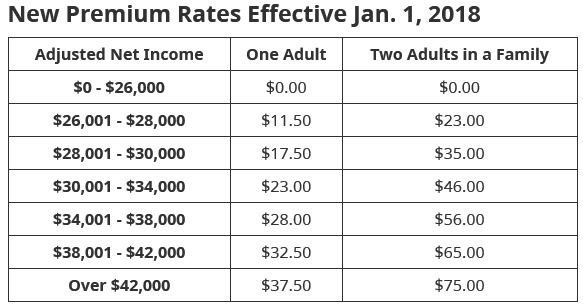
BC monthly healthcare insurance premium chart 2018. Image courtesy of the British Columbia Medical Services Plan. Click the image to visit their website.
Yet, as reasonable as those premiums are, the full cost of care is covered by the Medical Services Plan (MSP) whether those injuries/sudden onset disease/chronic disease or other maladies befall the patient while in British Columbia or anywhere else in Canada — or while travelling abroad.
Further, whenever wait times for patient care become extended within the BC (MSP) system, British Columbia’s Medical Services Plan authorizes Doctors and Surgeons to outsource patient treatment to Canada’s other provincial healthcare systems, or patients may be sent for treatment to the United States where MSP pays the full cost of treatment — even if said treatment costs more in the U.S. than it would in British Columbia.
Which is a typical model that developed nation healthcare systems follow.
Secret Ingredient #2 – Accepting Foreign Patients to Add Revenue to the NHS
Some developing nations also follow this model with their national healthcare systems (outsourcing and paying for medically necessary procedures they can’t perform in their own country, or when they can’t perform necessary procedures in a reasonable timeframe due to scheduling issues) and private insurers often shop for a better rate or timeframe for insured persons so that the patient receives expert and more timely care — which creates better healthcare outcomes for their clients.
So, why wouldn’t the UK government fund dozens of brand-new, state of the art, energy efficient NHS hospitals specially designed with additional capacity to accept planeloads of patients sent to the UK by foreign healthcare providers?
In that way, over time — and let’s be realistic, this is a 10-year programme to capture every possible foreign healthcare opportunity and payment from overseas healthcare systems — the NHS could begin to show a profit, thereby helping to subsidize the astonishingly high cost of providing healthcare services to Britons.
Even if accepting foreign patients earns the NHS only adds 5% to their revenues in year-5 of this proposal, that’s still 5% more funding than the NHS presently receives from the UK government.
Therefore, a massive new hospital spending programme is a sensible way to improve the NHS budget picture and help them fund the purchase of expensive diagnostic and other medical equipment. Not to mention better healthcare outcomes for Britons and for Commonwealth nation citizens who will travel to the UK to receive treatment paid-for by their respective healthcare insurer, whether private or public.
Let’s hope that British politicians are wise enough to see the value of such a proposition and that they’re larger than life — because that’s what it’s going to take to get the job done.
In previous generations British politicians were up to the challenges of their time; Wouldn’t it be great if this generation of UK politicians were up to the challenges of our time?
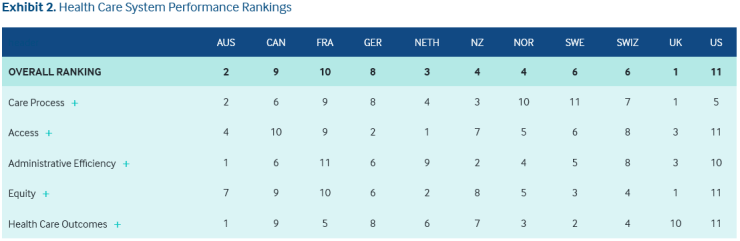
UK and 10 other countries, Health Care System Performance Rankings 2018. International Health Policy Center. Image courtesy of the Commonwealth Fund.
The above chart demonstrates why foreign countries could and should send their overflow patients to the NHS… as every year since rankings began, the NHS has scored either #1 or #2 in the annual Commonwealth Healthcare Performance Rankings.
Have a great week, everyone!
 Letter to Britain