Home » Posts tagged 'Theresa May' (Page 30)
Tag Archives: Theresa May

Organic Food: Can Britain Capture a Growing Market?
The freshest thing on many lips these days is organic food.
Yet, supply isn’t keeping up with demand even as prices for organic foods range from reasonable to outrageous and there isn’t a global standardized labeling system to inform retail shoppers that the produce is ‘certified organic’.
People want to buy food they know is organic and has passed rigorous government inspection to ensure the organic food claim is accurate — especially with some of those prices we see in the grocery stores (said every organic food shopper ever)
In the United States and Canada, big box grocery stores like Whole Foods, Sobey’s and others have rooftop gardens where they grow their own organic salad greens and other small vegetables. Everything from shallots to every variety of mushroom, cucumbers, tomatoes and more, are grown on the rooftops of those stores, or on rented space atop nearby buildings.

- Organic Foods / Rooftop Farming: Gotham Greens’ second greenhouse facility was built in 2013 in the Brooklyn neighborhood of Gowanus, on the roof of Whole Foods Market’s first ever Brooklyn store. The rooftop greenhouse, designed, built, owned and operated by Gotham Greens, measures over 20,000 square feet and grows over 200,000 pounds of fresh leafy greens, herbs and tomatoes each year. Image courtesy of Whole Foods. READ MORE HERE.

New York City and Chicago have some amazing rooftop gardens which offer public tours where you can see the food as it is being grown and speak to the people who grow your salad greens. Very cool stuff.
READ: Gotham Greens rooftop garden supplies organic food to Whole Foods stores in NYC (Whole Foods Market)
In Chicago, several indoor farming operations combine vertical farming with aquaponics. Small fish (tilapia) live in large holding tanks and their waste stream is the perfect organic fertilizer for plants. Eventually, the plants strip the nutrients out of the water, leaving only purified water to return to the fish tanks.
READ: Inside the Nations Largest Indoor Vertical Farm (EcoWatch)
The advantage of aquaponics is that no synthetic fertilizers are required to grow healthy organic food crops and millions of gallons of water are saved every year.
Panasonic grows 81 tons of organic produce every year in a nondescript 11,000 square foot warehouse in Singapore that meets .015% of all leafy green vegetable demand in the island nation and it hopes to reach a full 5% of the market within a few years.
The company is relentless in its pursuit to add efficiency to its indoor farming operation via their advanced electronic lighting and environmental control systems.
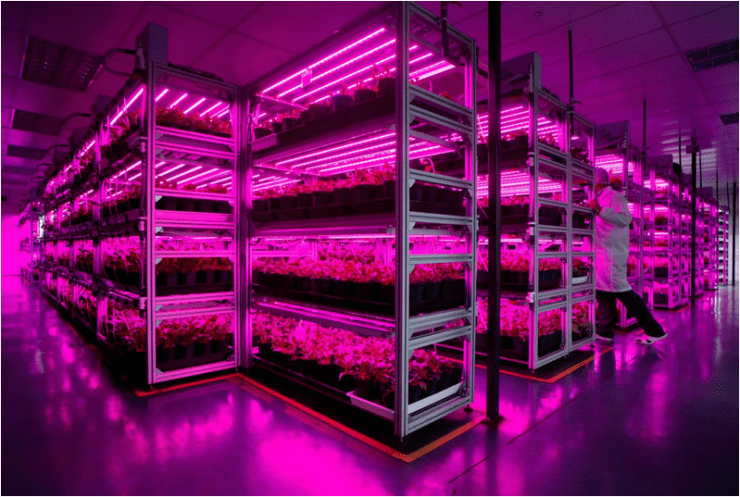
- Organic Food + Indoor Farming: Panasonic LED lights shine at a specific frequency that encourages the plants to grow quickly. The farmers also control the warehouse’s climate, including its humidity and temperature. Image courtesy of Edgar Su / Reuters.
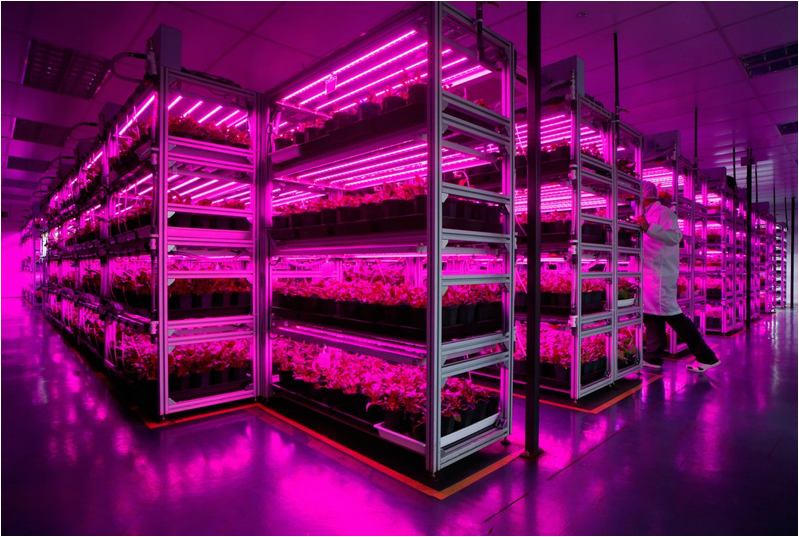
PHOTOS: Panasonic’s first indoor farm can grow over 80 tons of greens per year (Business Insider)
Taking things a bit deeper, Growing Underground grows its leafy greens in abandoned WWII-era tunnels beneath the City of London.
“Growing Underground is using a 550-square-metre area fitted with hydroponics that will produce about 20,000 kg of greens every year. As the business grows, so will the farm – they have 20,000 square metres to expand into. And their produce will be exclusively for consumers within the M25.”

- Organic Food being grown in London’s underground. Image courtesy of Wired UK and Christoffer Rudquist

READ: Growing underground: the hydroponic farm hidden 33 metres below London (Wired UK)
The above examples represent a fraction of the indoor farming operations worldwide and there is considerable room for growth in this market segment. Billions of pounds of produce are consumed every year globally and few countries have stepped up to ensure recognizable and standardized labeling to indicate these foods are 100% organic and are healthy for consumers.
It’s not only the benefits of organic food that we’re talking about here; Food that is grown locally doesn’t need to be trucked or flown hundreds of miles to get it to your grocer’s shelves. And locally grown food doesn’t need to be picked days prior to delivery and then warehoused for several more days prior to arriving at the market. It means you’re getting healthier, less bruised, and fresher produce. It also represents a drastic lowering of CO2 emissions per billion pounds of produce.
READ: Scotland’s first vertical indoor farm to be operational by Autumn 2017 (The James Hutton Institute)
It seems natural for the UK government to quickly agree on a standardized labeling system for organic food, much of which is grown indoors — which makes it easier to guarantee the produce is 100% organic and free from GMO cross-contamination or from chemical contamination such as pesticides, etc.
Once a standardized labeling regime is in place (and please, make the label graphics easy-to-read and easy-to-understand!) it will put UK organic farmers on the fast-track to grow their market within the UK, but also throughout Europe. And that’s just what this small but burgeoning segment needs.
Instead of getting their produce shipped in from Spain or the Netherlands, UK shoppers and restaurants will be able to buy UK certified organic vegetables and fruits that are grown within a hundred footsteps of the grocery store. And the jobs that are part and parcel of growing that organic food will be UK jobs, the energy required to power indoor farms will come from UK power companies, and the income taxes paid by British workers will be paid to the UK government, instead of workers in foreign countries paying their income taxes to their government.
It’s a ‘Win-Win-Win’ for British consumers and indoor farmers if the UK government can facilitate the exponential growth curve in locally grown organic foods. And if it doesn’t, countries like Germany and Denmark surely will.
By getting the standards and labeling handled early, organic food producers can then turn their attention to expanding their operations within the UK and begin making strong client relationships with grocery store chains from Iceland to Sicily.
Let’s hope that when the House of Commons resumes sitting this autumn that Theresa May will put a strong focus on growing a newish segment of the economy that still has plenty of growth potential.
Related Article:
- Futuristic farms to fight possible post-Brexit food supply problem (Sky News)

The Brexit Team: Swiss Watch or Contraption?
One of the most credible economic stewards to serve Britain in a long time is the inscrutable Philip Hammond who has done nothing but improve the UK economy since the day he was sworn in to the post. Which was merely an extension of him having been born for the job, it seems.
It’s not only that; Mr. Hammond’s word carries a lot of weight in foreign capitals, and in the EU his word is his bond. Soft-spoken, adroit and adept, Hammond is one of the darlings of financial capitals everywhere and it’s a great thing to see him in his element.
So began Prime Minister Theresa May’s summer vacation, where she and her husband (also named Philip) went off to Switzerland to take the mountain air and hold long and meaningful conversations at full stride up the Matterhorn.
Leaving the country in the capable hands of Philip Hammond must be a comforting thought for Theresa May as she and hubby blow past the tourists struggling to get to the top for a selfie. My advice: Just get out of their way or you’ll get run over. Seriously.
The Exchequer comments on post-Brexit Immigration
However wonderful it is having a powerful Exchequer, there is the temptation for them to overstep their bounds and cross over into the areas of responsibility reserved for the Prime Minister.
And just as predictably as that; Before Theresa May had gotten her first alpine air, Hammond told reporters, “there should be no immediate changes to immigration or trading rules when Britain leaves the EU in March 2019.” (Sky News)
It’s forgivable, and probably wise for Conservatives to be seen voicing the concerns of voters on both sides of Brexit. However, Exchequers should stick to their primary interest (the economy!) and let others, whose direct responsibility it is, to hold forth on immigration issues.
With Theresa away, the Remainers will play
While Theresa May gets some mountain air, the Remainers in the Prime Minister’s cabinet are clearing the air by presenting their side of Brexit — and that’s fine. But let’s make certain that fair play rules are enforced; Which means that cabinet officers publicly comment only on their primary area of responsibility. Only the Prime Minister has the authority to publicly comment on all matters, otherwise it looks like a circus.
Every misstep is celebrated in foreign capitals. People in the EU who may be opposed to Brexit are incredibly strengthened by each implied criticism directed towards the Prime Minister by members of her cabinet.
The entire period of Brexit is a highly unique time, a time where all Britons must pull together and come to the realization that many in the EU are fighting for a ‘Win-Lose’ outcome, an outcome where Britain loses vis-à-vis the European Union.
Meanwhile, the best of the Brexiters are fighting for a ‘Win-Win’ outcome where both Britain and the EU win. And those are the people I’m putting my money on.
Clear Lines + Clear Thinking = Positive Results
There’s nothing wrong with MP’s on both sides of Brexit informing the public about how they would proceed on any matter — as a sort of trial balloon to gauge public mood. That can be useful moving forward by keeping those who voted Remain interested and engaged with Brexit, and there is every opportunity that Remainers may come up with excellent ideas related to soft Brexit implementation within their field of expertise.
But greater care must be taken to avoid strengthening the hand of anti-Brexit forces in the EU, now that Britain has finally! asserted her rights.
Government ministers must draw the distinction between legitimate discussions about how Remainers (read: Soft Brexiters) or vocal Brexiters (read: Hard Brexiters) would handle any Brexit issue — and how the wrong sort of discussions or even the wrong tone of discussions could work against Britain in foreign capitals. The wrong public discourse works against both versions of Brexit.
Let’s not be naive. Each misstep by anyone in the UK government is celebrated at the EU Parliament and certain EU capitals. Whatever is going on behind the scenes within the UK government, a unified face must be presented to the world in order to obtain the best Brexit result.
Controlling the Narrative: Job #1 for Every Prime Minister
UK government ministers, and possibly even the Prime Minister herself may not yet realize the extent to which the world now sees the United Kingdom as a completely different entity. The UK no longer exists as only one of 28 EU members, and what the UK will eventually become, is unfolding every day like an onion being unpeeled.
Is the UK destined to become a nation of cross-talkers, mixed messages and unreliable partners? Or is Britain starting with a clean sheet to become all that she can and should become in the 21st-century?
Only the Prime Minister knows, as she’s the one holding the pen. Let’s see what script she writes.

This Week in Brexit: The Conservatives weak negotiating hand
One of the reasons I’m a Theresa May fan is that she took a highly principled position by calling an election prior to Brexit, presumably to further legitimize her premiership with voters and thereby gain a stronger negotiating hand heading into Brexit negotiations.
Before becoming Prime Minister, Theresa May had been an MP for 20 years and served as Home Secretary for 6 years, and only then was she named PM by the Conservative Party when former PM David Cameron stepped down. Which is to say, Theresa May is as legitimate as any UK Prime Minister ever appointed (but not elected to) the PM’s chair.
Nevertheless, at the most important political moment since the end of WWII, Theresa May decided to further legitimize her premiership by calling a snap election with the intent of causing her party to rally ’round her in time for the upcoming Brexit negotiations, thereby empowering Britain in its dealings with the European Union.
By any definition it was an admirable plan.
It Worked! (Sorta)
Except for the Conservative MP’s that didn’t campaign hard for her and were only interested in maintaining their position as a Member of Parliament, and excepting the millions of former UKIP voters — only some of them supported the Conservatives on election day.
All in all, a surprising result.
Perhaps three terrorist incidents in the UK within 90 days of the election changed the mood of the electorate, or maybe when confronted with an actual Brexit complete with veiled threats emanating from some EU capitals it’s possible some British voters felt cowed into lowering their Brexit expectations.
If so, that would be a shameful indictment on the British people, the people who succeeded admirably even after suffering horribly in two world wars and are a people who carry-on through all manner of terror attacks, social upheavals, recessions, and Britain’s famously inclement weather.
Now with a ‘weaker hand’ Theresa May must pull-off a reasonable Brexit
How to do more, with less? That’s the job facing Prime Minister Theresa May over the next five years.
It’s an unenviable position for a veteran British MP with 6 years as Home Secretary to her credit and 1 year as Prime Minister of the United Kingdom, who deserved better from her party and from voters.
At least 42.4% of UK voters agree with Theresa May (see BBC election chart here) which was a gain of 5.5% for the Conservatives since the last election when David Cameron became Prime Minister. The business community likes the progress on the economy, and she is highly regarded by foreign leaders. But still, that got her (only) 318 seats, which isn’t enough for a majority government.
She deserves better than she’s gotten.
Methinks there are strings being pulled in places that we know not…
But just for the record, let’s look at a July 17 poll result from an internationally recognized polling firm.

- One year on from the Brexit vote and business sentiment remains high (Says it all, doesn’t it?) Click image to enlarge.
Another chart for the doubters
One thing that Britons have every right to be proud of is the National Healthcare Service (NHS) and in recent years it has begun to score well in the prestigious Commonwealth Fund rankings. In fact, the 2017 ranking puts the NHS in 1st place over 10 other wealthy nation healthcare systems. But you’d never think it because (according to some) the NHS is falling apart at the seams.
Just as former PM David Cameron was rightfully proud of the 2013 Commonwealth Fund ranking (1st place) so Prime Minister Theresa May should feel proud of the 2017 NHS ranking (1st place) even as some of the countries named in the study improved on their 2013 rankings.
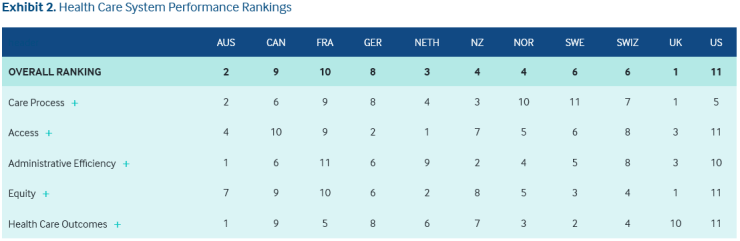
- UK and 10 other countries, Health Care System Performance Rankings, courtesy of the Commonwealth Fund (2017) Click image to enlarge.
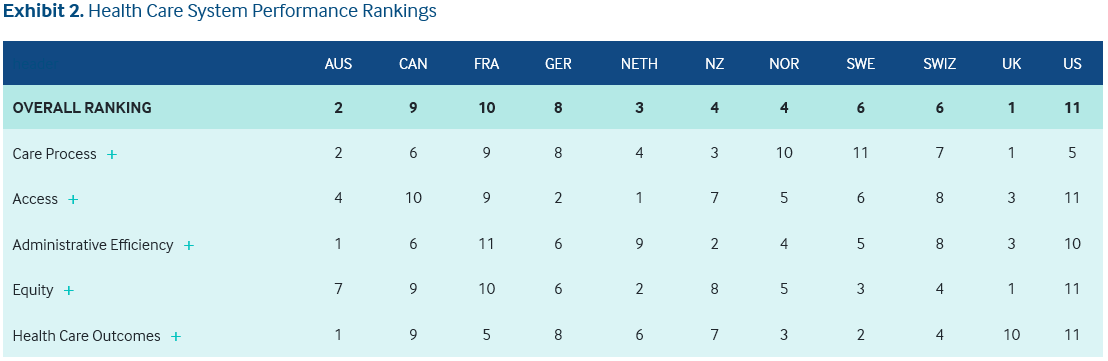
For comparison purposes, I’ve included the 2013 Commonwealth Fund ranking graphic below.

- The Commonwealth Fund 2013 International Health Policy Survey in Eleven Countries, courtesy of the Commonwealth Fund (2013) Click image to enlarge.

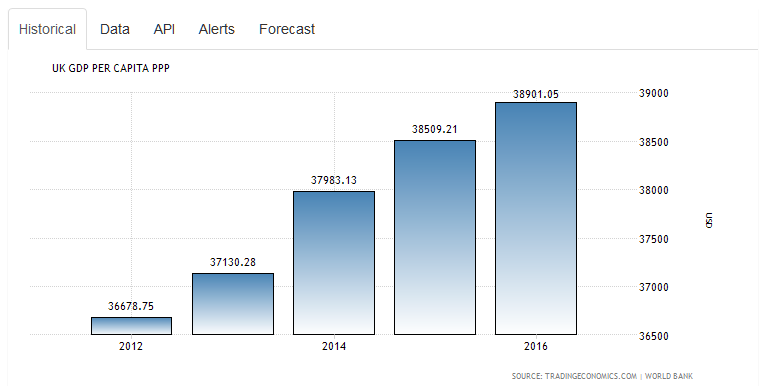
One more chart that uses actual facts to combat negative perceptions — shows how well the UK is faring
This chart shows GDP in Purchasing Power Parity (PPP) which illustrates that purchasing power of both UK citizens and expats is increasing — even though (according to some) the sky is falling every day!

- UK GDP per capita Purchasing Power Parity PPP. Source: tradingeconomics.com Click image to enlarge.
With all of that going for the UK in 2017 (and more positives that I haven’t included because I don’t want to drown you in charts) you’d think that Prime Minister Theresa May would get plenty of respect from her party, from certain media outlets and from voters.
But apparently in the United Kingdom, almost-perfect scores aren’t good enough to get the Prime Minister the majority she needed to allow the country to cruise through Brexit. And that’s a shame.
 Letter to Britain