Home » Posts tagged 'Theresa May' (Page 22)
Tag Archives: Theresa May

Time to Begin Planning for Life After Brexit
It looks like the so-called ‘Project Fear’ campaign has failed in its quest to force referendum after referendum until they got the answer they wanted (which to observers, seemed they wanted to stay in the European Union at any cost) and that Brexit will occur on March 30, 2019 as planned.
All that remains to be decided between the UK and the EU is whether future relations will be based on World Trade Organisation rules, or on a bilateral trade agreement that allows both sides to prosper while maintaining a reasonable level of protection for national sovereignty, for their respective economies, and is able to shelter startups or other businesses that may require some form of special treatment or protection.
Either UK and EU leaders are up to the task, or they’re not. We’ll soon know.
And if they aren’t up to the task, every one of them deserves to get the boot at the next election.
First on the Agenda for the UK
Of paramount importance for the UK are free trade agreements with its Commonwealth partners — agreements that automatically come into effect within 24 hours of the official Brexit date.
It’s important to begin with Commonwealth trading partners because if Commonwealth nations aren’t willing to sign bilateral trade agreements with the UK, why would other countries want trade deals with the UK?
(If I represented a non-Commonwealth country and the UK couldn’t get its act together enough to sign worthwhile free trade agreements with its own Commonwealth partners, I wouldn’t be interested in signing with the UK either)
Yesterday, Australia’s Prime Minister generously indicated his country will sign a bilateral trade agreement to automatically come into effect the day after Brexit, and New Zealand, Canada, India, and other Commonwealth nations have indicated they’re open to bilateral trade agreements with the UK too.
Therefore, it isn’t a reach to suggest that such agreements be ready for a signing ceremony the day after Brexit and that UK foreign direct investment (FDI) in those countries will thenceforth take an instant leap forward.
The time to get such negotiations done is NOW so that a simultaneous signing ceremony can be televised across each of the Commonwealth’s 53 capital cities at 00:01 (in the UK timezone) on March 30, 2019.
What a tribute to enduring relations between Commonwealth members. Such a historic moment!
Second on the Agenda for the UK
No later than 24-hours after Brexit (which puts us at March 31, 2019) the UK should have free trade agreements automatically coming into effect with every economy in the world — agreements that work for each country just as well as they work for the UK.
‘Win-Lose’ thinking is no longer an option in the 21st century and anything less than ‘Win-Win’ isn’t worth spit. In fact, unless trade agreements are ‘Win-Win-Win’ these days, their value is questionable.
FOR EXAMPLE:
If the UK offers a ‘Win-Win’ trade agreement to China, but Japan offers a ‘Win-Win-Win’ trade agreement to China; Which of the two countries will be China’s most favoured trading partner?
Obviously, Japan’s offer would win, and the UK offer would simply gather dust as Japan’s relationship with China surged forward.
These negotiations must occur NOW and be led with a high level of urgency by Prime Minister Theresa May and Secretary of State for International Trade Dr. Liam Fox, so that by April 1, 2019 the UK will have bilateral trade deals with every country in the world — that automatically come into effect the day after the official Brexit date.
Anything less than that stellar achievement should be considered by UK voters to be a mediocre performance by the (then) ruling party in the UK House of Commons.
The world wants quality UK goods and services both now and in the post Brexit era.

Transferability – The Solution to Systemic Bottlenecks in the NHS
Unfortunately for large healthcare providers like the UK’s highly rated National Health Service (NHS) people don’t always get sick near their local hospital. Rather, people will become ill, get injured, or encounter long-term illness everywhere throughout the United Kingdom regardless of where hospitals are located. Which is why some UK hospitals are full to overflowing while others have spare capacity.
One way to improve healthcare outcomes in the NHS is to incorporate transferability of treatment to relieve bottlenecks in the system.
Patients who can’t be treated in their local hospital due to lack of available capacity could be transferred to other hospitals in the UK where some amount of spare capacity exists and receive their treatment sooner than waiting for treatment at their local hospital. And even accounting for airline or rail tickets, possibly an overnight stay in a reasonably priced hotel in cases where the airline vs. operating room schedules don’t match, and for other incidental patient costs the health service would be required to pay, it would save the NHS money and dramatically improve healthcare outcomes for patients.
Patients who desire an upgraded hotel room could pay the difference themselves between the (covered by the NHS) standard room rate and the upgraded room rate.
When a patient has cancer, heart problems or other serious health issues, nothing is gained by making the patient wait for a treatment date in a hospital close to their home, because almost 100 per cent of the time those conditions will worsen as the patient waits for treatment.
Delayed treatment significantly increases treatment costs — because during the days, weeks or months of delay, the patient’s disease is certain to worsen.
Even those with slipped discs or other musculoskeletal impairments find their condition worsens over the amount of time their treatment is delayed. To say nothing about the suffering of the individual and their families while the person remains in a precarious health situation.
But if patients with serious conditions receive treatment sooner, healthcare outcomes for patients will improve and NHS statistics would improve because the disease or condition won’t have progressed as far in the case of faster treatment vs. waiting extra weeks or months for treatment at a local hospital.
Increase in Productivity
Workers who can’t work, can’t contribute much to GDP.
What is also true is that with faster treatment workers can return to work sooner and contribute to their company and by extension to the GDP of the United Kingdom.
Unhealthy people cost the economy, while healthy people contribute more. It’s therefore in the best interests of the government to get everyone the treatment they need with the minimum of delay.
Little Room for Improvement in the NHS
For an idea of just how highly the NHS is ranked in the world, please view the following chart courtesy of The Commonwealth Fund, an organization which ranks global healthcare systems via a number of metrics.
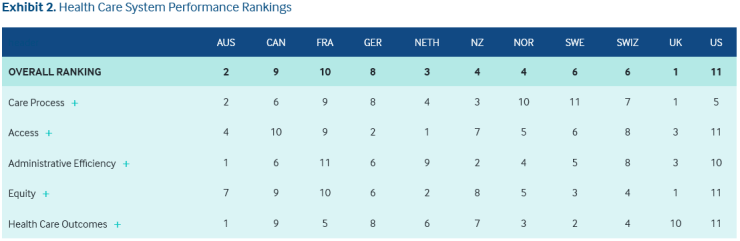
Health Care System Performance Rankings for the UK and 10 other countries. Image courtesy of The Commonwealth Fund.
It’s easy to see there is little room for improvement within the NHS, but Access (the ability to access treatment within a reasonable timeframe) and Health Care Outcomes (the success rate of treatment — which is often related to waiting times associated with treatment) could be significantly improved.
Scotland, Here I Come!
Some amount of transferability of treatment exists within the NHS at present, however, those in England tend to be treated or wait for treatment within England only. Scottish patients may be transferred to other hospitals in Scotland, and Welsh patients may be transferred to other hospitals in Wales. It’s likely a similar situation exists within Northern Ireland.
What would work to decrease bottlenecks in the NHS and thereby improve healthcare access and healthcare outcomes would be treatment transferability for patients throughout the entire United Kingdom.
Doctors could provide their patients with options for treatment when full transferability becomes the norm; (Example) “You can wait 6 weeks for treatment at your local hospital, or we can fly you to Scotland tomorrow, put you up in a reasonable hotel overnight and your operation will be scheduled for 7:00am the following day, and we’ll fly you home a day or two after the attending surgeon approves you for travel.”
For patients in severe musculoskeletal pain, or experiencing rapid cancer growth, or increasing difficulty in breathing or experiencing other serious symptoms, the sooner they can obtain treatment the happier and healthier they’re likely to be. That’s a win for patients, for doctors, for under-booked operating rooms in far-flung regions, for NHS statistics, and even for UK productivity stats and GDP.
There are so many ways to win with treatment transferability throughout the entire United Kingdom. It’s really the only systemic improvement left for the NHS.
Building more hospitals is expensive (and necessary in any case) but directing patients to underutilized hospitals (now, and even after more hospitals are built) can help patients towards sooner and better health while improving Access and Health Care Outcomes statistics for the NHS.

Brexit + Commonwealth & NAFTA Trade = Economic Powerhouse
Timid minds are wondering whether the UK should continue along the Brexit path that British voters approved in 2016.
But just imagine what kind of world it would be today if Winston Churchill had given in to timidity during WWII, or if Albert Einstein was too small a man for the job, or if Franklin Delano Roosevelt was too afraid of failing and thereby didn’t pursue his plan to ‘put a chicken in every pot’ in Depression-era America? We’d be living in a far different world now, wouldn’t we?
There is a thing about leaders and it’s this, if they don’t actually Lead they are useless baggage. And that’s all that needs to be said about that.
Prime Minister Theresa May was given a mandate by voters to take the UK out of the European Union, and whether it rains too hard on Sunday, or if Manchester United can’t seem to win a game, or even if the Russians are scaring us, Brexit must remain at the forefront of Britain’s To-Do List and everything else must be considered a distraction until the job is done.
How the UK can fulfill its proper role in the world
With a strong UK government the chips would fall into place rather quickly and completely bereft of excuses, the following would occur:
- Brexit (even a WTO or so-called ‘Hard Brexit’) or a sweet-for-both-sides Brexit would occur by the designated date of March 29, 2019.
- The UK would apply to join the (by then) recently renegotiated NAFTA accord — or perhaps all the parties would agree they’d be better served by partial UK membership in NAFTA. Hey, you never know until you try, but magic occurs when people of goodwill meet-up to plan mutual success!
- The UK would enter into trade negotiations with every Commonwealth member nation to see what the UK can offer those nations (expertise, financial services, high-tech) and what those nations can offer the UK (agricultural products, oil and gas, metals and minerals, perhaps even a source of low-cost seasonal labour for UK farms) and so much more! Again, you never know until you try!
- And remember, Theresa… the goal isn’t to say; “Well, at least we tried.” The goal is to secure a standardized free trade agreement, or a standardized low-tariff trade agreement with the Commonwealth nations and every non-Commonwealth nation — especially the NAFTA ones.
What’s to Gain?
By accomplishing those steps in the proper order, the UK economy would grow 5% over existing projections — or the government is doing it all wrong.
India alone will have 1.3 billion consumers by 2019, and the United States, the highest-consuming nation in the world, will have 331 million consumers by 2019.
Post-Brexit does not mean five or ten years after Brexit — it means one year after Brexit.
These goals are eminently achievable and there can be no excuses for not hitting these metrics by 2020.
Orchards full of apples will be missed for the sake of handfuls of grapes if the UK government is too ‘small’ for the job, or if it suffers from low ambition, or if because of timidity, it can’t grab the brass ring of destiny.
The time is now for the UK to take control of its future and to stop being distracted from the oft-stated goal of Building a Better Britain.
More power to Theresa May’s government for as many days, months or years they strive to meet the will of voters and continue to work to fulfill the UK’s rather obvious destiny!
 Letter to Britain