Home » Posts tagged 'Theresa May' (Page 14)
Tag Archives: Theresa May

Theresa May’s speech to the CBI: November 19, 2018
VIDEO: Theresa May speaks to the CBI on November 19, 2018
Copyright: Confederation of British Industry and BBC
Transcript of Theresa May’s speech to the Confederation of British Industry, November 19, 2018
INTRODUCTION: “Thank you very much. It is a pleasure to be back with the CBI again.
Let me start by thanking Carolyn for your leadership of the CBI as Director General.
And also welcome John Allan, who has taken up his role as President since I last addressed you.
I know John from his time on the Home Office Supervisory Board and I know he will make a fantastic contribution as President.”
SPEECH: “There is one paramount issue facing our country at the moment, and I know it is the number one concern of the CBI, so let me get right to it.
Last week the Cabinet agreed the terms of the UK’s withdrawal from the European Union.
We also agreed a draft outline of the political declaration on the future relationship between the UK and the EU.
Both documents were the result of many hours of negotiation between the United Kingdom and the European Union.
Together they represent a decisive breakthrough – but they are not the final deal.
We now have an intense week of negotiations ahead of us in the run-up to the special European Council on Sunday.
During that time I expect us to hammer out the full and final details of the framework that will underpin our future relationship and I am confident that we can strike a deal at the council that I can take back to the House of Commons.
The core elements of that deal are already in place.
The Withdrawal Agreement has been agreed in full, subject of course to final agreement being reached on the future framework.
That Agreement is a good one for the UK.
It fulfils the wishes of the British people as expressed in the 2016 referendum.
I have always had a very clear sense of the outcomes I wanted to deliver for people in these negotiations.
Control over our borders, by bringing an end to free movement, once and for all.
Control of our money, so we can decide for ourselves how to spend it, and can do so on priorities like the NHS.
Control of our laws, by ending the jurisdiction of the European Court of Justice in the United Kingdom and ensuring that our laws are made and enforced here in this country.
Getting us out of those EU programmes that do not work in our interests, like the Common Agricultural Policy and Common Fisheries Policy.
And that is exactly what we are going to deliver.
Let me say a little more about the first of those items – getting back full control of our borders – because I know that is an issue of great importance to the British people.
The United Kingdom is a country that values the contribution that immigration has made to our society and economy over many years.
And in the future, outside the EU, immigration will continue to make a positive contribution to our national life.
But the difference will be this: once we have left the EU, we will be fully in control of who comes here.
It will no longer be the case that EU nationals, regardless of the skills or experience they have to offer, can jump the queue ahead of engineers from Sydney or software developers from Delhi.
Instead of a system based on where a person is from, we will have one that is built around the talents and skills a person has to offer.
Not only will this deliver on the verdict of the referendum. It should lead to greater opportunity for young people in this country to access training and skilled employment.
And we want an immigration system for the future that everyone can have confidence in.
Yes, a system that works for business. One that allows us to attract the brightest and the best from around the world, more streamlined application and entry processes. And we are already taking action in that regard, introducing the use of e-gates for visitors from the USA, Japan, Australia, New Zealand, and Canada.
But it also needs to command the confidence of the public by putting them in control of who comes to this country.
That is what I am determined to deliver, and I look forward to working with you to achieve it.
So now we have agreed the Withdrawal Agreement it is important that we focus on the new relationship we want to build with the EU.
And that new relationship must set us on the path to a more prosperous future.
To do that, it needs to work for jobs right across our economy.
Because we are not talking about political theory, but the reality of people’s lives and livelihoods. Jobs depend on us getting this right.
And what we have agreed unashamedly puts our future economic success, and the livelihoods of working families up and down this country, first.
So we have agreed a transition period, to avoid a cliff-edge for business and to provide the certainty you need to invest.
On goods, the outline future framework agrees to the creation of a comprehensive free trade area with the EU, our biggest and nearest goods market.
Zero tariffs, no fees, charges or restrictions across all goods sectors, with an ambitious customs arrangement that respects both sides’ legal orders.
That is what our businesses need, and that is what my deal will deliver.
That is the right thing for the future of our country. Because while the world is changing fast, our geography is not.
Europe will always be our most proximate goods market and ensuring we have free-flowing borders is crucial. Skilled jobs rely on it.
Take the automotive industry. Since 2010 our manufacturing output has increased by 9%, but in auto manufacturing the growth has been 60%.
Nissan in Sunderland. Jaguar Land Rover in Coventry. Alexander Dennis in Falkirk. Honda in Swindon. Vauxhall at Ellesmere Port. Wrightbus in Ballymena.
These firms support tens of thousands of jobs – both directly and indirectly. Often they are at the heart of their local economies.
All rely on parts being able to flow across borders to support just-in-time supply chains.
The same is true for our food exporters and our supermarkets.
The deal proposed will work for all of them and sustain the livelihoods they provide to working people across the UK.
But the method that works best for goods would not be the right one for services and investment.
A world being made ever smaller by changes in technology presents different opportunities in the services sector, and that requires a different approach.
Because the UK is not just a European hub but a global hub for services – and our future success depends on us continuing to be so.
So we have agreed with the EU to negotiate a trading relationship in services more ambitious than any existing free trade agreement.
It will deliver a level of liberalisation that goes well beyond WTO terms.
All modes of supply will be covered and it will remove substantially all discrimination in the sectors it covers.
Regulatory autonomy will be preserved, but we will each ensure that our approaches are transparent, efficient and compatible as far as possible, doing all we can to avoid unnecessary regulatory requirements.
We will make appropriate arrangements on professional qualifications and right across the board – in digital, in financial services, in intellectual property, in transport, in energy – the agreement provides the certainty businesses need.
For the safety of all our people we have ensured that our close security and intelligence co-operation with the EU will carry on.
And for our whole economy, we have worked hard to deliver a deal that put jobs and livelihoods, prosperity and opportunity first.
That is what Brexit should be all about – getting a good deal that unlocks the opportunity of a brighter future for this country and all our people.
Over the last eight years, our economy has been transformed and we approach Brexit from a position of recovered strength.
Our public finances are in the healthiest state for a decade, with the deficit down by four fifths and our debt as a share of the economy now falling.
And businesses have continued to show their confidence in the British economy.
Last month Amazon announced that it would be opening a new office in Manchester, and they have plans to create 1,000 research and development jobs across the country.
Rolls-Royce announced 200 new jobs at their head office and manufacturing plant at Goodwood.
British firms won contracts worth £1 billion to support Royal Navy ships, supporting over 700 jobs.
And in September I was at a Zero Emissions Vehicles Summit, where industry announced over £500 million of investment that will create 1,000 jobs across the UK.
And today Equinix have announced a further £90 million investment in a new data centre to service growing demand for digital financial services in the City of London, bringing their total UK investment to £295 million this financial year – a vote of confidence in its future as the world’s premier financial hub.
But the most striking economic success story of the last few years has been the jobs miracle that sound economic management has delivered since 2010.
Youth unemployment has almost halved.
More disabled people in work than ever before.
The female unemployment rate has fallen to a record low.
And 1,000 more people have found work every day.
Last week we saw some more excellent employment numbers.
A record number of people are now in work – 350,000 more than a year earlier.
Over three million more since 2010.
And wages rose by 3.2%, the biggest rise in a nearly a decade.
Now I never forget what is behind those numbers: not figures on a spreadsheet – but real people.
It is the young person who has left school or college and swapped their pocket money for a wage they earned themselves by their own hard work.
They might still be living at home, and can afford to give their parents a little each week towards their board. And maybe even start saving for a place of their own.
It might be a parent, who is moving off benefits and is able to provide a better quality of life for their family. They could be able to take their first foreign holiday or get a new car.
Or an older person, who may have given up hope of ever working again, but who accessed training, learnt new skills, and now feels the rush of pride that comes with being able to make a contribution and be part of a team again.
Or someone with a disability, who has faced their whole life being told they didn’t have anything to offer in the workplace, who has been helped by the DWP’s Disability Confident scheme to access a new opportunity.
That’s the difference that having a job can make; it can provide a sense of purpose and dignity on which a happy life is built.
That is what businesses like yours provide to millions of people across the United Kingdom every day.
It is why starting a business, growing a business, and keeping it thriving and successful are some of the most socially responsible things you can do in life.
And it is why the deal we will strike with the EU has securing jobs and prosperity at its heart.
Now I got into politics to help people who want to work hard and do their best to have a fair shot and the chance to get on in life.
And I know that businesses have an essential role to play. Business can and should be a force for good in our world.
But at a time when many are questioning whether free markets and an open trading economy can work for everyone in society, business need to do more to win that argument.
It is not just a job for politicians: all of you must play your part too, by stepping up to demonstrate that you truly have a stake in the success of this country.
The very best way of doing that is by investing in the future of the next generation by giving them a chance to develop their skills and begin a rewarding career.
And the government will work with you every step of the way.
When I first became Prime Minister I immediately identified the need for government to step up and be much more engaged in shaping our economy to be ready for the challenges of the future – and so we set about developing our new Modern Industrial Strategy.
At a time of great change and technological transformation as we pass through a fourth industrial revolution governments have to think and act strategically, in partnership with business, to strengthen the foundations of productivity and build up our comparative advantages.
That means investment in our traditional physical infrastructure – roads, rail, air, and now also broadband and this government is doing that with record investment.
But for the UK it is also about our knowledge infrastructure and our human talent too.
So I want to harness the power and expertise of businesses to transform our skills base and drive up our productivity in the years ahead.
We have some of the best universities anywhere in the world, and after eight years of Conservative education reform, our schools are scaling new heights of achievement.
But technical education has not kept pace.
So we are transforming it in England through a programme of major and lasting reform.
High-quality T-levels will stand alongside A-levels as gold-standard qualifications – backed with an extra £500 million a year once fully rolled out.
They will represent a step-change in quality and ambition for technical education.
The average hours a young person spends learning on their vocational course will increase by over 50%: from 600 hours per year to over 900 hours per year.
There will be a clear route into higher-level technical training and apprenticeships, supported by a reformed apprenticeship levy.
New Institutes of Technology across England will help deliver T-levels, serving key sectors in their locality and helping to drive growth at a local level.
A crucial aspect of the new qualifications will be a high-quality industry placement to help young people gain the experience employers need.
Businesses will play a crucial role in delivering these placements, and I want every business leader here to think hard about what opportunities your company can offer to a young person to join your team for up to three months.
For them, it could be an amazing opportunity to build their skills, learn from your team, and test out what they have learned in an industrial environment.
For you it is an opportunity to build the pipeline of skilled young people coming into your industry – broadening and deepening your skills base.
And it is a chance to demonstrate your commitment to the communities in which you do business. And there is much more that business can do.
By investing in research and development you can help the UK become the ideas factory of the future, leading the world in new technology, turning scientific breakthroughs into economic rewards.
The government has set an ambitious target of increasing the UK’s R&D spend to 2.4% of our national income. Government is doing its bit to achieve that – but we will only succeed if business steps up and plays its part too.
In the budget last month we increased the annual Investment Allowance from £200,000 to £1 million – it is now for business to make full use of it.
By doing more to ensure greater fairness and diversity in the workplace, tackling the gender pay-gap, improving BAME representation in the workforce, you can tap into new talent and help restore faith and confidence in business as a great force for social progress.
As the gig economy expands, you can ensure that all workers are treated fairly and decently.
The CBI is a great partner and champion in making the case for this positive and forward-looking approach.
And in all of this, government will be your staunch ally.
We all believe in business as a force for good – and I want everyone here to work with me to make the most of the opportunities that lie ahead.
And those opportunities are real and substantial.
The key to unlocking them is getting a good Brexit deal agreed and delivered over the next few weeks.
That is my focus. My job is to get the best deal. Parliament must then examine it and do what is in the national interest.
And I know what that deal needs to do.
Deliver on the referendum vote by giving us control of our borders, laws and money.
Get the UK out of the Common Agricultural Policy and the Common Fisheries Policy.
Set us on course for a prosperous future where livelihoods are protected, our security is maintained, and our Union secured.
It was never going to be easy or straightforward.
And the final stage was always going to be the toughest.
But we have in view a deal that will work for the UK.
And let no one be in any doubt – I am determined to deliver it.
Thank you.”
Transcript courtesy of gov.uk

3 out of 4 Isn’t Bad Theresa May – But Your Brexit Deal Isn’t Worth Signing
Last week Theresa May returned from the continent with a 585-page Brexit proposal in hand that she says is worth signing so that Brexit negotiations can move forward to the ‘Future Relationship’ phase where the UK and the EU scope out what each side wants from the other over the next 50-years.
But is that appropriate when she’s attained only three of the four goals that 17.4 million Leave voters voted for in the EU referendum?
It seems Theresa May has done her best. Of that, there is no doubt.
Certainly, she has travelled many thousands of miles, endured being summoned to Brussels at 5:00 in the morning to discuss Brexit with her EU counterparts, has suffered through countless knock ’em down drag ’em out marathon negotiating sessions, been castigated in the world media and has faced down a fractious Conservative Party that should’ve had her back throughout the entire process.
And all of that added to the knocks that she receives in relation to the rest of her job — the non-Brexit-related portion of her Prime Ministerial duties. Being a British Prime Minister is tough at the best of times. More people want you to fail than to succeed. I can’t imagine why anyone would offer themselves up as an ongoing human sacrifice like that.
In short: adding Brexit to her brief, meant adding to Theresa May’s grief!
As unfair as it sounds, Theresa May, for all her good and admirable intentions has failed to deliver the Brexit deal that 17.4 million Britons voted for and in good conscience empowered the Prime Minister to accomplish.
Now Theresa May wants to skip past one of the four pillars of a successful Brexit and begin negotiating the future relationship with the EU. And that’s a non-starter.
As terrible as it sounds, Theresa May has failed to deliver what she promised to voters, to UK business, and to her party. So, does that mean she should resign? Does it mean her party should fire her and put someone else in 10 Downing St? Does it mean the acting Queen of the United Kingdom should ask for Theresa May’s resignation?
In a word, yes. (All three) But, first, let’s try to make Theresa May understand that she promised to deliver a fair and balanced Brexit agreement — one that included the four pillars of Brexit success — and that she still has work to do in order to be allowed by her party to proceed onto the next phase of the Brexit negotiations.
She’s been (mostly) fair with us and the British public has been (mostly) fair with her. The same applies to Conservative MP’s, to non-Conservative MP’s, the media, UK business, and in relation to other stakeholders in Britain’s future; She has been (mostly) fair with them and they’ve been (mostly) fair with her.
So, let’s continue to be fair to Ms. May and give her the information she needs to realize that 3-out-of-4 isn’t good enough and also give her our full support to empower her to bring home all four pillars of Brexit success — before allowing her to proceed any further with the Brexit negotiations.
If she can’t bring home a worthwhile Brexit agreement that will pass in the House of Commons, then the UK needs a new Prime Minister.
But before we take that drastic step, let’s pull out all the stops to give Theresa May every possible opportunity and all the support she needs in order to succeed in obtaining a worthy Brexit deal. She’s earned that respect from us.
The Four Pillars of the Leave Campaign
The four markers of success for Brexit were the reason that 17.4 million Britons voted to Leave the European Union. And only on the basis that Theresa May said she could attain those four goals was she hired-on as UK Prime Minister.
Hitting 3-out-of-4 of those goals wasn’t discussed.
If she had at the time of her hiring, mentioned that she could attain only 3-out-of-4 of those goals she wouldn’t have been hired to be the UK Prime Minister and someone else would’ve gotten the job. But we believed her, and therefore, she got the job.
The Four Pillars:
- Take back control of the UK’s borders and immigration
- Take back control of the UK legal system
- Take back control of the UK economy
- Take back control of UK trade
And Theresa May’s Brexit deal delivers only three of those points.
As the Prime Minister has said in recent days, her agreement will allow the UK to take back control over its borders and immigration policy, it will allow the country to take back control over its court system, and it will allow the UK to take back control over its economy.
But the deal she has handed in won’t allow the UK to negotiate free trade deals with other countries — and very much worse than that — there’s no end date for that portion of the agreement.
Theoretically and probably practically as well, the EU could keep the UK in a state of suspended animation — with the UK unable to write its own trade agreements — forever. And forever is a long time. Trust me on this.
Theresa May Has a Promise to Keep or She Must Step Aside
As horrible as it sounds, Theresa May has only kept 3-out-of-4 promises in regards to her most recent Brexit pronouncements, and if she can’t keep her fourth promise, she needs to step aside and let a new Prime Minister tackle the thing that couldn’t be done.
But first she should read a great poem by the poet Albert A. Guest:
Somebody said that it couldn’t be done
But he with a chuckle replied
That “maybe it couldn’t,” but he would be one
Who wouldn’t say so till he’d tried.
So he buckled right in with the trace of a grin
On his face. If he worried he hid it.
He started to sing as he tackled the thing
That couldn’t be done, and he did it!
Somebody scoffed: “Oh, you’ll never do that;
At least no one ever has done it;”
But he took off his coat and he took off his hat
And the first thing we knew he’d begun it.
With a lift of his chin and a bit of a grin,
Without any doubting or quiddit,
He started to sing as he tackled the thing
That couldn’t be done, and he did it.
There are thousands to tell you it cannot be done,
There are thousands to prophesy failure,
There are thousands to point out to you one by one,
The dangers that wait to assail you.
But just buckle in with a bit of a grin,
Just take off your coat and go to it;
Just start in to sing as you tackle the thing
That “cannot be done,” and you’ll do it.
As far as the rest of her premiership, Theresa May has done a fine job and until last week when she crashed a bit or ran out of steam, she was getting stronger and more focused every week since taking the job in July 2016, and therefore, should be accorded every respect should she choose to step down.
Few people have worked harder or endured such media spectacle and political grief and in British politics that’s saying something. All of that said however, the future of the country is more important than one Prime Minister no matter how admirably she has tried.
So, let us know your decision, Theresa. We stand by to help you reach a perfect 4-out-of-4 score — which is the only score the UK can contemplate in this case. And if you feel you can’t deliver what you’ve many times promised we wish you well in your future endeavours!
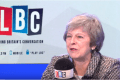
PM Theresa May Takes Calls on LBC: November 16, 2018
UK Prime Minister Offers Her Draft Brexit Proposal and Chaos Ensues!
Since Prime Minister Theresa May offered her 585 page draft Brexit document to the UK Cabinet, she has lost 2 Cabinet officials and 5 junior officials, with rumblings of perhaps double that amount to submit their resignations by Monday of next week, and further on this, ERG spokesman Jacob Rees-Mogg has submitted a Letter of No Confidence to the Conservative party executive.
It may be that Jacob’s letter to the party executive is the first of many such letters and according to the rules, once 48 such letters are received the party can then trigger a leadership contest to replace the Prime Minister. Which would be bad timing in the extreme for anyone who cares about obtaining a decent Brexit.
There is of course, only one problem with the draft document that Theresa May has proposed (and apparently the EU27 have approved) and it is that there is no mechanism for the UK to leave the proposed Customs Union before the Implementation Period ends in 2020, nor at any time following the Implementation Period.
Which means the UK will be stuck in the EU’s Customs Union and subject to their regulations indefinitely with no way out. A complete non-starter.
It’s been pointed out that it would be more difficult for the UK to leave that neverending Customs Union agreement than to leave the EU using the Article 50 clause of the Treaty on European Union. Scary thought.
The Present Chaos Will Continue Until PM May Makes a Move – Any Move!
Her choices are limited, but she must act quickly to minimize the slow motion car crash that is HM government at this time.
- She could resign, which is a terrible idea. Theresa May is the best person and is the person Britons voted for to carry out Brexit. Not only that, she’s more informed about Brexit than any of her ministers, and has been living in the eye of the storm moreso than any other House of Commons member since the EU referendum.
- She could do nothing and just let the present chaos continue, which is an even worse idea. More Cabinet Secretaries, ministers, department heads and even junior staff are poised to quit their posts in the coming days in the absence of positive steps by Theresa May to remedy the failures of the draft Brexit document.
- Theresa May could hit the talk shows to explain her Brexit proposal more fully to Britons, which is somewhat worthwhile, but that conversation will forever come back to the fact that there is no mechanism for the UK to get out of the EU Customs Union. Ever. The UK will forever be chained to the EU by the present draft agreement — even if Italy and Greece suffer a massive economic crash and take the whole works into a disastrous and long-lasting economic depression. In which case, so much for the Brexit dividend!
- The Prime Minister could put the present flawed agreement to a free vote in the House of Commons, which would prove to her how insufficient this draft proposal really is. (I don’t think she gets it) Remember, a free vote allows MP’s to vote using their own conscience and in such votes party whips focus on nothing but getting MP’s to the chamber so they don’t miss the vote. I doubt that it would muster 50 votes out of 650 at this point. Maybe much less, if she waits a week.
- Theresa May could put the present flawed agreement to a normal vote in the House of Commons and policed by party whips and it still wouldn’t pass. Not only that, she would then face the double jeopardy of more Cabinet resignations and the body politic even more frustrated with their politicians. The media… would love it though! It was nice to see them so happy to have some exciting news to report since the moment the Prime Minister released her draft proposal.
- The Prime Minister’s best course of action would be to add an end date to the document, present it to her Cabinet for their approval, and the next day present it in the House of Commons for a free vote — and it would likely pass with flying colours. However, it might not pass with the mandarins in Brussels. But a little bit of moxie is what is needed at this time, not more appeasement. I can’t stress enough, this option is the best option by a very wide margin. The EU is just going to have to like it — or make a counter-proposal — something they’ve done precious little of during the Brexit process. And why would they? So far, it’s been Theresa May negotiating with Conservative MP’s, with Labour MP’s, with her own Cabinet, and with herself. It’s time to put the EU side on the hotseat. At the very least, it will prevent an ongoing political bloodbath for Ms. May, it will help her to keep her job, it will put some of the responsibility for a successful Brexit on the shoulders of the EU side (as it should be, as it takes two to tango) and it is the most efficient way of getting past the present disastrous moment.
- If Theresa May feels she can’t do as I suggest in #6 above, she needs to resign OR she needs to declare that this draft proposal was stillborn and we are now onto a Hard Brexit which would save British taxpayers £40 billion. Or as much as £51.5 billion which is the number that is buzzing around over the past few days.
In the present political climate and with dissatisfaction by voters from all parties growing by the hour, Prime Minister May’s worst option is to do nothing.
She must act decisively, for her career, for her party’s fortunes, and for the good of the country. Sitting this one out just isn’t an option.
 Letter to Britain