Home » Posts tagged 'Prime Minister Theresa May' (Page 6)
Tag Archives: Prime Minister Theresa May

Theresa May Cuts a Deal With the EU
Just as Theresa May’s government appeared to be on the brink of collapse, the European Commission President asked the British Prime Minister to meet him in Brussels to jointly announce that negotiators had achieved the breakthrough to move forward to Phase II of the Brexit process.
EC President Jean-Claude Juncker said that “sufficient progress” had been made on Phase I discussions by December 8th, and the parties can now move on to matters of trade. Which is a great relief for some. For others, not so much.
Member of the European Parliament (MEP) Nigel Farage is on record as being against anything other than a complete Brexit with only the timeline to be negotiated.
Indeed, this is the position of many of the 17,410,742 people who voted for Brexit in the June 23, 2016 referendum that decided the United Kingdom’s future in, or out of, the European Union. And as negotiations drag on and as more political plays come to light courtesy of the ever-present media, the number of Britons who support Brexit are increasing, while those who supported it from the beginning want a faster, ‘harder’ and more complete Brexit.
If those who voted Remain were once within striking distance of preventing Brexit, their hopes are surely dashed now. ‘Off to Sgt. Pepper’s Lonely Hearts Club Band, are we?’
We hope you will enjoy the show.
So, What Did Theresa May Agree To on Behalf of All UK Citizens?
a) In May’s favour, it appears she agreed to continue negotiating with the EU, more than anything else
For now, nothing will change in the UK until Brexit day. The existing EU customs and trade union will continue to be in effect and the European Court of Justice (ECJ) remains the top court for the entire European Union, including the UK.
It’s also been reported that the ECJ will continue to be the court that rules over EU citizens living, working or studying in the UK for up to 8 years after Brexit — thereby giving European Union expats full access to the British court system — but also full recourse to the ECJ.
Essentially, EU citizens living in the UK will enjoy the protection of two court systems, while UK citizens will have the protection of only one court system.
Further, Theresa May has agreed that from December 8, 2017 until Brexit completes (whenever that is) the UK will abide by all laws and regulations passed by the European Parliament, the European Commission, and that the UK will accept European Court of Justice rulings. The final Brexit date has been suggested as March 29, 2019 but at this stage anything could happen including the government bodging the job and not getting voters their Brexit for another decade.
Goodness knows what kind of legislation the EU could pass during that time, yet the United Kingdom would be obligated to follow both the spirit and letter of that legislation. And EU citizens living in the UK would have more rights than UK citizens due to the ECJ deal. Let’s hope they don’t send an extra 5 million migrants to Britain annually (for example) as the UK would be obligated to accept them under the terms of this agreement.
If breaking the UK Treasury and maybe breaking the country is the goal of the EU (or if it ever ‘becomes that’ due to new politicians coming to power in the EU/EC) that’s surely the way to accomplish it. Certainly, the United Kingdom is in a precarious position from now until the day Brexit occurs.
Finally, there will be no transition period for Gibraltar.
Oh, and it Cost £40 Billion
Did I forget to mention that? Yes, they did too at their joint press conference, until a reporter asked about it.
Now the UK is obligated to pay £39 billion to the EU, and will continue to pay £8.6 billion (net) to the European Union budget until such times as the UK is no longer a member of the union.
Nobody has really said what the £39 billion is for — other than to say it covers the UK’s future obligations to the EU (which, reliable sources have said should only amount to £6.15 billion) and let’s keep in mind that the United Kingdom remains part-owner of many EC and EU buildings and properties — including the Parliament buildings in Brussels, Strasbourg and Luxembourg, and Britain’s share in the value of those and other EC/EU holdings exceed £9.65 billion.
Now for the Sweet Part of the Deal
Thus far, it sounds like a pretty one-sided deal in the EU’s favour — and many are now calling Prime Minister May ‘Theresa the Appeaser‘ after former British Prime Minister Neville Chamberlain who tried to ‘appease’ Adolf Hitler and his Nazis prior to Britain’s entry into WWII — for which he was unceremoniously booted from the Prime Minister’s chair never to return.
Others have called the deal a ‘sell-out’ of British interests, while other groups claim that Theresa May (an admitted Remainer) is trying to scupper the deal by using the high cost of Brexit to get more Britons over to the Remain side.
b) Maybe Theresa May is smarter than everyone suspects
What if it’s true that this deal is merely the deal that the UK will be forced to honour if UK and EU negotiators can’t arrive at a better deal that supersedes this deal?
There is real incentive for Theresa May and her Conservative Party to excel here because it is 100% certain they will lose the next election if this deal isn’t replaced by a better deal prior to March 29, 2019.
Prime Minister May will thereby have almost as much power as a wartime Prime Minister to get a better deal done, and that’s as good a way as any to move things along.
What if she now spends a year trying to negotiate a better deal knowing that at worst the present agreement is the worst that can possibly happen? A little brilliant, I’d say.
c) So she spends a year negotiating uphill with the EU trying to get a better Brexit deal
And in the meantime, the worst-case scenario is survivable by her country but unsurvivable by her party if they want to win the next election.
In the simplest terms, if Theresa May’s Conservative Party don’t fully cooperate with her to gain a better Brexit deal, they will by default, have handed the reins of power to Labour’s Jeremy Corbyn.
d) By virtue of the December 8th baseline agreement, Theresa May now ‘owns’ her party until March 29, 2019
Which means that the Prime Minister with her party helping, must find a way to improve on the present deal and they have one year to make it happen.
As one Machiavellian to another; Nice touch, Theresa.
Prime Minister Theresa May in the House of Commons on December 11, 2017 where she comments on the December 8th Phase I agreement with the EU.

Theresa May’s Full Plate of Issues: November 2017
It’s always a busy time for a British Prime Minister, isn’t it? Poor Winston had WWII to deal with and faced some very tough weeks, several British PM’s had utterly sleepless weeks during the height of the Cold War, and Maggie endured a backsliding economy, the ‘Troubles’ in Northern Ireland, the Falkland Islands debacle, and destabilization in Zimbabwe — and sometimes all in the same week.
Theresa May on the other hand, has “only” Brexit to worry about — complete with an increasingly hostile EU Parliament, Donald Tusk demanding evermore unearned money ahead of any agreement with the EU, a Conservative Party that offers lukewarm support, Cabinet members either not communicating well or going off in various directions, and uncertainty in Zimbabwe an important Commonwealth partner.
Sheesh Theresa, anything else?
Where Do We Go Now?
There are only two outcomes here; Either Theresa May crumples under the strain of things imposed on her by others, or she tosses the lot of them aside and rises like the British lion with steely eyed determination, hunting down each challenge and owning it.
And that will determine the Theresa May premiership for future historians.
Frankly, she’s been too nice, too accommodating, too gentle and too PC, and these are wonderful attributes for normal folk but terrible liabilities for sitting PM’s.
Such niceties are detrimental to progress for Presidents, Prime Ministers, Kings or Queens, Popes, and Generals and Admirals because at a certain point someone (anyone!) must stand up and make the tough decisions and be seen to be in charge by their own people and by the public.
And in Britain’s case it’s got to be the Prime Minister of the United Kingdom. Full stop.
Don’t Hold Back Theresa, Tell Us How You Really Feel!
When the day finally arrives that Theresa May unloads on everyone trying to keep her ‘down’ is the day she will finally rise above the problems that surround her — most of which aren’t her fault BTW — although by being too nice, too docile, too accommodating, she may have allowed them to continue longer than is healthy for her and her government.
Theresa May’s To-Do List, November 20 – 27
- Fire the most problematic Cabinet minister (whomever that is)
- Tell Donald Tusk to take a hike! (Yes he’s a very nice man, but he’s NOT working for Britain’s best interest, is he?) See you sometime after January 1st, Donald.
- Inform the EU Parliament that a WTO Brexit is now Britain’s default option (but if they want to work something out, sure, we’ll consider it)
- Call the CEO’s of VW, BMW, Mercedes-Benz, Seimens, and other notable EU companies to ask if they still want to export to the UK. (Just a friendly question, not one word more, not one word less) That will get them phoning their EU parliamentarians to ensure free and fair trade with Britain continues after Brexit!
- Invite Nigel Farage and other well-known Brexiteers to 10 Downing St. for a working lunch. (Why would she do this? Think about it. All she ever hears is the tired Project Fear / Professional Remoaner party line. A PM needs to hear both sides of every issue, every week, in order to make the best decisions for the country)
- She needs to inform her Conservative Party that lukewarm support just won’t cut it any longer and that party fortunes are falling due to the aforesaid lukewarm support. It’s time for the party to throw their entire weight behind Ms. May as the next 16 months are chock-a-block full and leadership contests are quite out of the question if anything of value is to be accomplished in that small-ish timeframe.
- Theresa May, more than anyone should be calling for free and fair elections in Zimbabwe to replace the possibly deposed but ailing 93-year old Robert Mugabe and offering as many UK and Commonwealth election observers as Zimbabwe requests. And she should dangle an amount equivalent to 1/10th the annual UK foreign aid budget in front of Zimbabwe in order to put some impetus behind the drive toward free and fair democratic elections there. Maybe Grace Mugabe will win one election which might smooth the transition to open democracy? You never know until you try.
- Ask the Foreign Office why the UK spends foreign aid money in any country that isn’t a Commonwealth member nation? It astonishing this has been allowed to happen. Keep the money in the family, Theresa! (No, it’s not her fault, it’s been going on for ages) Not one sterling in foreign aid should go to a non-Commonwealth nation. Ever. There are plenty of other countries to assist non-Commonwealth developing nations and it’s high time for them to step-up.
- Keep standing up loud and proud in the House of Commons. Some of Theresa May’s best days in office have been the recent PMQ’s where the PM dressed like the owner of the House of Commons and blasted anyone who tried to put one over on her. At the very least, give as good as you get Ms. Prime Minister.
- A lot less with the pleasantries Theresa, and a lot more banging your fist on the Cabinet table. If you don’t appear to be in charge, you’re not.
Don’t Let Brexit be ‘The Biggest Thing In The UK’ or the EU Will Own Your Narrative!
Sure, Brexit is important. But it’s only a means to an end.
What’s really important are the opportunities that come after Brexit, like the ability to trade with any nation in the world under rules decided through friendly bilateral talks.
It’s the ability to have a UK-only foreign policy. It’s the ability to allow only the people into the country that Britain wants and can afford to house and provide jobs — instead of being forced to accept millions of cast-offs from other nations, and to tailor Britain’s new infrastructure construction to actual, definable needs, instead of trying to provide enough appropriate housing during a time of staggeringly irregular refugee and economic migrant flows.
It’s the ability to create UK-only laws with the guidance of Britain’s best legal minds and with the approval of British citizens. (Although the European Court will continue to be an important source of guidance to UK courts, for a time)
And the UK won’t be sending £8 billion (net) annually to the EU just to be nice neighbours. ‘Oh Luvvie, those nice Brits filled up the EU Parliament wine cellar again!’
Finally, ‘The Biggest Thing In The UK’ will again be the opportunity for it to become all that it can and should be — without restraint. And that should be Job Number One for every UK Prime Minister. Always.

The Problem with Immigration
Immigration policy continues to appear in British headlines and excessive annual immigration loads in the UK are cited by many citizens as one of the main reasons Britons voted to Brexit the European Union.
Immigration has been a factor in Britain going all the way back to Roman times, and without it the United Kingdom wouldn’t be the thriving country it is today.
As with so many things in life it’s all about balance. The other important factor in this discussion is the implementation of immigration policy.
Some Immigration Stats for You
Britain has a population of 66 million people and it received 650,000 economic migrants and refugees in 2016 alone. Yes, it’s like that every year. Of course, people in favour of higher immigration levels will always refer you to the net migration number, which was 335,000 in 2016.
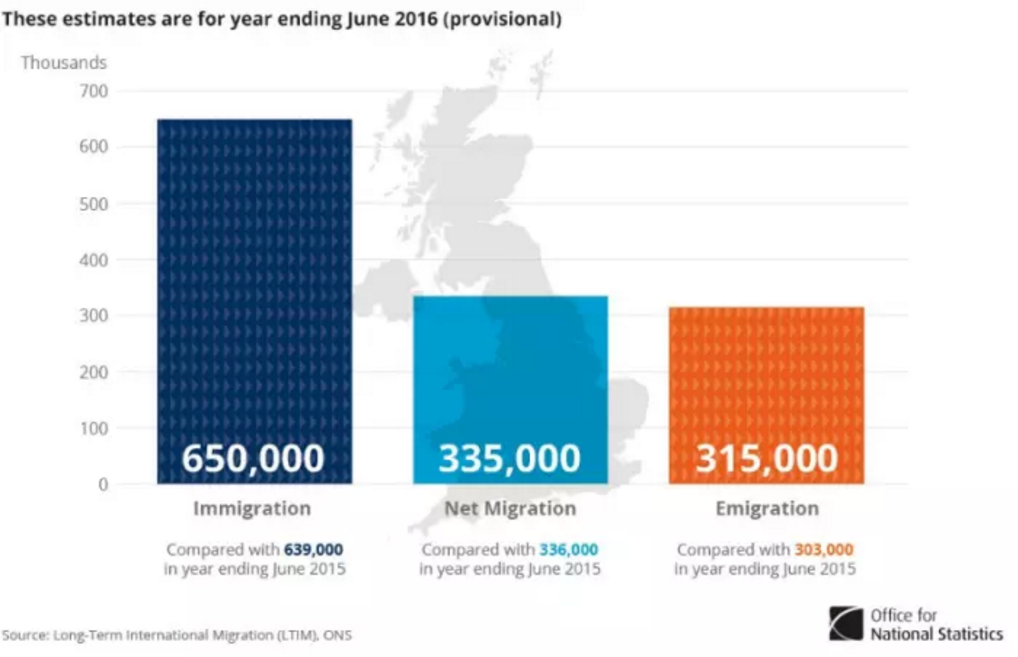
Immigration to Britain for year ending June 2016. UK Office for National Statistics.
Regardless of how you choose to calculate UK immigration, millions of Britons have a negative view on the topic and blame scarce jobs, higher infrastructure costs, longer wait times for government services and higher taxes on unprecedented immigration.
High numbers of migrants aside, the UK economy continues to grow and companies are making better profit due to the lower wages paid to immigrant workers.
No economist on the planet will dispute these two points; Higher immigration results in improved corporate profit and growing GDP.
Although it needs to be said that the economy can still grow with lower or even zero immigration when government economic policy is perfect and all the stars are aligned.
By now you’re concluding that high immigration loads are the lazy politicians way of improving the annual GDP statistic, increasing corporate profits, and (probably) increasing donations to their political party. Yes, every economist agrees with you.
Your Economic Status Determines Your Worldview
If increased profits for companies, higher GDP, and donations to your political party are all that matter to you — you’ve hit a home-run! as they say in America. Congrats to you.
Others disagree and cite quality of life issues — real life problems like increased unemployment among native Britons, longer wait times for government services, and the higher personal taxes that pay for the rapidly growing infrastructure required to sustain increased demand.
Your view no doubt, depends on which side of the unemployment line you’re standing on and your tolerance for higher taxes.
It’s easy to see where all this is heading in a decade or two; Those who view immigration negatively will join new, right-wing, anti-immigrant parties similar in concept to Germany’s nationalist AfD party, while big business and (some) politicians will morph towards Trump-style politics — resulting in a quantum shift to the right of the political spectrum among a majority of voters (but very important to note here) that shift will split between many factions.
And isn’t that exactly what has recently happened in Germany, Hungary, Austria, Poland and America?
Is Multiculturalism a Failure, or is Implementation to Blame?
It’s interesting to note that Canada has maintained a multicultural policy since the late 1960’s and that it’s been an astonishing success story with few Canadian detractors.
Led by former Prime Minister Pierre Elliott Trudeau, multiculturalism was sold to Canadians as a silver bullet to;
1) fix a falling Canadian birthrate,
2) to increase aggregate demand in the economy,
3) to attract the highly skilled workers that Canada desperately needed,
4) to access the low wage workers to do the jobs Canadians no longer wanted.
It was also touted to diversify the social fabric of the country and work to subsume the extremely stark (and sometimes hostile) divide between Francophones and Anglophones in eastern Canada.
The level of skepticism was high, but because multiculturalism in Canada was properly and thoroughly sold to Canadians and because it really did accomplish all that Pierre Trudeau said it would, multiculturalism succeeded across the country.
- NOTE: Canada’s population of 36 million is augmented by 300,000 new arrivals annually, while Britain’s population of 66 million is augmented by 650,000 new arrivals per year. (Remember, these are gross total immigration numbers that have little in common with *net* migration numbers)
In recent months, Statistics Canada has reported the number of visible minorities (people from other countries and their Canadian-born offspring) living in Canada now outnumber Caucasian citizens of European descent. And nobody cares.
In Canada, the colour of your skin, your choice of religion, or your cultural bias, simply don’t matter. If you’re there to work, raise a family, and agree to abide by Canadian laws, Canadians are happy to have you along for the ride.
And in Canada émigrés tend to do what is expected of them because everything about becoming a ‘landed-immigrant’ and (after a significant probationary period) a Canadian citizen, is explained to them prior to their acceptance by Citizenship and Immigration Canada.
Unlike in Britain, migrants to Canada are walked through the process every step of the way and because of that, they are far more likely to understand Canadian values and Canadian culture, and are therefore more likely to assimilate well and become part of the Canadian mosaic.
The importance of informing future British citizens about what is allowed and what is expected of them cannot be underestimated — and the same importance must be attached to informing today’s British citizens how to work with new arrivals. It’s everything in this discussion.
In Canada, the federal government wanted multiculturalism to work and that’s why it worked. Full stop.
Where Do We Go From Here?
It’s taken decades for the UK to get to this point and every party represented in the House of Commons has been a part of the process. Playing the blame game is a waste of time, so let’s just focus on what’s to be done from here.
There is little Britain can do about the 9 million foreign-born residents already in the country. Of course, the argument could be made that they could all be deported to their countries of origin, but that isn’t a realistic solution to a perceived problem; “perceived” because less than half of Britons report being concerned about the number of immigrants in the country.

In 2016, the total number of foreign-born residents in the UK surpassed 9 million. UK Office for National Statistics.
‘Scofflaws Not Welcome’
Some have made the case that UK expats convicted of any crime more serious than a parking ticket should be deported to their country of origin, forthwith. There are plenty of people already breaking laws in the United Kingdom, the country shouldn’t be importing more of them!
And at an annual cost of £110,000 per year/per prisoner to incarcerate lawbreakers, Britain could save itself millions of pounds sterling annually for the cost of a few hundred airline tickets. Doing so would set a precedent, the kind of precedent that gets noticed for all the right reasons, and work to a) convince certain types to not relocate to the UK in the first place, or b) convince those already in the UK and considering committing crimes to choose an alternate lifestyle — either way, it’s a win-win for Britain.
Foreign Resident Tax
Prime Minister Theresa May has indicated that foreigners living in the UK will be paying an annual fee to help pay a tiny portion of the infrastructure, services, and security costs on a per capita basis — likely around £100 per year, per expat. The PM in a recent PMQ period mentioned the fee would be “about the cost of a passport” but would be due on an annual basis.
Post-Brexit Immigration Policy
One great thing about Brexit is the government will be able to choose its own immigration policy.
Britain should cap total immigration at 200,000 per year, but it should favour highly skilled individuals from the Commonwealth and America who should be moved to the front of the line.
If there are any additional spaces to fill, then and only then should Britain consider allowing people from other countries to migrate to the United Kingdom.
Better Multiculturalism Guidance for both Immigrants and Citizens Going Forward
Proper guidance to help prospective immigrants choose whether Britain really is the country for them, whether they are willing to live by the laws and (Western) culture of Britain, and guidance on how to integrate into British society would smooth the path for migrants and citizens alike.
It’s not only new arrivals that need guidance. A bit of knowledge, understanding and sensitivity can go a long way to keep small irritations small, rather than to have them burst into the media spotlight in a way that makes all sides look mean-spirited, uncultured and uneducated.
Canada has a verifiable track record of success in helping both their new arrivals and their citizens to get along together and keep them focused on working for the good of the country and its goals.
If the Home Office hired one experienced Canadian multiculturalism / immigration officer per UK immigration office location (as an advisor) it could make the difference between a successful immigration policy and a failed immigration policy.
And that Canadian multicultural officer should assist in cases involving both new arrivals to the UK and long-time expats with unresolved issues.
Summary
Brexit affords the United Kingdom the opportunity to start with a clean sheet and design any immigration policy it chooses.
Incorporating some Canadian success seems appropriate, as does deporting criminal expats within a fortnight.
And an expat tax reminds expats it’s their privilege not their divine right to live in the United Kingdom — although if they’re contributing to the good of the country about as well as anyone else, the UK government and its people should be respectful of their commitment.
Related Articles:
- Canadians in the Dark About Immigration: Survey (Ottawa Citizen)
- Canadians Increasingly Comfortable with Diversity: Survey (Ottawa Citizen)
- CBC’s The National – report on the Changing Face of Canada (CBC TV News)
- Canada immigration explained: Answers to 9 common questions (CBC TV News)
 Letter to Britain