Home » Posts tagged 'International Trade' (Page 8)
Tag Archives: International Trade
China to UK rail link to revolutionize trade
by John Brian Shannon | January 4, 2017
The biggest boon to UK trade in this century has just arrived in London with astonishingly little fanfare.
China, the largest exporter on the planet, has just linked its rail system to the UK as part of its One Belt, One Road initiative to promote global trade.
“China launched its first freight service to the United Kingdom on New Year’s day, according to the China Railway Corporation.
The service runs from the Chinese city of Yiwu, in the country’s eastern Zhejiang province, to Barking in London. The journey lasts for an average of 18 days and more than 12,000 kilometers, according to a Chinese government website.
The route will “revolutionize the way freight is moved from China,” Mike White, director of its U.K.-based arm, Brunel Shipping, told CNBC via telephone.
He explained that freight transport by sea from China to the U.K. can take twice the time of the new rail link. Also, it offers the potential for “huge savings” on existing air routes.” — Justina Crabtree MSNBC
For China, the One Belt, One Road initiative will eventually surpass even Chairman Mao’s Great Leap Forward where 600 million people were lifted out of abject poverty in a herculean effort that lasted 40 years. China’s trade with Europe and the rest of Asia is about to leap forward by one order of magnitude, and every economy the rail line passes through will advance accordingly because of it.

UK – China trade will be revolutionized by China’s One Belt and One Road initiative first unveiled by Chinese leader Xi Jinping in 2013.
For the UK, there’s no excuse good enough (no, not even Brexit!) to miss the opportunity to become a major player in this global rail link. The Prime Minister should drop everything and phone President Xi Jinping to congratulate him on this vision that is EurAsia’s newest and most hope-filled reality.
UK government should purchase advertising rights TODAY on 20% of those rolling billboards
Theresa May should very politely but assertively ask for the rights to purchase advertising on at least 20% of the railcars that travel that rail line in the interests of promoting British tourism, British universities, British products, and to advertise the great development work that The Commonwealth does around the globe.
Let’s get the website URL’s painted on those railcars this month!
We can worry about adding fancy graphics, later.
And when people visit those sites let’s ensure that every language is available on the website, especially the languages that are spoken in the countries those railcars pass through. (Otherwise, what’s the point of advertising?)
Getting the UK Brand out there
Such railcars can be travelling billboards for the UK, with the message painted directly on the sides of rail tankers, boxcars, and other types of railcars. These travelling billboards will be seen by many millions of people every day of the year as they pass through cities, towns, and rural countrysides in 8 countries.
Instead of letting government departments and UK businesses approach China’s Yiwu Timex Industrial Investment Co. (the owner-operators of the rail service) in a piecemeal approach, this is the time for LEADERSHIP by a great Prime Minister!
“President Xi, I’ll take 20% of the boxcar advertising that travel along that route. Alright with you? Wonderful, here’s the money. I have the graphics specs for you now. We’d also like an option for a further 20% of your China-to-UK railcar advert space for our Commonwealth partners. Back to you in a week on that.”
THAT’S how you get things done! THAT’S how you Build a Better Britain!
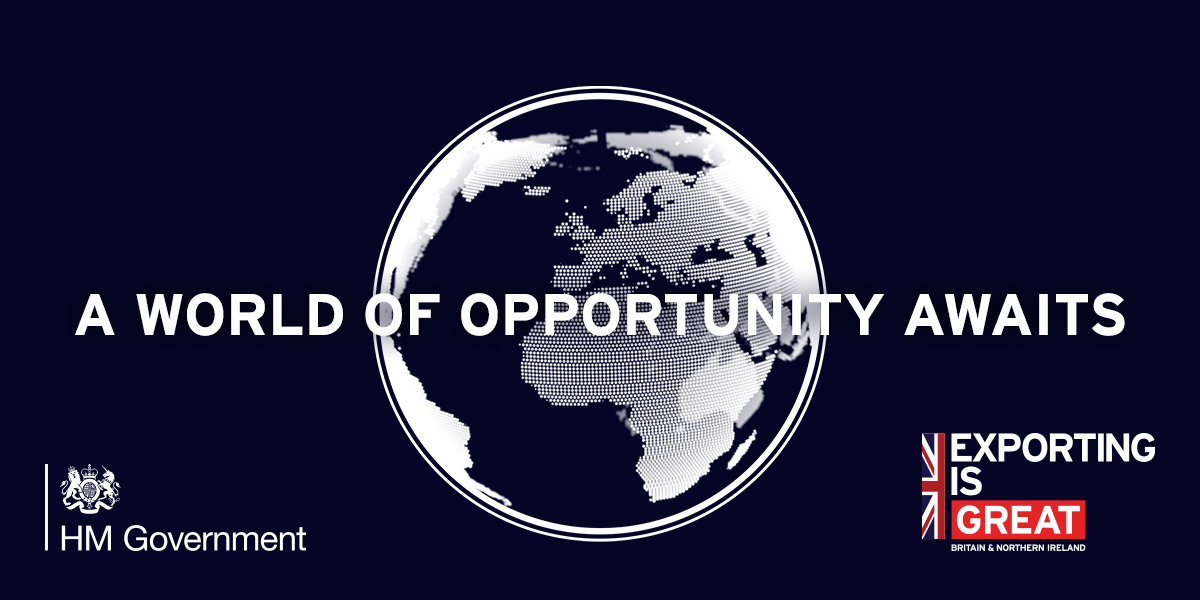
China – UK trade. Instead of “Exporting is Great” it could just as easily read “Aston Martin cars are Great” or “UK Tourism is Great” or “British Universities are Great” along with the relevant website URL.
Here’s another example of a splashy graphic that could be painted on the sides of China-bound railcars that depart from the UK. Of course, the text on the railcars should be written in every language spoken along the rail route.

UK Tourism – Heritage is Great! And so is advertising on the side of China-bound railcars.
Even the railcar advertising from earlier generations was effective. The following photo shows a railcar that hauled wheat and legumes with 1970’s-era Canadian government advertising painted onto the side of the railcar.

Britain could purchase advertising space to promote British industry and tourism on the side of China to UK railcars. — Image courtesy of Bill Grandin
It’s great to be diplomatic, and it’s great to have G20 meetings — but it’s opportunities like this that can result in virtuous cycles (economic multipliers) that drive an economy forward.
It’s the sort of thing that’s so important you must push yourself into the lineup, instead of being a wallflower and letting every other country get the prime advertising space, first. And we know that’s not the way politicians usually proceed, but as Winston Churchill used to say, “If you can’t get something done yourself, hire the best to get it done for you.”
With the greatest respect Ms. Prime Minister, you don’t need permission from the EU, you don’t need permission from America, you don’t need permission from British MP’s, and you don’t need permission from British business; This must be your top priority everyday until January 20, 2017 when U.S. President-elect Donald Trump is sworn into office.
Transforming Britain’s Trade Partnerships
by John Brian Shannon | July 25, 2016
Every day of the year, we teach others how to treat us.
If we consistently demonstrate that we’re reliable, we teach others to trust us. If we demonstrate that we’re untrustworthy, we teach others to avoid us.
And so it is with nations; By virtue of their policies and procedures and by their other actions, we teach the leaders of other nations and their corporations how to treat us, how to deal with us, or give them reasons to avoid us.
Pretty simple stuff. We learned this in kindergarten.
But sometimes we get so busy working in our business we forget to work on our business, and that message can lose place.
In the interdependent world of the 21st-century, the highest priority for British Prime Minister Theresa May and her ministers must be to work on our business and not get wrapped up in the daily routine, and thereby lose place.
The government of Theresa May is off to a good start and it’s too early to draw conclusions about her future economic policy, but governments of the past have ranged from inspired to dreadful in regards to steering Britain’s economy.
The United Kingdom is the 5th-largest economy on the planet. Let’s not lose that.
Partnership
We need to trade with stable regimes, it’s better for market certainty. They want us to be economically certain. We need them to be economically certain. In fact, economic uncertainty is our enemy and theirs.
Therefore, interdependence and symbiotic relationships will work best for us and for our trade partners.
If we ensure that engaging in trade with Britain always works to the advantage of our trade partners, we will teach them that more trade with us is their goal.
In this way, our trade partners become our best sales and marketing force. Handy, that.
Using Import Tariffs as Revenue Stream
Minimal standardized tariffs can offset government budget imbalances and balance of trade issues — and that applies not only to Britain, but also to it’s trading partners.
As a general rule, Britain should engage in free trade with every country and charge a standardized 5% tariff on every good that is shipped to the UK. And all countries that trade with Britain should likewise institute a harmonized 5% tariff.
Q: Why would Britain want foreign governments to charge a 5% tariff on British goods?
A: Each $1 billion dollars of British export earns that foreign government $50 million dollars in (import) tariff revenue.
But why would foreign governments shoot for British exports of only $1 billion per year / $50 million tariff revenue when those governments could collect $600 million in tariff revenue on $12 billion of exports from Britain?
Or ten times that amount. Let’s hope.
Easy Money
Therefore, the higher the gross total value of imports arriving from Britain, the more dependent the foreign government will become on that revenue. Which means they won’t want anything interfering with that simple and easy tariff revenue stream!
“Can you please continue to export to my country?”
“Why yes… yes we can.”
Anytime the UK government wants to increase exports, all it must do is ask each foreign government representative this sort of question:
“How would you like to be responsible for bringing home $600 million per year in tariff revenue, instead of the present $50 million per year?”
It’s so easy when they do the work for you…
Transformation
By asking for the cooperation of our trade partners in this manner, not only will UK exports realize a manufacturing boom, but the partner nation will see a tariff revenue boom — and that’s interdependence taken to the next level.
Symbiotic trade relationships become the path to prosperity for both partners.
If Britain does this, and does it well, every country in the world will become a highly motivated salesforce for British goods — your trade partners are practically marketing Britain’s manufacturing sector for you.
As the price of each imported item increases by 5%, it will spur domestic demand on account of UK-produced goods not having a price rise due to a 5% tariff.
In that way, domestic production will increase, which has several positive influences in the overall British economy; UK-produced goods will be incrementally cheaper in comparison to imported goods, increasing consumer demand for UK-produced goods, causing UK manufacturing sector unemployment rates to fall, and consequently the government will lower it’s unemployment insurance expenditures and receive higher income and sales tax revenue from those now-working citizens.
And that’s not all
In addition to those positives; The UK government gets a new revenue source to augment it’s spending programmes. In the UK, this translates into more funding for Britain’s highly-ranked National Health Service (NHS) and makes deficit-reduction a reality for the Exchequer.
Since the global financial crisis, the UK government has in addition to running a mild austerity programme, also run high budget deficits (8.5%) which simply accumulate as government debt — and that’s the last thing the country needs as the UK’s debt-to-GDP was already too high prior to the financial crisis of 2008.
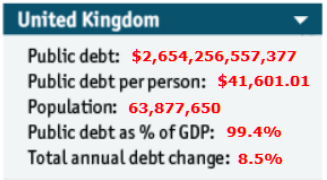
Global Debt Clock for Britain 2015. Image courtesy of The Economist’s Economic Intelligence Unit.
But with billions in tariff revenue helping to fund UK government operations, not only would deficits disappear and high public debt taper, there would be enough revenue left over to fund the ‘shovel-ready’ infrastructure projects that are unemployment-reducers, job-creators, and income tax generators for the country.
In economics, that is known as a virtuous circle. Which is a very wonderful thing.
Economists win Nobel Peace Prizes for engineering virtuous circles. Yes, it is that big a deal.
Investment
Tariffs should be seen by Britain and it’s trading partners as revenue generators.
Revenue from tariffs can fund deficit elimination, debt repayment, infrastructure and job creation or whatever gives the UK economy the best bang for the buck at that time.
Growing economies attract a lot of attention — the good kind. And every investor wants to invest in a winner.
By designing our economic fundamentals to mesh with the present economic moment, the UK could enjoy an almost unprecedented economic boom courtesy of the virtuous circles deliberately engineered into Britain’s economy.
Delivering on that goal should be our highest priority.
 Letter to Britain