Home » Posts tagged 'International Trade' (Page 6)
Tag Archives: International Trade

Is NAFTA a ‘Bad Deal’ for America?
There seems to be only one man in all of America who thinks the NAFTA agreement between the three North American economies is a bad deal for the United States. Which would be a very ordinary thing except that man happens to be the president of the United States of America. At least for now.
The one great thing about the American electoral system is that U.S. presidents can serve only two concurrent terms in office, so no matter how bad or popular a U.S. president is, he or she can stay in office for a maximum of 8 years. Although nothing prevents them from running for their old job once another president has served, other than the fact that American voters have never returned a previous two-term president to office.
That law is a tiny part of what makes the United States exceptional in the world. The most meritorious or most popular presidential candidates rise to the top — but unlike other countries where leaders can serve several terms in office — the American system is refreshed by new leadership every 4 or 8 years. And that’s what makes America great.
‘New blood’, a ‘new vision’, a ‘breath of fresh air’, or however you wish to describe it, occurs at regular intervals. No wonder America is exceptional! It’s too bad they don’t do the same thing with members of the Senate and Congress — and yes, even the office of Mayor in every U.S. city. If they did, the United States would be twice as exceptional on account of all that new blood and fresh enthusiasm.
Alas, because only one office in the land is refreshed regularly, America is great from the top down only — not up and down and in the middle — at least where governance is concerned.
Where Donald Trump is Wrong
President Trump arrived on the scene 13 months ago and with no particular government experience behind him, declared that many things are wrong with America and he’s just the man to fix it. And he may be that man, but only time will tell.
Yet, we’re seeing a man who sees symptoms and sincerely wants to treat the symptoms instead of wanting to solve the underlying condition that created the symptoms in the first place.
Certainly no one can fault Donald Trump for being enthusiastic about America, about America’s history in the world, and no one can deny he’s a breath of fresh air to the Oval Office.
But we need to have a conversation about the present symptoms in order to ascertain what the underlying condition may be in present-day America, and for that, we must travel back in time to see how America lost its way.
When Henry Ford was right: Creating the American middle class by filling a transportation need
Henry thought that ‘everyman’ should own an automobile, instead of only railway barons with their obscene personal wealth able to afford motorized transportation. During a downturn in Ford company fortunes, Henry decided to increase the pay of his workers to $5.00 per day, and was thereafter able to cherry-pick whatever workers he wanted from Louis Chevrolet, Buick, General Motors, Cord, Packard, and others.
Once Henry had created a whole new economic classification which later came to be called ‘the American middle class’ so many people bought Ford vehicles that 16.5 million Model T’s were produced in less than 20 years of production.
The moral of this story? Paying higher wages created ‘the middle class’ — a growing cohort of workers earning good wages and able to afford a car, which catapulted Ford’s fortunes into the stratosphere.
The Post-war Boom
Early in the 20th-century, the U.S. became the most powerful manufacturing nation in the world and surpassed even longtime patent leader Germany as the country that received the most annual patent applications.
This occurred only because of strong patent law in the United States. Any inventor with a worthwhile invention brought their idea to America for one reason — because out of all the countries in the world only the U.S. offered the maximum level of legal protection for their idea, design, system, or machine.
Even German scientists brought their ideas to America to have them registered with the U.S. Patent Office!
For countries other than America, the existence of a strong U.S. Patent Office created a ‘brain drain’ in their own countries, meaning that all their scientists and inventors headed to America instead of registering their contraptions in their home country.
Having received their patent protection in the United States, it was a natural step to have their inventions manufactured in America. Although not its primary mandate, the U.S. Patent Office was often excellent at matching inventors with such suppliers or manufacturers as they required.
It was a clear case of the American government passing the right legislation at the right time to attract the best and brightest in the world.
The moral of this story? Not a tariff in sight!
Because the postwar economy was booming and expectations were high, the Baby Boom generation went on a buying spree that is unparalleled in history
All of which worked to make all those patent-holders and their manufacturing companies obscenely rich. And good for them! When you work hard, you should see a positive return for your effort.
The favourable consequence of powerful U.S. patent protection combined with a huge and growing manufacturing base, created a booming economy and concomitant high consumer confidence which provided an unexpected result — usually about 9 months later.
Yes, during the boom times when one family member earned enough to support an entire family, the birthrate in America skyrocketed, creating even more demand as Americans began to have more children per fertile woman.
The moral of this story? When one breadwinner could support a spouse and up to 4 children, afford a new car every 3 years, a couple could own their own home via a 10-year mortgage and enjoy a refreshing vacation every year, the American economy was operating at full output!
American Foreign Policy in the Postwar Era
In the 41 years leading up to 1974, the Saudi government had been selling their oil to America for only the price of production (sans profit) as their contribution to the Cold War effort.
Interestingly, they were allowed to reinvest their cost of production payments in crude oil deliveries and refined oil products — so although they made zero profit on the crude oil as it came out of the ground — they were able to amass considerable wealth by speculating on oil stocks.
But that ended when it was perceived by the Saudis in 1973 that America was favouring Israel, a country that had never delivered billions of barrels of free oil to America.
When America’s oil supplier felt slighted, they decided that they wanted to get paid for their oil after all. ‘Oh, and, we’re pulling back on our Cold War commitment too.’
Which is why the Soviets thought they could successfully invade Afghanistan and tone the world’s opium supply down to almost zero.
When the Saudis suddenly wanted to be paid for their oil and they simultaneously lowered their Cold War commitment to America, the U.S. economy slowed.
With 20/20 hindsight, the ensuing economic disaster was only a symptom of a bungled foreign policy that caused a dramatic increase in new car registrations of foreign cars (with their better gas mileage) moving from 4% of all U.S. new car registrations in 1970 to 65% of new car registrations by 2017. Not only that, but up to 75% of the parts used in today’s American cars are made in Asia.
Therefore, the problem clearly isn’t NAFTA which came into effect in January 1994.
Here’s how that looks expressed as a math equation:
America -10 trillion dollars ∴ Japan +10 trillion dollars
(If you’re not into math, the symbol ∴ means ‘therefore’)
It could be argued that the United States took a highly principled stand on account of the people of Israel, but it was America’s decision alone, and it cost America 10 trillion dollars and poisoned relations with their oil-producing and Cold War ally, Saudi Arabia.
The moral of this story? The problem of offshoring American manufacturing jobs began in 1973 due to an American foreign policy decision which took place long before NAFTA had been created. Blaming Japan for American capital flight since 1974, or blaming NAFTA (which wouldn’t be created for 20-years) is disingenuous.
Social problems in 1960’s and 1970’s America: Racism, weak civil rights for women, and the Vietnam War worked to reverse America’s earlier gains
A lost generation occurred in the 1960’s where The People lost faith in their elected representatives, but they didn’t lose faith in the institutions of government.
President Carter worked to restore the faith the American people felt toward the executive branch of government by working on some very noble causes and meeting with some success. President Reagan moved things forward by strengthening the U.S. economy, infusing Americans with newfound confidence by offering loan guarantees to struggling American automobile manufacturers and dramatically increasing military spending.
The moral of this story? President Carter and President Reagan didn’t fix America by blaming other countries — they did it by empowering American citizens with tax changes and supporting American industry with loan guarantees to at-risk corporations, with huge defense spending increases, and plenty of positive exhortations about what made America great in the first place.
Every American, Canadian, or Mexican captain of industry wanted NAFTA back in 1994
If NAFTA was so grievous to be borne, why did almost every CEO in North America want NAFTA?

GDP growth in NAFTA countries since 1993 – NAFTA enacted January 1, 1994. OECD.
But some American Congressmen and Senators were nervous on account of the many U.S. job losses since 1974 and were concerned that even NAFTA could go wrong. And let’s face it, some members created a negative stir so that new U.S. president Bill Clinton would feel compelled to direct more federal funding to their districts in case NAFTA failed.
In reality, the only U.S. and Canadian companies that lived in fear of NAFTA were ones that didn’t keep up with the times. In the booming 1980’s and 1990’s economy, some companies decided they wouldn’t modernize and consequently continued to spend millions per month on electricity costs (for example) instead of reinvesting their (then record) profits in newer, energy-efficient factories or foundries.
For other corporations in the mergers era, it seemed a time to slow capital spending in order to maintain high profit margins and pay record-high dividends to their shareholders. But when the bull market finally came to its end, many businesses were suddenly cash poor and couldn’t afford a new, energy-efficient factory or foundry. Which was brilliant tactical thinking, but abysmal strategic thinking.
So… the question is; If corporations employ poor strategic thinking, should taxpayers be forced to bail them out?
Why should U.S. taxpayers bail out industries that choose high shareholder returns over sound financial management?
In the 1970’s and 1980’s, some American automakers needed the federal government to subsidize them with billions of taxpayer dollars to save them from implosion. That’s only one example out of thousands of U.S. companies that accepted or have lobbied for federal subsidies. Canada is just as bad as the United States on this point. Governments in both countries spend more on corporate welfare than they do on citizen welfare — times two!
Now in 2018, President Trump wants American taxpayers to pay even more for their cars (and anything else made of steel or aluminum) via a 25% tariff on steel imports and a 10% tariff on aluminum.
For one example, Trans Canada Pipeline will be forced to pay the tariff on the steel pipe for the proposed Keystone XL pipeline. Although steel is a small part of the overall cost of building a pipeline, the cost of the multi-billion dollar project will now rise by 5% or more. Just for comparison, 5% on 10 dollars is 20 cents — but 5% on 5.4 billion dollars adds 270 million dollars to the overall project cost.
The moral of this story? While Donald Trump’s motives are obviously ultra-pure, tariffs are simply a de facto form of taxation that U.S. citizens will pay because a few American corporations preferred high profits/high shareholder returns over competitiveness
Is there ever a good case for tariffs?
In a word, yes. Everything that’s imported into the U.S. (or any country) should face a globally standardized 5% tariff because every government needs money to improve port facilities, to streamline customs, and to maintain the transportation corridors that are essential to trade flows.
Even countries with free trade agreements like the NAFTA countries should institute a standardized 5% tariff on every good that crosses their border — and be required by legislation to use that money to improve transportation corridors and border security.
Consumers would find that presently high tariff items would drop in price, and zero tariff items would rise by 5%, but the trade-off would be astonishingly better roads, bridges, tunnels, rail links, airports and seaports, complete with better security. Every citizen would like to spend fewer hours per week stuck on congested highways, in airports, and enjoy faster and more secure delivery of goods.
Suddenly we wouldn’t be talking about ‘trade wars’ we’d be talking about improved trade, improved infrastructure, and a complete standardization and levelization of tariffs between every country.
And instead of heated rhetoric from politicians, we’d become more efficient throughout our countries and less efficient corporations wouldn’t continue getting rewarded for not re-investing in their businesses.

How to Resolve the Northern Ireland Border Question
Unlike the south of Ireland which broke away from Great Britain in a gradual process that began in 1921 and completed in 1949, the 6 northern counties of Ireland remained loyal to the United Kingdom over the past 477 years and they continue to play an integral role in shaping the future of the UK and The Commonwealth.
Now that Brexit decisions must be made, the UK is blessed by Northern Ireland wanting to remain a part of the United Kingdom.
‘A friend in times of need, is a friend indeed’ and the government and the people of Northern Ireland must always be respected by other UK citizens, in legal matters, in defence policy, in the House of Commons, and by the Monarchy.
EU Designs on Northern Ireland
It’s completely understandable that the EU might attempt to pry Northern Ireland from the UK during Brexit negotiations — which is quite a different thing than the UK agreeing that they should be allowed to get away with it! Yet, if British politicians are clumsy and treat Northern Ireland poorly, it isn’t out of the question that Northern Ireland could leave the United Kingdom.
For now, the EU is making noises about how much easier trade could be in the post-Brexit timeframe if the UK and Northern Ireland would simply give up and allow the EU to annex Northern Ireland. And to uninformed people it could pass as a plan to streamline Brexit negotiations and was probably designed to appeal to low-ambition politicians and uninformed UK citizens who might be tempted to agree to such a (treasonous) plan.
Were the situation reversed, of course the UK would try the same stunt. But the people of Northern Ireland have 477 years of history with the United Kingdom and (thankfully!) it appears they want to continue as an important part of the country.
Therefore, whatever it takes to rebuff the EU position on Northern Ireland, and whatever it takes to rebuff the Republic of Ireland’s position on Northern Ireland — it must be done, with no shirking nor excuses.
A Modest Proposal
Perhaps, instead of skillful EU negotiators maneuvering the UK into a situation contrived to make the UK the bad guy in all of this (keeping in mind it is unseemly to suggest Northern Ireland should leave the UK for the sake of EU convenience in the first place!) a helpful proposal could steer both sides towards a mutually beneficial agreement, thereby avoiding any unpleasant diplomatic scenes. Which would only serve to poison relations between the two blocs for decades.
As Erwin Rommel said; “Don’t fight a battle if you don’t gain anything by winning.” Fighting over Northern Ireland would cost both sides plenty, therefore, it’s silly to fight when the losses would counter the gains.
Rather than UK Prime Minister Theresa May being maneuvered into a situation loaded with bad optics, she should offer a plan that respects Rommel’s brilliant thinking and create an agreement that works for both blocs.
A One-Sided Border
On the UK side of the border
- The UK side of the Irish border should be free of manned border crossings.
- Signposts should inform travelers they are crossing into the United Kingdom and are expected to abide by the country’s laws and regulations for as long as they remain in Northern Ireland or any other part of the UK.
- Cameras and other technology could be deployed throughout Northern Ireland — especially near border areas — near roads, rail lines, airports, seaports, and in agricultural areas far from normal transportation corridors.
- A 1000 ft wide strip of land (on the UK side of the Irish border) should be cleared of trees, homes, buildings, large boulders and other landmarks along the entire 310 mile border, and be planted with low height crops to make it easier to catch (potentially) hundreds of thousands of illegal migrants crossing into Northern Ireland for whatever purpose, whether innocent or malign. Sophisticated audio-visual and thermal equipment — complete with face-recognition technology to identify everyone crossing the pastoral land between the two blocs — should be mounted atop wind turbines or other large poles at half mile intervals within that 1000 ft wide strip to see everything and everyone who crosses.
On the EU side of the Irish border
- Normal border stations on all road, railway, airports and seaports.
Information Sharing and Infrastructure Notes
Information sharing between the two sides would help both sides alleviate concerns about illegal crossers from either side, while helping to defray surveillance costs for both blocs.
The UK should build robust border crossing infrastructure (complete with the gate left in the ‘open’ position) but leave the buildings unmanned — except during extreme weather events or in the case of civil emergencies in either the Republic of Ireland or Northern Ireland.
Also, if tens of thousands of migrants or refugees began streaming into Northern Ireland every week, those pre-built (and ready to use within minutes) border stations could be put to good use, offering an official location to verify the identity of new arrivals and to issue instant and legal UK documentation of some sort (that could be time-limited or have other conditions assigned to it) to help speed the migrants on their way.
Summary
It’s in the interests of all sides to agree a ‘Soft/Hard Border’ plan where one side has an open but heavily monitored 1000 ft wide buffer zone complete with border stations that could be put into service whenever required — and the other side to have regular border crossings that feature typical border crossing infrastructure.
It’s a way to protect citizens of both countries and helps to share the burdens of operating the only common land border between the two blocs. It’s a way that both the UK and the EU can move past the present awkward moment towards an ever-improving diplomatic and trade relationship.
Every remaining issue between the two blocs is less important than a silky smooth and useful (to both sides!) border arrangement.

‘No-Deal’ Brexit scenario would cost both UK and EU billions
A new report by a prestigious polling firm says that a so-called ‘No-Deal’ WTO-style Brexit will cost one EU country €5.5 billion over the next two years, as opposed to a Brexit with a trade agreement where losses for that country would likely total €1.5 billion over the next two years.
That country is the Republic of Ireland.
“A hard Brexit could cost the Irish economy more than €5.5 billion over the next two years, a government-commissioned report has said.
A “soft” Brexit including a transition arrangement would cost less than €1.5 billion over the period, highlighting the importance to Ireland of the UK’s withdrawal talks with the EU.
The study by Copenhagen Economics, which examined four possible scenarios, also warns that the UK will probably take at least five years to implement new trade agreements, complicating Irish efforts at contingency planning.
[Ireland’s ‘Taoiseach’ which is the official title of the Irish Prime Minister] Leo Varadkar said last night that a comprehensive free-trade deal with the UK would be the best way to avoid a hard border. After a meeting with Theresa May, the UK prime minister, he said: “We both prefer [the option] by which we can avoid a hard border in Ireland, and that is through a comprehensive free trade and customs arrangement.
“That is the best way we can avoid any new barriers — north and south, and also east and west.”” — The Times
Other EU Nations Would Take a Hit in the ‘No-Deal’ Scenario
We can extrapolate that other EU countries would also take an economic hit in a ‘No-Deal’ scenario, but due to their much larger economies when compared to Ireland, such losses would amount to tens or even hundreds of billions over the same two-year period. Just think of all those German cars that wouldn’t be sold in the UK due to the higher tariffs that would automatically be imposed on EU countries in a ‘No-Deal’ Brexit!
Almost every country in the world uses WTO rules as the foundation of their trading relationship with other countries (but important to note) those same countries also diligently pursue bilateral trade deals with their important trading partners that allow both sides to legally sidestep the more costly WTO tariff ruleset in favour of something that works better for both partners. (And that trading relationship/tariff structure can be anything the two sides want in regards to any trade that happens between them)
So if country A and country B decide they want to trade, they’re completely free to build a better tariff structure than the comparatively expensive WTO ruleset, and that agreement will thenceforth supercede the WTO tariff structure. However, it only applies on trade between those two countries — the rest of their trade with the world would still be conducted under the auspices of the WTO.
It’s a pretty basic thing. Countries that do anything more than a smattering of trade between them negotiate bilateral free trade agreements to bypass the more onerous WTO trade rules and tariff regime.
There’s Still Time to Negotiate a Trade Deal with the EU
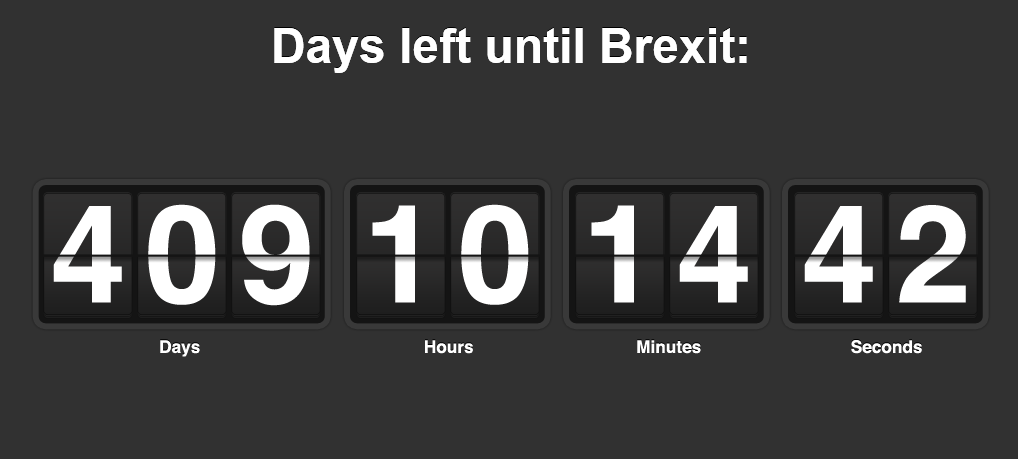
How many days until Brexit? Image courtesy of HowManyDaysStill.com
As of this writing there are 409 days remaining until Brexit and either we will have a trade agreement with the EU, or we won’t. If not, it will be costly for both sides, but more costly for the EU by one order of magnitude!
However, saying that there are 409 days remaining ’til Brexit — isn’t the same as saying there are 409 days left to negotiate a free trade agreement. Far from it!
The two sides have 258 days to arrange a free trade agreement. Let’s hope our politicians (and theirs) are up to the job (and if not, why are we paying them?) otherwise almost everything that citizens and businesses purchase will become much more expensive on both sides of the English Channel in the post-Brexit timeframe.
UK Prime Minister Theresa May has stressed that October 29, 2018 is the last date that both sides can agree a trade and customs deal before the UK must begin readying for the implementation of WTO trade rules. And on that point both sides agree. Even six months (during the period from October 29, 2018 to March 29, 2019) would barely suffice to put in place the necessary measures and standards to allow industry to prepare for life after Brexit.
UK and EU voters should remember who did, and who didn’t, get a free trade agreement signed when they head to the polling booth at the next election.
Related Articles:
- Day 548: Pass the Eggnog and Where Are We on Brexit?
- Theresa May + Customs Union = Conservative Coup?
- Theresa May’s New Year of Hope
- Brexit: An Opportunity to Create a Better UK / EU Relationship?
- UK Prime Minister Cuts a Deal With the EU
- Should the UK’s Theresa May Consider a 2nd Brexit Referendum?
- Irish border remains biggest barrier to orderly withdrawal from the EU
 Letter to Britain