Home » Posts tagged 'GDP' (Page 2)
Tag Archives: GDP

Will Theresa May and Donald Trump Meet the Existential Challenge of Our Time?
by John Brian Shannon | January 23, 2017
UK Prime Minister Theresa May has been invited to the White House on January 27 to meet with the new American president, Donald J. Trump.
It’s always an honour to be the first invitee of the new president, and the timing couldn’t be better as the Western economic order is beginning to churn.
In the West, the past 70 years have been a relatively stable era with increasing wealth (although since the Reagan-era tax cuts, obscene inequality has become a destabilizing force) and social mobility has increased dramatically since the creation of the internet.
This combination could prove extraordinarily useful to motivate leaders to provide the kind of leadership required of the times — or 2017 could prove to be the pivotal moment in the unravelling of the Western democracies.
President Trump wasn’t elected U.S. president because American citizens were bored by the Democrats.
Americans voted Trump/Pence to overthrow the existing plutocracy in Washington, not to overthrow foreign governments.
Regardless how many Middle Eastern conflicts the West prosecuted over the past 13 years, the rich keep getting richer and the poor keep getting poorer. But this time the problems are here at home, not in some faraway country.
Americans voted for Barack Obama (2008 and 2012) and now Donald J. Trump (2016) in large part to stop the unfolding economic disaster in the West. Britons may have held similar ideas to American voters about a sustainable economic plan when they voted for Brexit.

Will Prime Minister of Britain Theresa May and President of the United States Donald Trump work together to solve the existential challenge of our time? Image displays the share of the world’s total wealth for the Top 1% vs. the Bottom 99%. Image courtesy of OXFAM.
The chart below (from 2010) reveals the bottom 80 percent of Americans share just 7 percent of the nation’s wealth, but it’s much worse now (in 2017) and this phenomenon is no longer confined to the United States.
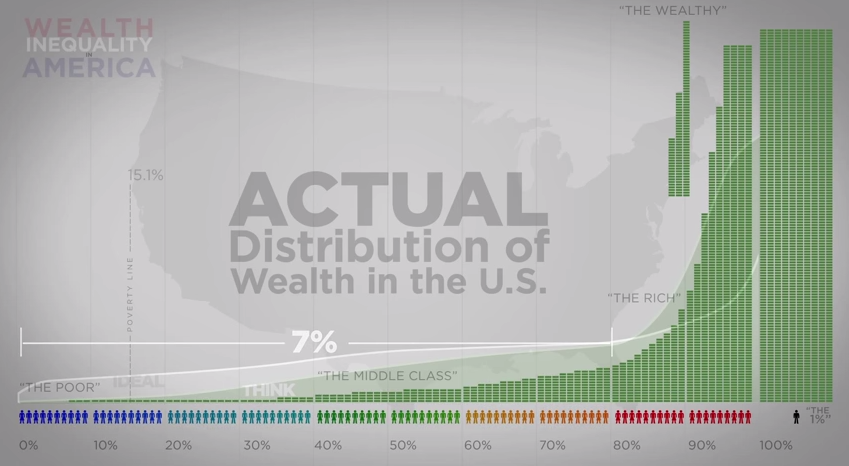
Britain must work with the United States to roll back record inequality that will eventually destroy the entire middle class. You can see the bottom 80% compete for only 7% of America’s total wealth. (This image is from 2010. It’s actually much worse now)
That trend will not change until politicians are bigger than the challenges that confront them, and actually do something about the record inequality sweeping the West.
It’s not a call to ‘do something, anything, anything at all’ — as some so-called ‘solutions’ might be worse than the problem.
But what citizens of the Western nations require is an acknowledgement by politicians of the sheer scale of the problem, and some initial steps to slow the rapid transfer of wealth away from the bottom three quintiles to the top 1 percent. (Even tiny baby-steps are preferable to the decades-long stony silence on the matter)

Britain and the United States must ensure that globalization and free trade work for everyone. Image courtesy of the New York Times, You can’t feed a family with GDP by Neil Irwin.
Inequality ignored, will only result in citizens ‘giving up’ on their governments and ‘giving up’ on democracy — and we know how that will end. Badly. For everyone.
Including powerful politicians who serve for amazingly short stints of time in office. Once you’re in politics, four years pass by like a long summer!
Today’s toxic combination of ultra-low taxes on the rich and unrestricted globalization aren’t working for 3/5ths of the population. In 10 years, it won’t be working for 4/5ths of the population. And let’s remember, all of them are voters.
Here’s how that looks
In 2016, more than 50 percent of the world’s wealth was owned by the 1 percent.
By 2030, more than 70 percent of the world’s wealth will be owned by the 1 percent.
By 2045, more than 85 percent of the world’s wealth will be owned by the 1 percent.
Put another way; Do you really want to live in a world where 8 billion people are fighting over the then-remaining 30 percent of the world’s wealth?
Can you imagine what it’s going to look like in 2045 when 9 billion people are fighting over the then-remaining 15 percent of the world’s wealth?
At that time, you’d better be living on an island in the mid-Pacific that doesn’t appear on any map, in a castle with 100-metre high concrete walls.
I respectfully suggest to Prime Minister Theresa May and President Donald Trump that if inequality isn’t addressed this year, it’ll be too late. Just look for a remote island in the Pacific Ocean… now, before the rush begins.
The time involved in getting new legislation passed, combined with the lag time involved for it to take effect during the following fiscal cycle, is years from the day it is first discussed.
Therefore, let’s hope that January 27, 2017 will come to be known as ‘the day the decline of the bottom-three quintiles was halted and reversed’ by these two great leaders.


A Development Bank for The Commonwealth
by John Brian Shannon | October 27, 2016
The World Bank, the International Monetary Fund, the Kuwait Fund, the African Development Bank Group, the Grameen Bank, and more recently, the Asian Infrastructure Investment Bank are all highly respected development banking institutions — but not one of them are dedicated to the improvement and well-being of the nation states that make up The Commonwealth of Nations.
And that’s a shame. The Commonwealth of Nations spans the globe, it encompasses nation states with tiny populations measured in thousands, to India with 2.2 billion citizens (consumers) by 2025, and nations that range from the 5th-largest economy in the world (Britain) to the tiniest economies in the world — and everything in between. Huge resource wealth, almost boundless agricultural opportunity, ocean access, tourism, and many other benefits await for development banks, corporate financial institutions, and private investors.
Wealthy Commonwealth nations can find much to like about investing in other nations that lie within the Commonwealth organization, in resources, in agriculture, in reasonable labour costs, in tourism, and more.
Such an institution could pool funds, create a bank, get some immediate projects rolling, and quickly generate some bank profits — profits that will simply be re-invested in the next project somewhere within the Commonwealth.
For a relatively small investment relative to the total Commonwealth GDP, come outsized gains in involvement by other members of that organization, a greater level of economic success among and between member nations, and much gain to offer banks, infrastructure construction companies and their supplier corporations.
Each development loan between Commonwealth nations further strengthens the Commonwealth and thereby, all of the nations in the group are strengthened.
If ever there were a textbook case upon which to base a successful development bank, The Commonwealth nations are it.
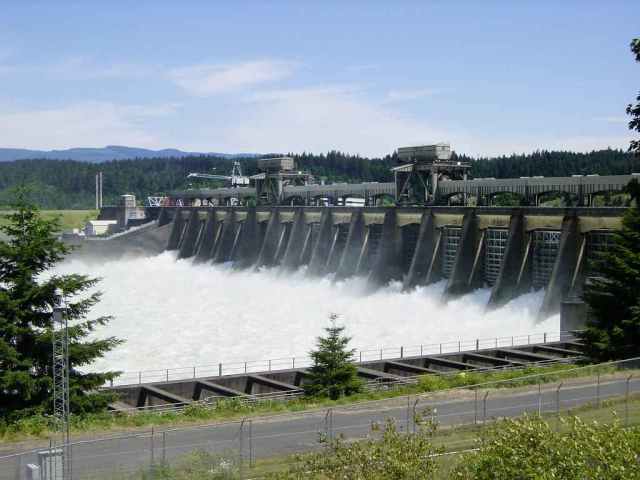
Hydro-electric dams in developing nations are highly valued by government, corporations, and citizens alike — and represent low risk and steady income for development banks and private investors. Image courtesy of pluginindia.com
Whether in the energy sector, agriculture, tourism, and in other segments of the developing economy, having a Commonwealth-only development bank distinctly geared towards financing and providing design and engineering expertise will benefit investor nations, commercial banks, and private investors — and provide a double benefit for those developing nations growing their economies while trying to provide better services for citizens.
How can Britain Afford This?
Britain is one of the most generous donor nations in the world, paying out some .71% of GDP in foreign aid annually. Few countries surpass this (Norway pays out 1% of GDP to foreign aid) but most fall well-short of Britain’s foreign aid commitment.
Canada, for instance pays .20% of GDP (and its total GDP is much smaller than the UK) and EU foreign aid spending averages .45% of GDP.
Instead of directing .71% of it’s GDP to non-Commonwealth nations, Britain should continue to pay .71% of GDP towards development aid, but spend it within the Commonwealth bloc exclusively.
In that way, billions of pounds sterling can immediately begin to strengthen Commonwealth economies, with two-way trade becoming dramatically enhanced between Britain and member nations.
Building a new hydro-electric dam, a major bridge, or a superhighway system in a Commonwealth nation?
Please source as much steel, hardware, and expertise, etc. as you can from the UK. And for developing nations without major construction firms large enough to take on megaprojects, please allow British firms to bid on your construction project.
Seems reasonable, doesn’t it?
Summary
By redirecting all of Britain’s foreign aid to Commonwealth of Nations countries exclusively, the UK will strengthen ties between Britain and all of those nations.
It will also serve to increase GDP of those nations, while British construction firms and their infrastructure hardware suppliers would get a welcome boost. As GDP growth leaps forward in member nations, demand for goods, skilled labour, and interim project financing from Britain will increase at a linear pace.
For developing nations within the Commonwealth, it’s the fast-track to developed nation status, higher GDP growth, better and sooner services for citizens, and (typically) a more stable economic and political situation.
And that’s better for everyone in this world, Commonwealth citizen, or not.

Trading ‘Globalization’ for ‘Interdependence’
by John Brian Shannon | August 19, 2016
Globalization has done much to lift the total GDP of many nations, except that inequality has increased by orders of magnitude (even within rich countries) due to the sloppy and sometimes corrupt implementation of the thing we call Globalization.
Read the prescient 2014 article by the New York Times’ Neil Irwin You Can’t Feed a Family With G.D.P.
‘Interdependence’ would be a better catchword to replace the word ‘Globalization’.
‘But aren’t they the same thing?’ some might ask. Well no, they’re not.
Globalization can best be described as ‘having the ability to export to other countries in exchange for goods or currency (and only if we must) accept goods from other countries, and pay for them in goods or currency.’
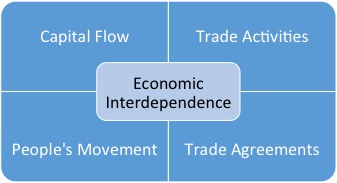
Whereas Interdependence could be described as ‘mutually beneficial trade between nations, where each block of transactions can be recorded as a ‘Win-Win’ for those trading partners.’
Yes, it’s a bit more complicated than just dumping your stuff in another country and getting the loot. (Globalization in a nutshell)
But if each block of transactions were properly engineered to produce the Win-Win result from the beginning, we wouldn’t have the follow-on effects of Globalization to deal with — inequality and the ‘trickle-up economy effect’ whereby in 2016 the 1% own 50% of the world’s total wealth and by 2030 will own 76% of the world’s wealth, and financial crises and trillions (globally) paid by taxpayers in corporate welfare over the postwar period, mountains of debt that will never be repaid, and deteriorating democracies as corporations take the reins from governments, and if TPP isn’t stopped soon the corporations will be taking governments to court for lost profit opportunities due to governments following the instructions of voters!
Originally, the North American Free Trade Agreement (NAFTA) was a great agreement designed to make North America more competitive vis-à-vis the other continents — but it was badly implemented by mediocre minds — which resulted in it being spoken of in the same tone of voice reserved for other words deemed filthy, such as that ‘Globalization’ word.
In regards to such agreements, it seems that no matter how noble and exceptional the original agreement (with the exception of the Montreal Protocol) it seems that proper implementation of these agreements fail. see; Kyoto Accord, see; hundreds of unfulfilled UN resolutions, etc.
But one step better than enforcing the terms and conditions of globalization’s international trade agreements, would be to have ‘Interdependence’ become the new catchword thereby superceding (Canadian spelling) Globalization.
Civilization must always advance.
That doesn’t mean that gadgets become more sophisticated (although some might think that’s the whole point of it) what it means is that our thinking must advance — all those shiny gadgets are merely a consequence of that higher thinking, not the purpose of it.
Our thinking about governance could move forward by a quantum leap if we’re advanced enough to grasp it.
Globalization = The ability to dump our goods in other countries and get loot for it, is one thing.
Interdependence = Ongoing, engineered agreements between nations (bilateral, trilateral, multi-lateral, as the case may be) where each agreement must result in a ‘Win-Win’ for each of the participant nations or there’s no signing ceremony.
Do you see the difference?
The difference is a more civilized world, fewer socio-economic problems generally and less inequality specifically, and fewer conflicts.
The reason we no longer live in trees and eat bananas is that we can grasp larger concepts; Hence, here we are, today.
The questions; Is this it? Is this who we are? Is Globalization our highest accomplishment? Or are we a people capable of better-yet?
Time will tell.
 Letter to Britain