Home » Posts tagged 'draft Withdrawal Agreement' (Page 3)
Tag Archives: draft Withdrawal Agreement

Why the ‘Norway Option’ Presents a False Choice for Brexit Britain
If there was one thing that unified the 17.4 million Britons who voted to Leave the European Union, it was to end freedom of movement between the UK and the EU, as the utter failure of the EU’s Schengen Agreement means that anyone from anywhere can simply walk across an EU border and can’t be deported under EU law.
These days, the bloc doesn’t even police much of the EU’s perimeter, whether on land or sea. People arrive from anywhere; They are given a landed immigrant card that entitles them to the same rights, privileges and freedoms as any EU citizen — which includes eligibility for free healthcare, social welfare programmes and social housing. And in recent months, rioting refugees and economic migrants have agitated for employment guarantees and it looks like they may win that right. Which is a right that not even native EU citizens enjoy. (Just to show you how nutty it can become in the EU)
Therefore, for some UK MP’s to suggest that the so-called ‘Norway Option’ is a viable way to honour the instructions of The People, they are sadly mistaken. In no way can continued free movement of persons from a bloc with zero control over its borders form part of the legitimate remit of British MP’s who work for the good of the country and its citizens.
Signing up to a worse deal than the UK has now is a non-starter. Signing up to a worse deal than Theresa May’s draft Withdrawal Agreement is also a non-starter. The so-called ‘Norway Option’ just isn’t an option for the UK and no amount of spin is going to walk back the primary demand of 17.4 million British voters.
As baseball umpires say; Steeeerrrike One!
Onward to Strike Two:
Another reason that anyone who believes in democracy and sovereignty shouldn’t be pushing the Norway Option is that another primary demand of 17.4 million British voters was to end the jurisdiction of the European court and Norway remains under the jurisdiction of the ECJ on many matters — especially on trade related matters.
British MP’s should know better than to peddle this shambolic plan that continues to allow freedom of movement and ECJ jurisdiction over trade, some healthcare, and other social issues.
The ECJ is a fine institution in and of itself, and that is recognized around the world. No issues there. However, it’s an EU institution and by definition it must rule in the EU’s favour — as it isn’t named the Chinese Court of Justice, the Australian Court of Justice, nor is it called by any other name. It’s an EU-centric organization and everyone realizes and respects that. It’s a court that’s in business for the EU — not Norway, not for post-Brexit Britain and not Japan — for three more examples.
Again, signing up to a deal that’s a worse deal than the UK presently has with the EU just isn’t an option.
For now, as long as the UK remains within the EU, the UK has a small amount of ‘pull’ with the ECJ as the UK is a dues-paying member of the EU for the time being — but after Brexit the UK won’t have any say into how the ECJ operates, nor will it be allowed to offer unsolicited legal opinions to the European court
Umpire, please make the call: Steeeerrrike Two!
On to Strike Three!
BASEBALL ANNOUNCER: “Alright everybody, get ready. The Norway Option is down two strikes and the last and final pitch is imminent here at the bottom of the ninth inning. Let’s see what happens… and no matter which way it goes folks, it’s going to be a blockbuster.”
Ask any Norwegian what they think of the Norway Option. That’s it. I win!
And the Umpire calls: Steeeerrrike Three!
BASEBALL ANNOUNCER: “It’s ‘Game Over’ for the Norway Option team!”
Post-Game Commentary
Yes, folks. It’s just that easy. Because there is hardly to be found anywhere in Norway anyone who would agree that their present deal with the EU is a good deal.
Business owners there like it because it grants them access to the huge EU market. But it’s a costly access and there are millions of regulations that must be strictly adhered-to which drives up costs for those businesses.
But the vast majority of Norwegians aren’t business owners surrounded by mountains of regulatory paperwork to keep them well-insulated during the harsh Norwegian winter.
Most are people who appreciate the EU for what it is, but don’t like masses of homeless refugees and immigrants sleeping in the streets and panhandling (such things were never before seen in Norway!) and making their contribution to other crimes — and increasingly nowadays — organized crime rings led by recent immigrants from North Africa, the Middle East and Eastern Europe.
In a country of only 5 million citizens, Norway has enjoyed one of the world’s lowest crime rates. Indeed, most years go by without one (not even one!) murder per year. Historically, Norway has astonishingly low rates of rape and other sexual assault, and the lowest rate of property crimes in the world. However, since freedom of movement was foisted on Norway via their arm’s-length EU contract these things have almost become commonplace.
The beautiful Norwegian people and the pristine countryside have been befouled by relatively large numbers of low-level criminals and Norwegian business has been curtailed by the high cost of accessing the EU Single Market.
It’s like getting nicely dressed for an outing to a prestigious art gallery and paying good money to see the Mona Lisa or Group of Seven painting and then getting spit-on by a refugee hiding behind the artwork. (That’s how I imagine Norwegians feel about their à la carte deal with the EU)
I won’t even start on the loss of sovereignty in other ways, nor will I discuss other high costs that Norway and Norwegian consumers must bear as part of their country’s deal with the European Union.
But let’s end this discussion without prejudice to the EU, which, aside from the problems noted above, has become a great asset to our world and leads the world community of nations in many ways.
It’s just that at present, with unrestricted immigration and the high costs of exporting into the EU’s Single Market, combined with loss of sovereignty as an EU member or arm’s length member, it’s not the best deal, nor is it the only game in town. Yet, let us continue to respect old Europa for all the positive things she’s accomplished.
BASEBALL ANNOUNCER: “Okay folks, that’s a wrap. It was an easy win here today at the ol’ ball game; Come back next week when Canada+++ goes up against the ‘No Deal’ Brexit team from Britain’s ERG. Goodnight everybody!”
Related Article:
- Why the Norway model is a flawed blueprint for Brexit (TheConversation.com)
The Day After Theresa May’s Draft Withdrawal Agreement Fails…
Theresa May’s draft Brexit Withdrawal Agreement (WA) may be better than nothing but it isn’t the best possible deal for the UK, for British business, nor for British citizens. But a better deal may still be in the cards for the United Kingdom and the European Union.
The difference between a *somewhat better than a No Deal Brexit* and the *best possible Brexit* amounts to making three changes to the present draft Withdrawal Agreement:
- Remove the backstop
- Remove jurisdiction of the European Court (ECJ)
- Add a guaranteed end date to Customs Union membership
That’s the difference between Theresa May’s risky deal and a great deal for both sides.
With better negotiators the UK government would’ve succeeded on all counts, including the three mentioned above. That goes without saying.
If Theresa May had brought that deal home it would’ve been signed, sealed and delivered by now.
However, if Parliament rejects the present draft WA as it seems destined to do on December 11, 2018 — there’s another kick at the can which could happen on any given day right up until March 29th, 2018. And that’s exactly what needs to happen.
In the very few days after the present draft Withdrawal Agreement fails in the UK House of Commons, British MP’s should vote on and approve such changes to the draft as necessary and send Theresa May or her Brexit secretary back to the EU with the new offer that’s approved by Parliament. The moment the EU signs on the dotted line it’s binding on all concerned parties. That’s how to get this deal done.
Offer, then counter-offer. Repeat, until both sides are satisfied. That’s how negotiations work. Comprendi?
What’s the Deal With the Backstop?
The whole Northern Ireland border issue is a red herring.
First off, the situation between the people of Northern Ireland and the people of the Republic of Ireland has matured over many years to the point where a normal border (like every country in the world employs) could be created and there wouldn’t be a problem operating a normal, hard border.
Alternatively, if the situation between the two jurisdictions isn’t as mature as I suggest, technology could be employed to capture tariffs and ensure standards are met at the point of delivery in both jurisdictions.
And if the UK decides to utilize a zero-tariff economy post-Brexit, there’s no need for remote or in-transit tariff technology as there won’t be any need to capture tariffs.
With a little bit of creative thinking the wholly contrived ‘backstop issue’ goes away and most of the problems with Theresa May’s draft Withdrawal Agreement disappear!
Without the Backstop, the ECJ Doesn’t Need Jurisdiction in Any UK Territory – Devolved or Not
Once the backstop disappears there’s no longer any need for the ECJ to have jurisdiction anywhere in the UK.
Even if that means that Republic of Ireland exports destined for Northern Ireland must first be shipped to England, Scotland or Wales (to allow proper border checks to occur in England, Scotland or Wales) and then on to Northern Ireland in the normal manner.
The reverse is true for exports from Northern Ireland travelling to the Republic of Ireland. To satisfy all UK and EU regulations goods could be shipped from NI to England, Scotland or Wales ports, and after passing inspection, shipped on to the RoI.
Such trans-shipment procedures are quite normal in the 21st-century, but it might be a first for Europe. Can they handle it?
Negotiations 101
Only a fool accepts the first offer in any negotiation process — and that is doubly true when dealing with politicians who spend their entire careers negotiating one thing or another.
The problem is that Brexit negotiations are taking too long. The longer it takes to agree a Brexit deal, the more uncertainty for markets on both sides of the English Channel.
Only in Europe could Brexit take 3-years (we’re almost at 3-years now) and at present rates of progress it looks like it could drag on for another 3-years.
When Britons stop acting like they live in the 120th-largest economic power in the world instead of the 6th-largest the UK will finally live up to its full potential.
I exhort Prime Minister Theresa May and the rest of the UK government to; “Rise and rise again, until lambs become lions!”
The draft Withdrawal Agreement was Created to Prevent a Hard Brexit
However, it has significant deficiencies that need to be rectified before it can be approved by the House of Commons. Once those corrections are made it should be passed immediately by UK MP’s and sent on to the EU27 for their approval.
Summary
- Theresa May should offer her draft Withdrawal Agreement up for vote in Parliament on December 11th as planned. Where it is likely to fail.
- The PM should then offer the Political Declaration (only) up for vote on December 12th to demonstrate goodwill to the EU. Where it should pass easily.
- Then the Prime Minister should consult with party leaders in the House of Commons and along with her Cabinet, create a counter-offer consisting of the existing draft WA, but with the backstop removed, any reference to the ECJ removed, and a firm end-date for leaving the so-called ‘temporary’ Customs Union with the EU. That date might be December 31, 2020, or it may be December 31, 2021.
- And that new Withdrawal Agreement should be voted on and passed by the House of Commons if MP’s wish to honour the will of UK voters.
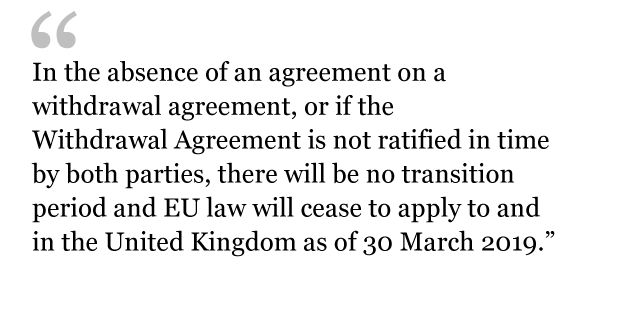
- If the EU ratifies those changes, they get £39 billion on March 29, 2019 that Theresa May promised them in exchange for a signed Withdrawal Agreement — but if they don’t ratify it the UK owes (only) £9.65 billion (according to reliable sources) to the EU to pay expected future obligations to the EU.
On top of everything, everyone should stop panicking. We’re talking about a DRAFT Withdrawal Agreement, which by definition, means it’s still subject to negotiation no matter what EU negotiators or Theresa May say. It’s a DRAFT proposal. Get it?
It’s time for British MP’s to grab hold of this process; Let the deal fail in the House of Commons, then get the Political Declaration passed in the House, and then make the alterations to the draft Withdrawal Agreement that a majority of MP’s can support, then get that officially passed in the House — and then offer it to the EU by December 31, 2018. In that order. And that soon.
If the EU accepts the new Withdrawal Agreement proposal, everyone’s Brexit problems are solved, which allows the EU to be eligible to receive £39 billion on March 29, 2019.
If not, there’s plenty more time for negotiations no. matter. what. the. politicians. say.
 Letter to Britain