Home » Posts tagged 'British Trade Policy' (Page 5)
Tag Archives: British Trade Policy

Hitting the Right Note with Russia
Renewing Economic Ties with Russia
It may surprise some that for hundreds of years Britain enjoyed a good working relationship with Russia mainly via their respective Royal Families, and that the Allied Powers received especially valuable cooperation from the Soviet Union during WWII. And after the breakup of the Soviet Union, Britain once more enjoyed a strong relationship with Russia and it’s leaders.
All of which means, there’s no reason good enough that the UK can’t enjoy a mutually beneficial relationship with Russia. All that’s required is to hit the right note to resume that formerly beneficial relationship.
Russia has much to offer Britain — especially in light of the Brexit vote. It’s a country rich in oil and gas, metallic ores and minerals, and in forestry and agriculture. In short, all the resources that a developed nation needs.
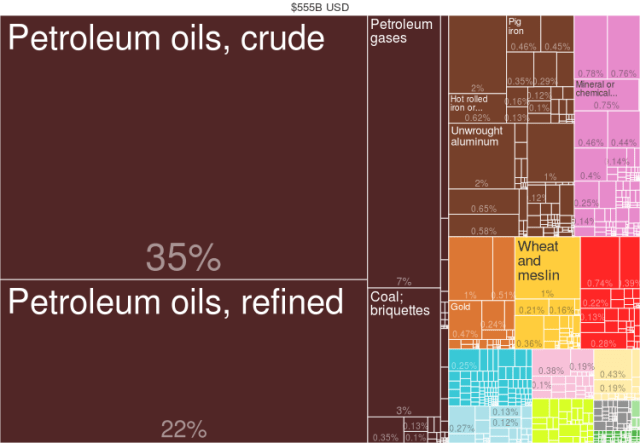
Britain needs all these things to grow its economy. Treemap of Russia exports (2014)
But more than that, Russia is a rapidly modernizing nation with 146 million consumers who have displayed a distinct appetite for travel and for European history.
Buying massive amounts of raw resources from Russia, adding value to them, then exporting them to the global marketplace is a natural for the United Kingdom. In this way, the future of Britain would be inexorably linked to Russia and in a mutually beneficial way. As demand for value-added goods rise, so will demand for Russia’s resources.
This is the kind of symbiotic relationship that Britain must advance with Russia, as it’s the only model that is a ‘Win-Win’ for both nations.
As we’ve seen in recent decades, setting up Win-Lose paradigms eventually leads to Lose-Lose outcomes.
Therefore, Win-Win is the only acceptable course for Britain in regards to Russia.
Renewing Strategic Ties with Russia
During WWII, the level of cooperation between the former Soviet Union and Britain was at an all-time high. The Soviets lost +20 million people during the war as the Soviet Army struggled against Hitler’s Operation Barbarossa “in the largest German military operation of World War II.”
But Soviet communications with Britain were of uniformly high quality and information content, and weren’t intercepted by the Nazis as had been feared by British commanders.
The ‘Lend-Lease’ programme, created by the United States and Great Britain to assist their ally, exported aircraft, navy ships, howitzers, and ammunition to the Soviet Union in an attempt to stop Hitler’s army from taking the entire country along with its unimaginable resources.
The cooperation between the three countries during WWII was unparalleled and it worked to benefit all three nations. Millions of lives were saved (especially in Britain) due to this unprecedented arrangement.
Opportunities as Big as the Sky, Where Economic and Strategic Links Meet
It makes sense that northern nations should work together to advance security in their hemisphere, particularly among those nations that own or claim part of the Arctic Ocean and its rich resources.
It would be interesting to locate some Scottish islands where the wind blows constantly (that would be all of them) and install a couple hundred wind turbines along with housing for +3000 presently unemployed blue-collar workers, so they might smelt aluminum ore for export.
But not only aluminum, refining crude oil or making steel uses obscene amounts of electricity too. With cheap wind power located right on-site — one of the biggest production costs for smelters and refiners (energy) is lowered by half — which translates into a pricing advantage for exporters.
Working together, hundreds of billions of pounds could be unlocked to invest in Russian oil and gas, and other resources, inside Russia proper or in the Arctic Ocean.
Hundreds of billions more could build new factories in Russia, taking advantage of the lower energy, labour and regulatory costs there, which could allow Russia to duplicate the astonishing manufacturing leap made by Japan in the 1970-2000 timeframe.
If British banks are financing these operations, and British companies are part-owners with their Russian counterparts, there will be plenty of incentive on all sides to make it work. The very definition of Win-Win.
Over the next 30 years Russia could match the incredible economic leap made by Japan while Britain’s banks get to earn profit on financing that transition, and both British and Russian workers enjoy a fast-paced and profitable economy.
Isn’t that a better future for British and Russian kids than sliding backwards toward a new Cold War?
Image credit: By Celinaqi – http://atlas.cid.harvard.edu/explore/tree_map/export/rus/all/show/2014/ CC BY-SA 4.0
Transforming Britain’s Trade Partnerships
by John Brian Shannon | July 25, 2016
Every day of the year, we teach others how to treat us.
If we consistently demonstrate that we’re reliable, we teach others to trust us. If we demonstrate that we’re untrustworthy, we teach others to avoid us.
And so it is with nations; By virtue of their policies and procedures and by their other actions, we teach the leaders of other nations and their corporations how to treat us, how to deal with us, or give them reasons to avoid us.
Pretty simple stuff. We learned this in kindergarten.
But sometimes we get so busy working in our business we forget to work on our business, and that message can lose place.
In the interdependent world of the 21st-century, the highest priority for British Prime Minister Theresa May and her ministers must be to work on our business and not get wrapped up in the daily routine, and thereby lose place.
The government of Theresa May is off to a good start and it’s too early to draw conclusions about her future economic policy, but governments of the past have ranged from inspired to dreadful in regards to steering Britain’s economy.
The United Kingdom is the 5th-largest economy on the planet. Let’s not lose that.
Partnership
We need to trade with stable regimes, it’s better for market certainty. They want us to be economically certain. We need them to be economically certain. In fact, economic uncertainty is our enemy and theirs.
Therefore, interdependence and symbiotic relationships will work best for us and for our trade partners.
If we ensure that engaging in trade with Britain always works to the advantage of our trade partners, we will teach them that more trade with us is their goal.
In this way, our trade partners become our best sales and marketing force. Handy, that.
Using Import Tariffs as Revenue Stream
Minimal standardized tariffs can offset government budget imbalances and balance of trade issues — and that applies not only to Britain, but also to it’s trading partners.
As a general rule, Britain should engage in free trade with every country and charge a standardized 5% tariff on every good that is shipped to the UK. And all countries that trade with Britain should likewise institute a harmonized 5% tariff.
Q: Why would Britain want foreign governments to charge a 5% tariff on British goods?
A: Each $1 billion dollars of British export earns that foreign government $50 million dollars in (import) tariff revenue.
But why would foreign governments shoot for British exports of only $1 billion per year / $50 million tariff revenue when those governments could collect $600 million in tariff revenue on $12 billion of exports from Britain?
Or ten times that amount. Let’s hope.
Easy Money
Therefore, the higher the gross total value of imports arriving from Britain, the more dependent the foreign government will become on that revenue. Which means they won’t want anything interfering with that simple and easy tariff revenue stream!
“Can you please continue to export to my country?”
“Why yes… yes we can.”
Anytime the UK government wants to increase exports, all it must do is ask each foreign government representative this sort of question:
“How would you like to be responsible for bringing home $600 million per year in tariff revenue, instead of the present $50 million per year?”
It’s so easy when they do the work for you…
Transformation
By asking for the cooperation of our trade partners in this manner, not only will UK exports realize a manufacturing boom, but the partner nation will see a tariff revenue boom — and that’s interdependence taken to the next level.
Symbiotic trade relationships become the path to prosperity for both partners.
If Britain does this, and does it well, every country in the world will become a highly motivated salesforce for British goods — your trade partners are practically marketing Britain’s manufacturing sector for you.
As the price of each imported item increases by 5%, it will spur domestic demand on account of UK-produced goods not having a price rise due to a 5% tariff.
In that way, domestic production will increase, which has several positive influences in the overall British economy; UK-produced goods will be incrementally cheaper in comparison to imported goods, increasing consumer demand for UK-produced goods, causing UK manufacturing sector unemployment rates to fall, and consequently the government will lower it’s unemployment insurance expenditures and receive higher income and sales tax revenue from those now-working citizens.
And that’s not all
In addition to those positives; The UK government gets a new revenue source to augment it’s spending programmes. In the UK, this translates into more funding for Britain’s highly-ranked National Health Service (NHS) and makes deficit-reduction a reality for the Exchequer.
Since the global financial crisis, the UK government has in addition to running a mild austerity programme, also run high budget deficits (8.5%) which simply accumulate as government debt — and that’s the last thing the country needs as the UK’s debt-to-GDP was already too high prior to the financial crisis of 2008.
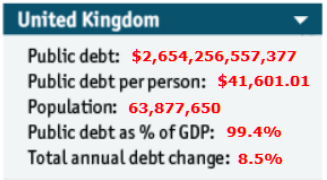
Global Debt Clock for Britain 2015. Image courtesy of The Economist’s Economic Intelligence Unit.
But with billions in tariff revenue helping to fund UK government operations, not only would deficits disappear and high public debt taper, there would be enough revenue left over to fund the ‘shovel-ready’ infrastructure projects that are unemployment-reducers, job-creators, and income tax generators for the country.
In economics, that is known as a virtuous circle. Which is a very wonderful thing.
Economists win Nobel Peace Prizes for engineering virtuous circles. Yes, it is that big a deal.
Investment
Tariffs should be seen by Britain and it’s trading partners as revenue generators.
Revenue from tariffs can fund deficit elimination, debt repayment, infrastructure and job creation or whatever gives the UK economy the best bang for the buck at that time.
Growing economies attract a lot of attention — the good kind. And every investor wants to invest in a winner.
By designing our economic fundamentals to mesh with the present economic moment, the UK could enjoy an almost unprecedented economic boom courtesy of the virtuous circles deliberately engineered into Britain’s economy.
Delivering on that goal should be our highest priority.
 Letter to Britain