Home » Posts tagged 'British Economy' (Page 3)
Tag Archives: British Economy
Transforming Britain’s Trade Partnerships
by John Brian Shannon | July 25, 2016
Every day of the year, we teach others how to treat us.
If we consistently demonstrate that we’re reliable, we teach others to trust us. If we demonstrate that we’re untrustworthy, we teach others to avoid us.
And so it is with nations; By virtue of their policies and procedures and by their other actions, we teach the leaders of other nations and their corporations how to treat us, how to deal with us, or give them reasons to avoid us.
Pretty simple stuff. We learned this in kindergarten.
But sometimes we get so busy working in our business we forget to work on our business, and that message can lose place.
In the interdependent world of the 21st-century, the highest priority for British Prime Minister Theresa May and her ministers must be to work on our business and not get wrapped up in the daily routine, and thereby lose place.
The government of Theresa May is off to a good start and it’s too early to draw conclusions about her future economic policy, but governments of the past have ranged from inspired to dreadful in regards to steering Britain’s economy.
The United Kingdom is the 5th-largest economy on the planet. Let’s not lose that.
Partnership
We need to trade with stable regimes, it’s better for market certainty. They want us to be economically certain. We need them to be economically certain. In fact, economic uncertainty is our enemy and theirs.
Therefore, interdependence and symbiotic relationships will work best for us and for our trade partners.
If we ensure that engaging in trade with Britain always works to the advantage of our trade partners, we will teach them that more trade with us is their goal.
In this way, our trade partners become our best sales and marketing force. Handy, that.
Using Import Tariffs as Revenue Stream
Minimal standardized tariffs can offset government budget imbalances and balance of trade issues — and that applies not only to Britain, but also to it’s trading partners.
As a general rule, Britain should engage in free trade with every country and charge a standardized 5% tariff on every good that is shipped to the UK. And all countries that trade with Britain should likewise institute a harmonized 5% tariff.
Q: Why would Britain want foreign governments to charge a 5% tariff on British goods?
A: Each $1 billion dollars of British export earns that foreign government $50 million dollars in (import) tariff revenue.
But why would foreign governments shoot for British exports of only $1 billion per year / $50 million tariff revenue when those governments could collect $600 million in tariff revenue on $12 billion of exports from Britain?
Or ten times that amount. Let’s hope.
Easy Money
Therefore, the higher the gross total value of imports arriving from Britain, the more dependent the foreign government will become on that revenue. Which means they won’t want anything interfering with that simple and easy tariff revenue stream!
“Can you please continue to export to my country?”
“Why yes… yes we can.”
Anytime the UK government wants to increase exports, all it must do is ask each foreign government representative this sort of question:
“How would you like to be responsible for bringing home $600 million per year in tariff revenue, instead of the present $50 million per year?”
It’s so easy when they do the work for you…
Transformation
By asking for the cooperation of our trade partners in this manner, not only will UK exports realize a manufacturing boom, but the partner nation will see a tariff revenue boom — and that’s interdependence taken to the next level.
Symbiotic trade relationships become the path to prosperity for both partners.
If Britain does this, and does it well, every country in the world will become a highly motivated salesforce for British goods — your trade partners are practically marketing Britain’s manufacturing sector for you.
As the price of each imported item increases by 5%, it will spur domestic demand on account of UK-produced goods not having a price rise due to a 5% tariff.
In that way, domestic production will increase, which has several positive influences in the overall British economy; UK-produced goods will be incrementally cheaper in comparison to imported goods, increasing consumer demand for UK-produced goods, causing UK manufacturing sector unemployment rates to fall, and consequently the government will lower it’s unemployment insurance expenditures and receive higher income and sales tax revenue from those now-working citizens.
And that’s not all
In addition to those positives; The UK government gets a new revenue source to augment it’s spending programmes. In the UK, this translates into more funding for Britain’s highly-ranked National Health Service (NHS) and makes deficit-reduction a reality for the Exchequer.
Since the global financial crisis, the UK government has in addition to running a mild austerity programme, also run high budget deficits (8.5%) which simply accumulate as government debt — and that’s the last thing the country needs as the UK’s debt-to-GDP was already too high prior to the financial crisis of 2008.
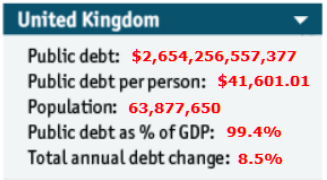
Global Debt Clock for Britain 2015. Image courtesy of The Economist’s Economic Intelligence Unit.
But with billions in tariff revenue helping to fund UK government operations, not only would deficits disappear and high public debt taper, there would be enough revenue left over to fund the ‘shovel-ready’ infrastructure projects that are unemployment-reducers, job-creators, and income tax generators for the country.
In economics, that is known as a virtuous circle. Which is a very wonderful thing.
Economists win Nobel Peace Prizes for engineering virtuous circles. Yes, it is that big a deal.
Investment
Tariffs should be seen by Britain and it’s trading partners as revenue generators.
Revenue from tariffs can fund deficit elimination, debt repayment, infrastructure and job creation or whatever gives the UK economy the best bang for the buck at that time.
Growing economies attract a lot of attention — the good kind. And every investor wants to invest in a winner.
By designing our economic fundamentals to mesh with the present economic moment, the UK could enjoy an almost unprecedented economic boom courtesy of the virtuous circles deliberately engineered into Britain’s economy.
Delivering on that goal should be our highest priority.

Brexit: A Warning for Globalization
Seventeen million Britons voted to leave the EU, and the world wants to know why.
Could it be the Economy?
All EU citizens are feeling the pressure of falling purchasing power and lower employment levels, but only Britons have had the opportunity to leave the European Union for a shot at a better existence.
I suggest that the bottom two economic quintiles in every EU nation would choose to leave the EU today! if they could, and for the same reasons voters in the United Kingdom voted Brexit on June 23, 2016.
That’s 203 million people out of a grand total of 508 million EU citizens who now find themselves in the bottom two economic quintiles in the European Union.
That is some statistic!
If the European economy was rocking along at a furious rate, it mightn’t be too much of a problem.
GDP growth is flat and EU unemployment is cast at 9 percent of the total workforce — but in reality it’s much higher, as huge numbers of people have given up looking for work and aren’t counted on official unemployment statistics, nor are those who’ve returned to college because they can’t find a suitable job, nor are those who find themselves on some kind of government (welfare) support. Which makes the real EU unemployment rate in excess of 20 percent.
Official youth unemployment in the EU ranges from 50 percent in Greece, to 45 percent in Spain, to 37 percent in Italy, to an EU-low of 7 percent for Germany.
And like elsewhere in the developed world many EU jobs are entry-level jobs. And sure, the people who have those jobs know they’re lucky to have them — but they also know they’ll never ‘get ahead in life’ for as long as they stay at that job.
It isn’t an EU-only problem. In recent decades, a larger proportion of employment opportunities are low-paying jobs as multinational corporations automate many of the operations formerly performed by skilled workers.
Why pay a human, when you can pay a machine less?
Could it be a lack of Democracy?
All over the EU, everything from the price of bread to how many migrants are allowed into your EU-member country are decided by unelected mandarins in the EU’s version of the Soviet Politburo.
With an official unemployment rate of 9 percent which equates to +21 million people (but a real unemployment rate of +20 percent, which equates to 44 million unemployed people) and 203 million people living in the bottom two economic quintiles; When you combine their numbers with the people who’ve had enough of being told how to live by the unelected bureaucrats in Brussels, you arrive at enough votes to exit the European Union. Exactly as happened in the UK last week.
Here’s the rough math on that for the entire EU:
- Total population of the EU = 508 million
- Of those EU citizens, 203 million are living in the bottom two economic quintiles + 44 million real unemployed + a minimum of 20 million voters living unhappily with the unelected mandarin situation in Brussels = 267 million unhappy EU citizens
- 508 million – 267 million unhappy voters (‘leavers’) = 241 million who would probably vote for continued EU membership (‘remainers’)
Do you see how the UK accumulated enough votes to leave the European Union?
If a vote were held in every EU country today, the exact same result would occur as in the UK last week.
And everyone would blame their economic woes, their lack of employment and quality of their employment, and the lack of democratic process in Brussels, for their decision to vote against EU membership.
Could it be Globalization?
Globalization has done some wonderful things for consumers over the past 25 years, some of which have been quite unnoticed by citizens.
It’s fair to say that globalization ushered in an era of low-priced and higher quality goods than would otherwise have been available. It’s also fair to say that consumers have a much wider selection of goods to choose from.
And importantly, competition dramatically sharpened between corporations — which increased productivity, efficiency, national GDP statistics, and has helped developing nations to become net assets to the global economy instead of draining the strength of the world economy.
It’s all good – except the parts that aren’t
The downsides of globalization are understood; Higher unemployment, lower wages, lower quality jobs, offshoring millions of jobs, the increased power of corporations vs. citizens, and the fear of our societies transitioning from true democracies into corrupt plutocracies.
Now that we’ve reaped the benefits of globalization (but lost the UK in the process!) now might be a good time to address some of the inadequacies of globalization before we lose significantly more.
“We cannot solve our problems with the same thinking we used when we created them.” — Albert Einstein
Legislation can solve every one of these problems if the political will exists.
If a higher minimum wage is legislated throughout the 28 EU nations (say, 15 euros per hour) and if people who earn less than 25,000 euros per year are exempted from paying income tax, and if job-sharing schemes are made mandatory with a view to employ every worker for a minimum of 6 months per year; Not only could the bottom two economic quintiles have an opportunity to improve their lives for the first time in decades, they will resume their normal voting patterns (which is more often than not) reelecting incumbent politicians and voting to remain in existing political unions.
See how easy it is?
“If you treat an individual as if he were what he can and should be, he will become what he can and should be.” — Johann Wolfgang von Goethe
By addressing the negatives of globalization, the EU could still become what it can and should be.
And by addressing the democratic gap in Brussels where unelected officials can never, ever, be removed by voters no matter how odious the policies, the European Union could become what it can and should be.
And that’s an EU worth joining.
Related Article:
- Brexit is a rejection of globalisation (The Guardian)
- EU referendum: The result in maps and charts (BBC)
 Letter to Britain