Home » Posts tagged 'Britain' (Page 15)
Tag Archives: Britain

Theresa May needs Parliamentary Approval for Brexit says Supreme Court
by John Brian Shannon | January 25, 2017
Britain’s Supreme Court ruled (8-3) today that the UK government must get parliamentary approval to begin the process of leaving the European Union.
Prime Minister Theresa May’s plans to trigger Article 50 of the Lisbon Accord in March 2017 to begin the Brexit process, could be delayed as a result of this ruling. However, the PM’s spokesman said that the plan to leave the EU remains unaffected and Brexit will proceed as planned.
Most Conservative MP’s have publicly stated they will support Brexit, and Labour Party leader Jeremy Corbyn said his party will vote to Brexit. (Read here)

List of Treaties and Acts signed without the benefit of a UK referendum, nor signed with any requirements set out by UK Supreme Court Judges.
The highest court in Britain also decided today (unanimously) that there’s no requirement to consult the governments of Northern Ireland, Scotland or Wales prior to invoking Article 50 because the United Kingdom entered the European Union as a single entity, therefore, the UK must leave the European Union as a single entity.
In defense of the high court, the Brexit referendum wasn’t a constitutional vote where the government was legally bound via a quid pro quo with voters to enforce Brexit, rather, it was a vote centered on finding the will of the public regarding continued EU membership.
British voters, after having voted in a referendum to tell the government of its wishes in regards to EU membership, are now informed by the UK Supreme Court that Parliamentary approval must also occur.
The bar keeps raising, but it’s only serving to make UK citizens more determined to have their voices heard and for Brexit to actually occur.
Although today’s ruling might be seen as a setback for the Prime Minister in some quarters, the Supreme Court ruling has caused Britons to demand even more vociferously for a ‘Hard Brexit’.
It seems the Supreme Court ruling requiring Parliamentary approval before Brexit might turn out to be good news after all for Prime Minister Theresa May and for millions of Brexiters.

Find more statistics at Statista – Click to enlarge the image
Will Theresa May and Donald Trump Meet the Existential Challenge of Our Time?
by John Brian Shannon | January 23, 2017
UK Prime Minister Theresa May has been invited to the White House on January 27 to meet with the new American president, Donald J. Trump.
It’s always an honour to be the first invitee of the new president, and the timing couldn’t be better as the Western economic order is beginning to churn.
In the West, the past 70 years have been a relatively stable era with increasing wealth (although since the Reagan-era tax cuts, obscene inequality has become a destabilizing force) and social mobility has increased dramatically since the creation of the internet.
This combination could prove extraordinarily useful to motivate leaders to provide the kind of leadership required of the times — or 2017 could prove to be the pivotal moment in the unravelling of the Western democracies.
President Trump wasn’t elected U.S. president because American citizens were bored by the Democrats.
Americans voted Trump/Pence to overthrow the existing plutocracy in Washington, not to overthrow foreign governments.
Regardless how many Middle Eastern conflicts the West prosecuted over the past 13 years, the rich keep getting richer and the poor keep getting poorer. But this time the problems are here at home, not in some faraway country.
Americans voted for Barack Obama (2008 and 2012) and now Donald J. Trump (2016) in large part to stop the unfolding economic disaster in the West. Britons may have held similar ideas to American voters about a sustainable economic plan when they voted for Brexit.

Will Prime Minister of Britain Theresa May and President of the United States Donald Trump work together to solve the existential challenge of our time? Image displays the share of the world’s total wealth for the Top 1% vs. the Bottom 99%. Image courtesy of OXFAM.
The chart below (from 2010) reveals the bottom 80 percent of Americans share just 7 percent of the nation’s wealth, but it’s much worse now (in 2017) and this phenomenon is no longer confined to the United States.
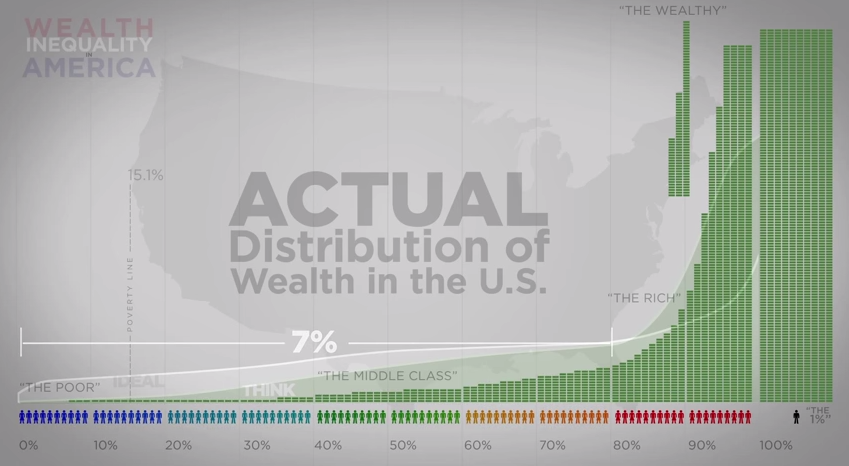
Britain must work with the United States to roll back record inequality that will eventually destroy the entire middle class. You can see the bottom 80% compete for only 7% of America’s total wealth. (This image is from 2010. It’s actually much worse now)
That trend will not change until politicians are bigger than the challenges that confront them, and actually do something about the record inequality sweeping the West.
It’s not a call to ‘do something, anything, anything at all’ — as some so-called ‘solutions’ might be worse than the problem.
But what citizens of the Western nations require is an acknowledgement by politicians of the sheer scale of the problem, and some initial steps to slow the rapid transfer of wealth away from the bottom three quintiles to the top 1 percent. (Even tiny baby-steps are preferable to the decades-long stony silence on the matter)

Britain and the United States must ensure that globalization and free trade work for everyone. Image courtesy of the New York Times, You can’t feed a family with GDP by Neil Irwin.
Inequality ignored, will only result in citizens ‘giving up’ on their governments and ‘giving up’ on democracy — and we know how that will end. Badly. For everyone.
Including powerful politicians who serve for amazingly short stints of time in office. Once you’re in politics, four years pass by like a long summer!
Today’s toxic combination of ultra-low taxes on the rich and unrestricted globalization aren’t working for 3/5ths of the population. In 10 years, it won’t be working for 4/5ths of the population. And let’s remember, all of them are voters.
Here’s how that looks
In 2016, more than 50 percent of the world’s wealth was owned by the 1 percent.
By 2030, more than 70 percent of the world’s wealth will be owned by the 1 percent.
By 2045, more than 85 percent of the world’s wealth will be owned by the 1 percent.
Put another way; Do you really want to live in a world where 8 billion people are fighting over the then-remaining 30 percent of the world’s wealth?
Can you imagine what it’s going to look like in 2045 when 9 billion people are fighting over the then-remaining 15 percent of the world’s wealth?
At that time, you’d better be living on an island in the mid-Pacific that doesn’t appear on any map, in a castle with 100-metre high concrete walls.
I respectfully suggest to Prime Minister Theresa May and President Donald Trump that if inequality isn’t addressed this year, it’ll be too late. Just look for a remote island in the Pacific Ocean… now, before the rush begins.
The time involved in getting new legislation passed, combined with the lag time involved for it to take effect during the following fiscal cycle, is years from the day it is first discussed.
Therefore, let’s hope that January 27, 2017 will come to be known as ‘the day the decline of the bottom-three quintiles was halted and reversed’ by these two great leaders.

Theresa May: World Economic Forum speech – January 2017
Transcript and video of UK Prime Minister Theresa May’s World Economic Forum speech in Davos, Switzerland, January 19, 2017 on Brexit, Internationalism, Economic Reform and Social Reform
“Thank you Professor Schwab for that introduction, and thank you for inviting me to speak here at the World Economic Forum this morning.
This is an organisation that is, as it says in the very first line of your mission statement, committed to ‘improving the state of the world’. Those of us who meet here are all – by instinct and outlook – optimists who believe in the power of public and private co-operation to make the world of tomorrow better than the world of today. And we are all united in our belief that that world will be built on the foundations of free trade, partnership and globalisation.
Yet beyond the confines of this hall, those forces for good that we so often take for granted are being called into question.
The forces of liberalism, free trade and globalisation that have had – and continue to have – such an overwhelmingly positive impact on our world, that have harnessed unprecedented levels of wealth and opportunity, that have lifted millions out of poverty around the world, that have brought nations closer together, broken down barriers and improved standards of living and consumer choice, forces that underpin the rules-based international system that is key to our global prosperity and security, are somehow at risk of being undermined.
And as we meet here this morning, across Europe parties of the Far Left and the Far Right are seeking to exploit this opportunity, gathering support by feeding off an underlying and keenly felt sense among some people – often those on modest to low incomes living in relatively rich countries around the west – that these forces are not working for them.
And those parties – who embrace the politics of division and despair; who offer easy answers; who claim to understand people’s problems and always know what and who to blame – feed off something else too: the sense among the public that mainstream political and business leaders have failed to comprehend their legitimate concerns for too long.
This morning, I want to set out a manifesto for change that responds to these concerns and shows that the politics of the mainstream can deliver the change people need.
I want to show how, by taking a new approach that harnesses the good of what works and changes what does not, we can maintain – indeed we can build – support for the rules-based international system.
And I want to explain how, as we do so, the United Kingdom – a country that has so often been at the forefront of economic and social change – will step up to a new leadership role as the strongest and most forceful advocate for business, free markets and free trade anywhere in the world.
Brexit
For that is the unique opportunity that Britain now has.
I speak to you this morning as the Prime Minister of a country that faces the future with confidence.
For a little over 6 months ago, millions of my fellow citizens upset the odds by voting, with determination and quiet resolve, to leave the European Union and embrace the world.
Let us not underestimate the magnitude of that decision. It means Britain must face up to a period of momentous change. It means we must go through a tough negotiation and forge a new role for ourselves in the world. It means accepting that the road ahead will be uncertain at times, but believing that it leads towards a brighter future for our country’s children, and grandchildren too.
So while it would have been easy for the British people to shy away from taking such a path, they fixed their eyes on that brighter future and chose a bold, ambitious course instead.
They chose to build a truly Global Britain.
I know that this, and the other reasons Britain took such a decision, is not always well understood internationally, particularly among our friends and allies in Europe. Some of our European partners feel that we have turned our back on them. And I know many fear what our decision means for the future of the EU itself.
But as I said in my speech earlier this week, our decision to leave the European Union was no rejection of our friends in Europe, with whom we share common interests and values and so much else. It was no attempt to become more distant from them, or to cease the co-operation that has helped to keep our continent secure and strong.
And nor was it an attempt to undermine the European Union itself. It remains overwhelmingly and compellingly in Britain’s national interest that the EU as an organisation should succeed.
It was simply a vote to restore, as we see it, our parliamentary democracy and national self-determination. A vote to take control and make decisions for ourselves.
And, crucially, to become even more global and internationalist in action and in spirit too.
Because that is who we are as a nation. Britain’s history and culture is profoundly internationalist.
We are a European country, and proud of our shared European heritage, but we are also a country that has always looked beyond Europe to the wider world.
That is why we are among the most racially diverse countries in Europe, one of the most multicultural members of the European Union, and why – whether we are talking about India, Pakistan, Bangladesh, America, Australia, Canada, New Zealand, countries in Africa, Asia or those that are closer to home in Europe – so many of us have close friends and relatives from across the world.
And it is why we are by instinct a great, global, trading nation that seeks to trade with countries not just in Europe but beyond Europe too.
So at the heart of the plan I set out earlier this week, is a determination to pursue a bold and ambitious free trade agreement between the UK and the European Union. But, more than that, we seek the freedom to strike new trade deals with old friends and new allies right around the world as well.
I am pleased that we have already started discussions on future trade ties with countries like Australia, New Zealand and India. While countries including China, Brazil, and the Gulf States have already expressed their interest in striking trade deals with us.
That is why, as I said in my speech on Tuesday, I want the UK to emerge from this period of change as a truly Global Britain – the best friend and neighbour to our European partners, but a country that reaches beyond the borders of Europe too; a country that gets out into the world to build relationships with old friends and new allies alike.
And that is exactly what we are going to do.
Global Britain
We are going to be a confident country that is in control of its own destiny once again.
And it is because of that that we will be in a position to act in this global role.
Because a country in control of its destiny is more, not less able to play a full role in underpinning and strengthening the multilateral rules-based system
A Global Britain is no less British because we are a hub for foreign investment. Indeed, our biggest manufacturer, Tata, is Indian – and you still can’t get more British than a Jaguar or a Land Rover.
Britain is no less British because it is home to people from around the world. In fact, we derive so much of our strength from our diversity – we are a multi-racial, multi-ethnic, multi-faith democracy, and we’re proud of it.
And Britain is no less British because we have led the way in multilateral organisations like the UN, NATO, IMF and the World Bank over many years.
Membership of these bodies magnifies all their members’ ability to advance the common goods of peace, prosperity and security.
I believe strongly in a rules based global order. The establishment of the institutions that give effect to it in the mid-20th century was a crucial foundation for much of the growing peace and prosperity the world has enjoyed since. And the tragic history of the first half of the last century reminds us of the cost of those institutions’ absence.
The litany of follies of that time are mistakes that we should never forget and never repeat.
So we must uphold the institutions that enable the nations of the world to work together.
And we must continue to promote international co-operation wherever we can.
One example of that is modern slavery – a scourge of our world, which we can only defeat if we work together, changing attitudes, rooting out such abhorrent practices and prosecuting the perpetrators.
That is why at Davos this year I have convened a high-level panel discussion to continue our co-ordinated effort to save those many lives which are, tragically, being stolen.
International co-operation is vital. But we must never forget that our first responsibility as governments it to serve the people. And it is my firm belief that we – as governments, international institutions, businesses and individuals – need to do more to respond to the concerns of those who feel that the modern world has left them behind.
Economic reform
So in Britain, we have embarked on an ambitious programme of economic and social reform that aims to ensure that, as we build this Global Britain, we are able to take people with us. A programme that aims to show how a strong Britain abroad can be a better Britain at home.
Because talk of greater globalisation can make people fearful. For many, it means their jobs being outsourced and wages undercut. It means having to sit back as they watch their communities change around them.
And in their minds, it means watching as those who prosper seem to play by a different set of rules, while for many life remains a struggle as they get by, but don’t necessarily get on.
And these tensions and differences are increasingly exposed and exploited through the expansion of new technologies and the growth of social media.
But if we are to make the case for free markets, free trade and globalisation, as we must, those of us who believe in them must face up to and respond to the concerns people have.
And we must work together to shape new policies and approaches that demonstrate their capacity to deliver for all of the people in our respective countries.
I believe this challenge demands a new approach from government. And it requires a new approach from business too.
For government, it means not just stepping back and, as the prevailing orthodoxy in many countries has argued for so many years, not just getting out of the way. Not just leaving businesses to get on with the job and assuming that problems will just fix themselves.
It means stepping up to a new, active role that backs businesses and ensures more people in all corners of the country share in the benefits of its success.
And for business, it means doing even more to spread those benefits to more people. It means playing by the same rules as everyone else when it comes to tax and behaviour, because in the UK trust in business runs at just 35% among those in the lowest income brackets. And it means putting aside short-term considerations and investing in people and communities for the long-term.
These are all things that I know the vast majority of businesses do already. Not just by creating jobs, supporting smaller businesses, training and developing people, but also by working to give something back to communities and supporting the next generation.
Businesses large and small are the backbone of our economies, and enterprise is the engine of our prosperity. That is why Britain is – and will always be – open for business: open to investment in our companies, infrastructure, universities and entrepreneurs. Open to those who want to buy our goods and services. And open to talent and opportunities, from the arts to technology, finance to manufacturing.
But, at the same time as promoting this openness, we must heed the underlying feeling that there are some companies, particularly those with a global reach, who are playing by a different set of rules to ordinary, working people.
So it is essential for business to demonstrate leadership. To show that, in this globalised world, everyone is playing by the same rules, and that the benefits of economic success are there for all our citizens.
This work is absolutely crucial if we are to maintain public consent for a globalised economy and the businesses that operate within it.
That is why I have talked a great deal about our country delivering yet higher standards of corporate governance, to help make the UK the best place to invest of any major economy.
That means several things.
It means businesses paying their fair share of tax, recognising their obligations and duties to their employees and supply chains, and trading in the right way; companies genuinely investing in – and becoming part of – the communities and nations in which they operate, and abiding by the responsibilities that implies; and all of us taking steps towards addressing executive pay and accountability to shareholders.
And that is why I welcome the World Economic Forum’s ‘Compact for Responsive and Responsible Leadership’ that businesses are being asked to sign up to at this conference.
It is this change – setting clear rules for businesses to operate by, while embracing the liberalism and free trade that enable them to thrive – which will allow us to conserve the ultimate good that is a globalised economy.
I have no doubt at all about the vital role business plays, not just in the economic life of a nation, but in society too. But to respond to that sense of anxiety people feel, I believe we – business and government working together – need to do even more to make the case.
That is why in Britain, we are developing a new Modern Industrial Strategy. The term ‘industrial strategy’ has fallen into something approaching disrepute in recent years, but I believe such a strategy – that addresses the long-standing and structural weaknesses in our economy – is essential if we are to promote the benefits of free markets and free trade as we wish.
Our strategy is not about propping up failing industries or picking winners, but creating the conditions where winners can emerge and grow. It is about backing those winners all the way to encourage them to invest in the long-term future of Britain.
And about delivering jobs and economic growth to every community and corner of the country.
We can’t leave all this to international market forces alone, or just rely on an increase in overall prosperity.
Instead, we have to be practical and proactive – in other words, we have to step up and take control – to ensure free trade and globalisation work for everyone.
Social reform
At the same time, we have embarked on an ambitious agenda of social reform that embraces the same principles. Active, engaged government that steps up and works for everyone.
Because if you are someone who is just managing, just getting by, you don’t need a government that will get out of the way. You need an active government that will step up and champion the things that matter to you.
Governments have traditionally been good at identifying, if not always addressing, the problems and challenges faced by the least disadvantaged in our societies.
However, the mission I have laid out for the government I lead – to make Britain a country that works for everyone – goes further. It is to build something that I have called the shared society – one that doesn’t just value our individual rights but focuses rather more on the responsibilities we have to one another. That respects the bonds that people share – the bonds of family, community, citizenship and strong institutions.
And that recognises the obligations we have as citizens – obligations that make our society work.
It is these bonds and obligations that make our society strong and answer our basic human need for definition and identity.
And I am absolutely clear that it is the job of government to encourage and nurture the relationships, networks and institutions that provide that definition, and to correct the injustice and unfairness that divides us wherever it is found.
Too often today, the responsibilities we have to one another have been forgotten as the cult of individualism has taken hold, and globalisation and the democratisation of communications has encouraged people to look beyond their own communities and immediate networks in the name of joining a broader global community.
To say this is not to argue against globalisation – nor the benefits it brings – from modern travel and modern media to new products in our shops and new opportunities for British companies to export their goods to millions of consumers all around the world.
But just as we need to act to address the deeply felt sense of economic inequality that has emerged in recent years, so we also need to recognise the way in which a more global and individualistic world can sometimes loosen the ties that bind our society together, leaving some people feeling locked out and left behind.
Conclusion
I am determined to make sure that centre-ground, mainstream politics can respond to the concerns people have today. I am determined to stand up for free markets, free trade and globalisation, but also to show how these forces can work for everyone.
And to do so, I turn to the words of the 18th century philosopher Edmund Burke who said “a state without the means of some change is without the means of its own conservation”.
That great conservative principle – change in order to conserve – is more important than ever in today’s complex geopolitical environment.
And I feel it is of huge relevance to those of us here in Davos this week.
And it is the principle that guides me as I lead Britain through this period of change.
As we build a new, bold, confident Global Britain and shape a new era of globalisation that genuinely works for all.
As we harness the forces of globalisation so that the system works for everyone, and so maintain public support for that system for generations to come.
I want that to be the legacy of our time. To use this moment to provide responsive, responsible leadership that will bring the benefits of free trade to every corner of the world; that will lift millions more out of poverty and towards prosperity; and that will deliver security, prosperity and belonging for all of our people.
Thank you.” — UK Prime Minister Theresa May January 19, 2017
 Letter to Britain