Home » Posts tagged 'Brexit' (Page 8)
Tag Archives: Brexit
Building a Failsafe Energy Grid post-Brexit
Last week, a rare but significant event occurred in the United Kingdom when a minor glitch at a national grid substation plunged hundreds of thousands of Britons into darkness and caused chaos throughout UK transportation networks.
Although unusual for the UK, such an occurrence could be exactly what it appears to be, or it could signify a larger problem.
Nevertheless, at every juncture in life and business, we have the opportunity to stop, examine, question, and propose new and better ways to (in this case) manage the UK grid and just because the UK electrical grid has evolved into what it is today, it doesn’t mean that it must remain that way indefinitely.
In fact, odd things can happen when anything is allowed to simply ‘evolve’ without an overriding vision to guide it. Besides the UK electrical grid, some examples of this are: the platypus (a funny-looking but diligent burrowing animal), the roadrunner (a comical-looking bird that can’t fly and seems to spend most of its time running beside cars on the freeway), and er, well, communism.
Yes! Things can evolve unpredictably and that’s why some animals and dinosaurs have become extinct over the eons.
Random genetic mutation can only get you so far without an overriding vision to get you past the challenging parts.
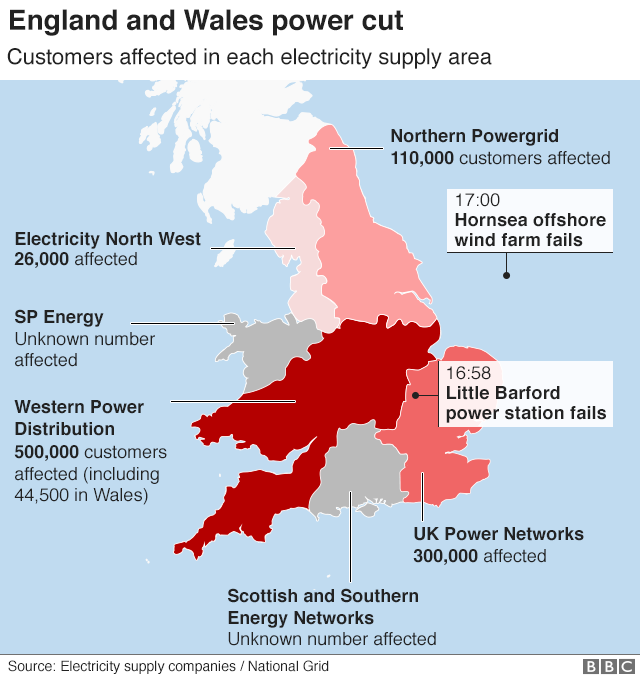
It turns out that the Little Barford power station failed, and so the national grid wouldn’t be overloaded, the Hornsea offshore wind farm curtailed its power delivery to the UK until the problem was fixed.
Creating an Electricity Grid for the 21st-century: Clean, ‘Islanded’ and Locally-Owned
No one in their right mind would’ve created the UK energy grid the way it presently sits were an intelligent species to land on Earth some 5000-years ago and begin to populate the landmass we now call the UK.
Major cities would’ve been located far inland near mountains and large water sources, not where they are located now.
Port cities would’ve been located far upriver with ease of defence in mind — not with the cannons of the Spanish Armada in mind. (The maximum range of Spanish Armada cannons were less than a mile which is why the UK’s present port cities sit about one mile back from the breakwater barrier)
All Britons would’ve served 2-years in the military after completing their academic schooling so they could instantly assist in the defence of the realm any time it was threatened from the sea or air.
And most of all, the UK wouldn’t have built humongous power plants with thousands of miles of powerlines and pylons crisscrossing the island if they wanted the highest level of security for the UK’s energy infrastructure.
Alas, these things evolved instead of being overseen by an intelligent designer with deep knowledge in regards to helping nation-states add energy security to the network.
From a security standpoint, using the OBF model is practically asking your enemies to bomb your power plants.
The OBF, or ‘One Big Factory’ model is what the former Soviet Union employed for factories — which was extremely efficient from the ‘economies of scale’ perspective — but was horribly flawed from the security perspective, as one bomb could destroy the country’s entire tractor production, or entire automobile production, or entire footwear production, etc., for a decade or longer.
In short, when economists design your economy, you build one gigantic factory to produce tractors (for example) to assist in the ‘economies of scale’ and to simplify the distribution system (all good there!) but it allows the possibility that an enemy could destroy your country’s entire tractor production with one bomb.
Or one bomb per year, should you ever decide to rebuild the facility, because that’s about how long it would take to rebuild after a successful attack.
Alarmingly, this is the model the UK has employed over past decades in relation to Britain’s electricity grid.
Nuclear power plants located close to the ocean, easy-to-access hydroelectric dams, large coal-fired power plants with a wire fence that can barely keep curious dogs out, and large natural gas power plants are easily found and accessed by anyone visiting or living in the UK — and all of them are huge and tempting targets in time of war or terrorism. Dangerously so.
No one person or group is responsible for this concerning state of affairs. The situation has ‘evolved’ instead of being led by security professionals and by the people tasked to defend the UK — the police, the security services, and profoundly, the UK military. To those folks, thank you again for protecting the United Kingdom.
It does no good to affix blame nor to scoff at energy experts. Since 1933 when the UK’s first electrical grid came online (on-time and on-budget!) utility companies have done exactly as instructed by government regulators. And it was all good, in its time. But that was then and this is now.
I’m saying that the present energy grid has evolved logically — but now needs to be ‘hardened’ — that is, to be made more secure and be made to be easier to secure.
A non-OBF model, if you take my meaning.
More, and Smaller, Power Producers Placed Closer to Demand Centres
Instead of OBF-model power plants located hundreds of miles away from demand centres complete with thousands of miles of hideously-expensive powerlines and pylons transferring energy across the UK, what the country needs is many, smaller power producers located nearer to demand centres.
Renewable energy gives us the opportunity to create a brand new energy grid — a decentralized grid — to better serve UK energy consumers.
The case I want to make is that ‘islanding’ electricity grids on a per-county basis is the way to go here, although such grid ‘islands’ are ultimately connected to a national grid for convenience and for failsafe/backup protection thereby allowing electrons to flow uninterrupted to energy consumers during fluctuations in the power supply (from any source).
For just one example of this, in the town of Güssing, Austria, a town that was dying economically, residents got together and decided to become ‘part of the solution instead of part of the problem’ and built a biomass burner that produced electricity — whereupon it suddenly became affordable to pay formerly unemployed residents to collect wood and decades of accumulated waste from the surrounding forest which created dozens of local jobs and initiated a badly needed forest cleanup!
‘Dead-end’ Austrian town blossoms with green energy (New York Times)
So, Let’s Compare Somerset UK, to Güssing Austria
The costs to deliver electricity from disparate power generation facilities located across the UK to Somerset’s 250,000 households 24/7/365 are astronomical. Also, powerline current losses in humid weather over such long distances can result in fugitive energy losses in the tens of per cent. Few or even zero jobs were created for Somerset in meeting the county’s electrical needs. And the thousands of miles of national grid powerlines and pylons required to deliver elecricity to Somerset adds vulnerability to Somerset’s energy paradigm.
Compare that to Güssing, Austria where residents are part-owners in that ‘islanded’ and profitable electrical grid where many residents work directly for the various community-owned power plants, or work indirectly for them by collecting and delivering feedstock to the local biomass facility, or they lease their land to the local grid for solar panel or wind turbine installations, or they gain other benefits (such as dividend cheques) from Güssing’s energy paradigm.
See the difference?
Self-Sufficient (‘Islanded’) Grids for Each UK County
There’s no reason in the world why Somerset couldn’t create its own ‘islanded’ grid sufficient to meet 100 per cent of the maximum demand of Somerset and reap the rewards thereof. Jobs! Jobs! Jobs! And profits for local Somerset shareholders, especially when that (hypothetical at this point) islanded Somerset grid would have the opportunity to sell surplus electricity to the national grid operator 24/7/365 except for the very coldest winter days when electrical demand hits its maximum annual peak in Somerset.
Be an Owner, Not a Renter!
If you live in Somerset, you might even lease some of your farmland to the Somerset energy co-op so they can install wind turbines on your land (which pays farmers about £4000/yr, per wind turbine) or you could rent the rooftop of your home or business for a solar panel installation.
Or you could own the solar panels yourself and sell your surplus electricity directly to the Somerset grid.
Video: Almost-bankrupt Boulder City, Nevada (now, rich Boulder City!) collects $20 million per year leasing city land to solar power companies (CNN)
In California (admittedly a sunnier location than Somerset, England) some residents are selling approx. $3000. worth of surplus solar energy to their local utility company annually. Under California law, energy companies must ‘square-up’ with homeowners by February 1 of each year or they lose their business licence.
When energy is local, the benefits are too.
How to Produce That Much Energy in Somerset
There are a few jargon words when we talk about energy and you can ignore all of them.
Leave terms like ‘baseload power’, ‘load-following’ power, and ‘peaking power plants’ to the experts. You don’t need to know those terms in order to support a local islanded energy grid based on the community-ownership model.
All you need to know is that it’s been done in many jurisdictions around the world, and that it can be done in your county.
Again, using Somerset as an example, let’s assume that 20,000,000 MWh/yr is the hypothetical grand total of MegaWatt hours of electricity used by all electricity consumers in Somerset County over the course of a year.
All that would need doing in order to ‘island’ Somerset’s grid, is to install a commensurate amount of electrical power generation in the county to meet 100 per cent of Somerset’s peak energy demand which occurs during the highest demand months of December and January.
During the rest of the year when Somerset isn’t using the peak energy demand amount, all surplus electricity generated by the locally-owned and operated Somerset grid could be sold to the national grid operator at the wholesale electricity price, thereby creating profit for Somerset community owners approximately 300-days of the year.
There are some generalities to discuss when setting up such a grid:
- Some regulations might need to be amended to allow cooperative ownership, although this model is currently in use in many countries.
- You’ll want to be an ‘islanded’ grid — yet still connected to the national grid to enhance grid stability in Somerset and in the rest of the UK. If the national grid goes down, an automatic switch would instantaneously flip Somerset back to 100% Somerset grid power only and you wouldn’t realize that the rest of the UK had been plunged into darkness until you read it in the newspaper the next day.
- Energy sold to the national grid would receive only the wholesale rate, not the retail rate. Still, that represents serious export revenue (profit) over the course of a year.
- Somerset could reasonably provide 10% of its electricity demand from burning local biomass. But trucking it in from other counties wouldn’t make economic sense.
- Somerset could install some so-called ‘run-of-river’ power producers — some of which fit inside a water main and produce electricity as water flows downhill through the turbine (or downstream, if the pipe is submerged in a river). See video here: Lucid Energy
- Huge opportunities await farmers and owners of other large properties for wind turbine installations, and at approx. £4000./yr to rent the land for each wind turbine, some farmers might find that ‘growing electricity’ pays better than growing crops. Really. Farmers that sell lots of wind won’t need agricultural subsidies. Ever.
- Reasonable opportunities await those with large rooftops that face the Sun and who are willing to install solar arrays allowing those homeowners to sell their surplus electricity to the community-based grid operator at the wholesale electricity price.
- Wave and tidal power plants could be a massive business for the local Somerset grid and although initial investment costs are high, they’re already doing this in Scotland and Wales.
- Small Combined Cycle Gas Turbine power plants (CCGT) could be placed much closer to demand centres like towns or factories. The smaller the unit is, the easier it is to get site approval for a natural gas CCGT power plant. Small units are a simple modular unit that produce 31 MegaWatts (enough to power approx. 30-thousand homes) and they take up surprisingly little space.
- Natural gas is expensive, so CCGT burners switch-on only when demand can’t be met by all the other producers on that grid working together, yet CCGT turbines are the most important part of any grid, islanded or not.
- Only natural gas generation can produce instant, on-demand power to deal with the frequent demand spikes during the day and General Electric (for example) has CCGT models that arrive in a shipping container and are instantly ready to produce electricity once you connect the gas and attach them to the grid. See short video here: GE TM2500 Gas Turbine. Impressive! This is called a ‘peaking power plant’ as it supplies huge blocks of power to the grid only during peak daytime demand, or when another electricity producer is offline for a few hours or days due to maintenance or unforeseen incident.
- Further, total CCGT capacity needs to be 20% of total islanded grid capacity. That’s not to say the CCGT will be running all day. Some CCGT units switch-on for as little as one hour per day to meet the sudden increase in electricity demand around suppertime. Demand spikes can be big and sudden, or small and intermittent, and you need the ability to instantly and automatically ramp-up electricity generation to meet those demand bursts. And only CCGT can do that. OK, burning oil can do that too, but it’s environmentally wrong.
- If Somerset employed a number of small coal-fired burners but limited their output to less than 2.5% of Somerset’s maximum islanded grid capacity, the county would still meet their per capita Paris Accord emission targets. Easily.
- Some amount of storage capacity is a must for all grids, especially in the ‘island’ grid scenario. In Scotland, hydroelectric dams store energy and create electricity by directing water to fall through spinning turbines in the normal way, but some of that water is pumped back up to the reservoir at night when electricity rates are low to be run through the turbine again the next day. This process is called ‘pumped storage‘.
- As Somerset has no major hydroelectric dams, it would need a giant battery such as the TESLA mega battery recently installed in Australia to help regulate energy flows and stabilize the grid. See: Tesla’s Record-Breaking Mega Battery Saves Australia $40 Million in Its First Year
Now that’s an energy future that could work for every county in the UK and provide opportunities to dispatch clean energy to other counties on an as-needed basis, thereby allowing Somerset’s grid ownership group to profit on every kilowatt dispatched, but also retain their ability to export massive blocks of clean renewable energy through the existing national grid operator infrastructure to the Republic of Ireland and the European continent in exchange for cold, hard, cash. (Thank you, national grid operator!)
Which should be the primary goal of the UK national grid operator anyway — managing electron flows between the UK’s (then) self-sufficient county grids, and to manage the (then) profitable energy exports to the continent and the Republic of Ireland.
9-Point Plan to Meet the UK’s COP22 Clean Air Commitments by 2022
- Coal generation to meet 2.5% (or less) of total UK demand.
- Biomass generation to meet 7.5% (or less) of total UK demand.
- Natural Gas generation to meet 20% (or less) of total UK demand.
- Nuclear power generation to meet 10% (or less) of total UK demand.
- Hydropower generation to meet 2.5% of total UK demand up from .5%.
- Pumped Storage generation to meet 2.5% of total UK demand, up from .5%.
- Wind power generation to meet 40% of total UK demand, up from 2019’s 20%.
- Solar power generation to meet 15% of total UK demand, up from 2019’s 5%.
- Mega Battery installations sufficient to stabilize the entire UK electricity grid.
Notes
A) Before coal, natural gas & nuclear generation can be decreased, renewable energy additions must be fully online before they can help to meet total UK demand.
B) Lower CO2 emissions via a 30% decrease in non-renewable energy generation compared to 2019.
C) Lower CO2 emissions via a 34% increase in renewable energy generation compared to 2019.
D) Mega-Battery installations sized appropriate to each UK county grid.
E) Surplus UK generation would be exported as electricity or hydrogen.
Benefits of Moving to an 85% Renewable Energy Grid by 2022
All of this necessary change would increase Britain’s GDP, help the UK environment, it would allow the community-based owners of county grids to lower their own energy costs and earn profit by supplementing other county grids and by exporting clean energy. And even non-owner Britons will enjoy lower electricity prices in a more secure primary energy paradigm.
Related Information
- Want realtime energy information on the UK grid? (GridWatch.co.uk)
- UK power cut: National Grid promises to learn lessons from blackout (BBC)
- How Utility Companies Select from a Myriad of Power Producers in Realtime (LetterToBritain.com)

Boris Johnson Week 3: The G7 Summit in Biarritz, France
Boris Johnson has been UK Prime Minister for 19-days as this is written and enjoyed the shortest ‘honeymoon’ period ever granted by the media and world governments in British history. That’s 0-days of honeymoon if you’re counting at home.
Which is merely a manifestation of the frustration felt by Britons, the media, foreign powers, and MP’s in the UK House of Commons on account of former PM Theresa May’s 3-year saga of failed Brexit negotiations.
Alas, Theresa May (naively) sought a truly splendid and diplomatic future relationship with the EU, however, EU leaders were having none of it as their noses were so out of joint due to the fact that 17.4 million+ Britons voted in a democratic referendum to leave the EU.
Emotional people rarely make the best decisions.
But when so much is at stake(!) one must be mature enough to put aside their (understandable) human feelings and concentrate on making the best out of the situation.
How Brexit unfolds will largely determine European relations for the next 100-years. Or more.
That’s a lot at stake! Far too much is at stake to allow human emotion to rule Europe’s future. Denial is not an option.
If certain leaders (including those in the UK) can’t wrap their heads around how profound this moment in time is, they should do the honourable thing and resign. It will be better for them, for their country and for their respective political union — whether UK or EU — because no good will ever come of bickering, haranguing, resenting, and ignoring the democratic will of voters.
Let’s hope that EU hurt feelings realize that Europe’s entire future is on the line, and let’s hope that new UK Prime Minister Boris Johnson finds a way to; #1, fulfil the result of the June 23, 2016 referendum by October 31, 2019, #2, finds a way forward for Brexit without further hurt feelings on the EU side, and #3, in the post-Brexit era finds ways to make the UK-EU relationship better than it ever was.
A tall order?
Not really. By definition, British Prime Ministers (and German Chancellors, BTW) must be ‘larger-than-life’ characters as their countries are large and important — but not so huge and as powerful as say, the United States, China, Russia, and the monolithic Soviet Union in its time.
Either Boris and Angela are larger-than-life and are therefore up to the task, or they’re somewhat less than that and will therefore fail to lead their countries to a place of mutual harmony and interdependence.
I’ve used Boris and Angela as an example here, but it also applies to the leaders of all G20 nations including those living under the EU27 umbrella.
All of those countries need larger-than-life leaders due to the unique challenges they face — including trying to compete in a world dominated by a still-powerful U.S. economy, an astonishing and still-rising Chinese economy, and the new, but powerful amalgam of CPTPP economies.
Fighting between ourselves only further hands the win to the U.S., China, and the CPTPP group — all of whom we love and respect(!) — but hey, we need to eat too.
So let’s not get in our own way.
What about it, Boris, Angela, Emmanuel, and other EU leaders? What way is it going to be?
Are Europeans going to continue shooting themselves in the foot as they did in the 20th-century (this time not in war, but in endless political and economic bickering) and continue to hand the lead to the three economic superpowers mentioned above?
Or will Europeans become part of their own solution instead of part of their own problem?
Every Country Brings Something to the G7 Table. What Will Boris Bring?
All eyes will be on new UK Prime Minister Boris Johnson as he is the newest leader of a G7 country, to see what he will add to the G7 family. They understand that as of today he’s only 19-days into the job, but by August 24-26 he should be a little further into his new position and more familiar with the reins of power.
It should be noted that much of the work done in advance by the UK’s G7 sherpa team was done by Theresa May and under EU oversight.
But Boris intends to actually deliver Brexit, so it is incumbent upon him to show the world what the refreshed UK will bring (add) to the G7 family.
Bringing a shipload of money (spending commitments) to the G7 just won’t cut it. There’s plenty of that already in the world. What the world needs and what the G7 needs is ideas and practical plans to make the world a better place.

This year’s G7 to be held in Biarritz, France, from August 24-26, 2019. French President Emmanuel Macron will serve as the host for the summit.
This year’s G7 theme is “Inequality” and “Environment” — which are worthy and interdependent goals. And no doubt, there will be some amount of progress as Merkel and Macron have worked diligently on these issues within their own countries and across the world and are supported by many countries in this.
But what could a new British Prime Minister thrown into the mix only days ago hope to accomplish?
Let’s hope that Boris and his team are working late into the night trying to come up with something so that Britain can be seen to be part of the solution on Inequality and Environment instead of underwhelming the world at this year’s G7.
Post-Brexit, the UK Will Take Care of its Own Poor and Marginalized, and Simultaneously Work to Improve its Own Environment
Which will help the EU to focus on their own problems in that regard, as 67-million Britons will no longer be the responsibility of the EU, nor will the ecology of the entire landmass of Great Britain and Northern Ireland.
Which is great because it takes those problems right off the EU’s plate.
In that way, 93,628 square miles (242,495 square kilometres) of environment will no longer need to be overseen by the EU, nor will the well-being of 67,000,000 people require one moment of the EU’s time, which should allow the EU27 to concentrate on their own environmental and inequality issues.
But even that’s not good enough, because the G7 not only looks after G7 countries it also sets the bar for other developed and developing countries. Therefore, Boris Johnson must not only solve the UK’s Inequality and Environment problems, the UK as a G7 power is expected to be one of seven countries that set the standard on these important issues and it must be seen to be an important part of the solution across the world.
At the very least, the UK needs to be seen taking strong action on these issues and succeeding, and be found to be creating a working model that other countries could emulate.
The Best Time to Plant a Tree Was 20-years Ago —
The Second Best Time to Plant a Tree is Right Now
Four Step Programme to Lower UK CO2 Emissions by Half
- How to Help the UK’s Poor and Help UK Air Quality?
- Easy. Have Them Plant a Billion Trees in the UK Annually.
- One Billion Trees Will Remove 24-million Tons of CO2 from the Air Each Year.
- Over 8-years (with a bit of ‘lag time’ for them to grow) 8-billion New Trees Could Cut UK CO2 Emissions by Half
What? You heard me. If Boris Johnson were to announce a new programme to plant a billion trees every year in the UK, and hire a large percentage of those UK residents and citizens who hail from the bottom and 2nd-from-the-bottom economic quintiles he would be solving two problems in one.

Trees remove large quantities of CO2 from the air 24/7/365 and sequester it for an average of 40-years and working people face less inequality than non-working people stuck on some kind of welfare programme (no matter how well-intentioned it is) such as the UK’s valiant attempt at an anti-poverty programme, called Universal Credit.
Pay poor people to plant tree seedlings and save the environment at the same time!
It’s not going to solve 100% of Inequality. It’s not going to solve 100% of the CO2 problem. But such a programme would be a relatively cheap way to improve the lives of those stuck in the inequality trap and improve UK air quality.
It shouldn’t be a temporary programme. Rather, it should become a permanent part of the UK government’s mandate to monitor air quality across the UK 24/7/365 and to order as many seedlings planted as possible to help counter the UK’s anthropogenic (human-caused) CO2 emissions.
Fifty-years from now, the ‘UK Ministry of Ecology and Forest Creation’ (or whatever it would be called) should still be hiring individuals experiencing inequality to plant enough trees to maintain the UK’s air quality on an annual basis!
Bonus: Improving City Spaces with Urban Forests
Not only could low income workers earn plenty of money planting trees in rural and wilderness areas of the UK;
But each UK city or county could hold a referendum to decide which is their most crime-ridden or dilapidated city block (or rural area) and submit the result to their respective MP for funding to; a) mow down that city block with bulldozers, b) prepare the ground for the planting of a city forest, c) plant the trees and install a walkway such as in New York City’s Poet’s Walk (photo below) d) hire the workers from a pool of workers selected from the bottom economic quintile and the second from the bottom economic quintiles.
And, most important of all; as soon as the workers are finished creating their first city forest, have the next location already approved and ready for workers to begin transforming it into a city forest that thousands of citizens can enjoy all year.

Poet’s Walk, Central Park, New York City, USA. Central Park served as NYC’s garbage dump until 18,000 trees were planted.
Re-Tree the UK Within 20-years!
Such a programme could complement groups that are already working to re-forest Sherwood Forest in Nottingham to its former (much larger) extent, for one example.
In fact, Boris; Why not call the leader of that programme and ask for a re-foresting presentation to show G7 leaders attending the summit?
There seems to be plenty of hectares that need planting in the UK but not enough people-power to get the job done in any reasonable timeframe.
Hire the people who need to earn income to plant the trees we need to clean our air.
Now, that’s what I would call being part of the solution instead of part of the problem!
As befits the UK’s rightful place in the world.
Related Posts:
- What Trees Absorb the Most Carbon Dioxide? (Hunker.com)
- Deforestation: Did Ethiopia plant 350 million trees in a day? (BBC.com)
- How much CO2 can a giant sequoia store? [1438 tons] (DewHarvest.com)
- Tree Planting for Carbon Sequestration (Congressional Research Service)
- The National Forest (UK) 25-years of Transformation (The National Forest)
- Trees for Life – Restoring the Caledonian Forest in Scotland (Trees For Life)
- Workless households for regions across the UK (Office for National Statistics)

Boris Johnson: An Upbeat Week 1
Finally, things are happening in the UK, now that the extended process for choosing a new Conservative leader is finally over. Thankfully.
New Prime Minister Boris Johnson had quite the week, didn’t he?
First there was his initial (short) speech in front of 10 Downing St (see the video here) and nicely followed-up by a full length speech in the House of Commons (see that video here) that outlined his priorities for the country. So far, so good.
Then it was off to visit the leaders of Wales, Northern Ireland and Scotland, followed by a positive appearance at a factory in the West Midlands. All well and good.
Further into the Prime Minister’s first week in office some negatives began to appear, such as the Scottish Conservative Party leader questioning Mr. Johnson’s thinking on Scottish affairs, and then the Conservatives lost a seat in a byelection reducing their parliamentary majority to one.
So, they remain the government, and as long as there isn’t a contentious issue that divides Conservative MP’s the Prime Minister will continue governing the United Kingdom.
However, should a divisive issue appear when the House of Commons resumes in September and any number of Conservative MP’s abstain or vote against a government bill, it could precipitate a Vote of No Confidence in the government, and the entire government could conceivably fall. This would bring about a snap election and it’s anyone’s guess as to who would win.
From here, it looks like the Liberal Democrats would win a tiny majority and with such little experience on the government bench between them, that government would likely fall itself within days or weeks. Maybe long enough to cancel Brexit, or not.
But the LD’s should exercise caution in regards to Brexit if they, by accident, happen to become the government.
Why? Well, for one, Brexit came about as a result of a democratic vote by the citizens of the UK. And while implementing Brexit has been delayed for 1137-days as of this writing, the delay has in no way undone the result of the democratic vote.
Just because Liberal Democrat MP’s don’t like Brexit doesn’t mean they’re free to not respect the will of the people. A majority of UK voters DID vote to leave the EU.
Indeed, entire UK governments have been elected into power on a smaller margin than the 4% margin of victory Brexiteers enjoyed and those governments served their full term in power. Saying the Brexit vote was won by a small margin of victory and is therefore something less than legitimate just doesn’t cut it.
Also, some Liberal Democrat constituencies voted to leave the EU, and that, in addition to a majority of UK voters casting their ballot to leave the EU.
- The EU was officially notified of the UK’s intention to leave the EU via the Article 50 instrument and it accepted the UK’s plan for leaving the EU.
- The EU signed the Withdrawal Agreement that former UK PM Theresa May and EU President Jean Claude Juncker agreed in early 2019.
- Subsequently, Theresa May couldn’t get the agreement passed in the House of Commons (3-times!) and the EU itself chose October 31, 2019 as the new Brexit date.
- Therefore, unless both the UK and the EU sign a new agreement to postpone or cancel Brexit before October 31, 2019, the UK is set to automatically leave the EU on that date.
Understand, leaving the EU on October 31 is the default modality. Changing that date or cancelling Brexit under these circumstances is a very big deal.
So the LD’s would be smart to remember the following points should they form a government prior to October 31, 2019:
- A majority of UK voters chose in a democratic referendum to leave the EU and that instruction has yet to be carried out by the government, through no fault of voters.
- MP’s are elected to serve the people of the UK — not the other way ’round. The fact that many LD’s don’t like Brexit is completely irrelevant.
- Should the LD’s win the right to form a government in a Vote of No Confidence scenario they might win by a tiny margin and could be bounced from power within weeks and Brexit would be ‘back on track’ as soon as the Conservatives resumed power.
- Voters have long memories. And should the LD’s cancel the Brexit that voters voted for, they will write their party’s epitaph as the party that went against the will of a majority of the UK people. Good luck ever getting back into power after gaining that kind of reputation! Thenceforth they would become known as the ‘We’ll DO WHAT WE WANT party’.
- Liberal Democrats would be wise to know that the reason Brexit is unpopular among some Britons is because of the three long years of economic uncertainty due to the overly-extended Brexit negotiating process. The whole ‘Project Fear’ campaign was wrong, wrong, and wrong again! Not one of their ‘doom and gloom’ predictions came true. In fact, far from it. The UK economy weathered a 3-year stress test called ‘Brexit uncertainty’ and passed with flying colours. In short, Brexit is unpopular (with some) due to the 3-years of uncertainty — not because there is anything intrinsically wrong with Brexit itself. Had Brexit been completed in one year as it should’ve been, there wouldn’t have been any reservations by a small and vocal group of Remainers. (Tail, wagging the dog)
- If the LD’s do get elected via a protest vote, they should remember that protest vote victories carry with them less legitimacy to govern than non-protest vote election results. Such governments formed in a protest vote situation aren’t voted-in for any other reason than the voters wish to expel the incumbent government because they’re angry at them for doing something wrong, or for not doing something that voters wanted done — not because the protest vote beneficiaries are themselves overflowing with virtue, or because they’re more popular. They get in because voters wanted the other party out of power and (LD’s in this hypothetical example) simply got more votes than the other protest vote party (Labour, in this example) nothing more. Therefore, it’s not a mandate to govern, it’s a coin toss.
First Weeks are Usually Chaotic. This First Week for new PM Boris Johnson was No Better nor Any Worse Than Any Other PM’s First Week
Of course, the media need to sell newspapers, get airtime, get clicks on their websites, but it’s time to move on. First weeks are always this way and have been since before there were rocks.
Boris Johnson hit a positive note in his first week, got a bit of bad news later in the week, and one hopes he simply carries on as Winston Churchill would do when faced with a similar week — and that is to raise the ante by a factor of one in regards to taking the fight to his political opponents, and even more importantly, continuing to inform Britons about his vision for the country.
Looking too far ahead isn’t a productive use of his time at present, but setting out his government’s plans for the foreseeable future would probably prove comforting to Britons.
And if the Prime Minister can get beyond merely informing Britons and the business community about his near-term plans for the country (which itself is uber-important) and carry right on to ‘the good stuff’ by getting some of those items ticked-off as DONE within the next few weeks, he will be doing himself and his party a world of good.
Let’s hope Boris Johnson has a thick skin and carries blithely on with his mission to create a more upbeat and more successful UK, and that he out-succeeds his political opponents every day until Brexit is completed and proves the ‘doomsters and gloomsters’ wrong for all time.
 Letter to Britain