Home » Posts tagged 'Brexit' (Page 49)
Tag Archives: Brexit

The European Union’s Brexit Endgame
by John Brian Shannon | December 8, 2016
In the aftermath of a landmark Supreme Court ruling in the UK, British MP’s have proposed the Conservative government authour a Green Paper, a Blue Paper, or a White Paper (these are different levels of British government policy documents) to inform members of the Parliament and the public about the government’s Brexit plan.
Ranking even higher than such policy documents would be a Public Inquiry, or the highest ranking, a Royal Commission (which although quite costly) employs all the resources of Her Majesty’s government to find the best solutions to the most important problems of each era.
UK Prime Minister Theresa May has so far resisted such calls for transparency claiming that by showing their hand it could help the European Union thwart Britain’s advantage in upcoming Brexit negotiations. (And I think she was mostly right about that)
But presenting a secret Brexit plan to the EU also implies presenting a secret Brexit plan to UK citizens — and that’s undemocratic.
Yes. Britons voted for Brexit! And yes, Britons voted for a Conservative government!
But they didn’t vote for Theresa May as Prime Minister, they voted for David Cameron. Not only that, but Britons didn’t vote for a secret Brexit plan to be imposed on them — should the EU accept without changes, Theresa May’s secret version of Brexit.
Therefore, Theresa May has taken not one, but two, liberties with voters. They didn’t vote for Brexit plans that were to be kept secret, and all of it decided by a Prime Minister they didn’t vote into office. Yet, it’s probable she was pursuing such a path in order to obtain the best Brexit outcome for Britain.
For small and medium policy decisions that’s 100% acceptable, but it isn’t acceptable for top-level policy decisions resulting in major changes to the way the country operates — even though she has likely done so with the best of intentions and with the best Brexit result in mind, from the British-point-of-view.
To my mind, the government now needs to show a high level of transparency with voters. Had Theresa May been voted into office by voters and not by Conservative Party members she would’ve had more wiggle room on this.
But the simple fact is, she inherited David Cameron’s chair, voters didn’t select her. Had she won the Prime Minister’s chair from the outset, she could’ve gotten away with publishing a very generalised Green Paper at any time in 2016, and the electorate would have simply trusted her to finish the job.
That’s the problem with inheriting a sitting Prime Minister’s chair; You inherit the position, but not their political capital, nor their popularity, nor their credentials.
Which is why MP’s are now calling for a detailed policy statement. And there’s no doubt any such policy documents will become public, even if it gets marked ‘Sensitive’ or ‘Classified’. It’s just the way of things these days.
Which gives the European Union an edge that it wouldn’t have otherwise had in the Brexit negotiation process.
Thanks to the UK Supreme Court ruling, and thanks to British MP’s who now demand full transparency, PM Theresa May cannot now produce a ‘fait accompli’ Brexit document to the EU Parliament and use other, non-specified leverages to get that document quickly approved by the EU Parliament and approval by the 27 remaining EU member nations.
For Theresa May, that’s a big loss, because that’s obviously what she had planned.
But it’s all moot since the UK Supreme Court ruling, and since notable British MP’s have called for a policy paper to guide the government itself, the House of Commons, and the public, on matters Brexit.
For the sake of argument, let’s say that my argument in favour of PM Theresa May, is true.
It doesn’t matter anyway. Because powerful political and psychological forces are at work in the EU Parliament and in EU member states. They’re upset that Britain is leaving the EU. Plain and simple.
And, why not? Britain pays the largest NATO contribution, it’s a large net contributor to the European Union budget paying-in much more than it receives, and it has allowed Eastern European governments to offload millions of their unemployed citizens to Britain. Why wouldn’t they want that to continue when it’s so obviously in their own best interests?
Surely, the EU plan is to reject any and all Brexit proposals — believing it’s in their best interests to force either a so-called Hard Brexit or a No Brexit result.
It’s not that EU leaders are evil — it’s pure common sense from the European Union point-of-view.
“Nations have no permanent friends or allies, they only have permanent interests.” — former British Prime Minister and Foreign Secretary Henry John Temple, 3rd Viscount Palmerston (1784–1865) also known as Lord Palmerston
We’ll eventually see that no matter how well-intentioned any Theresa May Brexit plan is, no matter how many White Papers are produced, no matter how many warm and fuzzy photo opportunities with EU leaders, the answer is going to be a resounding ‘No’ to any Brexit plan produced by the UK government.
Which leaves only two options: Hard Brexit, or the option that the European Union governments prefer, reversal of Brexit.
‘See? It’s too hard to leave. So just stay.’
It’s so obviously the EU strategy, that the British strategy must now be all about countering the European Union strategy.
UK Supreme Court rulings, MP’s demanding policy documents and any other happenings, must now be seen as incredibly minor waypoints along the path the EU is driving the British people towards; Hard Brexit (which Europhiles hope to make as ‘scary’ as possible) or Just Stay.
We must drop the notion that the European Union is going to be ‘looking out for Britain’s best interests’ and realize that even the most well-intentioned Brexit plan will be rejected, for the express purpose of forcing a show trial in the UK court of public opinion where the only two options will be; Hard Brexit or Just Stay.
Why? Because EU politicians believe that’s in the EU’s best interests.
Reacting to any Brexit news in the meantime, is merely tilting at windmills. The real show hasn’t begun.

Brexit, and now, Trump. What’s driving voters to reject the status quo?
by John Brian Shannon | November 14, 2016
After eight years of competent and relaxed rule by President Barack Obama, real estate tycoon Donald Trump arrived on the scene and swept Democrats and other Republicans aside to win the presidency of the United States. So obviously a protest vote — but a protest against what?
Pollsters and so-called ‘elites’ seem astonished at the Trump victory yet many saw it coming from afar. How is it that some people ‘never saw it coming’ while others saw it as a logical progression of the present societal moment?
The U.S.A. has a total population of 325 million people (November 2016) and when we look at the demographics of the country by quintiles, we see that there are five groups of 65 million people.
Each group is ‘one quintile’. The ‘top quintile’ are those who are the top income earners in the country, while the ‘bottom quintile’ are the lowest income earners in the country, etc.
The so-called ‘elites’ live in sumptuous luxury that few can imagine and tend to have stable lives which is a direct consequence of their high income levels and (usually) higher level of education.
Ninety-four percent of the people who live in the top-two quintiles are children of parents who also lived in the top-two quintiles.
(Yes Virginia, wealth is largely inherited and many studies attest to this — the myth of ‘work hard and you’ll get ahead’ represents only six-percent of the top-two quintile population in Western nations)
The bottom-three quintiles in America have been losing ground since the 1970’s when one person (the ‘breadwinner’ of the family) was able to earn enough to support a family, buy a reasonable home, and a new car every 2-3 years without needing to finance the purchase, take one vacation per year, and send their kids to college. All on the strength of one income-earner!
Nowadays, the bottom quintiles are barely working, many of their jobs off-shored to Asia. For those fortunate enough to have a job, it takes two income-earners to rent or buy a condo, buying a car means financing it for up to 8-years, and one ‘staycation’ per year (staying near home during vacations, with only daytrips to nearby sights) while their kids must obtain expensive student loans that can take decades to pay off.
It’s a different world from the 1960’s and 1970’s.
The major reason for this is the Reagan-era tax cuts that were designed to stimulate growth and investment in the U.S. economy (which were the right prescription for the times) and those tax cuts created a record number of billionaires — which eventually resulted in the creation of the so-called ‘1 percent’ who now invest their money in the ‘Asian Tiger’ economies which bring better financial rewards for those investors, but results in the off-shoring of millions of jobs in the Western nations.
At present, the 1 percent own more than 50% of the world’s total wealth. Leaving less than one-half of the world’s wealth for the remaining 7.3 billion people.
But by 2030, the 1 percent will own more than 75% of the world’s total wealth. Leaving only one-quarter of the world’s wealth for the (then) 8 billion people on the Earth.
And in 2040, the 1 percent will own more than 85% of the world’s total wealth. Leaving only one-sixth of the world’s wealth for the (then) 8.75 billion people to fight over.
World Wars have been waged over less!
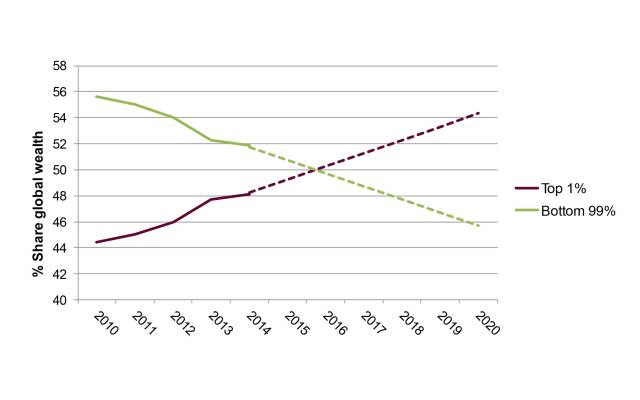
Brexit, and now, Trump. Share of the world’s total wealth for the Top 1 percent and the Bottom 99 percent. Image courtesy of OXFAM.
People wrongly blame ‘Globalization’ for this sorry state of affairs but it was a profound change in U.S. tax laws that allowed wealth to flow upward to the 1 percent who simply take their money and invest it in Asia. It represents trillions of dollars (U.S. and Canada) and trillions of euros (EU) and hundreds of billions of pounds sterling that will never, ever, return. It’s money that has left the West forever.
And some people wonder why things like Brexit and the stunning repudiation of the status quo candidate in the U.S.A. (Hillary Clinton) have occurred? Really? Are you kidding me?
Politicians and so-called ‘elites’ who didn’t see this coming have no business leading nations, nor should they be calling themselves ‘elites’ — nor have they ever spent a minute talking with a member of the bottom three quintiles in any Western nation.
In democratic societies ‘The People’ are always right. Some 52% of Britons voted to leave the EU, hoping for a better democracy and a better economy, while in the U.S.A. millions of voters chose hope over the status quo.
Upcoming elections in Italy, the Netherlands, France, and other Western nations are likely to show similar results.
It’s startlingly clear. ‘The People’ aren’t looking for more of the same. They voted for real change — not talk about change!
Politicians like PM Theresa May and President-elect Donald Trump have garnered a huge mandate for change. For politicians, it doesn’t get any better than this. Whatever these politicians do as long as it looks like they’re attempting to meet the needs of ‘The People’ they will be generously rewarded for their successes and easily forgiven if a particular policy fails to meet expectations.
It’s a time of unprecedented opportunity for politicians who’ve upset status quo candidates, but failure to deliver meaningful change now will bring us uncomfortably close to a total breakdown of the social contract that has worked so well for citizens and governments in the postwar era.
For those politicians elected to bring change, but who subsequently fail to do so, will find themselves losing landslide elections four years on — while bringing the wrath of ‘The People’ against ‘The Establishment’.
Let us do our part to make it easy for newly-elected politicians to do the right thing, and to forgive them easily if perchance some minor policy point goes awry.
We all need to do our part to assist the change that must now occur — otherwise, by 2040, some 8.5 billion people will be fighting over 15% of the world’s total wealth — resulting in an apocalypse worse than anything we’ve yet seen.
Related Articles:

A Better Immigration Model for Britain
by John Brian Shannon | September 8, 2016
One of two main reasons 17 million Britons gave for voting Brexit was widespread dissatisfaction over the unprecedented immigration levels of recent years.
The question in the UK today is how to go about addressing future immigration loads. I’m looking forward to some mature discussion about the kind of Britain citizens want to live in over the coming years.
Do we want to be a minority in our own country?
That’s a fair question and there are examples of countries where the native population represents only 10% of the total population, while the other 90% are expat workers and retirees.
The thriving Middle Eastern state of Qatar is one such example. Apart from the extraordinarily wealthy Qatar Royal Family and the other native Qataris, everyone else in the country (which represent some 90% of the total population of Qatar) hails from other countries and are often found working for relatively menial wages. Although compared to their home countries, the money they earn in Qatar would be considered exceptional remuneration — and much of their hard-earned wages are sent to their families abroad.
Foreign Remittances
Some south Asian economies receive a significant GDP boost from these so-called ‘foreign remittances’ which is the money that expat workers send home to their families.
Countries like Thailand receive 6% of domestic GDP from such foreign remittances. Each pound sterling that leaves the UK in the form of foreign remittances to family members, is one pound sterling that is added to Thailand’s GDP, and is one pound that will never return to the UK. Some areas of Somalia receive 70% of their GDP from family members working in Britain and in other countries.
The UK has hundreds of thousands of foreign workers from many nations who send home much of the wages they’ve earned, totalling millions of pounds sterling per month.
Note: Personal transfers described above are in addition to the almost 1 percent of GDP (0.71%) that Britain spends on developing nations in the form of government-to-government foreign aid — which means that a minimum of 1.5% of British GDP (including such foreign remittances) is leaving the country every year to assist people in developing nations. Most donor nations contribute much less than 1% of GDP (including foreign remittances) to developing countries. The EU donor average is 0.47% for example.
- Introduction To Remittances (Investopedia)
- Remittances: Funds for the Folks Back Home (IMF)
- Forget foreign aid: British migrants send £11 BILLION back to other countries in a YEAR (The Express)
Obviously, there are many foreign workers who are an asset to Britain and work in occupations that native Britons avoid, usually on account of the low pay involved. And although they send their wages abroad, many of these foreign workers still represent a real, net benefit to Britain.
Therefore, the question becomes; Who should stay and who should go?
Let’s have one standard that covers both present and future immigration and offer all of those people British citizenship after one-year of residency in Britain. (Assuming they don’t commit any criminal act during that probationary period)
Who should stay?
Category I: Professors, Doctors, MBA’s, and other degrees
Category II: Highly skilled workers
Category III: Honourably served in the UK military
Category IV: Immediate family of any of the above
Category V: Workers in segments where there are more jobs available, than British citizen applicants
Who should go?
Any foreigner who commits a crime in the UK should be deported, forthwith, and with no chance of ever returning to Britain. No exceptions except by Royal Pardon.
Making people Part of the Solution, instead of Part of the Problem
In this way, and over time, Britain will accrue the highest concentration of highly educated and highly motivated people, allowing it to prosper as never before, while (continuously) clearing the country of foreign criminal elements.
And all of this will work very well in conjunction with a better British education system — an education system that features tuition-free university for British citizens and continually adjusts to Build a Better Britain.
 Letter to Britain