Home » UK (Page 77)
Category Archives: UK

Brexit: The Path to UK Sovereignty
by John Brian Shannon | August 26 2016

As the UK government gears up to deal with the will of voters, four paths to trade in Europe appear that merit consideration
- EEA membership
- EFTA membership
- WTO rule-based membership, sans EEA or EFTA
- Negotiated trade deals that are none of the above
EEA membership would qualify Britain to trade with other EEA member nations, all of which are located in Europe, but not all are members of the European Union.
From the EEA website:
The EEA Agreement provides for the inclusion of EU legislation covering the four freedoms — the free movement of goods, services, persons and capital — throughout the 31 EEA States. In addition, the Agreement covers cooperation in other important areas such as research and development, education, social policy, the environment, consumer protection, tourism and culture, collectively known as “flanking and horizontal” policies. The Agreement guarantees equal rights and obligations within the Internal Market for citizens and economic operators in the EEA.
What is the EEA Not?
The EEA Agreement does not cover the following EU policies:
- Common Agriculture and Fisheries Policies (although the Agreement contains provisions on various aspects of trade in agricultural and fish products);
- Customs Union;
- Common Trade Policy;
- Common Foreign and Security Policy;
- Justice and Home Affairs (even though the EFTA countries are part of the Schengen area); or
- Monetary Union (EMU).
The Agreement on the European Economic Area, which entered into force on 1 January 1994, brings together the EU Member States and the three EEA EFTA States — Iceland, Liechtenstein and Norway — in a single market, referred to as the “Internal Market”.
Switzerland is not part of the EEA Agreement, but has a bilateral agreement with the EU. You can read more about this agreement on the European Commission website, and on the Swiss Federal Administration website.
EFTA membership governs free trade relations between EFTA States, which in 2016 are Iceland, Liechtenstein, Norway and Switzerland. Britain was a founding member of the EFTA in 1960 until 1973 when it joined the EC. It would need to apply to the EFTA in order to become a member.
From the EFTA website:
The European Free Trade Association (EFTA) is an intergovernmental organisation set up for the promotion of free trade and economic integration to the benefit of its four Member States.
The Association is responsible for the management of:
- The EFTA Convention, which forms the legal basis of the organisation and governs free trade relations between the EFTA States;
- EFTA’s worldwide network of free trade and partnership agreements; and
- The European Economic Area (EEA) Agreement, which enables three of the four EFTA Member States (Iceland, Liechtenstein and Norway) to participate in the EU’s Internal Market.
EFTA was founded in 1960 on the premise of free trade as a means of achieving growth and prosperity amongst its Member States as well as promoting closer economic cooperation between the Western European countries. Furthermore, the EFTA countries wished to contribute to the expansion of trade globally.
Based on these overall goals, EFTA today maintains the management of the EFTA Convention (intra-EFTA trade), the EEA Agreement (EFTA-EU relations), and the EFTA Free Trade Agreements (third country relations). The EFTA Convention and EFTA free trade agreements are managed by the Geneva office, and the EEA Agreement by the Brussels office.
EFTA was founded by the Stockholm Convention in 1960. The immediate aim of the Association was to provide a framework for the liberalisation of trade in goods amongst its Member States. At the same time, EFTA was established as an economic counterbalance to the more politically driven European Economic Community (EEC). Relations with the EEC, later the European Community (EC) and the European Union (EU), have been at the core of EFTA activities from the beginning. In the 1970s, the EFTA States concluded free trade agreements with the EC; in 1994 the EEA Agreement entered into force. Since the beginning of the 1990s, EFTA has actively pursued trade relations with third countries in and beyond Europe. The first partners were the Central and Eastern European countries, followed by the countries in the Mediterranean area. In recent years, EFTA’s network of free trade agreements has reached across the Atlantic as well as into Asia.
EFTA was founded by the following seven countries: Austria, Denmark, Norway, Portugal, Sweden, Switzerland and the United Kingdom. Finland joined in 1961, Iceland in 1970 and Liechtenstein in 1991. In 1973, the United Kingdom and Denmark left EFTA to join the EC. They were followed by Portugal in 1986 and by Austria, Finland and Sweden in 1995. Today the EFTA Member States are Iceland, Liechtenstein, Norway and Switzerland.
World Trade Organization (WTO) membership is perhaps the easiest way forward as Britain (and virtually all nations) are already members and the WTO is merely a standardized set of rules that govern trade between nations.
The present ruleset governing UK trade is the EU ruleset, meaning that who the UK trades with, tariff rates, and other rules and conditions have been decided by 28 EU nations — and not always in the interests of the UK — but in the combined interest of 504 million EU citizens.
The main thrust of this means that WTO rules would continue and that the UK would not be allowed to charge higher tariffs on EU-sourced imports, than what the EU charges on UK imports into the EU. Although the UK could certainly decide to charge lower tariffs than the EU charges. That could be a significant benefit for some UK industries.
There are other benefits to WTO membership. And as most nations are WTO members anyway, the ruleset is well-understood around the world.
In February 2014, the Swiss voted in a referendum to no longer pursue EU membership and left the bloc. The government of Switzerland has therefore negotiated a series of bilateral trade agreements with the European Union AND is a member of the EFTA, but not the EEA.
Of course, WTO rules still apply — unless both parties agree to abrogate or change some of the WTO rulesets.
Keep in mind that both the EFTA and EEA are European trading area agreements and don’t apply anywhere else in the world, while the WTO applies everywhere.
Therefore, non-EU trade will be largely governed by WTO rules (as is the case with most countries) while Britain’s trade with the EU could take several different paths.
Any combination of WTO, EFTA, or EEA, or bilateral agreements that supercede WTO rulesets could be negotiated between Britain and the EU.
At the end of it all, why did 17 million+ voters choose to Brexit?
Two main themes appeared to gain considerable traction during the campaign.
One, the democratic deficit in Brussels, and two, the wholly unregulated movement of people from eastern Europe and the Middle East/Levant and a complete breakdown of the Schengen Area border control system.
Brexit effectively solves the democratic deficit problem in Brussels by returning governance to the House of Commons and the House of Lords. While the mass migration problem is solved as Brexit returns sovereignty of Britain’s borders to the UK government.
The revised EFTA convention (the Vaduz Convention) extends beyond free trade in goods, and includes provisions on free trade in services and the free movement of capital and of persons. None of these should be problematical to the UK given that the Vaduz Convention only applies between its members and so would not act as a gateway for the free movement of persons from the r-EU or elsewhere. All four EFTA states have standards of living comparable to or even higher than the UK so do not present any mass migration risk. — Brexit and International Trade Treaties, The European Free Trade Association (EFTA)
Recommended Read Brexit and International Trade Treaties by Lawyers for Britain
None of this can occur until Article 50 is triggered and a 24 month clock begins ticking to end Britain’s membership in the European Union.
It would be quite wonderful if Prime Minister Theresa May would hold a press conference every six months to inform Britons of the various areas of progress and ongoing obstructions until the Brexit process is complete — a process that could take as long as 5-10 years from the June 23, 2016 start date.
We are in uncharted waters and Britons are excited to be getting their country back. They know it’s going to take time, resolve, and they know full well that there will be difficulties along the path to restoring Britain’s full sovereignty. But the payoff in 5-10 years will be brilliant.
Whatever Britain is now, it’s only going to get better.

Hitting the Right Note with Russia
Renewing Economic Ties with Russia
It may surprise some that for hundreds of years Britain enjoyed a good working relationship with Russia mainly via their respective Royal Families, and that the Allied Powers received especially valuable cooperation from the Soviet Union during WWII. And after the breakup of the Soviet Union, Britain once more enjoyed a strong relationship with Russia and it’s leaders.
All of which means, there’s no reason good enough that the UK can’t enjoy a mutually beneficial relationship with Russia. All that’s required is to hit the right note to resume that formerly beneficial relationship.
Russia has much to offer Britain — especially in light of the Brexit vote. It’s a country rich in oil and gas, metallic ores and minerals, and in forestry and agriculture. In short, all the resources that a developed nation needs.
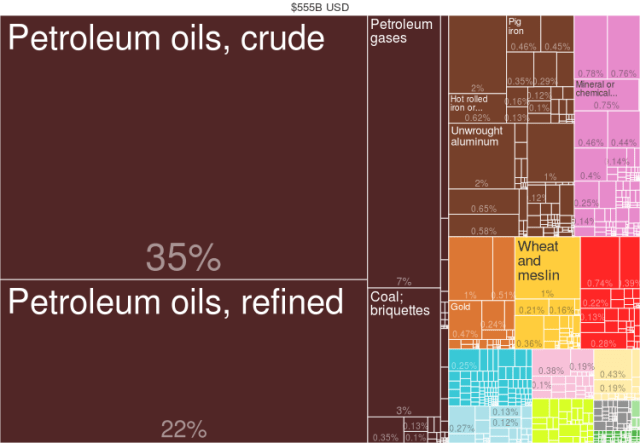
Britain needs all these things to grow its economy. Treemap of Russia exports (2014)
But more than that, Russia is a rapidly modernizing nation with 146 million consumers who have displayed a distinct appetite for travel and for European history.
Buying massive amounts of raw resources from Russia, adding value to them, then exporting them to the global marketplace is a natural for the United Kingdom. In this way, the future of Britain would be inexorably linked to Russia and in a mutually beneficial way. As demand for value-added goods rise, so will demand for Russia’s resources.
This is the kind of symbiotic relationship that Britain must advance with Russia, as it’s the only model that is a ‘Win-Win’ for both nations.
As we’ve seen in recent decades, setting up Win-Lose paradigms eventually leads to Lose-Lose outcomes.
Therefore, Win-Win is the only acceptable course for Britain in regards to Russia.
Renewing Strategic Ties with Russia
During WWII, the level of cooperation between the former Soviet Union and Britain was at an all-time high. The Soviets lost +20 million people during the war as the Soviet Army struggled against Hitler’s Operation Barbarossa “in the largest German military operation of World War II.”
But Soviet communications with Britain were of uniformly high quality and information content, and weren’t intercepted by the Nazis as had been feared by British commanders.
The ‘Lend-Lease’ programme, created by the United States and Great Britain to assist their ally, exported aircraft, navy ships, howitzers, and ammunition to the Soviet Union in an attempt to stop Hitler’s army from taking the entire country along with its unimaginable resources.
The cooperation between the three countries during WWII was unparalleled and it worked to benefit all three nations. Millions of lives were saved (especially in Britain) due to this unprecedented arrangement.
Opportunities as Big as the Sky, Where Economic and Strategic Links Meet
It makes sense that northern nations should work together to advance security in their hemisphere, particularly among those nations that own or claim part of the Arctic Ocean and its rich resources.
It would be interesting to locate some Scottish islands where the wind blows constantly (that would be all of them) and install a couple hundred wind turbines along with housing for +3000 presently unemployed blue-collar workers, so they might smelt aluminum ore for export.
But not only aluminum, refining crude oil or making steel uses obscene amounts of electricity too. With cheap wind power located right on-site — one of the biggest production costs for smelters and refiners (energy) is lowered by half — which translates into a pricing advantage for exporters.
Working together, hundreds of billions of pounds could be unlocked to invest in Russian oil and gas, and other resources, inside Russia proper or in the Arctic Ocean.
Hundreds of billions more could build new factories in Russia, taking advantage of the lower energy, labour and regulatory costs there, which could allow Russia to duplicate the astonishing manufacturing leap made by Japan in the 1970-2000 timeframe.
If British banks are financing these operations, and British companies are part-owners with their Russian counterparts, there will be plenty of incentive on all sides to make it work. The very definition of Win-Win.
Over the next 30 years Russia could match the incredible economic leap made by Japan while Britain’s banks get to earn profit on financing that transition, and both British and Russian workers enjoy a fast-paced and profitable economy.
Isn’t that a better future for British and Russian kids than sliding backwards toward a new Cold War?
Image credit: By Celinaqi – http://atlas.cid.harvard.edu/explore/tree_map/export/rus/all/show/2014/ CC BY-SA 4.0

A New Foreign Policy for Britain
by John Brian Shannon | August 5, 2016
British Foreign Policy post-Brexit
Now that Britain is delinking itself from the European Union’s foreign policy construct, the country is again free to chart its own course, instead of a foreign policy based on literally hundreds of compromises made to appease EU government and corporate leaders, and EU citizens.
The United Kingdom has an incredibly clean slate having shed its colonial power and responsibilities in the 20th century, and is presently shedding the EU construct early in the 21st century.
Windows of opportunity as large as the sky abound.

Britain Foreign & Commonwealth Office logo.
Of course, Brexit is a recent development, so we’re in early days yet.
But the possibilities are almost limitless from a foreign policy perspective. The British government could follow any existing foreign policy model or choose to create something novel and fine-tune it over time.
Trade
Central to any nation’s well-being is robust international trade. Gone are the days when a nation could survive on domestic trade alone. Today’s world requires an economy that fires on all cylinders — and that means foreign trade.
Nations with a heavy commitment to international trade also have thriving economies. Therefore, it’s mandatory that foreign policy be designed to attract the greatest number of businesses.
However, ‘doing what everyone else does’ in the foreign policy department just doesn’t cut it. Today, foreign policy leaders and bureaucrats must innovate policies that match the strengths of their particular country and sell it on its merits.
I: Strengthening the Business Case for Transnational Corporations to Headquarter in Britain
II: Working to the Strengths of British Industry and thereby Facilitating Massive Trade Surpluses
Convincing transnational corporations to relocate their headquarters (or even a branch operation) to Britain is one thing (and a very desirable thing) but it’s only half the story. The other half of the story is helping to create a massive export-driven economy, exporting billions of pounds worth of goods each month.
If Britain, post-Brexit is to be a success, it will be largely due to the Foreign and Commonwealth Office succeeding at strengthening Britain’s international trade relationships.
And if Britain’s economy fails in the post-Brexit years, most of the blame will land at the Foreign Office.
Read Britain: Between Now and Article 50
Security
Another pillar of post-Brexit foreign policy success is by necessity, security.
Again, the new government of Theresa May has a clean slate upon which to write any policy it chooses. That is a very fine thing, but change for necessity’s sake is good, while change for change’s sake usually involves wasted effort.
III: Continuing the NATO Commitment at the Approved 2% of GDP Level (unlike some NATO partners who typically miss that low target)
IV: Continuing to Support MI4 (GCHQ), MI5 and MI6 at a Robust Level
V: Creation of a British Homeland Security organization parallel to the U.S. Department of Homeland Security (DHS)
For an island nation located in the North Atlantic Ocean, leaving NATO would be the about worst single thing that Britain could do from a security standpoint. Therefore, foreign policy must be directed towards maintaining and improving that institution keeping in mind that it’s a dynamic beast, not some static entity that we throw money at in order to feel safe.
Rather, Britain, as a charter member of NATO must play a lead role in improving that organization, recognizing at once it’s strengths and it’s weaknesses. Proactive leadership within NATO is the best way for Britain to remain a stable, democratic, and secure nation.
GCHQ, MI5 and MI6 are needed now more than ever if Britain is to survive and thrive, and they have proven their worth countless times. These organizations operate in a constantly changing, threat-driven world. The government must proactively support these institutions and recognize that the intelligence business changes every day of the year, decade after decade. It never stops — and it never stops changing. Treating these as static operations would be a terrible blunder.
GCHQ monitors all manner of communications and operates parallel to the United States’ NSA, intercepting suspicious communications and routing them to the appropriate channels, while MI5 maintains a silent presence in the UK in the counter-intelligence environment similar to the FBI in America. The agency of James Bond, MI6, operates everywhere in the world — except the United Kingdom.
But nowhere in the United Kingdom is one super-agency responsible for security where the threat doesn’t come from foreign spies employed by a foreign government.
Back in the day, the local Royal Mail post office was informally charged with reporting incidents that occurred in the public domain, to whichever service it deemed appropriate. Even prior to WWII, each Postmaster or Postmistress in every county had a designated number to call in case of suspicious persons or events.
Now that the Royal Mail is a private company, there won’t be much of that.
All of the security bases in the United Kingdom are covered, except one.
New Scotland Yard for policing and investigations. GCHQ for communications. MI5 to monitor, track, and apprehend foreign (professional) spies and agents provocateurs. MI6 to handle foreign operations.
As truly awesome as all of that is, a gaping hole remains in Britain’s security. Millions of refugees and economic migrants, non-professional agents provocateurs, and even visitors to the United Kingdom (all of them legally allowed into the UK) could stage a multi-county or multi-city or other mega-event far, far, beyond the ability of the local constabulary to prevent or handle.
Mega Attacks, Mega Theft, or Terror Attacks Originating Inside the UK by Non-Professional Agents
We saw how unprepared and vulnerable the United States was during the September 2001 attacks in New York City — a country with a defence budget larger than the next 10 countries combined, and an intelligence budget bigger than many countries’ GDP.
This proposed organization needs a strong military command structure, yet it would operate in the public domain, inside the UK only. All other UK security issues are covered so it’s simply a case of having a Minister in charge (preferably one with a Royal Air Force command background) with a clear and powerful mandate “Protect the United Kingdom from domestic terror and other crimes not easily handled by other police and security agencies”
Each UK military base would need to designate at least 2 armed fighter jets, and a squadron of armed helicopters, and at least 100 personnel per base, on permanent standby. ‘Ready to move within one minute.’
It would also need a strong legal mandate giving it instant and powerful emergency powers, to do such things as; instantly close airports across the country, force aircraft to land anywhere, stop trains anywhere, detain ships entering UK waters, detain and question non-state actors and witnesses. And so much more.
In short, it would be the emergency headquarters for all of Britain.
During times of war, the Prime Minister calls the Minister of Defence.
During times of hooliganism or crime, the public calls the Constabulary.
“But who do we call, when people are flying aircraft into buildings? Who do we call, when people are planning mass attacks somewhere (anywhere) along the country’s transportation corridors? Who do we call when people in large numbers are taking control of entire counties and the police are several thousand officers short-staffed of being able to handle the job? Who do we call when sophisticated, mobile, and country-wide organizations are operating with impunity and the police just don’t have the resources or expertise to handle the onslaught? How many police can scramble and fly a fighter jet or assault helicopter to shoot down an aircraft with a stolen nuclear bomb on board heading towards a major city?”
Who do we call, when the matter is much larger than a policing issue, smaller than a war between nations, and doesn’t involve professional agents from a foreign country?
In today’s world, every UK citizen, non-citizen resident and visitor, must know an easily memorized phone number like #UKSECURITY to call in case of suspicious activity, terrorist or criminal acts — that instantly links the caller to the Department of UK Security where the information can be received, fighter jets instantly scrambled, etc.
Post-9/11, the Americans recognized the need for a Department of Homeland Security and it’s been a proactive and moderate force for good in the United States.
The UK must not wait until after a major event occurs; A parallel agency to DHS must be set up within one year to protect Britons and visitors from at-scale domestic events — events above the level of regular police and outside the mandate of GCHQ or MI5.
Renewing the Anglosphere
Brexit is the time for Britain to lead the re-creation of the Anglosphere as it was originally intended to be prior to WWI, WWII, and the Cold War.
Read The Anglosphere Revisited
Due to some history happening the Anglosphere did not continue to evolve, instead, an artificial construct has evolved.
Now is the time to get that destiny back on track, a destiny where all English-speaking nations work together at creating a free trade and immigration zone within the Anglo nations — combining their strengths to compete with the world’s new economic tigers.
It’s imperative that the UK initiate this move to dramatically step up all kinds of links between the Anglo nations, and to put a recognizable ‘brand’ on it.
Summary
The world is changing, and Britain has a unique opportunity to mould the United Kingdom into the kind of country it was originally destined to be, and for Britain to become an even more positive force in the world.
A world where anyone would be proud to live.
Have a comment? Please let us know your thoughts in the comment section below.
 Letter to Britain