Home » UK (Page 75)
Category Archives: UK

London to Land’s End – in Two Hours Aboard a Tram
by John Brian Shannon | November 10, 2016
How would you like to board a tram in Bristol that travels to London in one-hour, has comfortable seating, a snack bar, free WiFi, and costs less than your daily London parking fee?
What an outstanding resource for commuters south or west of London!
Even with five-minute stops near Swindon, Reading, and Heathrow Airport — you’ll still arrive downtown London in one hour — even as you work on your laptop computer courtesy of the onboard WiFi.
At the weekend, Londoners could hop on the tram, travelling all the way to Land’s End in two hours (unless you stop for tea in Bristol) and enjoy a glorious day at the beach for a fraction of the cost of driving your own car the same distance.
(I’m talking about the total per kilometre costs of driving a car; Including purchase, insurance, maintenance, and fuel. Most experts suggest a range of 18 pence per kilometre (economy car) up to 30 pence per kilometre (luxury car) as the rate to base all-in vehicle costs per kilometre.
Which totals £153 for a one-way trip, by car, London to Land’s End 511 km, all-in vehicle cost for a luxury car owner — and £306 for a trip, by car, London to Land’s End and back home to London 1022 km, all-in vehicle cost for a luxury car owner)
Not only is this type of tram technology available, it’s operating in major cities around the world today.
One fascinating idea is China’s new line of Transit Elevated Buses (TEB) although it is presently speed-limited to 60 kilometres per hour when sharing roads with cars and pedestrians.
The Transit Elevated Bus (TEB) built by China can carry 1000 people and travel at speeds up to 305 kilometres per hour — but important to state here — only when it’s on an elevated roadway where it isn’t sharing the road with cars and pedestrians.

Artists original concept. Image courtesy of CCTV.
The video below shows the compartment of an early TEB with a spartan interior for general city bus use.
According to the company that builds China’s new TEB, each 3-car unit can replace 40 city buses, but up to four TEB cars can be linked together. Each 22-metres-long car can carry 300 passengers.

China’s TEB-1 received its inaugural test run in Qinhuangdao, Hebei province, China, on August 2, 2016. Image courtesy of AP.
In China, the TEB is set up as a simple transit bus for short duration trips, but there is no reason that aircraft or passenger train type seating couldn’t be employed, with a hostess serving soft-drinks from a cart.

Inside one of China’s new TEB transit buses. Image courtesy of AP.
In Britain, seating compartments could fit across the width of the TEB but leave plenty of room for a spacious centre aisle.
Due to the much longer routes envisioned in this proposal, trams could have larger and more comfortable seats than shown in the image below, and a pulldown laptop table with a USB3 connection.
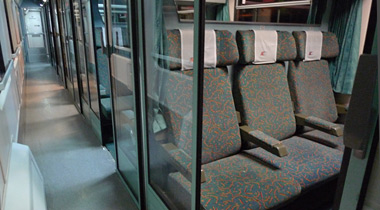
Britain’s TEB could have seating compartments across it’s full width (but with plush seating and a pulldown laptop tray) plus a spacious centre aisle. Image courtesy of the old Berlin-Warsaw train.
The Last Car could be set up as a restaurant or even a sports bar with widescreen TV’s. The image below shows what a restaurant-only car could look like.

The Secret Train (restaurant) in Bloomingdale’s Department Store in New York City.
The Last Car is obviously ‘the place to be’ during World Cup Soccer, cricket matches, and other sporting events!

Goooaaalll! The last car could be a sports bar. Image courtesy of SportsBar Bangkok.
As the premiere railway-building nation on the planet, the United Kingdom could design and build such a Made in Britain tram.
Each tram unit could be self-powered by 24 onboard 100kW TESLA batteries that automatically receive a 5-minute charge at each stop, and a full charge overnight. Not to mention 168 square metres of solar panels built right into the roof of each car that continually charge the onboard batteries.
An additional benefit for walkers and cyclists would be the paved ground-level paths under the elevated road system, allowing cyclists to ride any portion of the route.
Faster commute times, lower traffic congestion, lower air pollution levels in cities, a tourism boost for every city on the route, and a more comfortable and productive way to travel — that’s what a double-wide, elevated tram system can do for Britain.
NOTES: Below is the map from Bristol to London, as the crow flies. You can see the UK highway system isn’t direct from one city to the next — unlike an elevated tram which can go from city centre, to city centre in the straightest possible line.

‘As the crow flies’ from Bristol UK to London UK, the distance is 171 km.
Below is the map from Land’s End UK to Bristol UK, as the crow flies.

‘As the crow flies’ from Land’s End to Bristol, the distance is 283 km.
The map below shows the route for an elevated, high-speed, double-wide tram that connects southwest Britain to London.
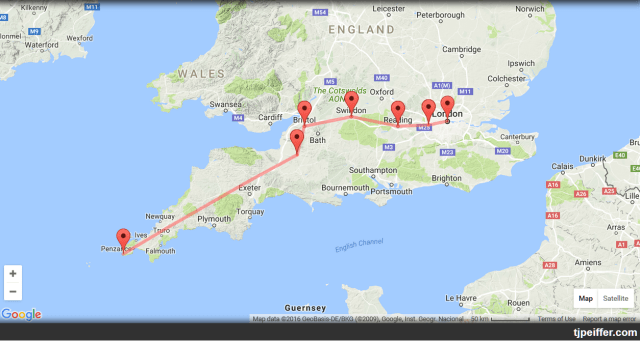
Land’s End to Bristol, Swindon, Reading, Heathrow Airport, and London in 2 hours. (Land’s End to Bristol = 1 hour) and (Bristol to London = 1 hour) including stops.
Land’s End is a great place to spend a weekend — walking the beach, cycling the entire region with many interesting stops, and an abundance of natural settings. A weekend in Cornwall is restorative to the soul!

Boosting Britain’s GDP 5% in three easy steps
by John Brian Shannon | October 18, 2016
Opportunities as big as the sky abound regarding UK exports to developing nations that need everything, and needed it yesterday.
India with 1.5 billion people now and 2.2 billion by 2025, need massive upgrades to their electrical grid. Although India has made great strides in recent years, some 400 million people living in rural areas of the country have never had electricity.
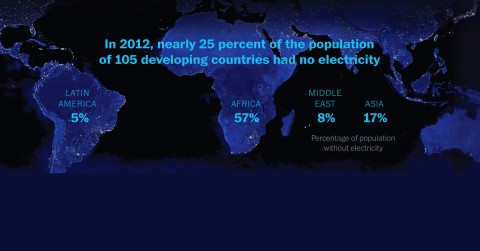
Is Britain ready to export electricity grid expertise and grid components to India’s 400 million citizens who have never had electricity in their homes? Such opportunity with real benefits for both nations!
Filling that need over the next two decades will cost hundreds of billions of dollars (if the Americans do it) but that begs the question Why leave it to the U.S.A. alone?
Such an opportunity represents hundreds of billions pounds sterling if the UK takes on part of that project — with significant opportunities to earn revenue by financing such projects — financing which are likely to be guaranteed via some combination of Indian government bonds, World Bank funding, and IMF loans.
Not only that, of course. India has a growing middle class with real purchasing power that want to purchase quality cars and trucks, housewares, electronics, and just about any product manufactured in the UK.
Further, Indian corporations need access to world class financing and market exposure afforded by the London financial sector, and some of the world’s preeminent legal and architectural firms have an obvious role in helping India to become all that it can and should be.
GCC kingdoms are always searching for evermore high-end warplanes and civilian jetliners, and they are always quick with the money. And, especially nice, no bickering when it comes time to pay the bill.
The GCC has transformed in recent years due to massive expansion in the formerly sleepy fishing villages of Dubai, Abu Dhabi, and Ras Al Khaimah — turning them into thriving financial centres, replete with stunning architecture and residential communities.
In fact, some of the most famous buildings in the world are located in those three cities and were designed by world class architects based in London, engineered by the most advanced engineering firms in the world, along with a host of other services such as project management, financing and property management, many London-based.
In the GCC, it isn’t about whether they have the money, because they sure do. It’s about having a presence and being there to meet opportunities as they arise.
In places like Dubai, major projects are envisioned, mooted, and completed in less than four years. Which is about the amount of time it takes to get just a simple development proposal permit approved in some cities. The message there is; Don’t nap, or you’ll miss it.
Brazil. The country’s formerly strong economy has taken some shocks in recent years. Both economic and political shocks have caused damage to the Brazilian economy, but that also presents many opportunities for investor groups. Huge Brazilian conglomerates that are barely holding together for now could be a real bargain for investors with sterling to spare.
What is great about commodity based economies is that when the price rises, it doesn’t get any sweeter. And when commodity prices are low, it’s almost always a good time to buy stock in those companies, or just buy the whole company.
Sugar from Sugarcane – and Biofuel Made from Sugarcane
Companies like Cosan and Raizen have the advantage of selling their sugarcane in two very different markets.
If the price of sugar is high, then the twice-yearly sugarcane crop gets sold as sugar commodity, or as finished sugar product at the retail level.
But when sugar prices drop, those same corporations simply sell their sugarcane to the huge biofuel market in Brazil, where 92.9% of Brazil’s cars run on a minimum 22% biofuel blend (E20) as mandated by Brazilian law, with many cars burning 100% biofuel (E100) which significantly lowers vehicle emissions and respiratory related healthcare spending across Brazil’s largest cities.
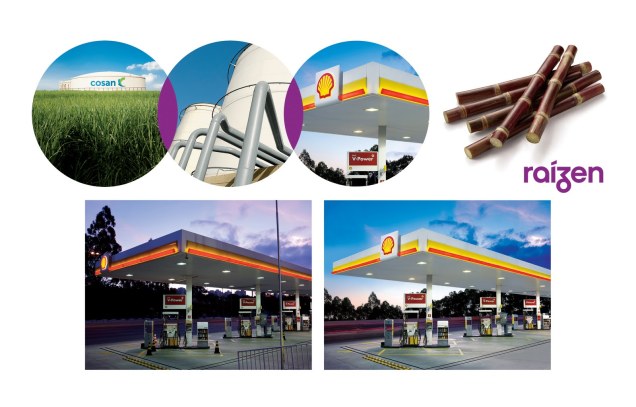
Raízen, the joint biofuel venture between Royal Dutch Shell and Cosan Ltd. is the 3rd-largest energy company in Brazil. Image courtesy of Raízen.
“A life cycle assessment by the Yale School of Forestry on jatropha, one source of potential biofuels, estimated using it could reduce greenhouse gas emissions by up to 85% if former agro-pastoral land is used — or increase emissions by up to 60% if natural woodland is converted to use.
In addition, biofuels do not contain sulfur compounds and thus do not emit sulfur dioxide.” — Wikipedia Aviation Biofuel
Aviation Biofuels
With global aviation accounting for 2% of total anthropogenic (human-caused) CO2 emissions, now is the time for Britain to legislate 50/50 blends of biofuel and conventionally sourced petroleum aviation fuel. Many airlines are already doing exactly that. Notably, the US Navy is doing the same as part of it’s Great Green Fleet programme. Biofuels can also help to moderate jet fuel costs when conventional fuels skyrocket due to wild price swings.
By switching commercial aircraft to 50% biofuel blends, aviation related CO2 emissions would drop by half and respiratory illness healthcare spending would drop by billions.
Summary
What makes these three opportunities so tantalizing are the sheer numbers; India with 2.2 billion consumers by 2025, the GCC nations with their unquenchable thirst for the trappings of a wealthy society, and Brazil for it’s commodities, especially the sugar/biofuel synergy with the opportunity to cut global aviation emissions by half.
With the right vision, the right approach by the British government, and some dedicated effort and follow-up by HM government, it should prove to be a cakewalk to grow the British economy 5% by 2021 (separate from already planned growth) on the strength of those three opportunities alone.
Related Articles:
Read: Sweetening The Biofuel Sector: The History of Sugarcane Ethanol in Brazil
Read: Sugar-Cane Fuel Wins in Brazil as Cheap Ethanol Beats Gasoline
Read: Shell and Cosan invest $1 billion to boost Brazilian biofuels

Becoming the Great Meritocracy: The Rise of Education in Britain
by John Brian Shannon | September 15, 2016
Prime Minister Theresa May says she wants Great Britain to become the world’s Great Meritocracy and one of the ways she intends to accomplish it, is by raising the priority given to education.
Which is brilliant! Of all the ways to spend taxpayer money to Build a Better Britain, equipping young minds to become all they can and should be must rank highest of all.
Much has been vocalized via the anecdotes of those who attended Grammar schools in Britain in the 1950’s-1980’s era who had decidedly poor experiences. In that era, education (and other parts of society) weren’t all that they could and should’ve been, and some schools, whether Grammar, Comprehensive, Modern, Academy, Faith, or Private, were downright terrible. And that is a shame.
But because a minority of students were badly educated or badly treated (or both) in various locations across the country, does not mean that Britain should close all schools or demonize certain kinds of schools.
Rather, let’s roll up our sleeves, find out what needs to be fixed and how to fix it, and Build a Better Britain
On that note, Grammar schools must be doing something right as the current Prime Minister and three members of her cabinet were educated in Grammar schools. Other PM’s and cabinet ministers over the years have likewise attended Grammars.
Read: Theresa May may see off Tory grammar school rebels, but her plans won’t survive unscathed
Due to the focus put on Britain’s education system by PM Theresa May, the comment forms at several UK websites show many people railing against the so-called 11+ exams (that’s the age the children take the exam) saying that they put undue pressure on students and parents, and that the result of one series of exams can turn a student’s entire future for the worse.
Accordingly, any blame for the pressure felt by students and parents in regards to the 11+ gets transferred onto the Grammar schools which, not incidentally, are performing wonderfully.

Clearly, the problem is the 11+ exam system itself, where parents feel they must hire (perhaps expensive) tutors to prep their child for the exam, and where the cost of failure breeds fear among students.
Miserable and over-pressured students do not learn well
Some children are late-bloomers and might fail the 11+ exam, but those same kids could hit their stride by age 12 or 13. For some students, it just takes the ‘right teacher’ to make learning fun and and they begin to excel for no apparent reason.
Once you have that going for you, exams are just enough of a challenge to keep your interest but not knock you off the planet with dread.
Therefore, let’s keep the 11+ exam, but normalize it by requiring one every subsequent year. To ensure that children get the best chance in life, let them take a 12+, a 13+, a 14+ and so on, until they have completed their primary and secondary education. Students could move to a Grammar when they are ready, while other children could leave Grammar school, returning to their Comprehensive or other school if they find that a Grammar isn’t working for them.
In that way children will find the school that is most appropriate to them, at the time they’re ready for it
There’s room for improvement in the British educational system and a simple course correction might be all that’s needed.
Here are three ways to improve educational outcomes for students:
- Instead of 11+ exams taken at age 11 (and only age 11) that can determine a child’s entire educational future based on one exam, add 12+, 13+, 14+ and 15+ exams to the mix. In that way, children will find the most appropriate school for them.
- Increased funding for schools, particularly at the pre-school and early development stages.
- Vocational schools that teach the academic programme, but are geared to appeal to those kids who know they want to work with their hands; The future home builders and skyscraper constructors, the automotive, rail, and aircraft manufacturers and maintenance staff of the 21st century. And so much more.
Instead of shooting for a minimum standard, Britain’s government should be empowering all of Britain’s students to become all that they can and should be whether they choose to become an Accountant or a Zoologist, or anything in between.
But whatever path they choose, let’s give them the ability to be the very best Accountant or Zoologist they can be.
That’s what it will take for Great Britain to become the world’s Great Meritocracy.

 Letter to Britain