Home » UK (Page 74)
Category Archives: UK

Why Scotland needs the UK
by John Brian Shannon | December 22, 2016
If Scotland chose to become an independent nation it would become a prohibitively expensive operation in very short order, and Scotland would need to find a big brother to pay its bills — as Scotland isn’t economically viable on its own.
The first thing that any country must consider (whether it’s a brand new and independent country or not) is national defence and public security. It’s the historical reason that nation-states were formed in the first place and without national defence and public security, a country is nothing. It then becomes the target of a hostile takeover.
Therefore, Scotland would require its own (viable) military from the first day of independence. Requiring immediate and large-scale expenditures and an annual operating budget.
The operating budget would be equal to $10 billion per year to properly maintain the force. But the first year especially, would be very costly — as a brand-new and fully-functioning from Day One military, would need to be created from scratch.
First purchase: An entire Navy – $5.6 billion for hardware alone

Pictured here is the highly regarded French Navy destroyer FS Forbin (D620) in the Arabian Sea. (U.S. Navy photo by Mass Communication Specialist 2nd Class Rafael Figueroa Medina/Released)
If Scotland separated from the United Kingdom, it would require four modern Navy Destroyers in order to protect its far-flung islands, sea-lanes and regional interests, and such vessels typically cost $250 million to $1 billion each, depending upon the type and capability level.
An independent Scotland would spend $2 billion on new destroyers alone
That’s before training and hiring the crews, and provisioning those ships with food, fuel, and ammunition (all combined, these provisions are called ‘ship’s stores’) and building the necessary naval port facilities, and training and hiring of onshore maintenance and security staff — all of which would come from the annual defence budget.

If Scotland became independent from Britain, Scotland would need 10 Navy frigates comparable to the highly capable Royal Netherlands Navy HNLMS Holland, a modern warship that won’t become obsolete anytime soon. Image courtesy of navyrecognition.com
An independent Scotland would also need many frigates, perhaps 10 of them; Some frigates would be rigged as minesweepers, others as destroyer escorts, others as anti-submarine warfare (ASW) ships, while others would be rigged for anti-piracy and interdiction roles.
And all of them would need to have so-called ‘wet bays’ where small, fast boats can quickly exit the main ship and race out to board any suspected ship or to conduct rescue missions, or to assist green water patrol boats in their respective missions, and all of them would need onboard helicopters and crews. Frigates with wet bays and helicopters usually cost in the neighbourhood of $200 million to $400 million apiece.
Scotland would be looking at $2 billion just to buy the empty, but brand-new frigates
That’s before training and hiring crews, and provisioning those ships and building naval port facilities, let alone training and hiring onshore maintenance and security staff, which would come out of the annual defence budget.

If Scotland were to separate from the UK, the first purchase would need to be 20 Svalbard-class (or equivalent) light-icebreaker offshore patrol vessels. Norwegian Coast Guard vessel KV Svalbard (W303) pictured. Norwegian Coast Guard photo.
And, Scotland would need (almost more than anything) about 20 Svalbard-class light icebreaker, coastal patrol vessels. Although no longer in active production, the Svalbard-class ships operate in the same region and have an excellent service record.
Ka-Ching! That’s $1.6 billion, just for green water defence craft
That’s before training and hiring crews, and provisioning those ships and building naval port facilities, let alone training and hiring onshore maintenance and security staff, which would come out of the annual defence budget.
Note: Although some articles reported that these ships cost the equivalent of $20 million apiece when they were being produced, it’s only because Norway simply built the new Svalbard hulls, then took everything they needed (engines, radars and sonars, warfare electronics and weapons systems, and almost everything else from their recently retired naval ships) and installed them on the new Svalbard ships. This lowered Svalbard costs from (approx.) $80 million, to $20 million per unit.
Second purchase: An entire Air Force – $1 billion please!

The SAAB Gripen fighter-bomber jet is the obvious choice if Scotland becomes independent, as these jets are famous for their low maintenance cost and high performance.
“Gripen has stable, affordable acquisition and low life cycle costs. This gives air forces a reliable basis on which to budget for operations and fleet sustainment over the long term. Gripen’s inherent reliability and low maintenance footprint boosts force levels and operational effectiveness.” — from the SAAB Gripen website.
Scotland would also need to acquire an Air Force from the very first day of independence. It would need at the minimum, 20 SAAB Gripen fighter-bomber jets and seven long-range search and rescue, and reconnaissance aircraft, like the Aurora. And five KC-135 airborne refueling tankers to ensure those aircraft don’t run out of fuel over the North Sea.

In case of Scottish independence, Scotland would need five CP-140 Aurora Maritime Surveillance Aircraft, which are considered the Gold Standard among maritime surveillance aircraft. Image of Royal Canadian Air Force Aurora.
The Gripen fighter jets cost $40 million per unit. And for surveillance aircraft, the Lockheed CP-140 Aurora is the automatic choice for any Western military at $25 million per copy, and for refuelling tankers the undisputed king is the $35 million per unit KC-135.
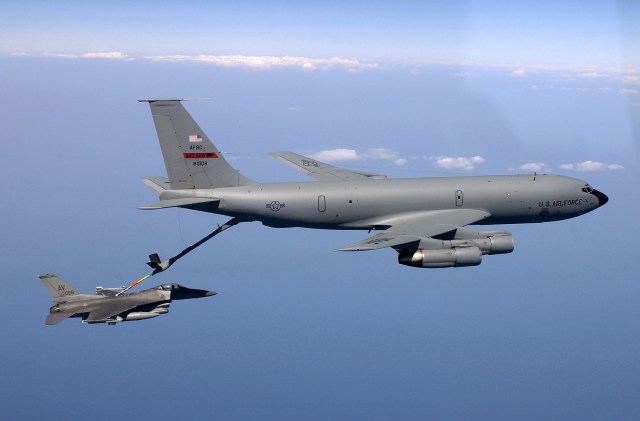
If Scotland leaves Britain, the ability to refuel its military aircraft in-flight is paramount. A Boeing KC-135 Stratotanker refuels an F-16 Fighting Falcon. (U.S. Air Force photo by Tech. Sgt. Mike Buytas)
Scotland would be looking at $1 billion just to buy the various aircraft
That’s before training and hiring crews, and provisioning (bombs and bullets) and building airfield facilities, let alone training and hiring maintenance and security staff, which would come out of the annual defence budget.
Third purchase: An entire Army – $1 billion+ for hardware only

Britain’s legendary Challenger 2 tanks escorted by stealthy (ultra-quiet) Westland helicopters in wargames at Salisbury Plain.
Oh, I forgot to mention that Scotland would need a 10,000-person Army, and due to financial constraints, those soldiers might need to be shunted between the Scottish Army, the Air Force and the Navy, on a daily, weekly, or monthly basis (as required) to keep all positions covered. The weakest link in any chain, is the link that isn’t there.
That’s before the provisioning of army bases, the hiring and training of infantry and tank and other military vehicles personnel, let alone hiring and training on-base maintenance and security staff, which would come out of the annual defence budget.
Note: The Army, Air Force, and Navy cost estimates assume the Scottish government donates at no cost to the military, the necessary land for naval port facilities, for military airfields, and for army bases and training areas.
Military-only costs for a newly independent Scotland
In the first year, Scotland would need $30 billion (conservative estimate) just to field a small, but respectable, Navy, Air Force, and Army. All of those would be required from the very first day of independence, you simply can’t leave a country unprotected while you spend a couple of years shopping for and having navy ships built.
And it would cost $10 billion per year thereafter, across the entire Scottish military, just to keep all seats filled, wearing appropriate military uniforms, military personnel fed and sheltered, with all regular pay and pensions paid, and never find themselves out of fuel or ammunition. (Want your army to quit en-masse? Run them short of ammo)
Other Independence Costs
Thus far, and we’ve only talked about defending Scotland, we’ve yet to talk about creating a national currency were Scotland to be truly independent, a federal reserve-type banking system, a Scottish police force and an MI4 (GCHQ) an MI5 and MI6-equivalent role security agencies, nor have we talked about the creation of a Scottish foreign affairs office to promote Scottish trade abroad and to assist and protect inward investors, and to assist and protect Scottish companies doing business in other countries. All of that must be paid-for by Scottish taxpayers.
Where to find that money? In the markets? The IMF? If so, what’s the collateral?
Scottish debt-to-GDP would be 100% in the first year, and get worse every year from that point… unless the oil price happened to skyrocket to $140 barrel, stayed there permanently, and huge oilfields were suddenly found in Scottish waters. Not likely.
If Scots want true independence, Scottish taxpayers will pay three-times more tax
Remember, the true cost of Scottish independence from the UK could easily surpass $20 billion annually, in addition to the first year start-up costs. And, if it’s true independence that Scots want it will be Scottish taxpayers footing the bill, via much higher personal, sales, and corporate tax rates.
But if Scots want EU membership, their economic overlords would be the European Parliament
Why do I say ‘economic overlords’?
Because, based on the principle of ‘No taxation without representation’ I suppose reverse taxation (subsidizing an entire country, where the money flows from the EU to Scotland) the Scots wouldn’t receive much representation for their tax payments.
In fact, as the EU would be funding Scotland’s budget deficits, the EU would get to make the majority of Scotland’s decisions from the safety of Brussels. Which is quite a-ways down the road for Scottish citizens if they ever felt the need to stage a peaceful protest.
If Scots want continued UK membership, the present paradigm continues
At present, Scotland receives 16 billion pounds sterling more, than it contributes to the UK economy, on an annual basis. Not a bad deal for Scotland! But yes, some decisions are made in London for the betterment of all Britons. That can seem unfair if you’re a Scottish citizen and your heart was set on a certain policy or outcome. Still, it’s the best deal on offer.
(But if you find a better offer, take it!)
Imagine Scotland no longer having that 16 billion pound annual subsidy from the UK, and needing to pay $20 billion USD for one-time costs to create a brand-new armed forces, and thenceforth having to pay $10 billion USD annually to keep the armed forces fed, clothed, sheltered, trained, paid, and a with reliable supply of fuel and ammo.
Without the UK contribution, Scottish independence (military costs only) amount to an annual difference of $29.7 billion USD. Something important to note; The first year of independence (military costs only) amount to $49.7 billion USD.
What Scotland and the devolved regions really need are people selected from their own region to be employed as Cabinet Ministers in the Westminster government (not only a UK Cabinet Minister for Scotland, Northern Ireland, and Wales, but a Cabinet Minister for England too) who represent the interests of their particular region within the UK central government.
In this way, devolved governments and their taxpayers will have better representation and more engaged relationships with the central UK government, and thereby receive superior governance outcomes from the UK government.
And isn’t that what fair government is all about?
Related Quote: “If I had asked people what they wanted, they would’ve said faster horses.” — Henry Ford

Theresa May’s Secret Weapon – the UK Economy
by John Brian Shannon | November 29, 2016
Some things are expected, and some things sure aren’t. And one of the things that wasn’t expected even by the most vociferous Brexiteers prior to the June 23 referendum, was the strength of the UK economy.

Britain’s GDP from 2010 to 2020. To view the interactive chart, visit Statista.com
In the run-up to the referendum, Bremainers used the fear of an economic crash in the UK to good effect, lowering support for Brexit from a high of almost 70% down to 52% in the final two weeks of the campaign.
Even so, Britons ‘knowing’ in their hearts there would be high economic costs to exit the EU (because famous Op/Ed journalists told them so) they still voted for more democracy, more sovereignty, and more control over immigration
The latest OECD report, informs us that GDP growth in the UK next year will be a healthy 2% — beating major Western and developing nation economies, and the following year is estimated to be in the 1.5% range. Not bad, considering the doom that was supposed to be upon us and considering that the OECD itself had earlier predicted UK growth to be at 1.5% and 1.2% (at best) over the same two-year period.
Sure, some things need to be carefully navigated. Raising the minimum wage for UK workers over age 25 (called The National Living Wage) could be an additional cost for some employers and could thereby increase the unemployment rate among workers. But it’s an overstatement to say that could happen in a growing economy however, if the economy begins to contract it becomes incrementally more serious.
Something else that bears watching is the fall in the value of the pound — which is seen as a desirable thing by economists as it increases exports in almost every country where currency devaluation has ever occurred — but if it doesn’t happen, a speedy remedy must be found. A falling currency with no appreciable increase in exports has no value at all, and only serves to make foreign goods and foreign travel for Britons, more expensive. Government intervention must therefore be instant and right on target in order to rectify the problem.
The UK economy is largely service based (due to the historical high valuation of the British pound) and with a falling pound manufacturing exports should rise in tandem with the falling currency (with plenty of lag time, as it isn’t an instant process) yet if it carries on for too many months, government must intervene to help exporters.
Help is not ‘help’ unless it is actually help.
Providing the right kind of assistance to British manufacturers is key here. There’s no use having the international trade office providing help to access foreign markets if transportation bottlenecks are the problem! Likewise, if limited access to rare-earth metals is the thing restricting manufacturers, lowering the corporate tax rate won’t help.
It’s about listening carefully to the needs of exporters
It’s about meeting every manufacturing CEO and giving them a full and fair hearing in regards to their corporate needs. And then, solving the problems surrounding their inability to export in huge volumes.
It’s doubtful that a one-size-fits-all solution is going to work in Britain’s case. It’s likely that a range of issues need to be addressed. Certainly, companies have a different challenges. For example, some have never exported railway steel (due to the historically high pound) while others that export designer clothing (the high pound just isn’t a factor in this particular market) but face competition from nations which allow ‘knock-offs’ of Britain’s famous clothing brands.
In previous decades, governments threw money at corporations or give them massive tax breaks to allow them to take care of the problems, themselves. But those days are past.
In our time, governments simply don’t have multi-billions to hand to industry as the massive economic growth that was a consequence of massive population increases (courtesy of the baby-boom generation) are long past — and massive corporate tax breaks just aren’t possible as the present corporate tax rates can only be termed ‘marginal’ compared to the ‘heavy’ corporate tax rates of the 1950’s – 1990’s.
All of this means that the British government must begin to see UK companies as ‘part of the solution’ to Britain’s economic future as opposed to ‘part of the problem’ — which is how the corporate world was viewed by government in the pre-2000 era.
High growth is a wonderful thing for senior executives, it’s a great thing for a sitting government, but it means the people in the bottom-three quintiles face ever-lower wages, more unemployment, resulting in a lowered standard of living for those citizens. And let’s not forget, lower standards of living directly and always equate to higher healthcare costs so there’s no savings anyway. At least, not for governments or families.
While the days of fixing everything with one silver bullet are over, there is still plenty the UK government can do to boost GDP; By assisting manufacturers to re-learn how to export and find new markets, helping industry to boost productivity by redirecting education towards the always changing needs of industry, by providing additional R&D tax breaks for companies — and to provide decent jobs for those left behind via massive and ongoing infrastructure spending programmes, rather than have them rely on eternal government support.
It’s clear that Building a Better Britain begins and ends with Building a Better Economy
Therefore, as important as every other matter before government is (including Brexit!) it’s all for naught if the economy begins to fail, because when the economy fails, so does industry, society, and governments, which tend to fall… hard. Just ask any former politician.
Related Article:

Choosing Triumph or Tragedy for Britain’s Economy
by John Brian Shannon | November 21, 2016
In this new century every country has its challenges. And these days, even advanced nations like Britain are challenged to balance the books while still providing the services that citizens depend on, and international partners expect.
No Worries. It’s easy as pie!
But we’ll get to the pie charts later. For now, let’s sketch out some broad outlines that a vast majority of people probably agree on.
And number one on the list must be that rich countries shouldn’t be running budget deficits. Ever. With the possible exception of major national emergencies or God-forbid, another World War. Other than those caveats, there is simply no excuse good enough that G7 nations should be running budget deficits. Full stop.
Ours is the most advanced civilization the world has ever known, we are literally swamped in knowledge and technology, and our ability to communicate and trade with other nations is almost limitless.
Why then, do developed nations have budget deficits that have piled-up over the decades to the extent that some nations have debt levels approaching 260% of GDP? (NOTE: Government debt is merely the total of their accumulated deficits)
It’s a very good question and the answer is; WWI, WWII, the Cold War, assorted other wars like Vietnam, the 1990 Gulf War, the Iraq War and the Afghanistan War — all of these required massive spending on a buy-now/pay-later basis.
For one example of how costly this is, the total interest payments just to service U.S. government debt since deficit spending began, equals $2.5 trillion dollars.
Here are the highlights from the U.S. Debt Clock (courtesy of the U.S. Treasury)
- U.S. total national debt — $19.8 trillion
- U.S. debt per citizen — $61,131
- U.S. debt per taxpayer — $166,240
- U.S. budget deficit — $590 billion (when calculated using GAAP rules, this number totals $5.6 trillion)
America alone spent one trillion dollars on the Iraq War.
For one trillion dollars (from the year 2000 through the year 2050) every unemployed American citizen could have been given a job paying them $50,000/year for their entire working life, and each kid who couldn’t afford to pay their university tuition themselves could have gotten one baccalaureate degree paid for by the U.S. government, and each U.S. citizen living on welfare could have been paid $25,000/yr to keep the mailboxes on their street clean and painted, and the sidewalk swept. With quite a few billion dollars left over by the time 2050 rolled around.
Instead, all of the money spent on war by the United States was borrowed money that will never be paid off — and American citizens will be paying the interest indefinitely. Forever is a long time.
See this snapshot on U.S. government debt. Scared yet?
For comparison purposes, the population of the United Kingdom is almost exactly one-fifth of the United States. Below is a snapshot of Britain’s deficit and debt picture.
- Britain’s total national debt — £1.7 trillion
- Britain’s debt per citizen — £28,589
- Britain’s debt per taxpayer — £49,174
- Britain’s budget deficit — £19.1 billion
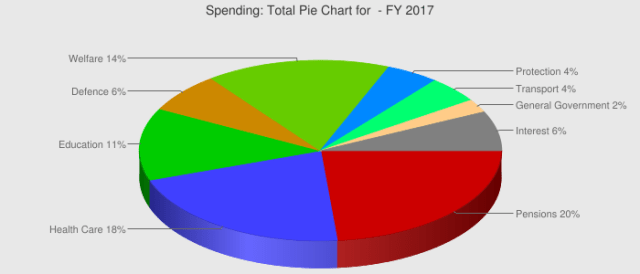
Britain – Government expenditures for Fiscal Year 2017
At the moment, the UK government is doing three things well to help Britain’s economy
The brightest spot for Britain’s economy is the already-passed legislation requiring that all central government budgets be balanced from 2020-onward.
Another hopeful sign is that Philip Hammond, Chancellor of the Exchequer, has devoted £1.3 billion to a road building plan in his recent Autumn Statement, thereby allowing thousands of workers to continue working, and adding hundreds of presently unemployed workers to the workforce.
In the creative accounting department, workers can now save some money and their employers can save even more — while both avoid some amount of National Insurance cost compared to the existing calculation method, via the so-called ‘Salary Sacrifice’ method.
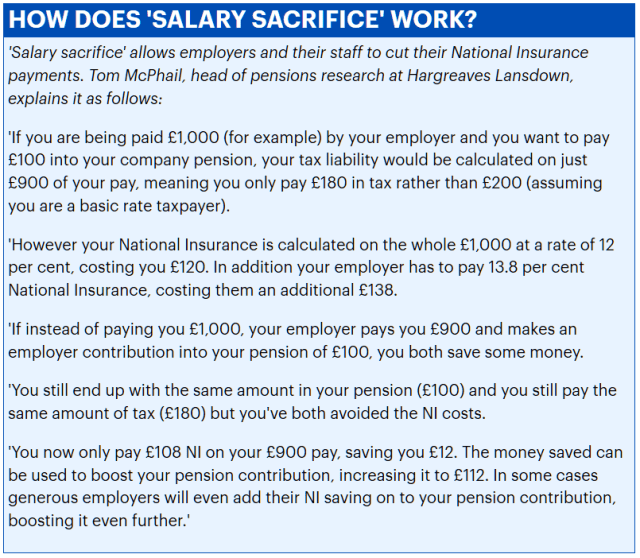
Britain – Chancellor of the Exchequer Philip Hammond does a bit of magical accounting (the good kind) to make British tax law more efficient. Click on the image to read the Daily Mail article.
While these seem to be small (but brilliant) improvements to the UK economy, it’s important to remember that the Theresa May government is less than 130 days old. And although these are baby steps, they are positive and add certainty to Britain’s economic outlook.
More fiscal and monetary levers need to be applied than that however. And importantly, countercyclical policy must be employed as a long-term economic lever throughout the British economy, with special emphasis on creating employment during economic downturns.
What else could be done to help Britain’s economy?
Quite a lot.
Every government in the world needs money to operate, and the taxes gained from personal income tax are already too high (just ask any taxpayer) while higher corporate taxes are detrimental to attracting business to your country.
Four quick ways to supercharge Britain’s economy
a) Match Canada’s lowest-among-the-G7 corporate tax rate
b) A 5% tariff on every imported good
c) Massive infrastructure spending programme equal to annual import tariff revenue
d) Legislation permitting up to 5% of electrical demand in each UK county be met with clean coal
Still bound by EU trade laws over the next (approx) 36 months, how can Britain excel economically?
a) One of the reasons that Canada virtually breezed-through the financial crisis of 2009-2012 is that it had the lowest corporate tax rate in the developed world, it ranks well for ease of doing business, and it has a streamlined process for existing businesses to relocate to Canada allowing corporations to easily move to a lower corporate tax rate — all of which worked to keep Canada on an even keel throughout the global financial crisis. (Not world-changing, but ‘just enough’ to get the job done for Canada)
In retrospect, during the boom times, a low Canadian corporate tax rate represented a slight loss in revenue for Canada, but during the recession the low corporate tax rate promoted many relocations to Canada — when they weren’t prevented by President Obama, that is.
In the case of the Burger King fast food chain, it decided to relocate to Canada in order to save billions in corporate taxes, however, the U.S. President decided to block the move. Although I’m still a fan of President Obama, it teaches us that there are very real limits to the benefits of low corporate taxes, due to market interference by politicians that say they believe in free markets, but don’t. And there are many of those.
Still, a low corporate tax rate that matches the Canadian rate would attract new business to Britain. There will be times that such moves are overruled by faux free trade governments, but on the main, Britain would gain more than it would lose by matching Canada’s corporate tax rate.
Yes, the UK government would lose some amount of corporate tax revenue in the short-term. However, that is balanced-off by the hundreds of new businesses that would relocate to Britain over the long-term — possibly even from Canada which can’t compete with the astronomical level of economic activity in London, nor a prestigious London address.
Inclusive in the term free enterprise with free markets, means that corporations are free to set their headquarters anywhere they want.
Where to recapture that corporate tax revenue loss and add billions more revenue?
b) The most efficient way for Britain to recover that short-term revenue loss and to gain billions more revenue, is by instituting a 5% tariff on every good that arrives in the country.
If Britain and her trade partners agree to the same 5% tariff and a standardized list of exemptions in their own countries, there will be nothing to fight over.
On a personal note, because I happen to believe that knowledge is the solution to all problems, I have a problem with taxes on books, whether they are books printed on paper, recorded on DVD’s, or are purchased as E-books.
Similar applies to those medicines that save lives. Such things should be exempted from all forms of taxation, including tariffs. Everywhere on the planet.
By instituting a nominal tariff of 5% Britain would also make imported products minimally more expensive, while Made in Britain products would become more cost-competitive. British manufacturing (jobs) would see an uptick and sales (profits) would increase.
NOTE: Not to make this too complicated here, but many of Britain’s exports are high-end items. If there happens to be a 5% tariff placed on British goods in other countries, don’t expect it to stop foreign buyers from purchasing an Aston Martin, for example.
At the other end of the market, low-end items such as imported T-shirts which typically sell for £1.40 will not be much affected by a 5% tariff. However, it would be reasonable to expect an uptick in the sales of UK manufactured T-shirts. (In a perfectly efficient UK T-shirt market, a 5% sales increase in UK manufactured T-shirts could be expected once the foreign manufactured T-shirt inventory is sold off)
Obviously, both the pricey and the least pricey items wouldn’t be much affected by a 5% tariff (for very different reasons) but foreign manufactured items in the middle price ranges will be the items affected, and the market would see a corresponding rise in the sales of UK manufactured items. Things like computer monitors, home exercise equipment, and food processors, for example.
A 5% tariff would raise uncountable billions of pounds sterling for the British government — exactly in the time of deficit elimination, and as unprecedented immigration levels have increased unemployment among blue-collar workers in Britain, and as Brexit roils the markets, and as a potentially protectionist U.S. administration is crowned.
In short, there is every reason for Chancellor of the Exchequer, Philip Hammond, to create a minimal and standardized tariff structure (that all of Britain’s trade partners could buy-into) means that it could be passed immediately if EU parties agree thereto. Otherwise, it can’t begin to take effect until the day after Brexit occurs.
Even so, there’s no reason that the legislation couldn’t be researched and written now, ready for Day One of post-Brexit Britain.
I can’t emphasize it enough. The Chancellor of the Exchequer and the Prime Minister must SELL their trade partners on this tariff, proving that it will be a net benefit to all of Britain’s trade partners. (If a mild tariff can do all that for Britain’s economy, it can do the same for EU nation economies)
In the absence of convincing EU trade partners of the wisdom of this plan, three years of tariff revenue will be lost — revenue that could have been used to dramatic effect in the UK economy.
c) While Philip Hammond’s £1.3 billion road building plan is a good one, it needs to be upgraded to a £130 billion national infrastructure plan.
So much of Britain’s infrastructure — from roads and bridges, to trains and trams, to airports and seaports, and to significant other structures and buildings — need replacement, repair, or major upgrades.
It could even save money over the long-term. In the case of many of Britain’s old government buildings, due to their obscene electricity consumption and inefficient insulation, some old buildings cost millions of pounds per month to light and heat.
Building new, Zero Net Buildings, means that they produce as much energy as they consume over the course of the year, saving millions of pounds sterling annually.
Retrofitting older structures isn’t quite as efficient, yet can still save millions of pounds annually.
Millions of British jobs would be created over 10-years and all of it paid for by a tariff on imported goods.
(Yes China, the U.S., and other UK trade partners, please export more stuff to Britain, as we need the tariff revenue!)
The tariff could easily provide enough funding to accomplish all of this and more, once Britain is running balanced budgets.
d) Legislation that permits up to 5% of electricity demand *in each UK county* be met with clean coal, means return to employment for thousands of coal miners, it means the construction of hundreds of small, clean-coal power stations, and it means that an amount of reliable and cheap electricity equal to the demand of all government buildings is sourced, produced, and sold — in Britain, for Britain, and by Britons.
Allowing 5% of demand per county to be met with clean coal power stations ensures that the country can stay on track to meet its international CO2 commitments and avoid the negative healthcare costs associated with behemoth scale coal power stations located near major population centres.
These are simple ways to attract new business to Britain, to increase revenue for a government still on the mend from the global recession, to create jobs and increase profits for the construction, manufacturing, and coal mining and coal-fired generation segments of the economy, and to add much-needed stability to the UK energy grid.
Instead of waiting to do it all after Brexit — and who knows what might happen to the global economy in the meantime — it’s better to take Britain out of its economic shackles, now, proactively, and with vigour.
The Chancellor of the Exchequer, Philip Hammond, has made some deft moves in recent days. Let’s hope this is the beginning and not the end of this trend.
 Letter to Britain