Home » UK (Page 27)
Category Archives: UK

A Vision of Manufacturing in Post-Brexit Britain

McLaren celebrates their 5000th supercar on February 2, 2015. File photo courtesy of compositestoday.com
Yes folks, it really does take that many people to build a McLaren supercar!
In fact, it takes many thousands of people combining forces to build any car, aircraft, or other modern and/or technologically advanced vehicle.
And the point of this blog post is to show that the UK can add one million manufacturing jobs in the automotive sector alone, just by adopting the right policies — policies that help foreign automakers become ‘part of the solution instead of part of the problem.’
So, please bear with me while I show you how the UK could emerge a winner in the post-Brexit timeframe, create millions of homegrown jobs, boost the economy like never before, and supercharge UK manufacturing exports.
If you like the sound of that, then you’re a British patriot and you want the best for your country. I salute you!
(If you’re a foreign car manufacturer, don’t panic, it’ll work out for you too in the post-Brexit era. Just keep reading ’til the end)
UK Slaps a £25,000 Tariff on any Car or Truck (New or Used) That’s Imported After Brexit
WOW! That got your attention, didn’t it?
It’s not as bad as it sounds, because every auto manufacturer would be invited to establish their headquarters for all Commonwealth of Nations countries (and this blogger suggests) that the UK government should provide brand-new, free-of-charge, turnkey factories to every auto manufacturer that wants to build cars and trucks in the UK and sell them to every Commonwealth of Nations country including the UK, sans tariffs, simply by manufacturing those vehicles in the UK.
Remember, The Commonwealth comprises 53 countries with a combined population of 2.5 billion people by 2020 and a combined GDP that nearly matches the U.S.A.
The UK alone, is the 5th-largest economy in the world by GDP (6th by PPP) and India is the 6th-largest economy in the world by GDP (5th by PPP) and other countries in the Commonwealth include Canada (10th) Australia (13th) Nigeria (30th) South Africa (33rd) and Pakistan (40th) and many others whose economies are rocketing upwards in this young century.
Nigeria alone will have more citizens than the United States by 2060. Maybe sooner.
How many auto manufacturers want enhanced access to 2.5 billion consumers, most of whom live in rapidly growing economies with upward disposable income?
The Commonwealth consumers not living in those burgeoning economies live in developed nations with high per capita incomes like the UK, Canada, Australia, New Zealand and Singapore.
Brand-new, ‘build to suit’ factories, paid for and owned by the UK government, leased to each manufacturer for £1 per year — with the benefit of zero UK or Commonwealth tariffs for those auto manufacturers, and streamlined access to 2.5 billion Commonwealth of Nations consumers.
If you’re a global auto manufacturer, you can’t lose!
Why Would Commonwealth Nations Agree to This Plan?
The UK unemployment rate is low at present, and falling each year.
In 2019, the UK unemployment rate sits at 3.8% and you’ll remember from your economics class that 2.5% unemployment is functionally a 0% unemployment rate — as exactly that many people are in some kind of transitory employment state without being actually unemployed.
Which means the UK is 1.3% away from zero functional unemployment even with all the Brexit uncertainty due to the overly-long negotiating period. (3.8% – 2.5% = 1.3%)
Q: In the immediate Post-Brexit era and assuming a (functional) 0% unemployment rate in the UK, who will the UK call-on to fill perhaps a million new manufacturing jobs?
A: The Commonwealth of Nations countries, that’s who.
And that’s the benefit of being a member of a large and diverse bloc such as the Commonwealth. For the UK, membership in that group means a huge pool of highly motivated workers ready to jump on a plane and begin working in the UK immediately.
For Commonwealth countries, it means hundreds of thousands of their young people will have good paying jobs waiting for them in the UK at the end of their schooling, and good kids will send some money home to Mom and Dad — who after all, probably paid for their child’s entire education and the airfare to the UK.
Workers who show up on-time and do a good job will of course be invited to stay on where the manufacturing continues year ’round, or find themselves invited to return to the UK by their company at the beginning of the next production cycle.
For the UK, this plan would reduce UK unemployment to zero, then allow any additional labour to be sourced from Commonwealth of Nations countries.
For foreign auto manufacturers, this plan would provide a specially-built for them factory at a cost of £1 per year, and guarantee them no automotive tariffs in the UK and other Commonwealth of Nations countries.
Saving Money, Streamlining Production, Centralizing Administration
Let’s pretend at present that Ford Motor Company builds the F-150 pickup truck in different Commonwealth nations and earns low profit per vehicle because the sales numbers in each country don’t quite support one factory per country. And all of its vehicles are subject to a plethora of different tariffs and fees in the various Commonwealth countries, depending upon where those F-150’s are built and where Ford is shipping them. Very inefficient!
But if Ford decides to build all of its UK and Commonwealth-destined F-150’s in the UK, it means that one humongous factory in Britain could build all of them. There are economies of scale in that approach! And to have the land and building built and paid for by the UK government guarantees the economics work for Ford.
All Ford must decide is where in the UK it wants the factory, which car lines or trucks to build in the factory, and pay an annual £1 rent payment to the UK government.
And no automotive tariffs for Ford in any Commonwealth nation, including the UK. Ever!
But This is An Expensive Plan!
No, not really. Especially when you factor-in some of the possible alternatives.
Such as the entire auto manufacturing sector in the UK dying completely. Which is happening in slow-motion anyway. (Rolls-Royce, Bentley, JLR, Mini, Lotus, Triumph, MG, Rover cars, BSA motorcycles, etc. are almost gone, or already gone)
There go a million existing UK jobs! (For just one example of it going wrong) And there go the additional one million UK jobs I’ve proposed.
But if UK unemployment hits 0% in the UK as I expect AND if one million new auto manufacturing jobs are created via this proposal, that means (on average) each of those additional one million auto workers will pay an average £20,000. income tax annually, and thousands of pounds in other taxes on their discretionary spending because almost every time you buy something in the UK you pay some kind of tax on it. New house, new car, new baby pram, you get the idea.
What is one million times £20,000. anyway? That’s £20 billion annually in income tax revenue HM government isn’t presently earning.
It’s even better if those one million additional workers spend every pound sterling they earn on taxable items in the UK. Maybe twice as good as the calculation above shows.
- Check the math: 1,000,000 x £20,000. = £20,000,000,000. annual income tax revenue alone.
- Over 10-years, that equals £200 billion in tax revenue alone for HMG.
- Yes, some of the £200 billion would be spent to build turnkey factories over that decade, but nowhere near all of it.
Remember: This is Just One Example of Why Britons Shouldn’t be Shrinking Back from Brexit!
Whether we’re talking Volkswagen Golf, BMW 5 Series, Audi A8, or whatever car you want to buy in the UK — if they don’t build them in the UK after Brexit — each vehicle imported into the UK would be subject to a £25,000 tariff.
Because at present, those cars are built in the EU, by EU companies, by EU workers who pay EU income taxes, in EU-subsidized factories — and the UK is getting no benefit whatsoever — other than UK drivers are encouraged by slick advertising to hand over their hard earned money to EU car manufacturers.
However, if they build them in the UK — a no automobile tariff regime for those auto manufacturers would apply anywhere in the Commonwealth of Nations, under this proposal.
I posit that vehicles destined for the UK and Commonwealth market could and should be built in Britain, and by adopting better policies, UK manufacturing will succeed as never before!

Two Brexit Flops Cost the UK Billions & Have Put Britain Years Behind Schedule
Now that the UK has missed two ‘firm’ Brexit dates, the pressure’s on. And because Prime Minister Theresa May couldn’t get the job done (twice) doesn’t mean the world has stopped while Conservatives get their act together.
The world is moving-on, in case you didn’t notice the EU Parliament Election 2019 results.
How Time Flies!
One of the best things Theresa May did during her time as PM was to visit U.S. President Donald Trump early in his presidency and ask him to move Britain ‘to the front of the line’ in regards to Britain’s place in any future trade deal with the U.S.
‘Success!’
You’ll recall that U.S. President Barack Obama famously said that ‘the UK will move to the back of the line’ regarding any trade deal with America — because Obama was the consummate globalist, and the EU his partner in compelling the UK to join their globalist plot to control much of the world’s trading system. Hey, it was worth a try! I’d have said the same thing were I the U.S. president to keep the EU, my (much larger than the UK) trading partner, happy.
But, sometimes: ‘Success’ has a shelf-life
As of today, President Donald Trump has 597-days left in his first term and if you believe the opinion polls, Joe Biden (corporatist, globalist, former Vice President under Barack Obama, and the present leading contender for the top job in the U.S.A.) might win the next U.S. election and could conceivably send Britain ‘to the back of the line’ in regards to any future trade deal with that gigantic economy.
The moment where the UK could’ve gotten a great trade deal with the U.S.A. will have passed, should Trump lose the next U.S. election!
And there’s the lollygagging of Theresa May dangling Brexit under everyone’s nose from July 16, 2016 until today (June 1, 2019) and any of those 3-years were the prime time to get Brexit done, a U.S. trade deal done, a CPTPP trade deal done, an EU trade deal done, a Commonwealth trade deal done, and an EFTA trade deal done.
Among many other important things. Too many to list here.
But no. Theresa May probably realized early-on that she wasn’t up to the task of Brexit and just decided to hang-on to power as long as possible. Very disappointing.
Lead, Follow, or Get Out of the Way!
The time for talking is over!
I’ve said it before, and I’ll say it again; If the ruling Conservatives don’t deliver Brexit by October 31, 2019 they’ll be unceremoniously booted from power by voters at the next General Election — and may not form a government for a full generation — or even two or three generations.
Politicians must deliver what they promise or they’ll be removed from power by the new generation of voters who want responsive and accountable politicians.
‘Talking about talking’ for months and years, is over!
In case you missed it in the last EU Parliament elections last week, voters aren’t going to tolerate mediocrity any longer. The gravy train is over, folks!
But if Conservatives get Brexit handled by November 1st (the new ‘firm’ Brexit date is October 31, 2019) I hope they’re ready for a lot more work. Because there’s a lot to do. Especially now that Brexit has been kicked down the road 3-times.
“The reward for doing good work, is the opportunity to do more.” — Dr. Jonas Salk
Going, Going, Gone!
Perhaps Conservative politicians aren’t aware of some of the items that will appear on their watch, so let’s inform them of these (already partially-missed) opportunities, and soon to be fully-missed opportunities.
“Don’t tell me what you can do, show me what you have done.” — Henry Ford
So, today is Day 1050 of Theresa May’s premiership and she has shown us, the EU, and the world, that she wasn’t the person to deliver Brexit. Standing up to EU elites for the rights of Britons just wasn’t her forte. No one can be everything, but standing up for Britons is an important job skill for a UK Prime Minister.
It’s plain to see that the governing Conservatives NEED A LEADER who can get Brexit done. So much of Britain’s future depends on getting Brexit out of the way — because, frankly, more important items than Brexit await.
And not one of them can be done until Brexit is done and dusted.
Brexit is Merely the Stepping Stone to a Better UK Future
Let’s do this exercise year by year, because in the best-case scenario each item on the following list would take the UK Parliament approximately one-year to accomplish. Which is depressing, because each of these items should take the UK Parliament 6-months at most.
If huge corporations can get big things done, if Malala can get big things done, and if little Greta Thunberg (age 16) can get big things done, then 650 UK Members of the House of Commons plus 800 Members of the House of Lords ought be able to get some big things done! (If not, let’s hire Malala and Greta to run the UK government!) You think I’m kidding, don’t you? Don’t you? (Hahaha!)
Let’s make a list (in no particular order) and let’s say that each item should take no more than one year to accomplish. And let’s also say that due to the 3-years of Brexit delays we’re already 3-years behind schedule. So, not a moment to waste!
- A free trade deal with America. Once Trump is gone, a U.S./UK free trade deal is gone too!
- A free trade deal with the CPTPP countries, the biggest trading bloc in the world once the UK leaves the EU, with member countries from three oceans.
- A CANZUK trade deal (Note: some CANZUK countries are also CPTPP signatories)
- A free trade deal with The Commonwealth of Nations (India alone, is the 5th-largest economy by PPP in the world)
- A free trade deal with the EU, and although the EU economy has fallen from 13% of global GDP and is expected to fall to 8% of GDP by 2025 it’s still relevant to the UK economy.
- A free trade deal with the EFTA countries, some of which have spoken privately about joining politically with the UK, after Brexit. (A strength-in-numbers equation)
- Northern Ireland belongs to the British Royal Family (Northern Ireland was purchased outright in 1800 by King George III with the King’s own money and granted to his niece) but with the best of intentions and after having spent billions (perhaps even a trillion pounds?) on it since the year 1800, it’s time to return that jurisdiction to the Republic of Ireland. There was a time for British involvement in Northern Ireland but that time is now past. However, such a transition cannot be done in the middle of a fractious Brexit situation, it must be done without undue delay following Brexit. Any UK citizens living in Northern Ireland at the time of the changeover should be compensated (and of course) given the opportunity to move house to England, Scotland or Wales.
- Many more countries are lining-up to join The Commonwealth and want trade deals with the UK, post-Brexit. (Think; AU nations that aren’t already Commonwealth members, some Middle East countries, some Atlantic-facing South American countries, as well as some Indian Ocean island nations that aren’t already Commonwealth members) Which should provide trade opportunities and easier access to certain tropical paradise islands for Britons.
- With Brexit out of the way, the UK can determine its own immigration policy and do as Canada does, which imports skilled immigrants to ‘fill holes in the system’ but only where a Canadian isn’t trained or available to do that particular job.
- With Brexit out of the way, the UK can re-write its agricultural and fishery regulations for the benefit of Britons — and not for the benefit of the ‘five dairy cows in France’ or the thousands of EU fishing boat owners who ply UK waters scooping up kabillions of fish every year.
Three-Years of Economic Uncertainty, But Only Because the UK had an Uncertain Prime Minister!
For 3-years Theresa May argued with herself, with her Conservative party, with opposition parties, and with the EU, in an attempt to deliver a Brexit Withdrawal Agreement, a Political Declaration, and a Joint Instrument (all of which weren’t on the June 23, 2016 referendum ballot) and in the end, just couldn’t get the job done.
“For if the trumpet gives an uncertain sound, who shall prepare for battle?”
— 1 Corinthians 14:8
Not that it’s a military battle with the EU. Far from it.
But that point doesn’t make it any less an existential fight for the United Kingdom — as a foreign power (the EU) was (illegally, according to the UK’s constitutional documentation) handed some amount of UK sovereignty by British MP’s from a previous generation — and now, the EU (a foreign power and an economic competitor) continues to make the rules for the UK in many areas; Including labour law, fishery and agriculture regulations, European Court of Justice, Court of First Justice (now, General Court) and in other ways, UK sovereignty was given away for free to a foreign competitor power. Shameful.
Only in Britain could political leaders vote to give away the UK’s hard-won sovereignty, acting against the UK’s longstanding constitutional framework and pass it off to voters as ‘normal business’. It remains an unprecedented act in the history of free countries!
In countries like Canada, where the Constitution of the country was written in plain English expressly so that every citizen has the ability to easily understand it, such a thing would’ve never occurred.
Example: “The resources of Canada (underground, on the land, in the lakes, and in Canada’s territorial marine areas) are owned by the citizens of the country, and such resources are to be administered by the provinces on behalf of, and for the betterment of, the residents of each province.”
Pretty simple stuff. No loopholes there. And no citizen in Canada needs a constitutional scholar on hand to understand those simple and self-evident concepts.
But alas, there are 10 major things for UK politicians to accomplish first (post-Brexit) long before we can begin thinking about formalizing the UK’s constitutional framework and writing it out in plain English so every Briton can easily understand what belongs to the state and what belongs to individual Britons.
And based upon what we’ve seen since June 23, 2016, that’s probably a good thing.
How Many Billions of Pounds Sterling Have Been Lost in the UK Due to Economic Uncertainty Caused by the Overly-Extended Brexit Negotiating Process? (Which Ultimately Failed)
No one knows for sure, of course. And the organizations that do know aren’t going to publish those stats!
Will Philip Hammond the Remainer Exchequer admit that the overly-long Brexit negotiating process has cost the UK billions over the past 3-years? I doubt it.
How about the CBI, which receives millions in funding from the EU? I double-doubt it.
How about Remainers? Never.
So, we know there’s been a cost. Brexit could’ve been completed within a year and the uncertainty factor wouldn’t have lasted long, nor amounted to much. But those trying to quash the UK’s exit from the EU thought that if they kicked the can down the road long enough, the icky democratic referendum result would go away.
But it didn’t. In fact, voters came roaring back last week voting in the EU Parliament Election 2019 — and The Brexit Party (only weeks old!) sent 29 MEP’s to the EU Parliament — while the Conservatives lost 15-seats and are down to only 4 MEP’s. Labour retains the same number of seats (10) but with a smaller percentage of the popular vote.
Remainer politicians have cost the UK economy billions, but inexplicably, they think they’ll get re-elected at the next General Election!
IMHO, every obstructionist politician (anti-Brexit = anti-democratic) in the UK House of Commons will be tossed from power at the next General Election in no uncertain terms.
And astonishingly to some Remain MP’s — many of the people who will vote for The Brexit Party in the next General Election IMHO will be true British patriots who also happen to be Remainers — who’ve seen exactly what 3-years of uncertainty have done to the economy and that harm far and away surpasses the cost of any WTO-style Brexit!
Look What Came Across the Wires as I Finished Writing This Blog Post Today!
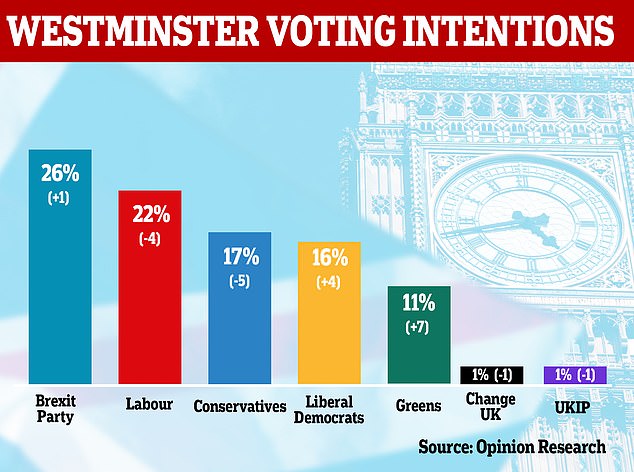
A survey last week by Opinium suggests Nigel Farage and his Brexit Party would be only 20 seats short of a majority in a UK General Election with Conservatives reduced to only 26 seats in the House of Commons. Opinium poll for The Observer published in The Guardian June 1, 2019.
“According to a seat predictor by the Electoral Calculus website, the result would leave Farage 20 seats short of a majority, with 306 MPs. The Conservatives would be reduced to 26 MPs, suggesting they could be the minor party in a coalition with Farage.” — The Guardian

What the EU Election Result Means to Europe and to the World
The Emotional Context of the EU Election 2019
If you want to begin by discussing the result of the EU Parliament Election 2019 in an emotional context there’s certainly no problem with that here (I’ll try to keep the euphoria out of my voice!) as the political map in the European Union has changed dramatically in less than one week, causing panic among pundits throughout the EU.
It seems that some people in Europe are frightened by democratic elections and may lose enthusiasm for democracy when the election results don’t go their way — but when the results go their way they’re among democracy’s strongest proponents!
It’s the funniest thing to see when politicians, pundits, commentators and even normal citizens gloat about ‘how great and strong our democracy is’ when election results go in their favour — yet at the very next election when the result goes the other way, they shriek about ‘how our democracy is broken’ and those other parties need to be outlawed! Hehehehe!
You either have the courage of your convictions or you don’t. Hissy fits are uncool.
The one thing that adults must admit and understand is, that in a democratic system sometimes you get what you want and sometimes you don’t. The peril of democracy.
“Life is like a box of chocolates. You never know what you’re going to get.” — Forrest Gump
Looking at the EU Parliamentary Election 2019 from a Practical Standpoint
Whether you’re pleased with the results of the EU election or not, one thing that must stand-out is that the EU runs a clean election. Not a word about election fraud, not one report of armed men taking over polling stations to prevent citizens from voting, and no candidate (to my knowledge) broke campaign laws.
A sincere ‘Well Done!’ to the European Union. That’s the way to do it.
On a related note, it’s another reason why EU election monitors are sought-after the world over particularly where elections are taking place in or near conflict zones, and in developing nations where democratic elections benefit from the assistance of a mature democracy to attain a clean (free from fraud) and safe election framework.
Even myself, as a Brexiteer (and notwithstanding that I hate the ‘black hole’ that is the EU budget, etc) admire the EU for being able to pull-off clean election after clean election, and it makes me happy to think that even after Brexit the European Union will continue to be the kind of neighbour any country would appreciate.
We all have neighbours we like and neighbours we don’t like, but in the post-Brexit world, the EU will remain a neighbour we like. May that ever be the case.
The Rise of Nigel Farage and The Brexit Party
In 1973, the UK joined the European Economic Community and a democratic referendum was held in the UK on June 5, 1975 that allowed Britons to approve/disapprove of that decision. British citizens voted to approve EEC membership by a comfortable margin. It must be noted that in joining the EEC the UK was not asked to give-up any amount of national sovereignty.
Subsequently, the UK was invited to join the European Union (the EU was a new entity as of January 1, 1993 and it replaced the old EC/EEC framework) and in 1998 the UK government did vote to join the then-recently formed EU. British citizens weren’t given an opportunity to vote on EU membership until 23-years later in June 2016, whereupon Britons voted to Leave the European Union. It’s important to note that in joining the EU, the UK did give-up some amount of sovereignty, and that under the UK constitutional framework that existed then (and now) it was (still is) something illegal that UK politicians approved.
At no time in all of this did the EU break any UK law. Rather, they merely asked the UK to join their union. Therefore, this is not an issue with the EU, this is an internal UK (House of Commons) matter.
In Summary
In summary, the UK joined the EEC legally in 1973 and with the benefit of a UK-wide referendum in 1975 — but the UK joined the European Union illegally in 1998 and without the benefit of a UK-wide referendum to approve it until 2016.
It wasn’t until 23-years later that Britons were offered a chance to vote on the issue, and the first chance they got to vote on EU membership (June 23, 2016) they rejected it.
Illegally joining in 1998, and then forcing Britons to wait 23-years to voice their opinion on joining the EU, isn’t democratic enough in the 21st-century, no matter how much we love our EU neighbours!
All of this is what has led to the Brexit referendum, to the hiring of a ‘Brexit Prime Minister’ (Theresa May) and an election win by Theresa May (June 8, 2017) in an election where all major UK parties campaigned on a pro-Brexit platform.
Further, the rise of UKIP, and now The Brexit Party and their astonishing success in last week’s EU election from a party that’s only weeks old at this point, have resulted from errors made by a previous UK Parliament.
The Brexit Party won 29-seats — and that, without running any candidates in Northern Ireland, nor did The Brexit Party run candidates in every constituency in England, Wales, or Scotland. Amazing!
Had The Brexit Party run candidates in all constituencies, they might’ve captured as many as 60 of the 74 seats available to the UK in the EU Parliamentary Elections 2019.
The Future of Brexit
In the wake of EU Parliamentary elections, if UK Conservatives don’t now deliver a reasonable Brexit by October 31, 2019 they will lose the next election in the biggest political landslide in British history and may never form a government again.
The time for ‘talking about talking’ is over!
Likewise for Labour; If they’re seen to be obstructing Brexit, they’ll go down at the next election as never before. Other parties will simply take their place and both Conservatives and Labour will become unknown to a new generation of voters who demand responsive and accountable politicians in government. And that’s a fine thing.
Citizens Want Responsive and Accountable Politicians in the 21st-Century
At the next UK General Election the Brexit Party will run a full slate of candidates in the UK and win a majority government on a platform of delivering Brexit (and they will deliver Brexit!) while the Liberal Democrats will represent ‘Remainers’ and form the official opposition in the House of Commons. The Green Party is likely to make significant gains and take seats from the Liberal Democrats in the House of Commons.
British MP’s in 1998 pulled a fast one on Britons and then didn’t give British citizens a say on EU membership for 23-years — and having finally gotten a vote in EU membership they’re not about to give up their right to shape the country as they see fit.
Whether Brexiteers realize it or not, The Brexit Party exists merely to correct an historic mistake that hasn’t been corrected in all this time, and it will; Become the government; Fix the mistake once in power; And eventually merge with whatever is left of the Conservative Party in the post-Brexit era.
That is the way of things. And nothing can stop it short of an asteroid destroying the planet.
A wrong will be righted. And life will go on. Sans drama, one hopes!
 Letter to Britain