Home » UK (Page 12)
Category Archives: UK

Solving Britain’s Coal Tip Problem by Building Coastal Resiliency
Mountains of coal tip waste could be put to good use via land reclamation from the sea, thereby protecting vulnerable UK coastlines
The UK has two problems that could be solved via a constructive land use approach: One, Great Britain is a small island with a growing population, and Two, since about 1690, the detritus created by coal mining and coal burning has accumulated into veritable mountains of colliery waste which now spills onto rail lines, housing developments, and farming communities during heavy rainstorms. Not to mention that coal ash and fly ash chemical components can leach into local groundwater.
Although the UK’s coal tips may have been built with the best available technology and the best intentions decades ago, some of them are becoming unstable and need to be dealt with soon. Coal tip land is presently unavailable for farming or other any use until the waste is removed and the site cleaned, but that land could easily be turned into forest or crop land once remediated.
The solution seems rather obvious, doesn’t it?
Reclaiming Land from the Sea using Colliery Waste in Sealed Metal Containers, Sunk into Concrete
We see how land has been reclaimed from the sea in the Netherlands for centuries now, and how in the UAE entire islands have been created from nothing more complicated than dumping enough sand into the Persian Gulf and compacting it until the new land has risen above sea level.
Here are some examples of land that has been reclaimed from the sea using basic materials and engineering.
This fascinating video has 15.5 million views on YouTube. Once you start watching, you can’t stop.
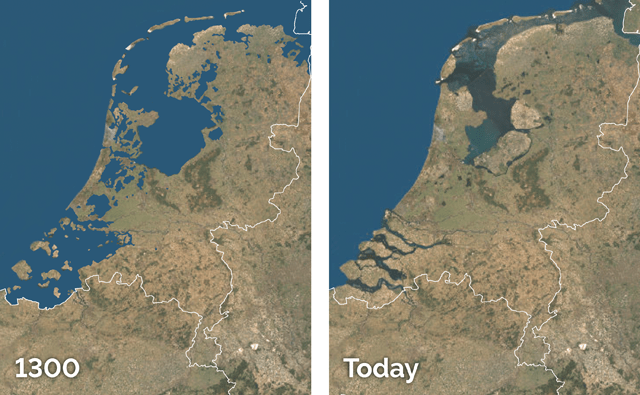
Netherlands Reclamation Map. Image courtesy of EARTHmagazine.org
In the Netherlands, the entire coastline was changed using a different method where dikes were built some distance out to sea and the seawater was then pumped out, and soil and gravel was used to level the reclaimed land, thereby making it suitable for underground water pipes and sewer lines, and for roads and buildings.
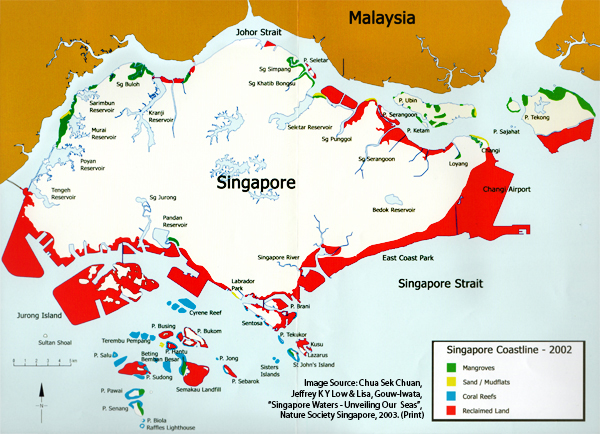
Singapore land reclaimed from the sea. Image courtesy of NTU blogs
And in Singapore, fully 25% of the country consists of land reclaimed from the sea, with plans to reclaim even more land by 2045.
So, Don’t Tell Me It ‘Can’t Be Done’
It’s being done, every day, all over the world. Creating new land is common in the 21st century. Even Tokyo’s gigantic Haneda Airport was built on land reclaimed from Tokyo Bay. The trick… is to do it in a cost-effective manner.
Filling 55-gallon oil barrels or shipping containers with coal ash and other colliery waste and setting them into wet concrete slurry that hardens before the tide comes back in, is a cheap way of safely storing colliery waste for centuries.
What better use for soggy coal ash than to seal it in metal containers, and securely set the filled containers in plenty of concrete in order to help reclaim hundreds of square miles of land from the UK’s coastal areas, thereby protecting homes and businesses from dangerous storms blowing in from the sea, and consequently increasing the country’s resiliency from sea level rise brought on by global warming?
Tumbling such metal containers off the back of a truck onto coastal areas is a terrible idea, but if the lid is welded shut and each barrel surrounded by 1-foot thick of concrete slurry — once the concrete is cured — those containers won’t be going anywhere for the next 1000-years.

Reclaiming a one-mile-wide strip of land from the sea. Image courtesy of Dougal.co.uk
From Great Yarmouth in southeast England to Berwick-upon-Tweed in the northeast, the project would create thousands of jobs and 2020 could be year-1 of a 50-year project. Start with only 1-square-mile this year, and ramp-it-up annually!
Yes, I get it would be a massive and costly undertaking — but the simple fact is that Great Britain isn’t getting any bigger as its population continues to increase — even as the sea rises and massive storms erode more of the country’s land every year.
A 1-mile-wide strip of reclaimed land could be used for many purposes, including wind farms, agricultural land, containerized shipping ports, warehousing, industrial use, and a high speed rail link and motorway to speed people and goods to and from the north.

Wind turbines and tulip farms on land reclaimed from the sea in the Netherlands. Image courtesy of VVVNoordoostpolder.nl
Each 1-square-mile section would need to rise 40-feet above sea level, be sturdily constructed to weather the fiercest storms, and be covered with plenty of trees and fields to help prevent soil erosion over the decades.
On the Great Britain side of the reclaimed land (not the side facing the North Sea) it could be left to become an inland sea (a fisherman’s paradise!) or in some places local governments may decide to infill those areas to add even more land to their territories.
With a topping of gravel and soil to bring the reclaimed land up to an altitude of 40-feet above sea level, many square miles of land could be added to the UK’s vulnerable coastal areas, and that reclaimed land could be made into truly spectacular golf courses, sports fields, or other recreational uses.
Golfing by the Sea, anyone?

Another example of land reclaimed from the sea at Pebble Beach Golf Links, Carmel Bay, California, USA. Image courtesy of MoneyInc.com
Just under 250-square miles of additional land would be added to the UK’s total land area and this 1-mile-wide strip of land would help to prevent erosion on existing land along England’s east coast, provide better storm defences, protect the country from eventual sea-level rise, and allow an expedited road and high speed rail route for people and goods travelling to the north of the country.
All that’s required to get this programme started is the political will to do it, so if you see merit in such a plan, please email your MP or local government and tell them you want a 1-mile-wide seawall between you and the open sea that would add beauty, recreation, an enhanced transportation corridor and industry to the region, and that colliery waste could be an important part of this great job creator.
Who knew that waste from coal mines and coal-fired power plants could play a part in solving the multiple problems of soil erosion, temporary coastal flooding/storm surges, and eventual (but permanent) sea level rise?

UK Budget 2020: How to Deliver on Promises Without Breaking the Bank
Nobody likes paying taxes, that’s understood.
But sometimes, in order to fulfil the promises made during an election — the promises that were made to appease and please those who voted the present government into office! — taxation levels must accordingly increase to provide the things that voters have hired the government to accomplish.
The trick for governments is how to keep their election promises without losing the confidence of voters, and I therefore offer the following well-meant suggestions using the proven example of Canada’s economic miracle during the 1994-2015 timeframe:
- As in Canada, the national GST rate in the UK should be set to 7% and should always hover between 5% and 10% in order to arrive at a zero-deficit budget, year-in and year-out. The GST shouldn’t be required to do anything else except to balance the budget, or, in the best-case scenario, to paydown some amount of government debt during any subsequent economic ‘boom years’ for the economy. That keeps it simple. (Although Canada has strayed from this plan recently and is now beginning to pay a price for its lack of committent to it’s formerly strict budgetary goals).
- The national GST should apply to every single transaction in the UK and only medical items should be exempt, such as female hygiene products, emergency medical kits, plasters/band-aids, prescription medications, and diagnostic imaging equipment like MRI’s and Cat Scan’s etc.
- Other than those exceptions, not one thing should be exempt from the national GST which would raise the total tax take for the government by a significant amount. (This plan worked wonders for Canada when it was in an economic tailspin) See: Jean Chretien: Lessons from Canada’s ‘basket case’ moment.
- Things like fuel (any kind of fuel, such as fuel for aircraft, cars, pleasure boats and ships, locomotives, home heating fuels like kerosene or natural gas, coal, firewood, wood pellets, etc.) and every other thing that is sold in the UK should be GST taxable, including financial transactions of any kind, including fees paid for legal or financial advice, and on the fees to purchase mutual funds, bonds, and other financial instruments, and on homes, cars, lumber, kitchen gadgets, and every item or service sold in the UK.
- Also, part of Canada’s economic miracle which began in the 1990’s was to lower corporate tax rates to 15%, then 14.5% and finally to 14% over a number of years, with a special tax rate of 10% for small-cap companies. This stimulated SME growth in the country that continues to this day, Indeed, Canada barely noticed the global financial crisis of 2007-2009, and it remained the fastest growing G7 economy before, during, and for a time after the U.S. subprime mortgage crisis.
- The other important part of Canada’s economic miracle of the 1990’s and early 2000’s is that the government got rid of wasteful and overlapping government programmes — basically telling every government department that they had 5% “fat” built-in to their annual budgets and that each department (except for the Department of Defence) would be required to submit budget proposals for the next 3-years showing a 5% spending cut from planned spending levels — or the government would simply lop 5% ‘right off the top’ from said department without any further warning or consultation.
- Not only did these things work well, but Canada also managed to make significant payments to paydown the government debt which was negatively affecting the economy and was costing a fortune in annual debt servicing costs. This in turn, allowed the Canadian government more room to manoeuvre from a federal budget perspective in subsequent years as less government revenue was required to service the accumulated deficits (debt) of Canada’s federal government.
- The next government that came into power after Liberal Party of Canada’s Jean Chretien and Paul Martin, was Stephen Harper’s Conservative government which in 2015 implemented a brilliant stimulus package (a home renovation tax credit) that boosted the Canadian economy with only a tiny amount of stimulus. Which, as it happened, put every available tradesperson in the country to work for a full 3-years just to meet the demand. So many Canadians decided to spend more than the allowable $5000. tax credit amount to renovate their homes… that home building centres, home decorating centres, and car dealerships that sell tradesman vans and trucks could barely keep up with demand. It was the perfect solution to boost the economy after years of budget cuts designed to balance the federal government budget.

This image is familiar to Canadian taxpayers as it appears frequently on income tax related documents, showing where each taxation dollar is spent by the federal government of Canada. Image courtesy of Canada Revenue Agency
Rather than trying to reinvent the wheel, the new Chancellor of the Exchequer, Rishi Sunak might consider following the tried-and-true Canadian example of ending the many complicated and difficult to administer taxes throughout the UK economy and roll them into a simplified GST with a 7% rate that taxes everything except medical supplies and equipment, followed by a plan to lower government deficits to zero over 5-years (with legally-enforceable punishments for the government if it fails to meet its zero deficit targets) and by lowering the corporate tax rate to match Canada’s corporate taxation rates to stimulate the economy over the medium term, and by stimulating the economy with a modest tax credit for home renovations where better home insulation is a part of that programme which works for homeowners to lower their electricity bills and further stimulate the economy over the short term.
In this way, the UK government can begin its Brexit year on a sound financial footing, losing some confusing and overlapping smallish taxes while dramatically increasing its total taxation revenue, while at the same time it attracts new businesses to the UK and supports existing UK businesses with lower corporate tax levels, and by employing every single tradesperson in the country for at least the next 3-years.
Congratulations and best wishes to the new and highly-esteemed Chancellor of the Exchequer, Mr. Rishi Sunak!

Leaving the Floodplains Will Save Billions & Needless Misery Every Flood Season
Every year in the UK, billions of pounds sterling are spent to repair the damage caused by successive heavy rainfalls accumulating in the low-lying landscapes commonly known as ‘floodplains’…

Isn’t there a better way?
Of course, there is, but do various levels of government have the overall vision, the foresight and the long-term committent to provide the funding to move every floodplain home, business, school, and other building (yes, even listed buildings would need to be disassembled brick-by-brick and carefully reassembled in a new location) up the hill far enough to get them out of the floodplain area?
Flooding costs the UK around £2.2 billion each year: we currently spend around £800 million per annum on flood and coastal defences; and, even with the present flood defences, we experience an average of £1,400 million of damage. — Foresight.Gov.UK (PDF)
Billions are wasted each decade and thousands of British lives are interrupted with devastating floods every year, and with increasing regularity as the climate continues to change.
It seems a no-brainer that the various levels of government would create legislation designed to prohibit construction of any new building in a floodplain, except for soccer fields, golf courses, or parkland and the like.
And it seems even more obvious that private insurance companies and the various levels of government in the UK would benefit from a (large) one-time government spend to move homes and businesses out of the floodplains — in order to save many more billions — over the next 25-years.
Aside from the obvious disruption to the lives of Britons, to local economies and to national GDP, there are the health implications of the millions of gallons of raw sewage that mix with floodwaters that inevitably wind up in people’s basements, high street businesses, factories, and even schools in low-lying areas.
“Over £200 billion worth of assets are at risk around British rivers and coasts and in towns and cities,and we are all vulnerable to the disruption of transport and power when a major flood occurs.” — Sir David King KB ScD FRS Chief Scientific Adviser to HM Government and Head of the Office of Science and Technology
British taxpayers who’ve been allowed by the government to purchase existing buildings or to build new homes in floodplain areas… deserve not only the compensation they receive after each successive flood, they deserve a new piece of land located well above flood prone areas… and to have the entire cost of moving their homes and businesses and reassembling them above the floodplain paid-for by the government they trusted when they purchased those buildings.
Although this would result in a significant one-time cost for the government (but spread over a number of years) it would be cheaper than continuing to pay year-in and year-out for flood damage to homes, businesses, schools and other buildings. Imagine the savings to the country over 25-years!

Billions are spent annually to repair damage caused by successive heavy rainfalls in the UK’s floodplains. Image courtesy of BBC.com
When the government is actively pursuing the well-being of UK citizens instead of merely reacting to such predictable disasters caused by the poor planning of previous governments, taxpayers will finally begin to feel they’re actually getting something of value in exchange for their tax contributions to the UK budget.
Yes, a Brexit trade deal with the EU is very important, but even that isn’t as important as the health and safety of UK citizens. In fact, the underlying reason behind Brexit was to allow the UK government to become more responsive to the legitimate needs of British citizens.
Now’s the time to prove this out in fact and in deed, Mr. Prime Minister!
 Letter to Britain