Home » Theresa May (Page 16)
Category Archives: Theresa May

Brexit: Are We There Yet?

As the Brexit negotiating process drags on, perhaps Theresa May’s grand negotiating strategy is to leave everything until the end — and then negotiate furiously. Let us hope!
As of today, we’re 286 days from the official Brexit date and much remains to be done, and for all the squallering about it, not much has happened. At least, not that the public can see.
Yes, a final Brexit date has been set, Prime Minister Theresa May has agreed to pay a £20 exit fee (or perhaps as much as 40 billion according to some reports) to the European Union, there may (or may not be) an interim period when the UK is partly in and partly out of the UK (and without EU representation during that interim period — even though the UK will continue to pay billions to the EU) no trade deal has been agreed, nor have customs issues been resolved.
And all of it built upon the principle that ‘nothing is agreed until everything is agreed’ which means that the UK has effectively nothing if negotiations go awry.
Further, the Good Friday Agreement could be endangered if the ‘no agreement’ scenario comes to pass.
Not very confidence inspiring.
Perhaps All is Not Lost
Negotiators have different ways of obtaining agreements and sometimes the most effective strategy is to wait until the end of the negotiating cycle and hit ’em hard with a deal they just can’t refuse just as the last few days tick off the calendar. Which is a legitimate negotiating plan, if, if, if, that’s what the plan is.
There’s something to be said for playing ‘defence’ (watching the other side to get familiar with their tactics and devices) as EU negotiators play ‘offense’ using all their ammunition to try to slow, obfuscate, or completely derail Brexit.
In short, it might be better for the UK to let the EU expend all of its effort — and withstand that barrage — then at the last-minute, the United Kingdom suddenly offers up a trade deal that the European Union can’t pass up.
If that’s Theresa May’s strategy to deliver Brexit to UK voters, it’s a good one. But only if she and the MP’s whose constituents voted for Brexit can withstand the ongoing negotiating and media blitz for 286 more days.
Otherwise, she will fail, and so will Brexit.
Risky (if you have a weak team) and brilliant (if your team is strong)
We shall see…

Austerity Has Changed How the World Views the UK
Why, for the love of God, don’t governments utilize the most obvious solutions to solve their budgetary challenges whenever a global financial crisis hits, instead of defaulting to budget cuts that can appear either inept or mean-spirited?
Finance Ministers don’t set out to craft inept or mean-spirited policies during times of economic crisis, but that’s how it plays out in the media and in living rooms across the country or wherever people gather to discuss the economy.
In the UK, this manifests itself in the names that people call their political parties.
If government austerity cuts don’t affect you, you continue to call the Conservative Party by its rightful name. But if austerity hits you hard, then you’re one of those who’ve taken to calling the Conservatives ‘The Nasty Party’ — and they’ll never get your vote ever again, etc., etc. (Yes, I do empathize, BTW. But that’s not what this blog post is about)
It just depends upon which side austerity hits you.
And budget cuts (at least budget cuts perceived as unfair by a significant percentage of the population) almost always result in either a lost election or loss of parliamentary majority at the next election. Check out those stats! (You’ll see how true that statement is)
Theresa May’s ‘hung Parliament’ election result in June 2017 is 100% attributable to the UK austerity budgets that have been in effect since 2010, and hers is just one example out of many majority governments around the world that have suffered as a result of their austerity policies.
There IS a Better Way!
Due to market conditions, about every 25-years a recession comes along in the capitalist countries. You can almost set your clock by it. It’s the ‘nature of the beast — carry on’ is how recessions are described by economists, and nobody tries to prevent recessions, as such ‘resets’ help to prevent even worse economic crashes in the future.
Still, there’s a way for countries to survive economic downturns WITHOUT shooting themselves in the foot every day of the recession. (A novel idea!)
The public knows an economic downturn when they see it. In fact, they have enough experience in their own lives balancing family finances when times are good, let alone when domestic financial challenges appear such as a job loss or (suddenly) another mouth to feed. Therefore, they know the government must compensate whenever the country faces a financial challenge.
The question for governments is how to do it and not lose the next election. Or the one after that.
And the answer is; To do it fairly.
That is; Apply cuts that will be perceived as ‘fair’ by a majority of the public — instead of deep cuts to some departments while other departments see no cuts at all, or worse, are able to increase their spending.
Does it seem fair to you while in recession that Health or Education should receive deep cuts, while spending on the military or the environment is unaffected? (I’m just using hypotheticals here for an example. Every Briton knows their military is chronically underfunded and few begrudge the UK military being exempted from budget cuts)
Back to the subject at hand; Every department in practically any organization on the planet has 5% ‘fat’ built-in to it. It’s just the way of organizations.
Budgets tend to be tightly managed in the first few years, then, over time, surpluses accrue or unused properties aren’t sold off as quickly as they could be, or in other ways there’s potential for either budget savings or revenue increases. Or, depending on the department, perhaps a combination of selling off unused assets and departmental savings could meet the new budget targets set by the government.
If you’re a large organization like the UK government and you expect your revenue to fall by 7% (for example) here’s the way to do it fairly!
Simply inform your departments of the 7% budget exigency, and instead of arranging deep cuts for some departments and zero cuts to others which sets the seeds for future electoral defeat, inform all departments to cut their budget by 7% — or alternatively — tell them to find ways to increase their revenue by the shortfall amount.
Let me be clear, if former Chancellor of the Exchequer George Osborne had simply told every government department in 2010, “We’re facing a 7% (or whatever percentage) cut in revenue, therefore, each government department must cut 7% from their annual budget until further notice,” each department would’ve done exactly that and hardly anyone would’ve noticed. (Remember, every organization/department already has 5% ‘fat’ in their system, so only a 2% budget challenge remains in this hypothetical example. At that point, accounting for the final 2% equates to selling off surplus real estate assets until that amount is obtained)
On the other hand, some departments might be real estate ‘heavy’ and could counter their entire 7% budget challenge by simply unloading their surplus real estate, thereby meeting the government’s directives to cut costs by 7% or increase revenues by 7% (or any combination thereof) to hit their departmental budget targets.
Wouldn’t that have been much better than the pain inflicted on the bottom-two economic quintile people in Britain (and which cost Theresa May a parliamentary majority) all of which has conspired to cheapen the ‘British brand’ around the world?
Read here, in the New York Times just how ‘fairly’ or ‘unfairly’ (depending on your worldview) the United Kingdom’s austerity plan has been portrayed around the world.
A country’s fortunes (fairly or unfairly) can rise or fall based on the perceptions of large numbers of people. Let’s hope that future UK budget cuts will not only be fair, but be seen to be fair by large numbers of Britons and by people around the world.

Transferability – The Solution to Systemic Bottlenecks in the NHS
Unfortunately for large healthcare providers like the UK’s highly rated National Health Service (NHS) people don’t always get sick near their local hospital. Rather, people will become ill, get injured, or encounter long-term illness everywhere throughout the United Kingdom regardless of where hospitals are located. Which is why some UK hospitals are full to overflowing while others have spare capacity.
One way to improve healthcare outcomes in the NHS is to incorporate transferability of treatment to relieve bottlenecks in the system.
Patients who can’t be treated in their local hospital due to lack of available capacity could be transferred to other hospitals in the UK where some amount of spare capacity exists and receive their treatment sooner than waiting for treatment at their local hospital. And even accounting for airline or rail tickets, possibly an overnight stay in a reasonably priced hotel in cases where the airline vs. operating room schedules don’t match, and for other incidental patient costs the health service would be required to pay, it would save the NHS money and dramatically improve healthcare outcomes for patients.
Patients who desire an upgraded hotel room could pay the difference themselves between the (covered by the NHS) standard room rate and the upgraded room rate.
When a patient has cancer, heart problems or other serious health issues, nothing is gained by making the patient wait for a treatment date in a hospital close to their home, because almost 100 per cent of the time those conditions will worsen as the patient waits for treatment.
Delayed treatment significantly increases treatment costs — because during the days, weeks or months of delay, the patient’s disease is certain to worsen.
Even those with slipped discs or other musculoskeletal impairments find their condition worsens over the amount of time their treatment is delayed. To say nothing about the suffering of the individual and their families while the person remains in a precarious health situation.
But if patients with serious conditions receive treatment sooner, healthcare outcomes for patients will improve and NHS statistics would improve because the disease or condition won’t have progressed as far in the case of faster treatment vs. waiting extra weeks or months for treatment at a local hospital.
Increase in Productivity
Workers who can’t work, can’t contribute much to GDP.
What is also true is that with faster treatment workers can return to work sooner and contribute to their company and by extension to the GDP of the United Kingdom.
Unhealthy people cost the economy, while healthy people contribute more. It’s therefore in the best interests of the government to get everyone the treatment they need with the minimum of delay.
Little Room for Improvement in the NHS
For an idea of just how highly the NHS is ranked in the world, please view the following chart courtesy of The Commonwealth Fund, an organization which ranks global healthcare systems via a number of metrics.
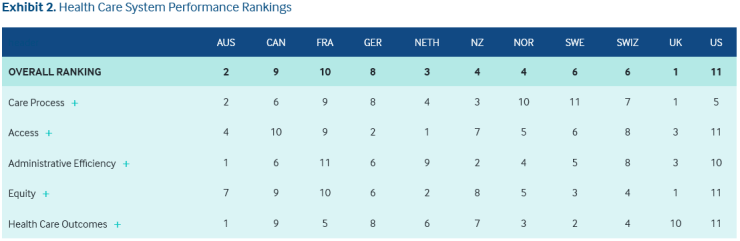
Health Care System Performance Rankings for the UK and 10 other countries. Image courtesy of The Commonwealth Fund.
It’s easy to see there is little room for improvement within the NHS, but Access (the ability to access treatment within a reasonable timeframe) and Health Care Outcomes (the success rate of treatment — which is often related to waiting times associated with treatment) could be significantly improved.
Scotland, Here I Come!
Some amount of transferability of treatment exists within the NHS at present, however, those in England tend to be treated or wait for treatment within England only. Scottish patients may be transferred to other hospitals in Scotland, and Welsh patients may be transferred to other hospitals in Wales. It’s likely a similar situation exists within Northern Ireland.
What would work to decrease bottlenecks in the NHS and thereby improve healthcare access and healthcare outcomes would be treatment transferability for patients throughout the entire United Kingdom.
Doctors could provide their patients with options for treatment when full transferability becomes the norm; (Example) “You can wait 6 weeks for treatment at your local hospital, or we can fly you to Scotland tomorrow, put you up in a reasonable hotel overnight and your operation will be scheduled for 7:00am the following day, and we’ll fly you home a day or two after the attending surgeon approves you for travel.”
For patients in severe musculoskeletal pain, or experiencing rapid cancer growth, or increasing difficulty in breathing or experiencing other serious symptoms, the sooner they can obtain treatment the happier and healthier they’re likely to be. That’s a win for patients, for doctors, for under-booked operating rooms in far-flung regions, for NHS statistics, and even for UK productivity stats and GDP.
There are so many ways to win with treatment transferability throughout the entire United Kingdom. It’s really the only systemic improvement left for the NHS.
Building more hospitals is expensive (and necessary in any case) but directing patients to underutilized hospitals (now, and even after more hospitals are built) can help patients towards sooner and better health while improving Access and Health Care Outcomes statistics for the NHS.
 Letter to Britain