Home » International Trade (Page 5)
Category Archives: International Trade

How to Resolve the Northern Ireland Border Question
Unlike the south of Ireland which broke away from Great Britain in a gradual process that began in 1921 and completed in 1949, the 6 northern counties of Ireland remained loyal to the United Kingdom over the past 477 years and they continue to play an integral role in shaping the future of the UK and The Commonwealth.
Now that Brexit decisions must be made, the UK is blessed by Northern Ireland wanting to remain a part of the United Kingdom.
‘A friend in times of need, is a friend indeed’ and the government and the people of Northern Ireland must always be respected by other UK citizens, in legal matters, in defence policy, in the House of Commons, and by the Monarchy.
EU Designs on Northern Ireland
It’s completely understandable that the EU might attempt to pry Northern Ireland from the UK during Brexit negotiations — which is quite a different thing than the UK agreeing that they should be allowed to get away with it! Yet, if British politicians are clumsy and treat Northern Ireland poorly, it isn’t out of the question that Northern Ireland could leave the United Kingdom.
For now, the EU is making noises about how much easier trade could be in the post-Brexit timeframe if the UK and Northern Ireland would simply give up and allow the EU to annex Northern Ireland. And to uninformed people it could pass as a plan to streamline Brexit negotiations and was probably designed to appeal to low-ambition politicians and uninformed UK citizens who might be tempted to agree to such a (treasonous) plan.
Were the situation reversed, of course the UK would try the same stunt. But the people of Northern Ireland have 477 years of history with the United Kingdom and (thankfully!) it appears they want to continue as an important part of the country.
Therefore, whatever it takes to rebuff the EU position on Northern Ireland, and whatever it takes to rebuff the Republic of Ireland’s position on Northern Ireland — it must be done, with no shirking nor excuses.
A Modest Proposal
Perhaps, instead of skillful EU negotiators maneuvering the UK into a situation contrived to make the UK the bad guy in all of this (keeping in mind it is unseemly to suggest Northern Ireland should leave the UK for the sake of EU convenience in the first place!) a helpful proposal could steer both sides towards a mutually beneficial agreement, thereby avoiding any unpleasant diplomatic scenes. Which would only serve to poison relations between the two blocs for decades.
As Erwin Rommel said; “Don’t fight a battle if you don’t gain anything by winning.” Fighting over Northern Ireland would cost both sides plenty, therefore, it’s silly to fight when the losses would counter the gains.
Rather than UK Prime Minister Theresa May being maneuvered into a situation loaded with bad optics, she should offer a plan that respects Rommel’s brilliant thinking and create an agreement that works for both blocs.
A One-Sided Border
On the UK side of the border
- The UK side of the Irish border should be free of manned border crossings.
- Signposts should inform travelers they are crossing into the United Kingdom and are expected to abide by the country’s laws and regulations for as long as they remain in Northern Ireland or any other part of the UK.
- Cameras and other technology could be deployed throughout Northern Ireland — especially near border areas — near roads, rail lines, airports, seaports, and in agricultural areas far from normal transportation corridors.
- A 1000 ft wide strip of land (on the UK side of the Irish border) should be cleared of trees, homes, buildings, large boulders and other landmarks along the entire 310 mile border, and be planted with low height crops to make it easier to catch (potentially) hundreds of thousands of illegal migrants crossing into Northern Ireland for whatever purpose, whether innocent or malign. Sophisticated audio-visual and thermal equipment — complete with face-recognition technology to identify everyone crossing the pastoral land between the two blocs — should be mounted atop wind turbines or other large poles at half mile intervals within that 1000 ft wide strip to see everything and everyone who crosses.
On the EU side of the Irish border
- Normal border stations on all road, railway, airports and seaports.
Information Sharing and Infrastructure Notes
Information sharing between the two sides would help both sides alleviate concerns about illegal crossers from either side, while helping to defray surveillance costs for both blocs.
The UK should build robust border crossing infrastructure (complete with the gate left in the ‘open’ position) but leave the buildings unmanned — except during extreme weather events or in the case of civil emergencies in either the Republic of Ireland or Northern Ireland.
Also, if tens of thousands of migrants or refugees began streaming into Northern Ireland every week, those pre-built (and ready to use within minutes) border stations could be put to good use, offering an official location to verify the identity of new arrivals and to issue instant and legal UK documentation of some sort (that could be time-limited or have other conditions assigned to it) to help speed the migrants on their way.
Summary
It’s in the interests of all sides to agree a ‘Soft/Hard Border’ plan where one side has an open but heavily monitored 1000 ft wide buffer zone complete with border stations that could be put into service whenever required — and the other side to have regular border crossings that feature typical border crossing infrastructure.
It’s a way to protect citizens of both countries and helps to share the burdens of operating the only common land border between the two blocs. It’s a way that both the UK and the EU can move past the present awkward moment towards an ever-improving diplomatic and trade relationship.
Every remaining issue between the two blocs is less important than a silky smooth and useful (to both sides!) border arrangement.
‘No-Deal’ Brexit scenario would cost both UK and EU billions
A new report by a prestigious polling firm says that a so-called ‘No-Deal’ WTO-style Brexit will cost one EU country €5.5 billion over the next two years, as opposed to a Brexit with a trade agreement where losses for that country would likely total €1.5 billion over the next two years.
That country is the Republic of Ireland.
“A hard Brexit could cost the Irish economy more than €5.5 billion over the next two years, a government-commissioned report has said.
A “soft” Brexit including a transition arrangement would cost less than €1.5 billion over the period, highlighting the importance to Ireland of the UK’s withdrawal talks with the EU.
The study by Copenhagen Economics, which examined four possible scenarios, also warns that the UK will probably take at least five years to implement new trade agreements, complicating Irish efforts at contingency planning.
[Ireland’s ‘Taoiseach’ which is the official title of the Irish Prime Minister] Leo Varadkar said last night that a comprehensive free-trade deal with the UK would be the best way to avoid a hard border. After a meeting with Theresa May, the UK prime minister, he said: “We both prefer [the option] by which we can avoid a hard border in Ireland, and that is through a comprehensive free trade and customs arrangement.
“That is the best way we can avoid any new barriers — north and south, and also east and west.”” — The Times
Other EU Nations Would Take a Hit in the ‘No-Deal’ Scenario
We can extrapolate that other EU countries would also take an economic hit in a ‘No-Deal’ scenario, but due to their much larger economies when compared to Ireland, such losses would amount to tens or even hundreds of billions over the same two-year period. Just think of all those German cars that wouldn’t be sold in the UK due to the higher tariffs that would automatically be imposed on EU countries in a ‘No-Deal’ Brexit!
Almost every country in the world uses WTO rules as the foundation of their trading relationship with other countries (but important to note) those same countries also diligently pursue bilateral trade deals with their important trading partners that allow both sides to legally sidestep the more costly WTO tariff ruleset in favour of something that works better for both partners. (And that trading relationship/tariff structure can be anything the two sides want in regards to any trade that happens between them)
So if country A and country B decide they want to trade, they’re completely free to build a better tariff structure than the comparatively expensive WTO ruleset, and that agreement will thenceforth supercede the WTO tariff structure. However, it only applies on trade between those two countries — the rest of their trade with the world would still be conducted under the auspices of the WTO.
It’s a pretty basic thing. Countries that do anything more than a smattering of trade between them negotiate bilateral free trade agreements to bypass the more onerous WTO trade rules and tariff regime.
There’s Still Time to Negotiate a Trade Deal with the EU
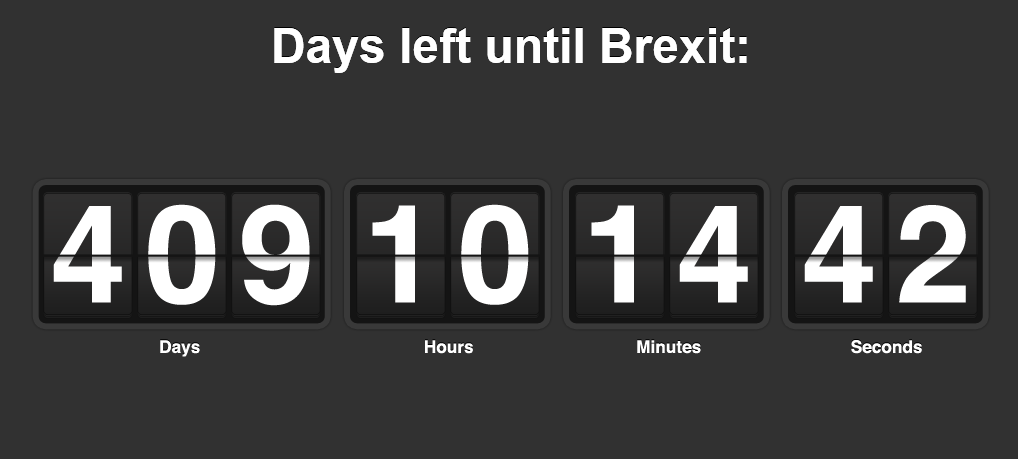
How many days until Brexit? Image courtesy of HowManyDaysStill.com
As of this writing there are 409 days remaining until Brexit and either we will have a trade agreement with the EU, or we won’t. If not, it will be costly for both sides, but more costly for the EU by one order of magnitude!
However, saying that there are 409 days remaining ’til Brexit — isn’t the same as saying there are 409 days left to negotiate a free trade agreement. Far from it!
The two sides have 258 days to arrange a free trade agreement. Let’s hope our politicians (and theirs) are up to the job (and if not, why are we paying them?) otherwise almost everything that citizens and businesses purchase will become much more expensive on both sides of the English Channel in the post-Brexit timeframe.
UK Prime Minister Theresa May has stressed that October 29, 2018 is the last date that both sides can agree a trade and customs deal before the UK must begin readying for the implementation of WTO trade rules. And on that point both sides agree. Even six months (during the period from October 29, 2018 to March 29, 2019) would barely suffice to put in place the necessary measures and standards to allow industry to prepare for life after Brexit.
UK and EU voters should remember who did, and who didn’t, get a free trade agreement signed when they head to the polling booth at the next election.
Related Articles:
- Day 548: Pass the Eggnog and Where Are We on Brexit?
- Theresa May + Customs Union = Conservative Coup?
- Theresa May’s New Year of Hope
- Brexit: An Opportunity to Create a Better UK / EU Relationship?
- UK Prime Minister Cuts a Deal With the EU
- Should the UK’s Theresa May Consider a 2nd Brexit Referendum?
- Irish border remains biggest barrier to orderly withdrawal from the EU

How Brexit Could Create a Better UK/EU Relationship
As European Union negotiators can’t see any reason to support Brexit, they will continue to keep the European Union’s best interests in mind — which is to say, they will try to stop, slow, obfuscate, or otherwise derail the Brexit process by almost any means possible.
And why shouldn’t they feel that way? The EU is a net beneficiary of £8.6 billion annually courtesy of the UK, so there’s little incentive to stop a contribution that is larger than that of all other EU-member countries except Germany.
If there are any Brexit benefits to the European Union, nobody has bothered to tell EU negotiators or EU media channels.
So how would anyone know if there will be Brexit benefits for the EU when the UK government hasn’t mentioned them once? And yet there are likely many Brexit benefits — for both sides — that just aren’t being discussed.
How to Sell a Product or Idea
When you’re trying to sell apples to a potential customer, giving them a nonstop spiel about how much *you* like apples won’t help you sell many apples!
But if you hand your potential customer a hot glass of mulled apple cider and walk them past appealing displays of fresh apples, followed by a pleasant tour through the on-site bakery bursting with the aroma of piping hot apple pies and offer them a tantalizing sample at the exact moment their interest in apples is high, you’ll sell more apples.
If you’re selling cars, you don’t spend your time telling the customer about the specifications of the car and how it can transport you here and there with ease. Any ol’ car can do that.
Instead, you answer their questions about the car, you offer a test drive so they can experience how much better it drives, sounds, and looks than their present car, all of which work together to help them fall in love with the car you’re selling.
If you’re a really smart salesperson, you’ll slap a dealer plate on the new car and let your customers take it home for the weekend so they can show it off to their comrades who will help convince them the new car is much better than their old jalopy.
And have you ever noticed that beer commercials don’t show you endless cans of beer and a quick snapshot of the brewery?
Breweries are highly experienced marketers and they want to show you good-looking people having a great time socializing with their friends and family in a picturesque setting or while engaged in enjoyable activities.
Look at that product placement! There’s the can of beer right beside those sizzling steaks on the barbecue while those great people in the background are enjoying their evening.
Considering a run to the beer store? Well yes you should — because you’re a good person, you work hard, you love spending quality time with your friends and family and you deserve a summer’s evening just like the people on that commercial. That’s the message.
Marketing types call this Feature/Benefit selling, ‘Selling the sizzle, not the steak’ which isn’t about what the product or service actually is, it’s about what it can do for you and how it can make you look or feel happier and better.
What Isn’t Theresa May Doing?
She isn’t selling the benefits of Brexit to the EU.
We know there are many benefits for Britons but even that has been under-sold.
In the early days following the Leave referendum it might’ve looked to Remainers as though Brexit could still go either way, so Theresa May was probably wise to move cautiously at first. But that time has passed. Almost every person and business in Britain wants to get beyond the present period of uncertainty and get on with creating a fresh start for the UK outside the European Union.
The right time to begin crafting a trade agreement that works even better than the present trading system has arrived. And now that we’re at this point in time, under-selling the benefits of Brexit to UK and EU citizens is not the way forward.
What Is The Way Forward?
In a word, Vision.
Theresa May needs to put on her ‘Steve Jobs hat’ and figure out what the best possible Brexit vision looks like from both the UK and EU perspectives.
Starting with a completely clean sheet; What would that look like in its entirety? What would it look like five years on?
If she doesn’t offer an inspiring vision that a majority of people on both sides of the English Channel can ‘buy-in’ to her government will be paddling upstream all day, every day, for as long as she remains Prime Minister. (And that’s definitely a no-fun lifestyle, even for a British PM)
Once the vision has been considered by Theresa May, only then should it be communicated to her Cabinet, while the Department for Exiting the European Union (DExEU) should oversee all other UK ministries and departments as they compile reports that describe what their best-case scenario would look like in practical terms.
Then it’s simply a matter of working to those ideals as much as is practicable to create a Vision Statement that can be released to the public, sans the excruciating detail required in government policy papers.
“This is the Vision we’re working toward…” (Giving UK and EU citizens a view of what a better Brexit looks like)
‘How do you like those apples?’ someone cheekily asked.
The Three Principles Common to all Organizations
- Vision (or Mission)
- Leadership
- Management
Without equal weight given to each of those three factors any organization or project will ultimately fail.
It can’t be emphasized enough; Endless discussion about the best Brexit from the UK standpoint are irrelevant to European Union citizens and businesses. Brexit must work for the EU too, or it will be increasingly uncomfortable and expensive for the UK as time rolls forward.
Theresa May needs to find what things will work better for the EU in a post-Brexit world and promote those items on every visit to the EU. If there aren’t any Brexit positives for the EU, she better create some as they negotiate forward to a final trade and financial services agreement.
Without an overarching vision even the best management and leadership will underperform. Perhaps severely.
But as soon as May gives the order to each of her 25 Ministerial Departments and 20 non-Ministerial Departments to submit their best-case scenario (their best hopes and aspirations showing what their jurisdiction could look like five years on from Brexit) and from that she will be able to write a one page vision for each of the 45 departments.
From there she will need to direct the Department for Exiting the European Union to create a list of items that could be seen as positives by EU governments, EU businesses and EU citizens. Those are the apples she needs to sell on every visit to the European Union. And then sell the ‘sizzle’ Theresa, not the steak.
Summary
Theresa May must ‘create’ and ‘sell’ (Vision + Leadership + Management + Marketing) a Brexit that will benefit both the UK and the EU and begin to disseminate that better vision throughout both blocs.
Throwing £40 billion at the EU now and (potentially) another £40 billion to obtain a trade and financial services agreement isn’t visionary — it’s ‘buying an agreement’ with taxpayer’s money — which is fine if that’s the only option. But it isn’t the only option.
Getting citizens, businesses, and governments on both sides of the English Channel to buy-in to a grand vision that works even better than the present paradigm without it costing another £40 billion, must be Theresa May’s Number One Priority before the October 2018 Brexit deal-making deadline arrives.
[P.S. to Michel Barnier, chief negotiator for the European Union] Jeez, Michel, for £40 billion shouldn’t the UK have received a bespoke customs deal, a bespoke trade deal, a bespoke financial services agreement *and* a chocolate mint on every UK pillow?
 Letter to Britain