Home » International Trade (Page 4)
Category Archives: International Trade

To Xi With Love, from Donald Trump
President Xi Jinping of China was awarded a second term in office by the Communist Central Committee of China just days ago (and doubly rewarded because term limits no longer apply to Mr. Jinping) has received communication from the Trump administration that steel exports to the United States will now face a 25 per cent tariff and aluminum exports to the United States from China will have a 10 per cent tariff added.
The tariffs against China and selected other countries are scheduled to go into effect March 24, 2018.
President Donald Trump of the United States says there is a huge and historic trade imbalance between the U.S. and China and is using tariffs to counter that imbalance which has been pegged between 374 billion and 511 billion dollars, depending upon how those figures are calculated.
Further, Mr. Trump has asked President Xi to submit a plan to lower the trade deficit with the United States by 100 billion dollars as soon as possible.
Which Countries are Exempt from the Tariffs that Begin on March 24, 2018?
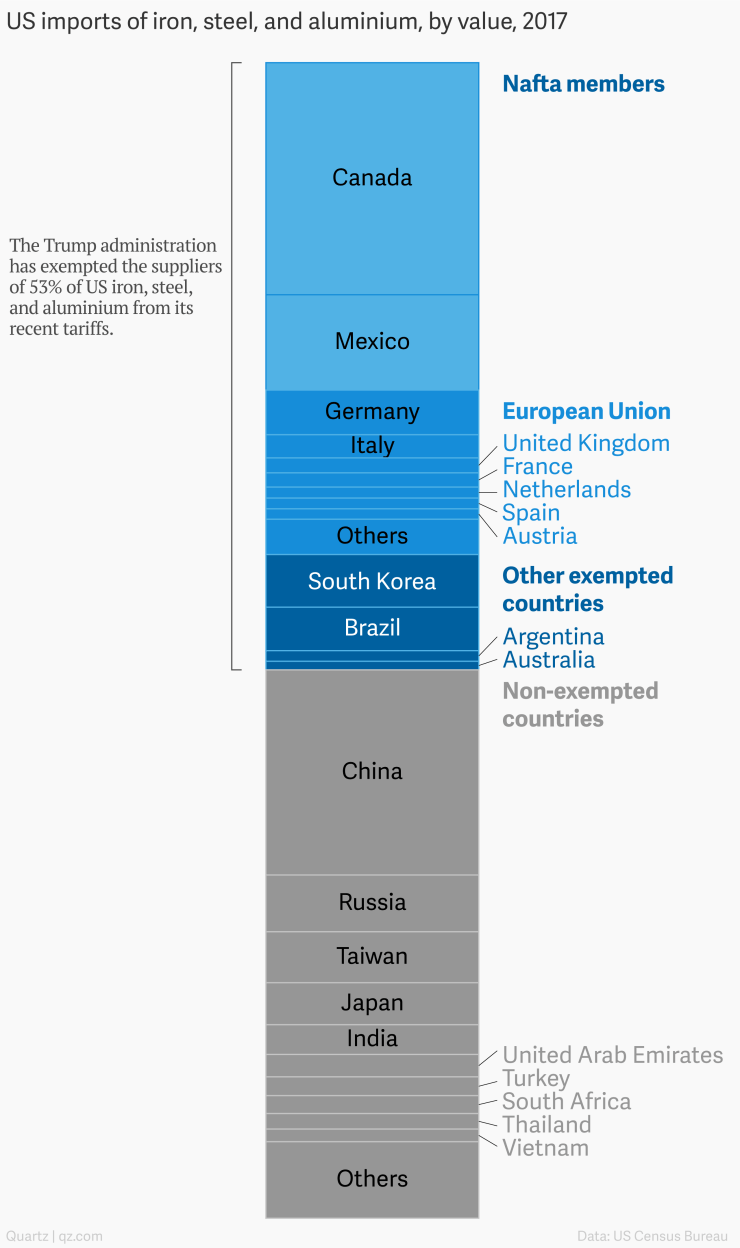
Image courtesy of Quartz.com. Click on the image to visit the Quartz image and article.
China has Responded to Trump’s Tariffs with Tariffs Against U.S. Goods
In response to Mr. Trump’s tariffs, China’s leader Mr. Jinping has responded with some mild tariffs against the United States.
China’s ambassador to Washington, Cui Tiankai, said on Thursday that Beijing would retaliate against those tariffs on about $60 billion of Chinese goods.
“We do not want a trade war with the United States or with anybody else, but we are not afraid of it,” Mr. Cui said, according to Xinhua, the official news agency. “If somebody tries to impose a trade war upon us, we will fight. We will do whatever we can to defend the legitimate interests.”
The $3 billion worth of goods that Beijing plans to penalize represent just about 2 percent of U.S. exports to China, which amounted to $130 billion last year, according to Chad Bown, a senior fellow at the Peterson Institute for International Economics.
“It’s not devastating economically by any stretch, but it’s certainly going to hurt those interests in the United States that are trying to export,” Mr. Bown said. He pointed out that the retaliation by China sends “a negative signal, that they are not seeking to de-escalate things.” — excerpt from the New York Times
All in All, Not a Trade War
Except that two superpowers are involved (which makes for great theatre) it’s not much of a trade war.
In fact, the Trump tariffs against Chinese steel (China supplies only 2% of U.S. steel) and Chinese aluminum (supplying less than 1% of U.S. aluminum) won’t amount to mega-billions of dollars.
Still, Trump has set the tone that countries that export to, and run huge trade deficits with the United States, will be addressed at the tariff level. Back in the old days getting your way in trade disputes was done by so-called ‘Gunboat diplomacy’ instead of the much softer tariff approach.
Thank goodness we’ve matured as a species!
Further tariffs may be levied on China and other countries by the Trump White House as the president seeks to balance America’s huge trade deficit across many nations that export to the United States.
The reason China has been singled-out is that it runs triple digit trade imbalances with America — not because anyone in the Trump White House has any particular enthusiasm to embarrass or anger China.
And although Donald Trump did make the numbers known to the public and did spend some time justifying his new tariff policy, it looks like the president sincerely wants a solution to the existing problem and doesn’t want a situation that escalates without resolution. We know that because he chose his words and his tweets very carefully.
Light at the End of the Tunnel?
What’s really at stake here is the long-term relationship between America and her trading partners.
China, Canada, Mexico, and the European Union are America’s largest trading relationships and in order for the United States to succeed it can’t allow huge trade deficits with every country it does business with.
If every country in the world ran a microscopic trade deficit of only 10 billion dollars with America, the U.S. trade imbalance would total 2 trillion dollars!
“To put that in perspective, if you stacked 1.9 trillion $1 bills on top of each other, the pile would reach about half way to the Moon.” — CNN
Not even the mighty United States of America can survive trade deficits of that magnitude.
China’s trade imbalance of ($374 billion to $511 billion in 2017, depending how you calculate it) is simply unsustainable for America, as are the double-digit trade deficits of several other countries.
This chart (unfortunately, from 2016) shows only the countries that have double or triple-digit trade imbalances with the United States (in millions of dollars)

Note: The European Union trade imbalance with the United States is 146 billion dollars, but some of those EU nations are also listed separately in this chart.
The Best Case Scenario?
As the tariffs go into effect, the best we can hope is that cooler heads prevail and that both the American and Chinese tariffs are seen as simple corrections to segments of the economy long neglected by policymakers on both sides of the Pacific.
Several countries that export steel and aluminum to the U.S. are exempt from the tariffs so American consumers will see very little change in prices. Consumers in China may see small price increases in certain foods that are imported from the United States.
The entire situation is an example that we should be mindful of our free trade privileges with other countries, neither exploiting them too much nor allowing ourselves to be exploited by them. Triple and double-digit trade imbalances don’t ‘just happen’ overnight! And they should be mindful of their free trade privileges with us.
If this in any way presages a shift toward fair trading rules between all nations — as opposed to unrestricted free trade — it means that international trade will be much more sustainable, and frankly, more easily welcomed by every country in the future.
Let’s hope this marks the beginning of the ‘Trump Doctrine of Fair Trade’ between nations.

Brexit + Commonwealth & NAFTA Trade = Economic Powerhouse
Timid minds are wondering whether the UK should continue along the Brexit path that British voters approved in 2016.
But just imagine what kind of world it would be today if Winston Churchill had given in to timidity during WWII, or if Albert Einstein was too small a man for the job, or if Franklin Delano Roosevelt was too afraid of failing and thereby didn’t pursue his plan to ‘put a chicken in every pot’ in Depression-era America? We’d be living in a far different world now, wouldn’t we?
There is a thing about leaders and it’s this, if they don’t actually Lead they are useless baggage. And that’s all that needs to be said about that.
Prime Minister Theresa May was given a mandate by voters to take the UK out of the European Union, and whether it rains too hard on Sunday, or if Manchester United can’t seem to win a game, or even if the Russians are scaring us, Brexit must remain at the forefront of Britain’s To-Do List and everything else must be considered a distraction until the job is done.
How the UK can fulfill its proper role in the world
With a strong UK government the chips would fall into place rather quickly and completely bereft of excuses, the following would occur:
- Brexit (even a WTO or so-called ‘Hard Brexit’) or a sweet-for-both-sides Brexit would occur by the designated date of March 29, 2019.
- The UK would apply to join the (by then) recently renegotiated NAFTA accord — or perhaps all the parties would agree they’d be better served by partial UK membership in NAFTA. Hey, you never know until you try, but magic occurs when people of goodwill meet-up to plan mutual success!
- The UK would enter into trade negotiations with every Commonwealth member nation to see what the UK can offer those nations (expertise, financial services, high-tech) and what those nations can offer the UK (agricultural products, oil and gas, metals and minerals, perhaps even a source of low-cost seasonal labour for UK farms) and so much more! Again, you never know until you try!
- And remember, Theresa… the goal isn’t to say; “Well, at least we tried.” The goal is to secure a standardized free trade agreement, or a standardized low-tariff trade agreement with the Commonwealth nations and every non-Commonwealth nation — especially the NAFTA ones.
What’s to Gain?
By accomplishing those steps in the proper order, the UK economy would grow 5% over existing projections — or the government is doing it all wrong.
India alone will have 1.3 billion consumers by 2019, and the United States, the highest-consuming nation in the world, will have 331 million consumers by 2019.
Post-Brexit does not mean five or ten years after Brexit — it means one year after Brexit.
These goals are eminently achievable and there can be no excuses for not hitting these metrics by 2020.
Orchards full of apples will be missed for the sake of handfuls of grapes if the UK government is too ‘small’ for the job, or if it suffers from low ambition, or if because of timidity, it can’t grab the brass ring of destiny.
The time is now for the UK to take control of its future and to stop being distracted from the oft-stated goal of Building a Better Britain.
More power to Theresa May’s government for as many days, months or years they strive to meet the will of voters and continue to work to fulfill the UK’s rather obvious destiny!
Is NAFTA a ‘Bad Deal’ for America?
There seems to be only one man in all of America who thinks the NAFTA agreement between the three North American economies is a bad deal for the United States. Which would be a very ordinary thing except that man happens to be the president of the United States of America. At least for now.
The one great thing about the American electoral system is that U.S. presidents can serve only two concurrent terms in office, so no matter how bad or popular a U.S. president is, he or she can stay in office for a maximum of 8 years. Although nothing prevents them from running for their old job once another president has served, other than the fact that American voters have never returned a previous two-term president to office.
That law is a tiny part of what makes the United States exceptional in the world. The most meritorious or most popular presidential candidates rise to the top — but unlike other countries where leaders can serve several terms in office — the American system is refreshed by new leadership every 4 or 8 years. And that’s what makes America great.
‘New blood’, a ‘new vision’, a ‘breath of fresh air’, or however you wish to describe it, occurs at regular intervals. No wonder America is exceptional! It’s too bad they don’t do the same thing with members of the Senate and Congress — and yes, even the office of Mayor in every U.S. city. If they did, the United States would be twice as exceptional on account of all that new blood and fresh enthusiasm.
Alas, because only one office in the land is refreshed regularly, America is great from the top down only — not up and down and in the middle — at least where governance is concerned.
Where Donald Trump is Wrong
President Trump arrived on the scene 13 months ago and with no particular government experience behind him, declared that many things are wrong with America and he’s just the man to fix it. And he may be that man, but only time will tell.
Yet, we’re seeing a man who sees symptoms and sincerely wants to treat the symptoms instead of wanting to solve the underlying condition that created the symptoms in the first place.
Certainly no one can fault Donald Trump for being enthusiastic about America, about America’s history in the world, and no one can deny he’s a breath of fresh air to the Oval Office.
But we need to have a conversation about the present symptoms in order to ascertain what the underlying condition may be in present-day America, and for that, we must travel back in time to see how America lost its way.
When Henry Ford was right: Creating the American middle class by filling a transportation need
Henry thought that ‘everyman’ should own an automobile, instead of only railway barons with their obscene personal wealth able to afford motorized transportation. During a downturn in Ford company fortunes, Henry decided to increase the pay of his workers to $5.00 per day, and was thereafter able to cherry-pick whatever workers he wanted from Louis Chevrolet, Buick, General Motors, Cord, Packard, and others.
Once Henry had created a whole new economic classification which later came to be called ‘the American middle class’ so many people bought Ford vehicles that 16.5 million Model T’s were produced in less than 20 years of production.
The moral of this story? Paying higher wages created ‘the middle class’ — a growing cohort of workers earning good wages and able to afford a car, which catapulted Ford’s fortunes into the stratosphere.
The Post-war Boom
Early in the 20th-century, the U.S. became the most powerful manufacturing nation in the world and surpassed even longtime patent leader Germany as the country that received the most annual patent applications.
This occurred only because of strong patent law in the United States. Any inventor with a worthwhile invention brought their idea to America for one reason — because out of all the countries in the world only the U.S. offered the maximum level of legal protection for their idea, design, system, or machine.
Even German scientists brought their ideas to America to have them registered with the U.S. Patent Office!
For countries other than America, the existence of a strong U.S. Patent Office created a ‘brain drain’ in their own countries, meaning that all their scientists and inventors headed to America instead of registering their contraptions in their home country.
Having received their patent protection in the United States, it was a natural step to have their inventions manufactured in America. Although not its primary mandate, the U.S. Patent Office was often excellent at matching inventors with such suppliers or manufacturers as they required.
It was a clear case of the American government passing the right legislation at the right time to attract the best and brightest in the world.
The moral of this story? Not a tariff in sight!
Because the postwar economy was booming and expectations were high, the Baby Boom generation went on a buying spree that is unparalleled in history
All of which worked to make all those patent-holders and their manufacturing companies obscenely rich. And good for them! When you work hard, you should see a positive return for your effort.
The favourable consequence of powerful U.S. patent protection combined with a huge and growing manufacturing base, created a booming economy and concomitant high consumer confidence which provided an unexpected result — usually about 9 months later.
Yes, during the boom times when one family member earned enough to support an entire family, the birthrate in America skyrocketed, creating even more demand as Americans began to have more children per fertile woman.
The moral of this story? When one breadwinner could support a spouse and up to 4 children, afford a new car every 3 years, a couple could own their own home via a 10-year mortgage and enjoy a refreshing vacation every year, the American economy was operating at full output!
American Foreign Policy in the Postwar Era
In the 41 years leading up to 1974, the Saudi government had been selling their oil to America for only the price of production (sans profit) as their contribution to the Cold War effort.
Interestingly, they were allowed to reinvest their cost of production payments in crude oil deliveries and refined oil products — so although they made zero profit on the crude oil as it came out of the ground — they were able to amass considerable wealth by speculating on oil stocks.
But that ended when it was perceived by the Saudis in 1973 that America was favouring Israel, a country that had never delivered billions of barrels of free oil to America.
When America’s oil supplier felt slighted, they decided that they wanted to get paid for their oil after all. ‘Oh, and, we’re pulling back on our Cold War commitment too.’
Which is why the Soviets thought they could successfully invade Afghanistan and tone the world’s opium supply down to almost zero.
When the Saudis suddenly wanted to be paid for their oil and they simultaneously lowered their Cold War commitment to America, the U.S. economy slowed.
With 20/20 hindsight, the ensuing economic disaster was only a symptom of a bungled foreign policy that caused a dramatic increase in new car registrations of foreign cars (with their better gas mileage) moving from 4% of all U.S. new car registrations in 1970 to 65% of new car registrations by 2017. Not only that, but up to 75% of the parts used in today’s American cars are made in Asia.
Therefore, the problem clearly isn’t NAFTA which came into effect in January 1994.
Here’s how that looks expressed as a math equation:
America -10 trillion dollars ∴ Japan +10 trillion dollars
(If you’re not into math, the symbol ∴ means ‘therefore’)
It could be argued that the United States took a highly principled stand on account of the people of Israel, but it was America’s decision alone, and it cost America 10 trillion dollars and poisoned relations with their oil-producing and Cold War ally, Saudi Arabia.
The moral of this story? The problem of offshoring American manufacturing jobs began in 1973 due to an American foreign policy decision which took place long before NAFTA had been created. Blaming Japan for American capital flight since 1974, or blaming NAFTA (which wouldn’t be created for 20-years) is disingenuous.
Social problems in 1960’s and 1970’s America: Racism, weak civil rights for women, and the Vietnam War worked to reverse America’s earlier gains
A lost generation occurred in the 1960’s where The People lost faith in their elected representatives, but they didn’t lose faith in the institutions of government.
President Carter worked to restore the faith the American people felt toward the executive branch of government by working on some very noble causes and meeting with some success. President Reagan moved things forward by strengthening the U.S. economy, infusing Americans with newfound confidence by offering loan guarantees to struggling American automobile manufacturers and dramatically increasing military spending.
The moral of this story? President Carter and President Reagan didn’t fix America by blaming other countries — they did it by empowering American citizens with tax changes and supporting American industry with loan guarantees to at-risk corporations, with huge defense spending increases, and plenty of positive exhortations about what made America great in the first place.
Every American, Canadian, or Mexican captain of industry wanted NAFTA back in 1994
If NAFTA was so grievous to be borne, why did almost every CEO in North America want NAFTA?

GDP growth in NAFTA countries since 1993 – NAFTA enacted January 1, 1994. OECD.
But some American Congressmen and Senators were nervous on account of the many U.S. job losses since 1974 and were concerned that even NAFTA could go wrong. And let’s face it, some members created a negative stir so that new U.S. president Bill Clinton would feel compelled to direct more federal funding to their districts in case NAFTA failed.
In reality, the only U.S. and Canadian companies that lived in fear of NAFTA were ones that didn’t keep up with the times. In the booming 1980’s and 1990’s economy, some companies decided they wouldn’t modernize and consequently continued to spend millions per month on electricity costs (for example) instead of reinvesting their (then record) profits in newer, energy-efficient factories or foundries.
For other corporations in the mergers era, it seemed a time to slow capital spending in order to maintain high profit margins and pay record-high dividends to their shareholders. But when the bull market finally came to its end, many businesses were suddenly cash poor and couldn’t afford a new, energy-efficient factory or foundry. Which was brilliant tactical thinking, but abysmal strategic thinking.
So… the question is; If corporations employ poor strategic thinking, should taxpayers be forced to bail them out?
Why should U.S. taxpayers bail out industries that choose high shareholder returns over sound financial management?
In the 1970’s and 1980’s, some American automakers needed the federal government to subsidize them with billions of taxpayer dollars to save them from implosion. That’s only one example out of thousands of U.S. companies that accepted or have lobbied for federal subsidies. Canada is just as bad as the United States on this point. Governments in both countries spend more on corporate welfare than they do on citizen welfare — times two!
Now in 2018, President Trump wants American taxpayers to pay even more for their cars (and anything else made of steel or aluminum) via a 25% tariff on steel imports and a 10% tariff on aluminum.
For one example, Trans Canada Pipeline will be forced to pay the tariff on the steel pipe for the proposed Keystone XL pipeline. Although steel is a small part of the overall cost of building a pipeline, the cost of the multi-billion dollar project will now rise by 5% or more. Just for comparison, 5% on 10 dollars is 20 cents — but 5% on 5.4 billion dollars adds 270 million dollars to the overall project cost.
The moral of this story? While Donald Trump’s motives are obviously ultra-pure, tariffs are simply a de facto form of taxation that U.S. citizens will pay because a few American corporations preferred high profits/high shareholder returns over competitiveness
Is there ever a good case for tariffs?
In a word, yes. Everything that’s imported into the U.S. (or any country) should face a globally standardized 5% tariff because every government needs money to improve port facilities, to streamline customs, and to maintain the transportation corridors that are essential to trade flows.
Even countries with free trade agreements like the NAFTA countries should institute a standardized 5% tariff on every good that crosses their border — and be required by legislation to use that money to improve transportation corridors and border security.
Consumers would find that presently high tariff items would drop in price, and zero tariff items would rise by 5%, but the trade-off would be astonishingly better roads, bridges, tunnels, rail links, airports and seaports, complete with better security. Every citizen would like to spend fewer hours per week stuck on congested highways, in airports, and enjoy faster and more secure delivery of goods.
Suddenly we wouldn’t be talking about ‘trade wars’ we’d be talking about improved trade, improved infrastructure, and a complete standardization and levelization of tariffs between every country.
And instead of heated rhetoric from politicians, we’d become more efficient throughout our countries and less efficient corporations wouldn’t continue getting rewarded for not re-investing in their businesses.
 Letter to Britain