Home » European Union (Page 11)
Category Archives: European Union
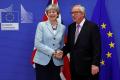
Theresa May Cuts a Deal With the EU
Just as Theresa May’s government appeared to be on the brink of collapse, the European Commission President asked the British Prime Minister to meet him in Brussels to jointly announce that negotiators had achieved the breakthrough to move forward to Phase II of the Brexit process.
EC President Jean-Claude Juncker said that “sufficient progress” had been made on Phase I discussions by December 8th, and the parties can now move on to matters of trade. Which is a great relief for some. For others, not so much.
Member of the European Parliament (MEP) Nigel Farage is on record as being against anything other than a complete Brexit with only the timeline to be negotiated.
Indeed, this is the position of many of the 17,410,742 people who voted for Brexit in the June 23, 2016 referendum that decided the United Kingdom’s future in, or out of, the European Union. And as negotiations drag on and as more political plays come to light courtesy of the ever-present media, the number of Britons who support Brexit are increasing, while those who supported it from the beginning want a faster, ‘harder’ and more complete Brexit.
If those who voted Remain were once within striking distance of preventing Brexit, their hopes are surely dashed now. ‘Off to Sgt. Pepper’s Lonely Hearts Club Band, are we?’
We hope you will enjoy the show.
So, What Did Theresa May Agree To on Behalf of All UK Citizens?
a) In May’s favour, it appears she agreed to continue negotiating with the EU, more than anything else
For now, nothing will change in the UK until Brexit day. The existing EU customs and trade union will continue to be in effect and the European Court of Justice (ECJ) remains the top court for the entire European Union, including the UK.
It’s also been reported that the ECJ will continue to be the court that rules over EU citizens living, working or studying in the UK for up to 8 years after Brexit — thereby giving European Union expats full access to the British court system — but also full recourse to the ECJ.
Essentially, EU citizens living in the UK will enjoy the protection of two court systems, while UK citizens will have the protection of only one court system.
Further, Theresa May has agreed that from December 8, 2017 until Brexit completes (whenever that is) the UK will abide by all laws and regulations passed by the European Parliament, the European Commission, and that the UK will accept European Court of Justice rulings. The final Brexit date has been suggested as March 29, 2019 but at this stage anything could happen including the government bodging the job and not getting voters their Brexit for another decade.
Goodness knows what kind of legislation the EU could pass during that time, yet the United Kingdom would be obligated to follow both the spirit and letter of that legislation. And EU citizens living in the UK would have more rights than UK citizens due to the ECJ deal. Let’s hope they don’t send an extra 5 million migrants to Britain annually (for example) as the UK would be obligated to accept them under the terms of this agreement.
If breaking the UK Treasury and maybe breaking the country is the goal of the EU (or if it ever ‘becomes that’ due to new politicians coming to power in the EU/EC) that’s surely the way to accomplish it. Certainly, the United Kingdom is in a precarious position from now until the day Brexit occurs.
Finally, there will be no transition period for Gibraltar.
Oh, and it Cost £40 Billion
Did I forget to mention that? Yes, they did too at their joint press conference, until a reporter asked about it.
Now the UK is obligated to pay £39 billion to the EU, and will continue to pay £8.6 billion (net) to the European Union budget until such times as the UK is no longer a member of the union.
Nobody has really said what the £39 billion is for — other than to say it covers the UK’s future obligations to the EU (which, reliable sources have said should only amount to £6.15 billion) and let’s keep in mind that the United Kingdom remains part-owner of many EC and EU buildings and properties — including the Parliament buildings in Brussels, Strasbourg and Luxembourg, and Britain’s share in the value of those and other EC/EU holdings exceed £9.65 billion.
Now for the Sweet Part of the Deal
Thus far, it sounds like a pretty one-sided deal in the EU’s favour — and many are now calling Prime Minister May ‘Theresa the Appeaser‘ after former British Prime Minister Neville Chamberlain who tried to ‘appease’ Adolf Hitler and his Nazis prior to Britain’s entry into WWII — for which he was unceremoniously booted from the Prime Minister’s chair never to return.
Others have called the deal a ‘sell-out’ of British interests, while other groups claim that Theresa May (an admitted Remainer) is trying to scupper the deal by using the high cost of Brexit to get more Britons over to the Remain side.
b) Maybe Theresa May is smarter than everyone suspects
What if it’s true that this deal is merely the deal that the UK will be forced to honour if UK and EU negotiators can’t arrive at a better deal that supersedes this deal?
There is real incentive for Theresa May and her Conservative Party to excel here because it is 100% certain they will lose the next election if this deal isn’t replaced by a better deal prior to March 29, 2019.
Prime Minister May will thereby have almost as much power as a wartime Prime Minister to get a better deal done, and that’s as good a way as any to move things along.
What if she now spends a year trying to negotiate a better deal knowing that at worst the present agreement is the worst that can possibly happen? A little brilliant, I’d say.
c) So she spends a year negotiating uphill with the EU trying to get a better Brexit deal
And in the meantime, the worst-case scenario is survivable by her country but unsurvivable by her party if they want to win the next election.
In the simplest terms, if Theresa May’s Conservative Party don’t fully cooperate with her to gain a better Brexit deal, they will by default, have handed the reins of power to Labour’s Jeremy Corbyn.
d) By virtue of the December 8th baseline agreement, Theresa May now ‘owns’ her party until March 29, 2019
Which means that the Prime Minister with her party helping, must find a way to improve on the present deal and they have one year to make it happen.
As one Machiavellian to another; Nice touch, Theresa.
Prime Minister Theresa May in the House of Commons on December 11, 2017 where she comments on the December 8th Phase I agreement with the EU.

Theresa the Brilliant, or Theresa the Appeaser?
It’s starting to heat up in Brexit-land after 17 months of jockeying for position, and this month more than any month since June 2016 might indicate whether UK Prime Minister Theresa May’s critics are right or wrong.
Will Theresa May travel confidently to the European Union this week to explain what she expects to receive in exchange for offering a £40 billion divorce payment? Or will she arrive and meekly accept whatever crumbs fall from the EU master’s table?
The result will determine what Prime Minister Theresa May will be called for the rest of her political life — she’ll either be known as ‘Theresa the Brilliant’ or ‘Theresa the Appeaser’ — or worse variations of those two titles.
Why Would the UK Choose to Offer £40 billion to the EU?
Certainly, the UK has pension and other legitimate obligations to the European Union that must be covered in the post-Brexit timeframe, no one is disputing that.
Also important to this discussion is that the UK has been and remains the second-largest contributor to the EU budget and is thereby part owner with the European Union of many shared buildings and properties — like the EU Parliament building in Brussels, for instance. (Total UK equity in the EC/EEC/EU institutions and real estate could be as high as £9.65 billion, although it’s difficult to find agreement on the amount)
So the question becomes; What’s the UK paying for, when it offers apropos of nothing, £40 billion?
Clearly, it isn’t to cover the legitimate obligations of the UK post-Brexit which amount to £6.15 billion, nor does it factor-in the UK’s share of the EU’s institutional equity — some £9.65 billion worth of land, buildings, and other holdings.
Indeed, Germany (#1) and the UK (#2) have paid the largest share of the EC/EEC/EU’s operating budget since 1972, and in recent years the UK’s annual net payment to the EU has hovered around £8 billion.
British Taxpayers: “If £40 Billion Isn’t Enough, Then It’s a WTO Brexit, Prime Minister”
Therefore it would seem that the £40 billion offer to the EU isn’t to pay future obligations, but that PM Theresa May has decided to pay in advance for (a) a bespoke free trade agreement with the European Union, (b) a bespoke Northern Ireland border agreement, and (c) to clear every single miscellaneous issue so that Brexit can proceed quickly.
And if that’s the Prime Minister’s thinking, it seems sound logic although it could be seen by some pundits as an expensive way to go.
Q: “Could I Have a Nice and Clean Brexit?”
A: “That Will be £40 Billion, Please.”
If Prime Minister May gets a nice clean Brexit, the UK can then sign free trade agreements with most of the countries and trading blocs in the world, in addition to maintaining a healthy trading relationship with the European Union which accounts for 15% of all global trade.
In addition to that, such a bespoke Brexit payment should guarantee perfect cooperation on a soft border between the Republic of Ireland and Northern Ireland.
It should guarantee that the European Court of Justice won’t comment or interfere on UK matters, and it will simply become one of many global courts that UK judges consult when making precedent-setting rulings.
And because in the whole history of the world there has never been such an unprecedented £40 billion divorce payment, Prime Minister Theresa May and every subsequent UK Prime Minister should be entitled to the utmost respect in EU capitals until the year 2100.
It Sounds Expensive, But It Isn’t
Once the UK signs free trade agreements with China, with all of the UK’s Commonwealth partner nations, with the United States, and perhaps ASEAN nations, MERCOSUR, Russia and its CIS partners, African Union member nations, and with other free trade associations like the Pacific Alliance, the UK will dramatically ramp-up exports to more than five billion people around the world.
If the Prime Minister and her negotiators can sign reasonable free trade agreements with much of the world immediately post-Brexit, it means that instead of paying the EU a net annual payment of £8 billion — increased exports and other positive economic activity (such as increased tourism) will boost the UK economy by £10 to £20 billion annually.
Making Theresa May’s present plan look brilliant, in retrospect.
A Slight Lag, Followed by Economic Boom
Although the first year won’t show instant results, and it depends on the quantity and quality of those free trade agreements and upon how quickly UK exporters can respond to the changed market, as time rolls forward, paying £40 billion to the EU in order to gain a bespoke Brexit and Free Trade Agreement might seem like an exceptionally wise decision by Theresa May.
At the very least and to get the ball rolling in the first few days after Brexit, the United Kingdom could coordinate military procurement with other Commonwealth of Nations countries so that navy destroyers, frigates, coastal patrol craft and army tanks required by Commonwealth countries could be sourced from the United Kingdom. The bonus of such a plan is that through bulk purchasing power and common design parameters, such military equipment costs could be reduced for all member nations.
That plan has ‘instant success’ written all over it because there is a real need among those countries for new and used UK military equipment.
Either Theresa May is one of the brightest politicians of our century (paying £40 billion to get free of the EU more quickly and completely, and by obtaining a bespoke UK/EU free trade agreement) or she’s heading off to Brussels this week to accept whatever crumbs the EU mandarins toss her way.
As the entire country waits this week for the news reports, let’s hope she’s the former.

Should the UK Have an Opinion on Catalonia?
As the UK remains a fully paid-up member of the 28-member European Union, it seems fair that the government should have a position on Catalonia’s recent move toward greater autonomy. Which in recent weeks, has grown beyond simple autonomy within the Spanish federal government architecture to seeking full independence, but the attempt has since been knocked down by the Spanish authorities.
Had the UK passed the Brexit threshold by now, it would be difficult indeed for the British government to have any public opinion at all as it then becomes a very different thing. It’s fair comment to opine on the internal politics of a fellow EU member state, but it is quite another for a non-member to criticize the goings-on in a foreign country.
For that reason, it’s well within Theresa May’s purview as the Prime Minister of a paid-up member of the European Union to comment on issues Catalonia.
Nigel Farage MEP certainly didn’t hold back from informing his viewers about his opinions on the Catalonian situation and it’s difficult to find flaws in his argument.
Certainly, it was a tragedy that 900 mainly peaceful protesters were injured and/or arrested by Spanish federal police, although many of those charges against protesters may be dropped in exchange for the much more serious charges against the police being dropped. Look for this to happen on a case-by-case basis. Many of the police are reputed to have used excessive force against the (probably annoying, but otherwise peaceful) protesters.
Until such times as Britain is no longer an EU member state, the UK and its citizens have every right to comment on the unfortunate Catalonian situation, but after Brexit I hope the government feels constrained about commenting on what will then be, a comment on the internal affairs of a sovereign bloc (the EU) a sovereign nation within the EU (Spain) and a state within that nation (Catalonia)
“What Goes Around, Comes Around”
This has been true since the universe began and were the British government to attempt to unduly affect the outcome (either way) in Catalonia, eventually it could work against the United Kingdom and conceivably against the Commonwealth, as there are rumours from time to time about disaffection among jurisdictions of either entity.
Therefore, it’s best for the UK government to comment in good form only and avoid trying to make political hay against the EU bloc simply because we may have other frustrations with them. (Hey, they’re frustrated too. It isn’t a one-way street. Let’s just get the Brexit done and not unduly antagonize the EU Parliament or its individual member states in the meantime, because that works better for the UK in the long run)
As a Member of the European Parliament and as a citizen of the United Kingdom, Nigel Farage has much more leeway to comment than the government, and his recent talk show brings up some fascinating points about Catalonia. Take a few minutes and watch Nigel take calls from all over the world about the attempted Catalonian secession.
 Letter to Britain