Home » British Trade Policy (Page 3)
Category Archives: British Trade Policy

Britain’s Economy Firing on All Cylinders until 2050
by John Brian Shannon | February 10, 2017
Under the expert care of Exchequer Philip Hammond, Britain’s growth rate will outperform all developed nations until 2050
What a relief it must be for Prime Minister Theresa May that the UK economy is expected to grow strongly every year until 2050, with a growth rate that surpasses all developed nations.
Britain will grow faster than any other major advanced economy over the next three decades as the EU’s share of global output diminishes, according to PwC.
UK economic growth is predicted to outpace the US, Canada, France and Germany between 2016 and 2050, with average annual growth of 1.9pc.
This is also double the average annual pace of growth expected in Japan and Italy. — The Telegraph
The chart below shows the average annual real GDP growth rate of G7 countries from 2016 to 2050.

According to a forecast from PwC, Brexit is only going to prove a bump in the road for the UK’s economy. Even though it may take a significant financial hit as a result of it’s exit from the European Union, the UK’s economy is set to grow faster than any other major advanced economy up until 2050. PwC predicts an average annual growth of 1.9 percent over the next 30 years. That’s more than double the expected growth rate of Japan and nearly twice that of Italy.” — by Niall McCarthy | You will find more statistics at Statista
And to show where the UK ranks in terms of global GDP here is another graphic for you.

You will find more statistics at Statista
It seems that Brexit will barely register as an economic hiccup and that Britain’s economy will continue to thrive in a post-Brexit world — and that, after many dire reports to the contrary were published prior to, and since the June 23 2016 referendum on EU membership.
You see? The sky isn’t falling, it’s snowing. Get outside and enjoy it! The UK is going to be just fine.
Related Articles:
- Brexit will not affect UK economy’s long-term future (The Independent)
- The World in 2050: Will the shift in global economic power continue? (PriceWaterhouseCoopers)

Free Trade or Protectionism for a Strong UK Economy?
by John Brian Shannon | January 17, 2017
Prime Minister Theresa May says that Britain must be a free trading nation to boost the UK economy and to better serve the aspirations of millions of Britons.
And Britain’s leader is correct, as history has proven that free trading nations outperform non-free-trading nations. From the seafaring Phoenicians of classical antiquity to the former British colony that became a superpower called the United States of America; Free trade and hard work have built our shared civilization, and any country that withdrew from free trade or liberalized trade agreements, consequently declined.
READ: Between Free Trade and Protectionism: Strategic Trade Policy and a Theory of Corporate Trade Demands by Helen V. Milner and David B. Yoffie | Published by MIT Press
That’s not to say that other economic practices don’t have merit, because they do. However, a group of non-free-trade nations will always be surpassed by a comparable group of free trade nations — due to the symbiotic nature of free trading relationships which produce small but measurable amounts of synergy that accumulate over time.
It’s the easier access to raw materials, the lower labour costs, and the ability to access larger export markets that make free trade work so well, but the ‘icing on the cake’ is the synergy produced by the symbiotic relationships which aggregate and thereby increase corporate profits and investor dividends that are often reinvested in the growing corporation. Over time, all this synergistic activity results in far greater outcomes than otherwise would’ve been the case.

The British Empire in all it’s glory was built on free trade with many partners, but in 2017 it’s even more important for Britain to be a free trading nation.
A perceived problem occurs when vast disparities are present, such as when one nation is blessed with abundant raw resources allowing it to basically dig money out of the ground which eventually accumulates into billions or even trillions of dollars, while another country in the same trading bloc may have few natural resources.
As long as all partners within the trading bloc have equal access to those raw resources, such problems are likely to be nothing more than minor jealousies.
Countries like the United States, Canada, Norway, Saudi Arabia and the United Arab Emirates have vast petroleum reserves, and importantly, good economic stewardship — which allowed them both rapid growth for the economy and a high standard of living for their citizens. It’s telling to note they are free trading nations — while other countries blessed with large petroleum reserves but restrictive international trading arrangements, haven’t prospered. Venezuela (the country with the world’s largest proved oil reserves) along with Libya and Nigeria, have poorer development due to their historically somewhat less than free trade practices. For economists, those nations serve as a warning to politicians considering the adoption of less liberal trade policies or outright protectionism.
Such disparities between nations, unless handled carefully, can result in explosive economic and political consequences.
READ: What does Free Trade mean? | Investopedia
Globalization: Lower-priced goods, but fewer jobs
It’s easy for some to forget that free trade and globalization are two different things. Free trade relates to the removal of tariffs, or at least the standardization of low tariff rates between member nations of the same trading bloc, while globalization refers to a highly interconnected political and economic world of which trade of any kind, whether free or not, is merely part of a large picture.
Those who feel left behind by globalization (and there are millions) tend to blame free trade, when in fact it was free trade that created a booming global economy from 1982 through 2007 (and a somewhat less booming economy) from 2012 through 2016.
Led by global elites, the rush to create high growth and high GDP meant that quality of life fell steeply for millions of Westerners for the first time since WWII due to the offshoring of Western jobs to countries with lower labour costs and non-existent environmental regulations.

Britain must ensure that globalization and free trade work for every Commonwealth citizen.
READ: You Can’t Feed a Family With G.D.P. | New York Times
It’s Not All Bad
Westerners have enjoyed unprecedented low-cost, quality goods manufactured in other countries.
Two examples of this are; 1) the Apple iPhone, which, if manufactured in the United States would have cost $2800. each, instead of the typical $650.-$950. price range. The iPhone wouldn’t have ever seen production if it hadn’t been manufactured in Asia. Over one billion have been sold since the first iPhone hit the market. And; 2) almost every computer chip in the world was manufactured in Taiwan, an industrious country with a very diligent workforce, but few natural resources. Computer chips have cost an average of $40. since Taiwan’s entry into the semi-conductor business, but if manufactured in the United States those chips would’ve cost hundreds of dollars each.
While low-cost goods are welcome in the West, people in the bottom quintiles now wish for a return to high paying employment and would gladly forego low-priced goods.
Which is exactly what the election of Donald Trump is all about. ‘Cheap goods are great, but we’d rather have jobs!’ — seems to be the main message there.
It’s difficult to blame those who harbour such resentments when 3/5ths of the population are doing less well, while only 2/5ths feel they have progressed in recent years.
Yet to blame the very free trade agreements that brought wealth to Western nations displays a lack of understanding of how globalization works vs. how free trade agreements work.
Free trade creates additional economic activity (with many virtuous cycles, which are always a good thing) while unrestricted globalization (under existing personal tax laws) rewards the top-two quintiles at the expense of the bottom-three quintiles. And it’s this fundamental misunderstanding which have people in an anti-free-trade mood — when instead, they should be protesting against global elites, unfettered globalization, and crass-and-uncaring politicians.
Had the global elites applied as much effort to ensuring that globalization worked for every economic quintile instead of the top-two quintiles exclusively, movements such as Occupy Wall Street along with the general disenchantment voiced by the public against politicians and economists wouldn’t have materialized. Ever.
When it works for everyone, there’s no complaining.
READ: In Defense of Globalization | Project Syndicate
Free Trade with a Standardized and Reciprocal Tariff Regime – Instead of Unfettered Globalization
PM Theresa May and Chancellor Philip Hammond should work to obtain a mutually-beneficial free trade agreement between all Commonwealth countries as part of a Tier 1 trade accord.
Such an agreement should ensure there are no tariffs, levies, nor other trade impediments — save for a highly standardized and reciprocal 5% tariff on all goods — except books (in any form) or those medicines that actually save lives, because principles do matter. A more educated and healthier Commonwealth are desirable outcomes. No VAT taxes or tariffs should be levied on books or life-saving medicines, ever. Anywhere on the planet, IMHO.
Why the 5% Tariff?
What the 5% tariff would do for all signatory countries is to pay for upgraded port facilities and enhanced security at ports, railways, and for cargo ships at sea.
Why the 10% Tariff?
A Tier 2 trade accord should be negotiated with nations that aren’t Commonwealth members with a standardized and reciprocal tariff of 10% — except for books and life-saving medicines which should be tariff-free and VAT-free in every case. As long as the trade partners agree to standardized and reciprocal tariffs, such tariffs won’t break WTO tariff rules. And such revenue could enhance port security, of course, but could also be used to pay for additional infrastructure programmes to put millions of workers back on the job.
Why the 25% Tariff?
Finally, a Tier 3 trading scheme could be created for those nations that won’t agree to a standardized list of tariffable items at a standardized and reciprocal rate, and won’t agree to not tariff books and life-saving medicines, and that tariff could be 25% on all imported items until the day arrives that country begins to abide by the Tier 2 trading rules.
In all three scenarios it puts the UK government firmly in the drivers’ seat in regards to imported goods and guides UK trading partners towards Tier 2, or even Tier 1 status.
The goal is to arrive at a situation whereby every nation willingly decides to join The Commonwealth in order to gain free trading status with the Commonwealth and agrees to a nominal, standardized, and reciprocal 5% tariff regime on every good except books and life-saving medicines.
It is still free trade, but with a nominal, built-in tariff designed to enhance port facilities and streamline security in all partner nations.
What to do with the revenue generated by such tariffs?
The main point is to upgrade existing port facilities, to increase security at Britain’s ports, and at reciprocal trade partner ports to ensure the security of ships at sea and the thousands of kilometres of rail lines that carry freight.
Any remaining tariff revenue could be used to soften the economic blows to those in the bottom-two quintiles who have suffered quite enough over the past 16 years.
Whether used to boost social welfare rates (good) or to boost national infrastructure spending (better) or both (best) it will be money well spent, and it would be revenue that arrived in the government hand via imported goods.
Which seems fitting, doesn’t it?
READ: Interview with Theresa May, Prime Minister of the UK, from the World Economic Forum 2017 | CNBC

Boosting Britain’s GDP 5% in three easy steps
by John Brian Shannon | October 18, 2016
Opportunities as big as the sky abound regarding UK exports to developing nations that need everything, and needed it yesterday.
India with 1.5 billion people now and 2.2 billion by 2025, need massive upgrades to their electrical grid. Although India has made great strides in recent years, some 400 million people living in rural areas of the country have never had electricity.
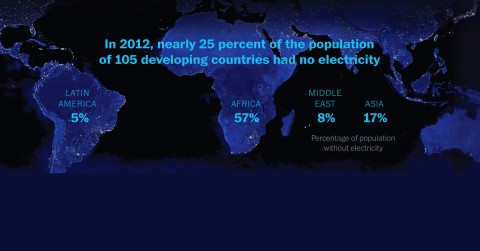
Is Britain ready to export electricity grid expertise and grid components to India’s 400 million citizens who have never had electricity in their homes? Such opportunity with real benefits for both nations!
Filling that need over the next two decades will cost hundreds of billions of dollars (if the Americans do it) but that begs the question Why leave it to the U.S.A. alone?
Such an opportunity represents hundreds of billions pounds sterling if the UK takes on part of that project — with significant opportunities to earn revenue by financing such projects — financing which are likely to be guaranteed via some combination of Indian government bonds, World Bank funding, and IMF loans.
Not only that, of course. India has a growing middle class with real purchasing power that want to purchase quality cars and trucks, housewares, electronics, and just about any product manufactured in the UK.
Further, Indian corporations need access to world class financing and market exposure afforded by the London financial sector, and some of the world’s preeminent legal and architectural firms have an obvious role in helping India to become all that it can and should be.
GCC kingdoms are always searching for evermore high-end warplanes and civilian jetliners, and they are always quick with the money. And, especially nice, no bickering when it comes time to pay the bill.
The GCC has transformed in recent years due to massive expansion in the formerly sleepy fishing villages of Dubai, Abu Dhabi, and Ras Al Khaimah — turning them into thriving financial centres, replete with stunning architecture and residential communities.
In fact, some of the most famous buildings in the world are located in those three cities and were designed by world class architects based in London, engineered by the most advanced engineering firms in the world, along with a host of other services such as project management, financing and property management, many London-based.
In the GCC, it isn’t about whether they have the money, because they sure do. It’s about having a presence and being there to meet opportunities as they arise.
In places like Dubai, major projects are envisioned, mooted, and completed in less than four years. Which is about the amount of time it takes to get just a simple development proposal permit approved in some cities. The message there is; Don’t nap, or you’ll miss it.
Brazil. The country’s formerly strong economy has taken some shocks in recent years. Both economic and political shocks have caused damage to the Brazilian economy, but that also presents many opportunities for investor groups. Huge Brazilian conglomerates that are barely holding together for now could be a real bargain for investors with sterling to spare.
What is great about commodity based economies is that when the price rises, it doesn’t get any sweeter. And when commodity prices are low, it’s almost always a good time to buy stock in those companies, or just buy the whole company.
Sugar from Sugarcane – and Biofuel Made from Sugarcane
Companies like Cosan and Raizen have the advantage of selling their sugarcane in two very different markets.
If the price of sugar is high, then the twice-yearly sugarcane crop gets sold as sugar commodity, or as finished sugar product at the retail level.
But when sugar prices drop, those same corporations simply sell their sugarcane to the huge biofuel market in Brazil, where 92.9% of Brazil’s cars run on a minimum 22% biofuel blend (E20) as mandated by Brazilian law, with many cars burning 100% biofuel (E100) which significantly lowers vehicle emissions and respiratory related healthcare spending across Brazil’s largest cities.
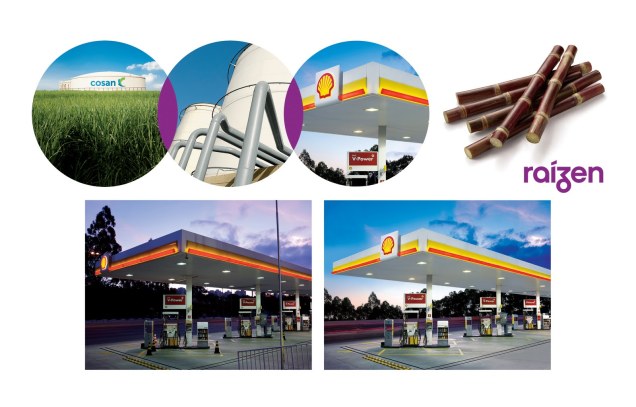
Raízen, the joint biofuel venture between Royal Dutch Shell and Cosan Ltd. is the 3rd-largest energy company in Brazil. Image courtesy of Raízen.
“A life cycle assessment by the Yale School of Forestry on jatropha, one source of potential biofuels, estimated using it could reduce greenhouse gas emissions by up to 85% if former agro-pastoral land is used — or increase emissions by up to 60% if natural woodland is converted to use.
In addition, biofuels do not contain sulfur compounds and thus do not emit sulfur dioxide.” — Wikipedia Aviation Biofuel
Aviation Biofuels
With global aviation accounting for 2% of total anthropogenic (human-caused) CO2 emissions, now is the time for Britain to legislate 50/50 blends of biofuel and conventionally sourced petroleum aviation fuel. Many airlines are already doing exactly that. Notably, the US Navy is doing the same as part of it’s Great Green Fleet programme. Biofuels can also help to moderate jet fuel costs when conventional fuels skyrocket due to wild price swings.
By switching commercial aircraft to 50% biofuel blends, aviation related CO2 emissions would drop by half and respiratory illness healthcare spending would drop by billions.
Summary
What makes these three opportunities so tantalizing are the sheer numbers; India with 2.2 billion consumers by 2025, the GCC nations with their unquenchable thirst for the trappings of a wealthy society, and Brazil for it’s commodities, especially the sugar/biofuel synergy with the opportunity to cut global aviation emissions by half.
With the right vision, the right approach by the British government, and some dedicated effort and follow-up by HM government, it should prove to be a cakewalk to grow the British economy 5% by 2021 (separate from already planned growth) on the strength of those three opportunities alone.
Related Articles:
Read: Sweetening The Biofuel Sector: The History of Sugarcane Ethanol in Brazil
Read: Sugar-Cane Fuel Wins in Brazil as Cheap Ethanol Beats Gasoline
Read: Shell and Cosan invest $1 billion to boost Brazilian biofuels
 Letter to Britain