Home » British Economic and Social Reform
Category Archives: British Economic and Social Reform

‘Getting Stuff’ vs. Creating a Culture of Excellence
For some people, life is about obtaining one square mile of pure gold and consequently being able to purchase anything (or anyone) you want.
For others, it’s about getting into the room with the big, shiny buttons — you know, the room where you make all the important decisions, where you have all the power, and you get all the glory. You, you, and more you!
It’s a free world and people can desire all kinds of things. I’m not here to crush anyone’s dream. If one of the above motivates you to reach for the stars, then good on you. More power to you!
But shouldn’t a person’s life be about something more high-minded than ‘getting all the stuff’ or ‘owning the power suite’?
The corporate world brings clarity to this question because corporate data is so carefully scrutinized, extrapolated, debated, gamed and summarized.
Therefore, we can use them to demonstrate various examples of ‘cultures of excellence’.
Some companies stand out for ‘all the right reasons’ while others stand out for ‘all the wrong reasons’
Ford Motor Company stands out for bringing affordable transportation to the masses in the form of it’s Model T Ford beginning in 1908 — and thereby, almost single-handedly creating the American middle class — at a time when there existed in the USA only a tiny ‘wealthy class’ of American aristocrats and the huge and mostly poverty-stricken American ‘working class’.
At least, until Henry Ford began paying his workers enough so that they could afford to purchase the cars his company manufactured.
Suddenly, it was a different America as other manufacturers were forced to match Ford’s wages.
Henry Ford’s dream to pay his workers well enough so they could purchase the cars they built was revolutionary at the time. Yet, the American economy, with it’s first in the world large middle class, set the domestic economic policy standard for the world since the first Model T rolled off the first in the world process-based, modern manufacturing production line, staffed by his first in the world well-paid workforce.
When economists consider the history of Ford Motor Company, they think of ‘innovation’. That’s product innovation, market innovation and employee remuneration innovation.
Volkswagen: The Case for Continuous Product Improvement
In Volkswagen’s case, the first VW ‘People’s Car’ or, as we know it, the Volkswagen ‘Beetle’ economy car, was mass produced from 1945 through 2003 — selling 21,529,464 Beetles over 58-years.
While the VW Beetle began as a very humble car, and not completely reliable, continuous improvements were added to the platform every year until it became a desirable car with a reputation for excellent reliability. In the last years of production, the Beetle employed the latest technologies — including components manufactured by Volkswagen’s own Porsche division.
Not only did the car improve over the decades, but VW designers and engineers changed the very nature of the car from an entry-level car (then available at an astonishingly low price) to a fun, sporty vehicle with it’s own vibe and cult following.
To this day, it’s impossible to get a negative comment from a former VW Beetle owner about Das Volksauto (the people’s car).
When marketing experts consider the history of Volkswagen, they think of ‘value’ — product value, ownership value and the value to the company of taking a basic product and moving it upmarket via constant improvements.
Why Land Rover Succeeds
Most Land Rover owners will never need to cross the Australian Outback, traverse the Gobi Desert, or scale steep and snowy mountains (sans roads) in Alaska. In fact, most won’t drive their Land Rover anywhere but on paved roads in their own country.
But isn’t it nice to know that you could if you wanted to?
That feeling of capability, of near-invincibility, and doing all of it with ease and panache, makes the high purchase price of a Land Rover worth every pence to some. We know who you are. You’re the rugged, self-made individual who will go where he/she wants, anytime he/she wants — and snow, rockslides, creeks, steep hillsides, outrageously hot or cold weather, or other obstacles, won’t be tolerated.
Nobody really needs this car, other than the Army. But it remains one of the most-desired vehicles in the world. How can this be?
Similarly, no one really needs a McLaren or Lamborghini. But the value proposition in the purchaser’s mind is what sells the car. It’s not about logic. It’s about how the car makes me feel! It’s about the engineering prowess. It’s about what it can do, if I let it!
Chalk this example of excellence up to brilliant marketing minds mastering human psychology and giving them what they want. How profound. ‘Give them what they want and they will buy it!’ — works every time.
The Difference between Wealth Accumulation / Power Accumulation, and a Culture of Excellence
However, in contrast to every Ford Motor Company, Volkswagen AG, Jaguar Land Rover, or other highly-ranked company, there are a number of ENRON’s and other companies that I won’t name (for legal reasons).
I can’t state categorically that every company that succeeds is an organization based upon the culture of excellence model. But along with this correlation must come a certain amount of causality.
Sure, some truly excellent products manufactured by excellent companies have failed. (Bad market timing, sudden recession, change in consumer preferences). And some truly terrible products/services/companies have succeeded. (Inexplicably)
But mostly, companies with a culture of excellence at heart, succeed and do so spectacularly. Names like Michelin, Ferrari, Aston Martin, Apple, Lexus, Radisson, Rolex, Levi Strauss & Co. and others succeeded because they FIRST created a culture of excellence among their workforce/investors/customers AND THEN began manufacturing their products or offering their service and selling in the global marketplace.
Had they chosen to create a culture of wealth accumulation (or power accumulation) FIRST among their workforce/investors/customers, they wouldn’t have succeeded and the world would’ve never benefitted from their products/service and example.
And these must be the questions for Britons in the 21st-Century:
What kind of country do Britons want to live in over the next 76-years?
Do Britons want to be a country that only cares about wealth accumulation by any means? (Forget the environment! etc.)
Do the people want a country that only cares about accumulating evermore political power and GDP and use it to control other countries? (Regime change, anon)
Do citizens see the value of creating a culture of excellence centred around (a product, service, governance, etc) FIRST, and ONLY THEN beginning to manufacture a product or deliver a service, or create informed policies, and thenceforth keeping that high standard of excellence for the life of that organization?
Do ethics matter?
Does curtailing or outright banning of non-ethical investing improve the UK’s brand?
Is it right that a wealthy country of 69-million people tolerates an average rating on the UN Happiness Index, or an average ranking on the Social Progress Imperative ranking, or only slightly better than average Corruption Perceptions Index ranking?
Is the country that created the first and best universal healthcare system in the world doing well enough for it’s patients — falling from it’s normal 1st-place rank to 4th-place in 2021? (Read: “Mirror, Mirror 2021: Reflecting Poorly” published by The Commonwealth Fund)
Is it acceptable that UK GDP has fallen from it’s 5th-place ranking to 8th-place since 2000?
These, and many other questions need to be asked, researched and discussed. And in a spirit of mutual problem-solving, all stakeholders and policymakers must work together to facilitate solutions by re-adding the very necessary and time-tested component we call the culture of excellence — which, once upon a time embodied almost every UK company and institution.

Resetting the UK Economy After Coronavirus
Things will never return to what has been thought of as ‘normal’ business in the United Kingdom following the biggest threat to Britons since WWII, yet there’s two paths forward where the country can either ‘survive’ or ‘thrive’ after Coronavirus. And that’s the focus of this blog post.
Here’s a short list of things that could be done in order to a) Prepare the UK for the next pandemic, b) Protect Britons from retransmission of a future SARS or MERS virus or other contagious pathogen, c) Build Resiliency into UK infrastructure, and d) Stimulate the UK economy to allow the country and its people to thrive, going forward.
Prepare, Protect, Build Resiliency, Stimulate
For me, ‘surviving’ isn’t enough. What the UK needs to do after any kind of negative event is to ‘thrive’.
When you’re 68-million people on a small island in the Atlantic Ocean that’s recently cut the cord with the EU, and still hasn’t reintegrated with the global economy, nor even the (eternally patient) Commonwealth of Nations, you’ve got to come out of a healthcare + economic crisis with a solid plan and impressive momentum behind that plan.
Let’s talk about what can and should be done as the UK comes out of the Coronavirus emergency.
Four Ways to Repair the UK Economy & Inoculate it from the Next Pandemic, While Supercharging the Economy Now
- Coat all publicly handled surfaces with copper. As you may know, copper kills germs, viruses, and bacteria upon contact in only a few seconds, therefore, such commonly handled surfaces like turnstiles, handrails, push-to-open door plates, door handles and door knobs, and the taps in public washrooms, and the buttons on the ATM or any vending machine should be coated with copper. Copper acts so powerfully against germs that even 25% copper content is enough to do the job. Plenty of coins in the world have a high copper content, yet their appearance is like that of pewter or brass, so if you don’t like the colour of copper, turnstiles and more, can appear to look like pewter, aluminium, or brass. Killing germs on frequently handled surfaces is a great way to stop retransmission of a pathogen to everyone who passes through that turnstile. How to get it done? The UK government should guarantee zero-interest loans to rail companies, airlines, ATM and vending machine operators, and to cities and towns to incentivize them to coat (electroplate, anodize, or otherwise layer) such surfaces with copper or copper amalgams with a copper content of 25% or more.
- Designate who works in ‘Essential Services’ and allow them to continue their duties unaffected by future ‘stay at home orders’. We can’t live without Doctors and Nurses, nor can we live without food and drink, nor without heat and light. And, it’s always nice to have police, fire and ambulance services available on speed dial. Similar is true of the military. Where would we be without them? So, thanks again to those people every day — all the way back to the Great Fire of London in 1666. How to get it done? The UK government should require each department to create a list of jobs in their department deemed ‘essential services’. Also, the UK government should consult with UK industry for a list of job titles considered ‘essential services’ and determine the total number of people required to staff those essential service positions — for the purpose of creating a massive database of people deemed ‘essential’ during any crisis. Maybe those people should be issued a passcard and a matching sticker for their car windscreen allowing them to automatically pass through any police checkstop, park their car for free (Doctors and Nurses shouldn’t be getting their car impounded when they’re busy saving lives, for example) and essential workers should be paid (by the government) an extra £500 per each full or partial month of any crisis (even if it’s a local ‘State of Emergency’ situation where local officials have duly informed the UK government about the emergency) to cover exceptional costs such as the worker having to stay in a hotel after working a 16-hour emergency shift rather than them driving home overtired, and then doing it all over again the next day.
- Consolidate all UK Department of Work and Pensions unemployment insurance, welfare/Universal Credit, and government pensions systems into one payments system operated by HM Revenue and Customs. At present in the UK (and most Western countries) there are many government departments offering similar or the same services, which represents a HUGE overhead cost and leads to massive inefficiency in government. All payments should be paid via the ‘reverse income tax’ method to vastly improve and streamline UK services to persons. How to get it done? HM Revenue and Customs should ‘top-up’ the income of every adult Briton who is living under the national poverty line to £1200 per month. Which is cheaper than continuing to operate a multiplicity of government departments dedicated to solving the financial, housing, and legal ills of everyone in the country — especially when you factor-in poverty-based crime and related policing, court, and incarceration costs. It would result in a lowering of taxes by tapering the astonishingly high overhead costs for several government departments — and a tax increase WOULD NOT be required. For example: If a person earns more that £1200 per month, they get nothing from this HM Revenue and Customs programme. If they earn an average of £1000 per month (as reported on their previous year income tax form) they would automatically have £200 added to their bank account via direct deposit each month. Millions of entry level workers, senior citizens, some unemployed persons, and others who earn less than £1200 per month would be automatically topped-up to that amount, but only if they’ve filed their income tax return for the previous year, and only if they’re over the age of majority. It can’t be emphasized enough: The overhead savings alone for the government would more than pay for this improvement and small businesses would benefit from reduced property crime + high insurance rates, and the threat of personal theft (getting ‘mugged’) would practically disappear. Remember, homeless people are only homeless because they don’t have funds to pay rent, therefore, they turn to crime, drugs and other unpleasant means to stay alive. And the gross total cost to the UK annually is in the billions. Take away the reason for the problem and suddenly, there’s no problem. So easy. And prevention is always cheaper than solving a deeply-entrenched problem!
- A number of major national infrastructure programmes should be made ‘shovel ready’ as soon as this crisis ends, as nothing says ‘Crisis Over!’ like plenty of jobs ready for people at the end of any emergency. It’s the news that people need to hear during a crisis as it will keep hope alive and keep them working towards a solution instead of them sinking into the abyss of worry, doubt, and substance abuse, or even worse. ‘Here’s a shovel. Now go plant a billion trees!’ is one way to help the bottom-two economic quintiles get back to a normal life. Anyone, even workers who live (whether above or below) the national poverty line might want to spend a few hours doing that at the weekends to make-up the income they’ve lost during the COVID-19 crisis. ‘Let’s reclaim a hundred square miles from the sea and build luxurious golf resorts there!’ might be another way to create millions of badly needed jobs at the end of any emergency including the present coronavirus crisis. Adding fill to the shallower areas of the UK coastline can build sea level rise resiliency and help to prevent the normal process of erosion of land by the sea while creating spectacular tourism areas (jobs, jobs, jobs!) for those who love ocean views. Seen The Palm Dubai, anyone? Dubai was a sleepy fishing village not so long ago. ‘Here’s a hammer. Now go install 10-solar panels on every roof in the UK’ and the UK government should provide zero-interest loan guarantees for any home or business owner willing to have such an array installed on their roof that contributes surplus energy to the national grid. ‘Here’s a tractor. Now go make the UK 100% self-sufficient in food within 10-years!’ and again, the UK government shouldn’t grant such money, it should provide zero-interest loan guarantees to those able to move the UK closer to that goal. Obviously, farmers in the UK won’t be growing coconuts or bananas, but any non-tropical fruit and veg should be doable in southern England. If UK policy is right and the financing is kept at zero-interest, UK farmers and ranchers should be able to accomplish the task with ease and have enough capacity to export significant quantities of UK produce. And the last suggestion is to ‘Get Britain Working Again!’ (but From Home) after the COVID-19 crisis ends by increasing internet and telephone bandwidth and by improving PC programmes that help people to work from home as efficiently as they do at their regular office, thereby allowing fully half of all Britons to work from their brand new home office. Which, of course, (you knew I was going to say it, didn’t you?) should be financed via zero-interest loan guarantees courtesy of the UK government.
You’ll Notice my Suggestions Don’t Cost Anything (net) and They’ll Save the UK Billions while Supercharging the UK Economy and Solving Many Social Ills
You’ve got to like that, whether you voted Conservative or Labour!

Why the UK Should Tax Robots Post-Brexit
One point that never seems to get enough attention in the UK and other Western democracies is that there are always more job-seekers than jobs available.
It doesn’t matter which country, which decade, which party is in power; There are always more people looking for work than there are jobs available and it remains a permanent condition in Western countries, much like the cosmological constant that defines the universe remains a permanent condition.
Telling people to “Get a job!” to solve their poverty issue or quality of life issue isn’t the answer to handle a force majeure like an eternal shortage of jobs. If everyone who could be employed followed that advice there would inevitably be 10% of the population who would miss out on a job simply because there isn’t the level of demand necessary to employ everyone who wants to work (or who needs to work to pay the bills) in any Western country. (Remember, official unemployment figures show only the number of people receiving unemployment insurance payments, not those who’ve exhausted their UI benefits and still want to work, nor do official figures show those who gave up looking for work and returned to college, or became a homemaker or unpaid intern, etc. There are significant numbers of these people in every Western nation)
Indeed, our Western economic model is predicated on human redundancy which works to keep significant downward pressure on wages, and that helps business to control their labour costs and thereby contributes to the bottom line.
It’s not that companies are evil entities, everything they do in this sphere is legal and is considered normal practice in our economic system. So, if you’re blaming industry for this state of affairs, I’m sorry, you’ve missed the point.
Government regulation over many decades have produced this result and it’s only government regulation that can solve or mitigate the consequences of this unfortunate situation, which has evolved it must be said. Nobody would create such a system from scratch. The system has evolved in piecemeal fashion.
Yet as creaky and wobbly as it is, it works. But it’s costly and it underperforms compared to what could be done.
The Robot-Tax Tour!
With all of that in mind, let’s go on a little tour to show us what rolling all social welfare programmes into one streamlined entity can do for the UK and it’s citizens, and what a low-ish tax on robots could do to pay for that all-in-one social care system:
- Imagine a low-ish tax on robots in the UK that accumulates enough annual revenue to pay for the country’s welfare system, disability benefits system, Universal Credit system, is able to top-up the monthly income of poverty-stricken senior citizens to a minimal level, end the need for food banks, solve homelessness and homeless-related costs like policing, court, and incarceration, and do away with the need for many overlapping social welfare programmes at all levels of government.
- It’s important to remember that all these programmes are already paid for by various levels of government and that I’m merely proposing to roll all of them together into one super-streamlined programme and have a ‘robot tax’ pay for it.
- Let’s also say there is massive duplication of services (there is) in all of these present-day programmes and that such duplication is costly to the various levels of government and to the taxpayer who pays every penny of it through taxation.
- The prime beneficiaries of all that paying seems to be industry, which enjoys the benefit of a labour pool permanently mired in a state of ‘job insecurity’ that works to keep workers ‘hungry’ for work and working for wages lower than would otherwise be the case. Shareholders around the world admire your contribution to their annual dividend payments!
- At present, robots aren’t taxed in the UK. Yet, these job-stealing marvels produce many times the output of a human being. Which means that if “Robert the human” produces 100 widgets per day, a robot can produce 1000 widgets per day. This means that “Robert” and 10 other people like him can be replaced by ONE ROBOT. But that statistic doesn’t tell the whole story because ONE ROBOT can work much faster than “Robert the human” and it can work for the full 24-hours and produce 10,000 widgets daily; Meaning ONE ROBOT can replace 1000 “Roberts”. The ratio then, is likely around 1/1000. Each robot replaces 1000 workers. See the future more clearly now?
- So, if one robot can replace 1000 workers and thousands of robots are going to take almost all manufacturing jobs, almost all agricultural jobs, almost all call centre jobs, and almost all clerical jobs, how many people will become “redundant” by 2033? And the answer according to the highly respected PwC is; 50% of all workers.
- Yet, even with those changes on the horizon (remember, this is already happening, it isn’t going to suddenly start in 2030 and be completed by 2033) it’s happening now and not one word about it has been uttered by world governments. Or maybe they know enough to keep quiet about the fact that EACH ROBOT can replace 1000 workers, thereby improving profits for companies. And as long as taxpayers aren’t rioting about it then maybe taxpayers finally accept that they exist, in part, to subsidize corporations.
- Another major consideration is that for each 1000 jobs replaced by ONE ROBOT the government is losing the income tax revenue generated by 1000 workers! The government must also pay former workers unemployment insurance payments or Universal Credit / welfare payments, or pay them via other anti-poverty schemes. Perhaps politicians think taxpayers don’t mind paying for all those costly and sometimes overlapping social programmes to support people whose jobs have been replaced by technology? That’s in addition to paying mega-millions to cover the costs of homelessness (in cases of long-term unemployment) and the crime / policing / court costs / incarceration costs that are associated with homelessness, illicit drug use, and other medical and mental health related costs. To put numbers on only a small part of this problem, each UK prisoner costs the taxpayer £81,000 per year to house + free medical + free dental + free prescription medications. Wouldn’t you rather have it that robots paid poverty-stricken people £13,056/yr + free medical + free dental + free prescription medications to help prevent them from ending up in prison in the first place?
- It’s not about being a Luddite! It’s about helping industry hire as many robots as they want (guilt-free!) yet taking care of living, breathing human beings in the meantime. That way, UK businesses can thrive as never before, hire only the humans they need, and still have a large pool of human labour to jump-in on an as-needed basis to fulfil those functions that robots can’t easily perform, such as customized or highly specialized orders.
- By rolling all UK anti-poverty programmes into one streamlined single-payer system and paying for it via a reasonable tax on robots, human workers can continue to live, eat, and remain housed (and remain ready to work on an as-needed basis) and UK corporations can begin to reap unprecedented profits!
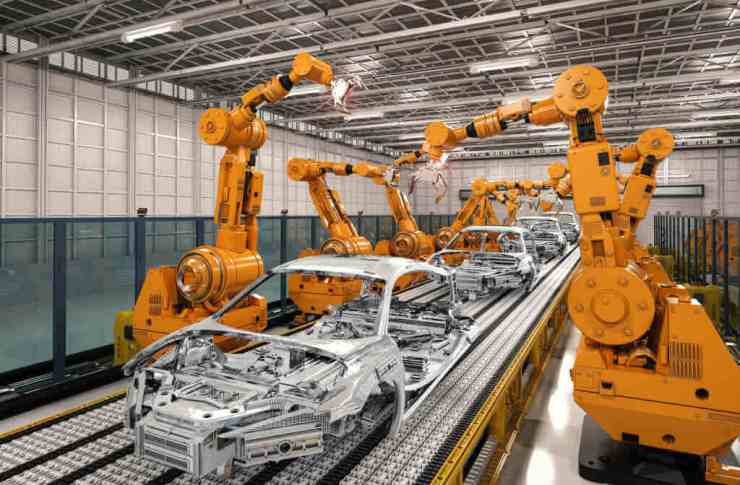
2018 looks to be a good year for world’s top industrial robotics companies, with many of them innovating and simplifying the industry. Industrial robotics services are also benefitting, expecting an incremental growth of well over $4 billion by 2021. Image courtesy of Technavio.com
ONE SYSTEM INSTEAD OF MANY
How to accomplish all of that? By switching all anti-poverty programmes in the UK into one streamlined single-payer system that pays every unemployed adult £1088/mo + free medical + free dental + free generic prescription medication. (This option is limited to those earning less than £13,056 per year from all sources, according to their latest income tax return)
LOW-INCOME UNEMPLOYMENT INSURANCE RECIPIENTS PAID BY THE SINGLE-PAYER SYSTEM
Due to previously working at a low wage job, a person receiving unemployment insurance payments may receive less than £1088/mo. from their unemployment insurance plan, therefore in such cases the single-payer administration would simply ‘top-up’ their monthly payment to £1088/mo. + the healthcare benefits listed above.
It would become one step easier by having the single-payer assume full responsibility for payments to that person and the unemployment insurance administrator would simply reimburse the single-payer administration the monthly amount they would’ve paid to that unemployed person anyway. (Limited to unemployed adults earning less than £13,056 per year from all sources, according to their latest income tax return)
LOW-INCOME SENIOR CITIZENS PAID BY THE SINGLE-PAYER SYSTEM
To lift senior citizens out of extreme poverty and to allow them to live a more dignified lifestyle (in return for helping to build the great UK we see today!) and be better positioned to assist younger members of their family, any senior who reports less than £13,056 annual income would have their monthly income ‘topped-up’ to £1088./mo and receive the same benefits as anyone else on the single-payer system. (£1088/mo. + free medical + free dental + free generic prescriptions)
Again, a government or private pension plan is already paying those seniors a predetermined monthly amount. All the single-payer system would do is ‘top-up’ the income of seniors to the £1088./mo (plus the benefits above) and those pension plans would simply transfer those payments to the single-payer administration which would merely ‘top-up’ the difference in the monthly amount and pay the senior directly. (Limited to seniors earning less than £13,056 per year from all sources, according to their latest income tax return)
UNIVERSAL CREDIT AND OTHER ANTI-POVERTY PROGRAMME RECIPIENTS PAID BY THE SINGLE-PAYER SYSTEM
Instead of the many overlapping and inefficient organizations trying to cope with the needs of poverty-stricken UK adults, the single-payer system can work more efficiently to meet the needs of those who otherwise may fall into ill-health, depression, homelessness, crime, or any other poverty-related condition that results in real costs to the UK government and society in general. Those costs are already being borne by UK taxpayers along with a perceived loss of personal security and mobility freedom among the UK population.
All of these overlapping and inefficient social welfare programmes should be ended by 2020 and replaced by a streamlined single-payer system based on the social insurance number and the individual’s latest income tax return. This is commonly known as a ‘reverse income tax’ among economists. Every UK adult who earns less than £13,056 per year (from all sources) would automatically be enrolled in the single-payer system and begin receiving payments the same month they file their tax return.
When every unemployed adult or retired Briton is earning a minimum of £13,056 per year + free medical + free dental + free generic prescriptions (using the reverse income tax/single payer model) AND all of it is paid for by robots that create 1000-times more wealth for their companies than human beings will ever create, that will be the day that the UK scores the biggest win since the National Health Service was founded.
Among the ‘wins’ of the reverse income tax/single payer model would be the end of homelessness and its associated crime component and a corresponding reduction of property insurance rates, and the end of wasteful, inefficient and overlapping anti-poverty organizations (both public and private) for just a few examples of the benefits of the single-payer model.
And all of it paid for by a moderate tax on robots and other job-stealing technologies that (each one of them) can do the work of 1000 human beings — which means that even with the ‘robot tax’ UK businesses will profit as never before!
It would create a better future for individual Britons, for UK business and their bottom line, and for every level of UK government when compared to allowing the status quo to continue unchanged.
Related Articles:
- New study shows nearly half of US jobs at risk of computerization (University of Oxford)
- Will Robots Really Steal Our Jobs? (PwC)
 Letter to Britain