Home » Britain (Page 12)
Category Archives: Britain

Why Scotland needs the UK
by John Brian Shannon | December 22, 2016
If Scotland chose to become an independent nation it would become a prohibitively expensive operation in very short order, and Scotland would need to find a big brother to pay its bills — as Scotland isn’t economically viable on its own.
The first thing that any country must consider (whether it’s a brand new and independent country or not) is national defence and public security. It’s the historical reason that nation-states were formed in the first place and without national defence and public security, a country is nothing. It then becomes the target of a hostile takeover.
Therefore, Scotland would require its own (viable) military from the first day of independence. Requiring immediate and large-scale expenditures and an annual operating budget.
The operating budget would be equal to $10 billion per year to properly maintain the force. But the first year especially, would be very costly — as a brand-new and fully-functioning from Day One military, would need to be created from scratch.
First purchase: An entire Navy – $5.6 billion for hardware alone

Pictured here is the highly regarded French Navy destroyer FS Forbin (D620) in the Arabian Sea. (U.S. Navy photo by Mass Communication Specialist 2nd Class Rafael Figueroa Medina/Released)
If Scotland separated from the United Kingdom, it would require four modern Navy Destroyers in order to protect its far-flung islands, sea-lanes and regional interests, and such vessels typically cost $250 million to $1 billion each, depending upon the type and capability level.
An independent Scotland would spend $2 billion on new destroyers alone
That’s before training and hiring the crews, and provisioning those ships with food, fuel, and ammunition (all combined, these provisions are called ‘ship’s stores’) and building the necessary naval port facilities, and training and hiring of onshore maintenance and security staff — all of which would come from the annual defence budget.

If Scotland became independent from Britain, Scotland would need 10 Navy frigates comparable to the highly capable Royal Netherlands Navy HNLMS Holland, a modern warship that won’t become obsolete anytime soon. Image courtesy of navyrecognition.com
An independent Scotland would also need many frigates, perhaps 10 of them; Some frigates would be rigged as minesweepers, others as destroyer escorts, others as anti-submarine warfare (ASW) ships, while others would be rigged for anti-piracy and interdiction roles.
And all of them would need to have so-called ‘wet bays’ where small, fast boats can quickly exit the main ship and race out to board any suspected ship or to conduct rescue missions, or to assist green water patrol boats in their respective missions, and all of them would need onboard helicopters and crews. Frigates with wet bays and helicopters usually cost in the neighbourhood of $200 million to $400 million apiece.
Scotland would be looking at $2 billion just to buy the empty, but brand-new frigates
That’s before training and hiring crews, and provisioning those ships and building naval port facilities, let alone training and hiring onshore maintenance and security staff, which would come out of the annual defence budget.

If Scotland were to separate from the UK, the first purchase would need to be 20 Svalbard-class (or equivalent) light-icebreaker offshore patrol vessels. Norwegian Coast Guard vessel KV Svalbard (W303) pictured. Norwegian Coast Guard photo.
And, Scotland would need (almost more than anything) about 20 Svalbard-class light icebreaker, coastal patrol vessels. Although no longer in active production, the Svalbard-class ships operate in the same region and have an excellent service record.
Ka-Ching! That’s $1.6 billion, just for green water defence craft
That’s before training and hiring crews, and provisioning those ships and building naval port facilities, let alone training and hiring onshore maintenance and security staff, which would come out of the annual defence budget.
Note: Although some articles reported that these ships cost the equivalent of $20 million apiece when they were being produced, it’s only because Norway simply built the new Svalbard hulls, then took everything they needed (engines, radars and sonars, warfare electronics and weapons systems, and almost everything else from their recently retired naval ships) and installed them on the new Svalbard ships. This lowered Svalbard costs from (approx.) $80 million, to $20 million per unit.
Second purchase: An entire Air Force – $1 billion please!
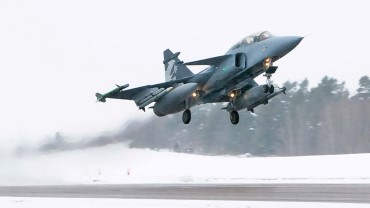
The SAAB Gripen fighter-bomber jet is the obvious choice if Scotland becomes independent, as these jets are famous for their low maintenance cost and high performance.
“Gripen has stable, affordable acquisition and low life cycle costs. This gives air forces a reliable basis on which to budget for operations and fleet sustainment over the long term. Gripen’s inherent reliability and low maintenance footprint boosts force levels and operational effectiveness.” — from the SAAB Gripen website.
Scotland would also need to acquire an Air Force from the very first day of independence. It would need at the minimum, 20 SAAB Gripen fighter-bomber jets and seven long-range search and rescue, and reconnaissance aircraft, like the Aurora. And five KC-135 airborne refueling tankers to ensure those aircraft don’t run out of fuel over the North Sea.
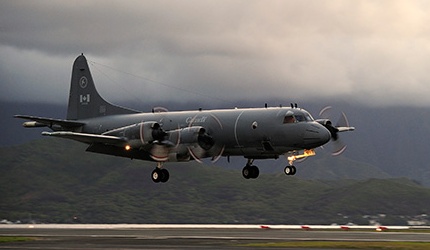
In case of Scottish independence, Scotland would need five CP-140 Aurora Maritime Surveillance Aircraft, which are considered the Gold Standard among maritime surveillance aircraft. Image of Royal Canadian Air Force Aurora.
The Gripen fighter jets cost $40 million per unit. And for surveillance aircraft, the Lockheed CP-140 Aurora is the automatic choice for any Western military at $25 million per copy, and for refuelling tankers the undisputed king is the $35 million per unit KC-135.
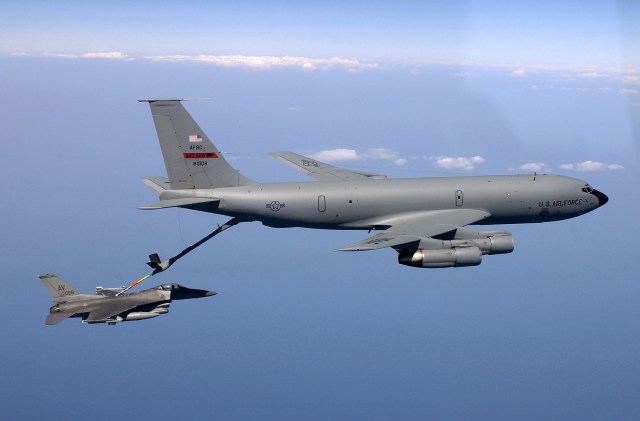
If Scotland leaves Britain, the ability to refuel its military aircraft in-flight is paramount. A Boeing KC-135 Stratotanker refuels an F-16 Fighting Falcon. (U.S. Air Force photo by Tech. Sgt. Mike Buytas)
Scotland would be looking at $1 billion just to buy the various aircraft
That’s before training and hiring crews, and provisioning (bombs and bullets) and building airfield facilities, let alone training and hiring maintenance and security staff, which would come out of the annual defence budget.
Third purchase: An entire Army – $1 billion+ for hardware only

Britain’s legendary Challenger 2 tanks escorted by stealthy (ultra-quiet) Westland helicopters in wargames at Salisbury Plain.
Oh, I forgot to mention that Scotland would need a 10,000-person Army, and due to financial constraints, those soldiers might need to be shunted between the Scottish Army, the Air Force and the Navy, on a daily, weekly, or monthly basis (as required) to keep all positions covered. The weakest link in any chain, is the link that isn’t there.
That’s before the provisioning of army bases, the hiring and training of infantry and tank and other military vehicles personnel, let alone hiring and training on-base maintenance and security staff, which would come out of the annual defence budget.
Note: The Army, Air Force, and Navy cost estimates assume the Scottish government donates at no cost to the military, the necessary land for naval port facilities, for military airfields, and for army bases and training areas.
Military-only costs for a newly independent Scotland
In the first year, Scotland would need $30 billion (conservative estimate) just to field a small, but respectable, Navy, Air Force, and Army. All of those would be required from the very first day of independence, you simply can’t leave a country unprotected while you spend a couple of years shopping for and having navy ships built.
And it would cost $10 billion per year thereafter, across the entire Scottish military, just to keep all seats filled, wearing appropriate military uniforms, military personnel fed and sheltered, with all regular pay and pensions paid, and never find themselves out of fuel or ammunition. (Want your army to quit en-masse? Run them short of ammo)
Other Independence Costs
Thus far, and we’ve only talked about defending Scotland, we’ve yet to talk about creating a national currency were Scotland to be truly independent, a federal reserve-type banking system, a Scottish police force and an MI4 (GCHQ) an MI5 and MI6-equivalent role security agencies, nor have we talked about the creation of a Scottish foreign affairs office to promote Scottish trade abroad and to assist and protect inward investors, and to assist and protect Scottish companies doing business in other countries. All of that must be paid-for by Scottish taxpayers.
Where to find that money? In the markets? The IMF? If so, what’s the collateral?
Scottish debt-to-GDP would be 100% in the first year, and get worse every year from that point… unless the oil price happened to skyrocket to $140 barrel, stayed there permanently, and huge oilfields were suddenly found in Scottish waters. Not likely.
If Scots want true independence, Scottish taxpayers will pay three-times more tax
Remember, the true cost of Scottish independence from the UK could easily surpass $20 billion annually, in addition to the first year start-up costs. And, if it’s true independence that Scots want it will be Scottish taxpayers footing the bill, via much higher personal, sales, and corporate tax rates.
But if Scots want EU membership, their economic overlords would be the European Parliament
Why do I say ‘economic overlords’?
Because, based on the principle of ‘No taxation without representation’ I suppose reverse taxation (subsidizing an entire country, where the money flows from the EU to Scotland) the Scots wouldn’t receive much representation for their tax payments.
In fact, as the EU would be funding Scotland’s budget deficits, the EU would get to make the majority of Scotland’s decisions from the safety of Brussels. Which is quite a-ways down the road for Scottish citizens if they ever felt the need to stage a peaceful protest.
If Scots want continued UK membership, the present paradigm continues
At present, Scotland receives 16 billion pounds sterling more, than it contributes to the UK economy, on an annual basis. Not a bad deal for Scotland! But yes, some decisions are made in London for the betterment of all Britons. That can seem unfair if you’re a Scottish citizen and your heart was set on a certain policy or outcome. Still, it’s the best deal on offer.
(But if you find a better offer, take it!)
Imagine Scotland no longer having that 16 billion pound annual subsidy from the UK, and needing to pay $20 billion USD for one-time costs to create a brand-new armed forces, and thenceforth having to pay $10 billion USD annually to keep the armed forces fed, clothed, sheltered, trained, paid, and a with reliable supply of fuel and ammo.
Without the UK contribution, Scottish independence (military costs only) amount to an annual difference of $29.7 billion USD. Something important to note; The first year of independence (military costs only) amount to $49.7 billion USD.
What Scotland and the devolved regions really need are people selected from their own region to be employed as Cabinet Ministers in the Westminster government (not only a UK Cabinet Minister for Scotland, Northern Ireland, and Wales, but a Cabinet Minister for England too) who represent the interests of their particular region within the UK central government.
In this way, devolved governments and their taxpayers will have better representation and more engaged relationships with the central UK government, and thereby receive superior governance outcomes from the UK government.
And isn’t that what fair government is all about?
Related Quote: “If I had asked people what they wanted, they would’ve said faster horses.” — Henry Ford
Leaning toward ‘Soft Brexit’?
Now that Brexit is beginning to sink-in for Britons and for UK politicians entrusted to carry out the will of ‘The People’ it seems that a so-called ‘Hard Brexit’ might be orders of magnitude more difficult than first imagined, while a so-called ‘Soft Brexit’ might be preferable to all parties, which appears to be an elegant solution at the point where the people’s interests intersect with the UK economy.
Because Philip Hammond’s economy is doing well considering everything that’s happened since 2008, PM Theresa May can relax about the economy and get on with her part of running the United Kingdom — namely, the political arrangements for a Soft Brexit now (let’s call that Brexit Stage I) and possibly a Hard Brexit later (let’s call that Brexit Stage II) if that part is approved by voters in the next UK election on May 7, 2020.

Soft Brexit vs. Hard Brexit. Image courtesy of J.P. Morgan Asset Management.
Soft Brexit probably equals mild uncertainty in the markets, while Hard Brexit might cause economic chaos
Since 1973 when Britain joined the European Community and it’s various and later governmental structures, the policies in all member nations have largely been set by common agreements forged with those organizations. There are literally hundreds of thousands of laws and regulations to replace in a post-Brexit UK. It will be a humongous task.
Even Greenland, with its total population of 56,196 took three years to exit the European Union. The UK with it’s $2.8 trillion (GDP) advanced economy has hundreds of thousands of EU laws, trade laws, tariff controls, manufacturing standards and immigration rules, that guide industry, the UK government, and Britons — all of which might take 5-10 years to replace with UK-centric legislation. Industry simply can’t function without proper regulations which leaves only one choice for many organizations; Leave Britain. That’s not in the best interests of Britons, the government, nor of UK industry itself.
A brilliant plan, is one that allows the UK to rejoin the EEA and the EFTA (as in the Norway or Swiss model) and it’s actually doable.
Have you seen Norwegian or Swiss economies? Let’s just say that on a per capita basis, they beat every European economy every year.
And, sure, some commenters will try to make things more complicated than they really are. But it isn’t complicated unless you desire it to be that.
With proper stewardship the UK economy can perform as well as any non-EU-member-nation noted in the links below. Check out their world-leading per capita income and low unemployment rates!
Norway Economic Outlook
Switzerland Economic Outlook
If Switzerland and Norway (for two examples) can have EEA and/or EFTA membership, and bilateral agreements with the EU, and booming economies — there’s no reason the UK can’t.
It’s not rocket science. Brexit does NOT mean the end of trade with the EU. That would cause long-term recession in the EU (likely leading to its dissolution) and a long-term case of the economic doldrums for the UK. The two blocs need each other whether some like it or not. So, get on with it!
UK Prime Minister Theresa May needs to stop everything(!) and get warm approval for EFTA membership accession from all four EFTA member nations.
Not to mention appointing a Minister for Scotland (a ‘Scot’) a Minister for Northern Ireland (a ‘Northern Irelander’) and a Minister for Wales (a Welsh resident) to shore-up relationships with the UK’s devolved regions, and also appoint a Minister for England.
And gain approval for Brexit among the remaining 27 EU member nations which must unanimously approve Britain’s exit from the European Union.
Accomplishing all of that would be five-years’ worth of dedicated work for any British Prime Minister! Even former Prime Minister extraordinaire Sir Winston Churchill, might’ve found a challenge in that.
UK Conservatives (with significant help from UKIP) have gained a mandate for Soft Brexit but I don’t think 52% is enough of a mandate for Hard Brexit. Which is why I support ‘Soft Brexit’ for now — and if approved by voters at the next election — ‘Hard Brexit’.
In the meantime, there’s an unimaginable amount of work left to secure a stable, fair, and expeditious Soft Brexit that solves some of the deficiencies of Britain’s EU membership, while leaving only free movement of labour and persons, and certain trade matters to negotiate, if it ever comes to Stage II Brexit.
Related Article:
- Philip Hammond becomes standard bearer of Soft Brexit (Financial Times)
- Hard Brexit would damage ‘almost every sector’ of UK economy (The Guardian)

The European Union’s Brexit Endgame
by John Brian Shannon | December 8, 2016
In the aftermath of a landmark Supreme Court ruling in the UK, British MP’s have proposed the Conservative government authour a Green Paper, a Blue Paper, or a White Paper (these are different levels of British government policy documents) to inform members of the Parliament and the public about the government’s Brexit plan.
Ranking even higher than such policy documents would be a Public Inquiry, or the highest ranking, a Royal Commission (which although quite costly) employs all the resources of Her Majesty’s government to find the best solutions to the most important problems of each era.
UK Prime Minister Theresa May has so far resisted such calls for transparency claiming that by showing their hand it could help the European Union thwart Britain’s advantage in upcoming Brexit negotiations. (And I think she was mostly right about that)
But presenting a secret Brexit plan to the EU also implies presenting a secret Brexit plan to UK citizens — and that’s undemocratic.
Yes. Britons voted for Brexit! And yes, Britons voted for a Conservative government!
But they didn’t vote for Theresa May as Prime Minister, they voted for David Cameron. Not only that, but Britons didn’t vote for a secret Brexit plan to be imposed on them — should the EU accept without changes, Theresa May’s secret version of Brexit.
Therefore, Theresa May has taken not one, but two, liberties with voters. They didn’t vote for Brexit plans that were to be kept secret, and all of it decided by a Prime Minister they didn’t vote into office. Yet, it’s probable she was pursuing such a path in order to obtain the best Brexit outcome for Britain.
For small and medium policy decisions that’s 100% acceptable, but it isn’t acceptable for top-level policy decisions resulting in major changes to the way the country operates — even though she has likely done so with the best of intentions and with the best Brexit result in mind, from the British-point-of-view.
To my mind, the government now needs to show a high level of transparency with voters. Had Theresa May been voted into office by voters and not by Conservative Party members she would’ve had more wiggle room on this.
But the simple fact is, she inherited David Cameron’s chair, voters didn’t select her. Had she won the Prime Minister’s chair from the outset, she could’ve gotten away with publishing a very generalised Green Paper at any time in 2016, and the electorate would have simply trusted her to finish the job.
That’s the problem with inheriting a sitting Prime Minister’s chair; You inherit the position, but not their political capital, nor their popularity, nor their credentials.
Which is why MP’s are now calling for a detailed policy statement. And there’s no doubt any such policy documents will become public, even if it gets marked ‘Sensitive’ or ‘Classified’. It’s just the way of things these days.
Which gives the European Union an edge that it wouldn’t have otherwise had in the Brexit negotiation process.
Thanks to the UK Supreme Court ruling, and thanks to British MP’s who now demand full transparency, PM Theresa May cannot now produce a ‘fait accompli’ Brexit document to the EU Parliament and use other, non-specified leverages to get that document quickly approved by the EU Parliament and approval by the 27 remaining EU member nations.
For Theresa May, that’s a big loss, because that’s obviously what she had planned.
But it’s all moot since the UK Supreme Court ruling, and since notable British MP’s have called for a policy paper to guide the government itself, the House of Commons, and the public, on matters Brexit.
For the sake of argument, let’s say that my argument in favour of PM Theresa May, is true.
It doesn’t matter anyway. Because powerful political and psychological forces are at work in the EU Parliament and in EU member states. They’re upset that Britain is leaving the EU. Plain and simple.
And, why not? Britain pays the largest NATO contribution, it’s a large net contributor to the European Union budget paying-in much more than it receives, and it has allowed Eastern European governments to offload millions of their unemployed citizens to Britain. Why wouldn’t they want that to continue when it’s so obviously in their own best interests?
Surely, the EU plan is to reject any and all Brexit proposals — believing it’s in their best interests to force either a so-called Hard Brexit or a No Brexit result.
It’s not that EU leaders are evil — it’s pure common sense from the European Union point-of-view.
“Nations have no permanent friends or allies, they only have permanent interests.” — former British Prime Minister and Foreign Secretary Henry John Temple, 3rd Viscount Palmerston (1784–1865) also known as Lord Palmerston
We’ll eventually see that no matter how well-intentioned any Theresa May Brexit plan is, no matter how many White Papers are produced, no matter how many warm and fuzzy photo opportunities with EU leaders, the answer is going to be a resounding ‘No’ to any Brexit plan produced by the UK government.
Which leaves only two options: Hard Brexit, or the option that the European Union governments prefer, reversal of Brexit.
‘See? It’s too hard to leave. So just stay.’
It’s so obviously the EU strategy, that the British strategy must now be all about countering the European Union strategy.
UK Supreme Court rulings, MP’s demanding policy documents and any other happenings, must now be seen as incredibly minor waypoints along the path the EU is driving the British people towards; Hard Brexit (which Europhiles hope to make as ‘scary’ as possible) or Just Stay.
We must drop the notion that the European Union is going to be ‘looking out for Britain’s best interests’ and realize that even the most well-intentioned Brexit plan will be rejected, for the express purpose of forcing a show trial in the UK court of public opinion where the only two options will be; Hard Brexit or Just Stay.
Why? Because EU politicians believe that’s in the EU’s best interests.
Reacting to any Brexit news in the meantime, is merely tilting at windmills. The real show hasn’t begun.
 Letter to Britain