Home » Brexit (Page 44)
Category Archives: Brexit

This Week in Brexit: UK to leave London Fisheries Convention
Environment Secretary Micheal Gove has signaled that the UK intends to leave the London Fisheries Convention (LFC) as the first move towards an eventual Brexit completion within 24 months.
The original LFC was signed in 1964 and it allowed vessels from Belgium, France, Germany, Ireland and the Netherlands to fish in British waters in the 6 to 12 nautical mile range which was a significant upgrade for those fishers as UK coastal areas are abundant fishing grounds.
It was also a significant upgrade for those who ship any kind of contraband to the UK because it allows them to get much closer to British shores and drop their loads with less chance of being detected by police — and people wonder why London has the world’s highest cocaine concentrations in their wastewater treatment plants!
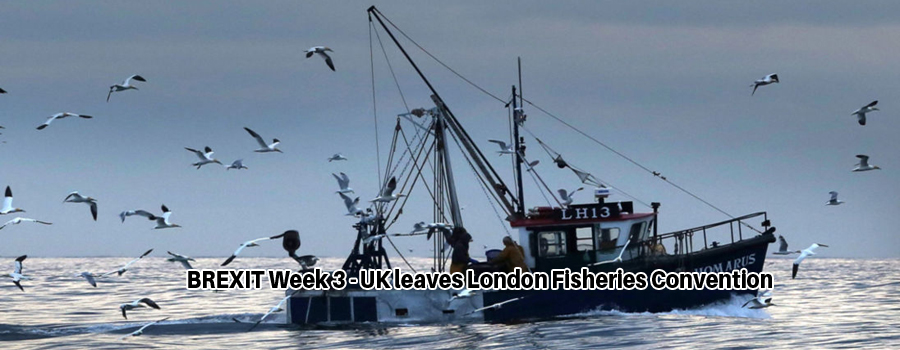
UK Environment Secretary Micheal Gove says Britain intends to cancel the London Fisheries Convention to stop countries fishing in British waters.
Once Brexit completes, UK fishers will obviously lose their right to fish in EU waters in the 6 to 12 nautical mile range.
The Tory government said the change will allow more direct control and better responsibility for fisheries management in the 0 to 12 nautical mile range.
“Leaving the London Fisheries Convention is an important moment as we take back control of our fishing policy. It means for the first time in more than 50 years we will be able to decide who can access our waters. This is an historic first step towards building a new domestic fishing policy as we leave the European Union – one which leads to a more competitive, profitable and sustainable industry for the whole of the UK.” — Michael Gove, UK Environment Secretary
“This is welcome news and an important part of establishing the UK as an independent coastal state with sovereignty over its own exclusive economic zone.” — Barrie Deas, National Federation of Fishermen’s Organizations
“For years, successive UK governments have blamed Brussels for their own failure to support the small-scale, sustainable fishers who are the backbone of our fishing fleet. If Brexit is to herald a better future for our fishers, the new Environment Secretary Michael Gove must keep the 2015 Conservative Party manifesto commitment to re-balance fishing quotas in favour of ‘small-scale, specific locally based fishing communities’.” — Will McCallum, Greenpeace UK
In 2015, the British fishing industry caught 708,000 tonnes of fish worth £775 million.
A claimed 10,000 tonnes of fish were caught by EU countries in Britain’s waters in the 6 to 12 nautical mile zone. (2015 statistics) It could be much higher than that, but nobody would know because nobody is policing it!
That’s a minimum of £17 million in fish that leaves Britain each year. Fish that will now be caught by UK fishers (and presumably) will be processed by UK fish processing and packaging plants, adding even more value to the British economy.
Scottish government says UK is right to leave fishing deal (BBC)
It’s true that since 1964 when the LFC came into existence the UK fishing industry lost millions of pounds sterling and hundreds of jobs every year for the privilege of belonging to the then-European Community / now European Union.
As so often happens in the postwar relationship between Britain and continental Europe, it is Britain that winds up subsidizing the continent.
How else can it be termed anything but ‘subsidizing the continent’ when millions of pounds sterling (in this example, raw fish) and hundreds of fish processing and packaging jobs were handed to the continent every year since 1964?
‘Here! Take our jobs! We’re British!’
Now that PM Theresa May has delegated this poignant case to Secretary Gove with instructions to effect a win for UK fishers, fish stocks will rebound, there will be more jobs for UK fishers, there will be more UK fish processing and packaging jobs, and anti-contraband efforts in UK waters will become more effective.
And that’s no fish story!

This Week in Brexit: What Scotland Lost
Congratulations to Prime Minister Theresa May for working out a ‘confidence and supply’ agreement with Northern Ireland’s Democratic Unionist Party (DUP) to allow the present minority Tory government to continue in office.
Theresa May strikes ‘confidence and supply’ deal with DUP
And congratulations to DUP leader Arlene Foster for negotiating so well on behalf of her jurisdiction, thereby gaining £1.5 billion in additional infrastructure and other funding.
That’s a ‘Win-Win’ for the Tories and for the Democratic Unionist Party — and more importantly (sorry, Theresa and Arlene!) it’s a ‘Win-Win’ for residents of Northern Ireland.
Theresa May signs ‘£1.5 billion’ deal with the DUP
Infrastructure in Northern Ireland is in bad shape and the funding appears at an opportune moment, as there comes a point when it becomes cheaper to tear down a bridge (for example) than to pay ever-increasing maintenance costs.
The same is true for all infrastructure. Whether roads, bridges, hospitals, schools, airports, or the underground infrastructure that carries water to homes and businesses, all of it has a ‘best before’ date where leaving vital infrastructure spending for too long can cost more than the savings of not doing the work.
The Conservative/DUP deal: what it says and what it means
Of course, £1.5 billion isn’t going to fix it all. But I wouldn’t be surprised if two years of successful DUP ‘confidence and supply’ support gets the residents of Northern Ireland additional infrastructure spending allocations, courtesy of DUP leader Arlene Foster and Prime Minister Theresa May.
And why not? Arlene Foster prevented a divisive and perhaps extended Parliamentary crisis — one that would’ve prevented much good from being done in the United Kingdom.
Speaking of which; See how infrastructure spending is increasing in Northern Ireland, and how it isn’t in Scotland? Not only additional spending, but PM May and DUP leader Foster also negotiated more devolved powers for Northern Ireland.
NOTE to Nicola: It’s great to have a particular ideology, but when it costs your jurisdiction £1.5 billion in the form of missed infrastructure funding, it’s time to review what you think you’re accomplishing!
Loss of opportunity is also a metric by which UK leaders must be measured — it certainly is for heads of government everywhere else — and not as much as it should be, but it’s still an important marker of successful leadership.
Nicola Sturgeon of Scotland’s SNP missed the boat. Arlene Foster of Northern Ireland’s DUP didn’t. And UK Prime Minister Theresa May begins to look like a bit of a deal-maker, which can only be viewed as a good thing as we head into Brexit. Well done, Theresa!
Related Articles:
- Confidence and Supply Agreement (Conservative and Unionist Party) (Theresa May statement)
- Agreement between the Conservative and Unionist Party and the Democratic Unionist Party on support for the government in Parliament (Conservative and Unionist Party) (full text – PDF)

This Week in Brexit: Expat rights
Now that Brexit issues of substance have percolated up into the mainstream everyone has stopped talking about the Tories getting their electoral wings clipped and we can now move on to far more important matters! And just in time folks, it was getting a bit much.
The Queen looked positively radiant reading aloud the document that will change European history on both sides of the English Channel.
Some comments were made about her EU-bleu hat which had five golden embellishments reminiscent of the gold stars on the EU flag. If so, it’s the Queen’s prerogative what to wear and if she wanted to send a polite message to the European Union via her choice of attire, why not?
If you asked 20 people what that message might have been, you’d probably get 20 different answers. Note to conspiracy theorists; Knock yourselves out!
You must be dying to know what my read of the Queen’s outfit is: After all, you ARE reading this blog, aren’t you?
I think the Queen knows there are hurt feelings in Brussels and that others in the EU are sad to see Britain leave. And it could be that as she read the speech written to begin the process to take the UK out of the EU, she wanted to politely emote, ‘We are leaving your Union, but we respect you and want to keep good relations with you.’
How could it be other than that? What else would you expect from the reigning Monarch of the United Kingdom? Of course, continental Europe will still need the UK… and the United Kingdom will still need the EU.
Trade, a common European defence, social causes, families, etc. are so interlinked between Britons and the people across the Channel that good relations must be preserved, sparing no effort.
EU Membership is no guarantee of a booming economy
Over 175 nations in the world are not members of the EU, nor do they have trade agreements with the EU.
Some nations, even those in close proximity to the EU declined to join the Union. And some, like Norway, Switzerland and others simply worked out different arrangements with the EU.
Greenland applied for EU membership, then withdrew its application once Greenlanders were consulted via referendum. Yet, Norway, Switzerland and Greenland have continued along just fine without EU membership, as have other European and non-European states.
The UK will get along fine without EU membership
Yes, some things will be better for Britons. Yes, there will be a period of adjustment. And minor economic disruptions could occur here and there, at various waypoints along the Brexit timetable.
But what negotiators on both sides must remember is that, ‘What’s good for the UK, is good for the EU.’
Large EU companies like BMW and Mercedes don’t want a recession in the UK! It’s one of their best markets. Large British companies like BP (British Petroleum) want continental Europe to thrive, else how can it remain profitable?
Arguably, small business is even more dependent upon thriving economies on both sides of the English Channel.
Which is why all of this must be made to work!
If the EU ‘stabs’ the UK, it will be the EU that bleeds! The reverse is also true!
Hurt feelings aside, let’s hope that negotiators on both sides are dedicated to ensuring they aren’t the cause of their own ‘bleeding’ and that they continually work towards a better agreement — one that works for Britons and EU citizens alike.
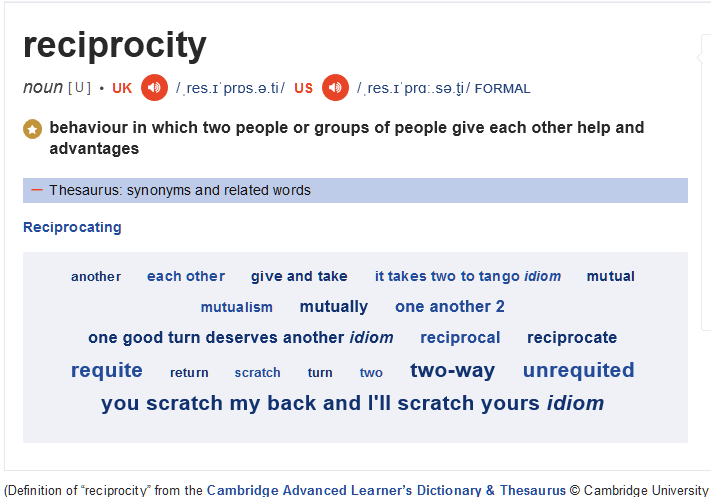
RECIPROCITY should be the watchword every day until Brexit negotiations are concluded. And thenceforth, all relations between the two sides should be guided by that ultra-important word in perpetuity.
What all this is leading up to is the present discussion surrounding expat privileges in both jurisdictions — succinctly covered by Laura Kuenssberg, Political editor at the BBC, here.
But we can’t have one rule set for UK citizens who live, work, attend university, or are retired in EU nations… and a different rule set for EU citizens who live, work, attend university, or are retired in the United Kingdom.
SSTWB: Simple Solutions Tend to Work Best
So with that in mind let’s declare that from January 1st 2018, any EU citizen who moves to (or already lives in) the United Kingdom for any reason (work, school, retirement, or to live as one of the idle rich) must register with the UK government and pay an annual £100 fee per each family member (in the case of EU citizens that move to the UK) and for those Britons who move to the EU for any reason (work, school, retirement, or to live as one of the idle rich) must register with the government of that jurisdiction and pay an annual €100 fee per each family member.
Once they have registered and paid, it thereby proves their status and good intentions to the jurisdiction in which they intend to live (or already live) and they should have the ability to join the NHS (in the case of EU citizens living in the UK) and pay the same NHS contributions as Britons do.
Of course, those contributions are scaled to income so EU citizens would need to provide a copy of their income tax form to the UK government when paying their annual £100 per family member expat tax in order to qualify for the subsidized NHS rate appropriate to their income level.
And all of it should be easily done every year — either online or in a government agent’s office. And it should be a simplified form so that the entire process takes less than 5 minutes. Keep it simple!
- Name
- Address
- Work or University address
- Income tax ID number
- Pay £100 per family member here via credit card
UK citizens that live, work, or retire in the European Union should receive corresponding privileges — the only difference being the value of the currency — the €100 annual fee per expat vs. the £100 annual fee per expat.
Issues of Law and (worryingly) Issues of Precedent arise
Some (very unreasonable) EU people suggest that EU laws should apply in Britain! (Yes, some people have actually said that aloud)
Do I have to say it? It is the very definition of Bureaucracy Run Amok!
And further, they’ve stated that EU citizens living in Britain should be bound by EU laws, and any court proceedings that involve EU citizens living in Britain would need to be conducted in an EU-court located somewhere in Britain. Facepalm!
It’s one of the most absurd things I’ve heard, and people who suggest such things need years of psychological treatment (You need to be deprogrammed Comrade Bureaucrat, as you’re no longer in the Collective!) and remains true EVEN IF they support having British courts in the European Union to adjudicate Britons who break UK laws while in the EU.
Stop the Insanity!
FACT: The Colonial Era is over. FACT: The United Kingdom was never a colony of the European Union. FACT: The United Kingdom really is leaving the European Union!
Trying to pull such stunts shows how buried in the sand, are some heads in the EU, even at this late Brexit date.
There is only one way it will work
EU citizens must obey the laws and be bound by British courts whenever they are in Britain — and the reverse is just as true — Britons living in the European Union must obey the laws and be bound by EU courts whenever they are in the EU. Full stop! No other choices available!
Although I’d certainly support a reciprocal incarceration agreement, whereby once sentenced, a UK citizen (for example) could apply to serve out his/her prison time in a United Kingdom prison instead of in the EU where he or she broke EU laws.
EU citizens who break the law in the United Kingdom should likewise be offered the opportunity to serve out their prison term in the EU.
And all of it should be simplified and standardized, so that any such prisoner requests could be completed within 48 hours. People in prison have families too — and why exactly should they be punished?
IN SUMMARY
Once we ditch the crazy people from the negotiations, mutual interests should prevail and allow the economies of Europe, a common European defence, commerce, industry, and family ties to remain unaffected, and in some ways improved. Above all else, overall improvement should be the goal for negotiators.
 Letter to Britain