Home » Articles posted by Letter to Britain (Page 98)
Author Archives: Letter to Britain

A New Foreign Policy for Britain
by John Brian Shannon | August 5, 2016
British Foreign Policy post-Brexit
Now that Britain is delinking itself from the European Union’s foreign policy construct, the country is again free to chart its own course, instead of a foreign policy based on literally hundreds of compromises made to appease EU government and corporate leaders, and EU citizens.
The United Kingdom has an incredibly clean slate having shed its colonial power and responsibilities in the 20th century, and is presently shedding the EU construct early in the 21st century.
Windows of opportunity as large as the sky abound.

Britain Foreign & Commonwealth Office logo.
Of course, Brexit is a recent development, so we’re in early days yet.
But the possibilities are almost limitless from a foreign policy perspective. The British government could follow any existing foreign policy model or choose to create something novel and fine-tune it over time.
Trade
Central to any nation’s well-being is robust international trade. Gone are the days when a nation could survive on domestic trade alone. Today’s world requires an economy that fires on all cylinders — and that means foreign trade.
Nations with a heavy commitment to international trade also have thriving economies. Therefore, it’s mandatory that foreign policy be designed to attract the greatest number of businesses.
However, ‘doing what everyone else does’ in the foreign policy department just doesn’t cut it. Today, foreign policy leaders and bureaucrats must innovate policies that match the strengths of their particular country and sell it on its merits.
I: Strengthening the Business Case for Transnational Corporations to Headquarter in Britain
II: Working to the Strengths of British Industry and thereby Facilitating Massive Trade Surpluses
Convincing transnational corporations to relocate their headquarters (or even a branch operation) to Britain is one thing (and a very desirable thing) but it’s only half the story. The other half of the story is helping to create a massive export-driven economy, exporting billions of pounds worth of goods each month.
If Britain, post-Brexit is to be a success, it will be largely due to the Foreign and Commonwealth Office succeeding at strengthening Britain’s international trade relationships.
And if Britain’s economy fails in the post-Brexit years, most of the blame will land at the Foreign Office.
Read Britain: Between Now and Article 50
Security
Another pillar of post-Brexit foreign policy success is by necessity, security.
Again, the new government of Theresa May has a clean slate upon which to write any policy it chooses. That is a very fine thing, but change for necessity’s sake is good, while change for change’s sake usually involves wasted effort.
III: Continuing the NATO Commitment at the Approved 2% of GDP Level (unlike some NATO partners who typically miss that low target)
IV: Continuing to Support MI4 (GCHQ), MI5 and MI6 at a Robust Level
V: Creation of a British Homeland Security organization parallel to the U.S. Department of Homeland Security (DHS)
For an island nation located in the North Atlantic Ocean, leaving NATO would be the about worst single thing that Britain could do from a security standpoint. Therefore, foreign policy must be directed towards maintaining and improving that institution keeping in mind that it’s a dynamic beast, not some static entity that we throw money at in order to feel safe.
Rather, Britain, as a charter member of NATO must play a lead role in improving that organization, recognizing at once it’s strengths and it’s weaknesses. Proactive leadership within NATO is the best way for Britain to remain a stable, democratic, and secure nation.
GCHQ, MI5 and MI6 are needed now more than ever if Britain is to survive and thrive, and they have proven their worth countless times. These organizations operate in a constantly changing, threat-driven world. The government must proactively support these institutions and recognize that the intelligence business changes every day of the year, decade after decade. It never stops — and it never stops changing. Treating these as static operations would be a terrible blunder.
GCHQ monitors all manner of communications and operates parallel to the United States’ NSA, intercepting suspicious communications and routing them to the appropriate channels, while MI5 maintains a silent presence in the UK in the counter-intelligence environment similar to the FBI in America. The agency of James Bond, MI6, operates everywhere in the world — except the United Kingdom.
But nowhere in the United Kingdom is one super-agency responsible for security where the threat doesn’t come from foreign spies employed by a foreign government.
Back in the day, the local Royal Mail post office was informally charged with reporting incidents that occurred in the public domain, to whichever service it deemed appropriate. Even prior to WWII, each Postmaster or Postmistress in every county had a designated number to call in case of suspicious persons or events.
Now that the Royal Mail is a private company, there won’t be much of that.
All of the security bases in the United Kingdom are covered, except one.
New Scotland Yard for policing and investigations. GCHQ for communications. MI5 to monitor, track, and apprehend foreign (professional) spies and agents provocateurs. MI6 to handle foreign operations.
As truly awesome as all of that is, a gaping hole remains in Britain’s security. Millions of refugees and economic migrants, non-professional agents provocateurs, and even visitors to the United Kingdom (all of them legally allowed into the UK) could stage a multi-county or multi-city or other mega-event far, far, beyond the ability of the local constabulary to prevent or handle.
Mega Attacks, Mega Theft, or Terror Attacks Originating Inside the UK by Non-Professional Agents
We saw how unprepared and vulnerable the United States was during the September 2001 attacks in New York City — a country with a defence budget larger than the next 10 countries combined, and an intelligence budget bigger than many countries’ GDP.
This proposed organization needs a strong military command structure, yet it would operate in the public domain, inside the UK only. All other UK security issues are covered so it’s simply a case of having a Minister in charge (preferably one with a Royal Air Force command background) with a clear and powerful mandate “Protect the United Kingdom from domestic terror and other crimes not easily handled by other police and security agencies”
Each UK military base would need to designate at least 2 armed fighter jets, and a squadron of armed helicopters, and at least 100 personnel per base, on permanent standby. ‘Ready to move within one minute.’
It would also need a strong legal mandate giving it instant and powerful emergency powers, to do such things as; instantly close airports across the country, force aircraft to land anywhere, stop trains anywhere, detain ships entering UK waters, detain and question non-state actors and witnesses. And so much more.
In short, it would be the emergency headquarters for all of Britain.
During times of war, the Prime Minister calls the Minister of Defence.
During times of hooliganism or crime, the public calls the Constabulary.
“But who do we call, when people are flying aircraft into buildings? Who do we call, when people are planning mass attacks somewhere (anywhere) along the country’s transportation corridors? Who do we call when people in large numbers are taking control of entire counties and the police are several thousand officers short-staffed of being able to handle the job? Who do we call when sophisticated, mobile, and country-wide organizations are operating with impunity and the police just don’t have the resources or expertise to handle the onslaught? How many police can scramble and fly a fighter jet or assault helicopter to shoot down an aircraft with a stolen nuclear bomb on board heading towards a major city?”
Who do we call, when the matter is much larger than a policing issue, smaller than a war between nations, and doesn’t involve professional agents from a foreign country?
In today’s world, every UK citizen, non-citizen resident and visitor, must know an easily memorized phone number like #UKSECURITY to call in case of suspicious activity, terrorist or criminal acts — that instantly links the caller to the Department of UK Security where the information can be received, fighter jets instantly scrambled, etc.
Post-9/11, the Americans recognized the need for a Department of Homeland Security and it’s been a proactive and moderate force for good in the United States.
The UK must not wait until after a major event occurs; A parallel agency to DHS must be set up within one year to protect Britons and visitors from at-scale domestic events — events above the level of regular police and outside the mandate of GCHQ or MI5.
Renewing the Anglosphere
Brexit is the time for Britain to lead the re-creation of the Anglosphere as it was originally intended to be prior to WWI, WWII, and the Cold War.
Read The Anglosphere Revisited
Due to some history happening the Anglosphere did not continue to evolve, instead, an artificial construct has evolved.
Now is the time to get that destiny back on track, a destiny where all English-speaking nations work together at creating a free trade and immigration zone within the Anglo nations — combining their strengths to compete with the world’s new economic tigers.
It’s imperative that the UK initiate this move to dramatically step up all kinds of links between the Anglo nations, and to put a recognizable ‘brand’ on it.
Summary
The world is changing, and Britain has a unique opportunity to mould the United Kingdom into the kind of country it was originally destined to be, and for Britain to become an even more positive force in the world.
A world where anyone would be proud to live.
Have a comment? Please let us know your thoughts in the comment section below.

The Anglosphere Revisited
by John Brian Shannon | July 29, 2016
Britain survived the 20th century despite two British-economy-wrecking wars (WWI and WWII) and the follow-up to those wars, the Cold War.
But imagine all that Britain could’ve become by now if it wasn’t required to wage World War I, World War II, and the Cold War in the first half of the 20th century. Great Britain would’ve been equal in economic and military power with the United States, and humanity would have completely missed two hot wars and one cold war.
The Anglosphere would’ve held dominion over the Earth — and let’s hope they would’ve had enlightened and moderate leaders.
There would’ve been no need for some of the overcompensating behaviors we witnessed in the 20th century.
The excesses thrust upon the world by continental Europeans in the 20th century are 100% responsible for the creation of two classes of overcompensators; The neocons and the terrorists — both of whom are engaged in a non-virtuous and negative relationship that could still destroy all life on the planet.
That is a scenario of if not when, unless we can completely overcome the three speedbumps in our civilizational development, recover, and get back on track — the track we were originally on until continental Europe changed history three times for the worse.
It could still be the end of us all. But only if we let them.
Not that I wish the continental Europeans one second of harm, it’s just that they’ve wreaked enough havoc. In fact, ‘I wish you the best, and have a beautiful day!’
It’s time to put Britain back together — and in tandem with a politically-moderate United States (and without prejudice to any other country or bloc) to recreate the Anglosphere as it was intended to be prior to the change in the world order made by 20th-century Europeans.
The time of war followed by plenty of overcompensating must now be over, or humanity won’t survive it.
Any nation that wishes to join the Anglosphere need only pass legislation that English is one of their official languages and have a politically-moderate foreign policy, then I would consider them eligible to join The Commonwealth of Nations, which is the umbrella organization of Anglosphere nations.
In that way, I would hope to (eventually) win over every nation. Yes, every one.
No more war. Peace and prosperity. Peace, Order, and Good Government.
That was the path that Great Britain, the United States, and other Anglo nations were on before three wars were thrown at us by continental Europe. (WWI, WWII and the Cold War)
As bad as those wars were, the two overcompensating responses (the neocons and the terrorists) may yet turn out to be even worse. Those two groups may ultimately spell the end of humankind.
And that’s what I’m trying to prevent.
In North America, we say; “If it ain’t broke, don’t fix it.” Well, the continental Europeans of the previous century broke the working model.
Now we need to get it back.
Transforming Britain’s Trade Partnerships
by John Brian Shannon | July 25, 2016
Every day of the year, we teach others how to treat us.
If we consistently demonstrate that we’re reliable, we teach others to trust us. If we demonstrate that we’re untrustworthy, we teach others to avoid us.
And so it is with nations; By virtue of their policies and procedures and by their other actions, we teach the leaders of other nations and their corporations how to treat us, how to deal with us, or give them reasons to avoid us.
Pretty simple stuff. We learned this in kindergarten.
But sometimes we get so busy working in our business we forget to work on our business, and that message can lose place.
In the interdependent world of the 21st-century, the highest priority for British Prime Minister Theresa May and her ministers must be to work on our business and not get wrapped up in the daily routine, and thereby lose place.
The government of Theresa May is off to a good start and it’s too early to draw conclusions about her future economic policy, but governments of the past have ranged from inspired to dreadful in regards to steering Britain’s economy.
The United Kingdom is the 5th-largest economy on the planet. Let’s not lose that.
Partnership
We need to trade with stable regimes, it’s better for market certainty. They want us to be economically certain. We need them to be economically certain. In fact, economic uncertainty is our enemy and theirs.
Therefore, interdependence and symbiotic relationships will work best for us and for our trade partners.
If we ensure that engaging in trade with Britain always works to the advantage of our trade partners, we will teach them that more trade with us is their goal.
In this way, our trade partners become our best sales and marketing force. Handy, that.
Using Import Tariffs as Revenue Stream
Minimal standardized tariffs can offset government budget imbalances and balance of trade issues — and that applies not only to Britain, but also to it’s trading partners.
As a general rule, Britain should engage in free trade with every country and charge a standardized 5% tariff on every good that is shipped to the UK. And all countries that trade with Britain should likewise institute a harmonized 5% tariff.
Q: Why would Britain want foreign governments to charge a 5% tariff on British goods?
A: Each $1 billion dollars of British export earns that foreign government $50 million dollars in (import) tariff revenue.
But why would foreign governments shoot for British exports of only $1 billion per year / $50 million tariff revenue when those governments could collect $600 million in tariff revenue on $12 billion of exports from Britain?
Or ten times that amount. Let’s hope.
Easy Money
Therefore, the higher the gross total value of imports arriving from Britain, the more dependent the foreign government will become on that revenue. Which means they won’t want anything interfering with that simple and easy tariff revenue stream!
“Can you please continue to export to my country?”
“Why yes… yes we can.”
Anytime the UK government wants to increase exports, all it must do is ask each foreign government representative this sort of question:
“How would you like to be responsible for bringing home $600 million per year in tariff revenue, instead of the present $50 million per year?”
It’s so easy when they do the work for you…
Transformation
By asking for the cooperation of our trade partners in this manner, not only will UK exports realize a manufacturing boom, but the partner nation will see a tariff revenue boom — and that’s interdependence taken to the next level.
Symbiotic trade relationships become the path to prosperity for both partners.
If Britain does this, and does it well, every country in the world will become a highly motivated salesforce for British goods — your trade partners are practically marketing Britain’s manufacturing sector for you.
As the price of each imported item increases by 5%, it will spur domestic demand on account of UK-produced goods not having a price rise due to a 5% tariff.
In that way, domestic production will increase, which has several positive influences in the overall British economy; UK-produced goods will be incrementally cheaper in comparison to imported goods, increasing consumer demand for UK-produced goods, causing UK manufacturing sector unemployment rates to fall, and consequently the government will lower it’s unemployment insurance expenditures and receive higher income and sales tax revenue from those now-working citizens.
And that’s not all
In addition to those positives; The UK government gets a new revenue source to augment it’s spending programmes. In the UK, this translates into more funding for Britain’s highly-ranked National Health Service (NHS) and makes deficit-reduction a reality for the Exchequer.
Since the global financial crisis, the UK government has in addition to running a mild austerity programme, also run high budget deficits (8.5%) which simply accumulate as government debt — and that’s the last thing the country needs as the UK’s debt-to-GDP was already too high prior to the financial crisis of 2008.
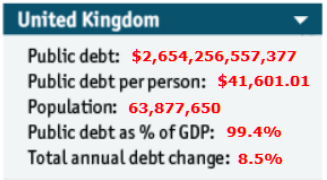
Global Debt Clock for Britain 2015. Image courtesy of The Economist’s Economic Intelligence Unit.
But with billions in tariff revenue helping to fund UK government operations, not only would deficits disappear and high public debt taper, there would be enough revenue left over to fund the ‘shovel-ready’ infrastructure projects that are unemployment-reducers, job-creators, and income tax generators for the country.
In economics, that is known as a virtuous circle. Which is a very wonderful thing.
Economists win Nobel Peace Prizes for engineering virtuous circles. Yes, it is that big a deal.
Investment
Tariffs should be seen by Britain and it’s trading partners as revenue generators.
Revenue from tariffs can fund deficit elimination, debt repayment, infrastructure and job creation or whatever gives the UK economy the best bang for the buck at that time.
Growing economies attract a lot of attention — the good kind. And every investor wants to invest in a winner.
By designing our economic fundamentals to mesh with the present economic moment, the UK could enjoy an almost unprecedented economic boom courtesy of the virtuous circles deliberately engineered into Britain’s economy.
Delivering on that goal should be our highest priority.
 Letter to Britain