Home » Articles posted by Letter to Britain (Page 62)
Author Archives: Letter to Britain

To Xi With Love, from Donald Trump
President Xi Jinping of China was awarded a second term in office by the Communist Central Committee of China just days ago (and doubly rewarded because term limits no longer apply to Mr. Jinping) has received communication from the Trump administration that steel exports to the United States will now face a 25 per cent tariff and aluminum exports to the United States from China will have a 10 per cent tariff added.
The tariffs against China and selected other countries are scheduled to go into effect March 24, 2018.
President Donald Trump of the United States says there is a huge and historic trade imbalance between the U.S. and China and is using tariffs to counter that imbalance which has been pegged between 374 billion and 511 billion dollars, depending upon how those figures are calculated.
Further, Mr. Trump has asked President Xi to submit a plan to lower the trade deficit with the United States by 100 billion dollars as soon as possible.
Which Countries are Exempt from the Tariffs that Begin on March 24, 2018?
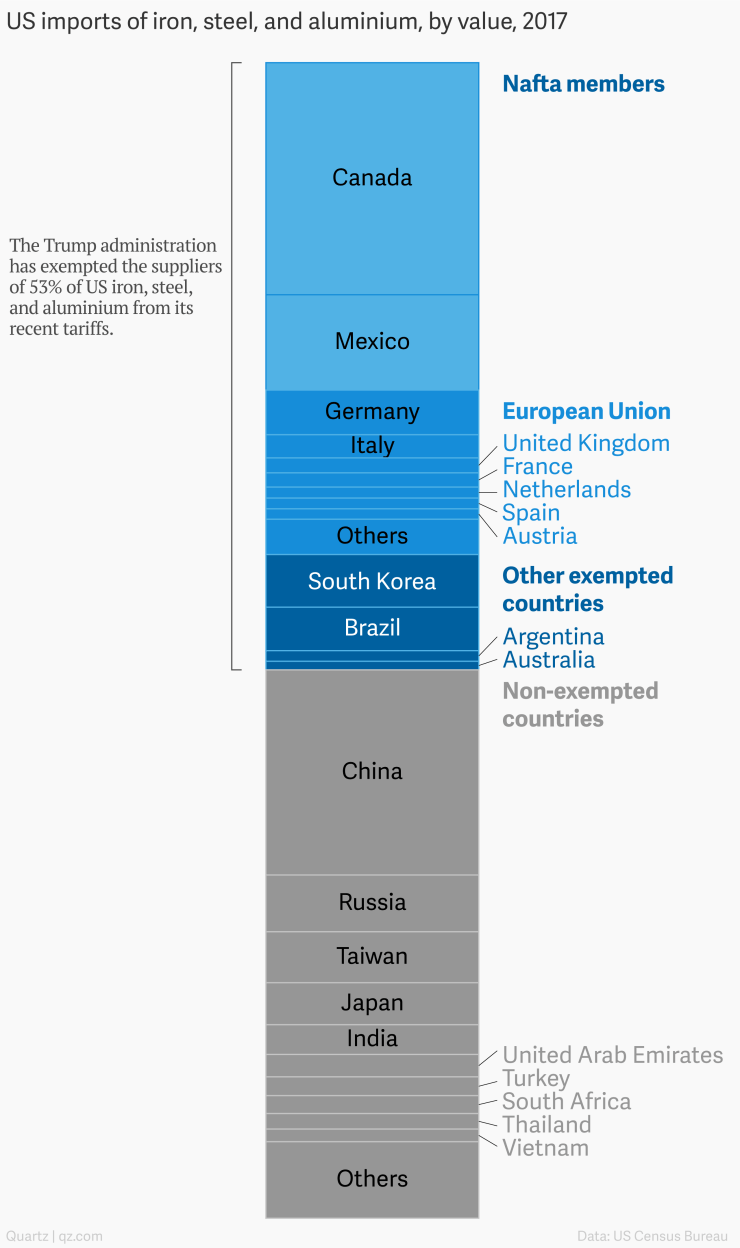
Image courtesy of Quartz.com. Click on the image to visit the Quartz image and article.
China has Responded to Trump’s Tariffs with Tariffs Against U.S. Goods
In response to Mr. Trump’s tariffs, China’s leader Mr. Jinping has responded with some mild tariffs against the United States.
China’s ambassador to Washington, Cui Tiankai, said on Thursday that Beijing would retaliate against those tariffs on about $60 billion of Chinese goods.
“We do not want a trade war with the United States or with anybody else, but we are not afraid of it,” Mr. Cui said, according to Xinhua, the official news agency. “If somebody tries to impose a trade war upon us, we will fight. We will do whatever we can to defend the legitimate interests.”
The $3 billion worth of goods that Beijing plans to penalize represent just about 2 percent of U.S. exports to China, which amounted to $130 billion last year, according to Chad Bown, a senior fellow at the Peterson Institute for International Economics.
“It’s not devastating economically by any stretch, but it’s certainly going to hurt those interests in the United States that are trying to export,” Mr. Bown said. He pointed out that the retaliation by China sends “a negative signal, that they are not seeking to de-escalate things.” — excerpt from the New York Times
All in All, Not a Trade War
Except that two superpowers are involved (which makes for great theatre) it’s not much of a trade war.
In fact, the Trump tariffs against Chinese steel (China supplies only 2% of U.S. steel) and Chinese aluminum (supplying less than 1% of U.S. aluminum) won’t amount to mega-billions of dollars.
Still, Trump has set the tone that countries that export to, and run huge trade deficits with the United States, will be addressed at the tariff level. Back in the old days getting your way in trade disputes was done by so-called ‘Gunboat diplomacy’ instead of the much softer tariff approach.
Thank goodness we’ve matured as a species!
Further tariffs may be levied on China and other countries by the Trump White House as the president seeks to balance America’s huge trade deficit across many nations that export to the United States.
The reason China has been singled-out is that it runs triple digit trade imbalances with America — not because anyone in the Trump White House has any particular enthusiasm to embarrass or anger China.
And although Donald Trump did make the numbers known to the public and did spend some time justifying his new tariff policy, it looks like the president sincerely wants a solution to the existing problem and doesn’t want a situation that escalates without resolution. We know that because he chose his words and his tweets very carefully.
Light at the End of the Tunnel?
What’s really at stake here is the long-term relationship between America and her trading partners.
China, Canada, Mexico, and the European Union are America’s largest trading relationships and in order for the United States to succeed it can’t allow huge trade deficits with every country it does business with.
If every country in the world ran a microscopic trade deficit of only 10 billion dollars with America, the U.S. trade imbalance would total 2 trillion dollars!
“To put that in perspective, if you stacked 1.9 trillion $1 bills on top of each other, the pile would reach about half way to the Moon.” — CNN
Not even the mighty United States of America can survive trade deficits of that magnitude.
China’s trade imbalance of ($374 billion to $511 billion in 2017, depending how you calculate it) is simply unsustainable for America, as are the double-digit trade deficits of several other countries.
This chart (unfortunately, from 2016) shows only the countries that have double or triple-digit trade imbalances with the United States (in millions of dollars)

Note: The European Union trade imbalance with the United States is 146 billion dollars, but some of those EU nations are also listed separately in this chart.
The Best Case Scenario?
As the tariffs go into effect, the best we can hope is that cooler heads prevail and that both the American and Chinese tariffs are seen as simple corrections to segments of the economy long neglected by policymakers on both sides of the Pacific.
Several countries that export steel and aluminum to the U.S. are exempt from the tariffs so American consumers will see very little change in prices. Consumers in China may see small price increases in certain foods that are imported from the United States.
The entire situation is an example that we should be mindful of our free trade privileges with other countries, neither exploiting them too much nor allowing ourselves to be exploited by them. Triple and double-digit trade imbalances don’t ‘just happen’ overnight! And they should be mindful of their free trade privileges with us.
If this in any way presages a shift toward fair trading rules between all nations — as opposed to unrestricted free trade — it means that international trade will be much more sustainable, and frankly, more easily welcomed by every country in the future.
Let’s hope this marks the beginning of the ‘Trump Doctrine of Fair Trade’ between nations.

Why Vlad Putin’s Re-election is Good for the West
Western leaders should be pleased that Russia’s President Vladimir Putin has been returned to power in Russia’s March 18 presidential race capturing 77% of the vote in what appeared to be an easy win for the four-time Russian president.
From the West’s point of view, the worst thing in the world would be a weak president in Russia (or any nuclear power) who could be replaced with a known or completely unknown person in the midst of a political crisis.
Even worse from the West’s point of view, would be a military coup. Western politicians simply don’t understand the mindset of normal Russians or their politicians, let alone the Russian military mindset!
Note: Vlad Putin also served one year as Russia’s Premier (1999) and a full term (2008-2012)
Vlad Putin’s Foreign Policy
While no one can deny that Mr. Putin is in business for Russia and that he wants to build the country into an economic powerhouse, he has delivered surprisingly moderate foreign policy that allows it to compete with other industrialized nations and he has played a helpful role in the verbal altercation between North Korea and the United States.
He continues to be an active force for good in institutions such as the United Nations, the BRICS countries, the SCO (Shanghai Cooperation Organisation), OPEC, the GCEF (Gas Exporting Countries Forum) and more.
Here’s a nice graphic that shows how important the BRICS economies are to the overall global economy.
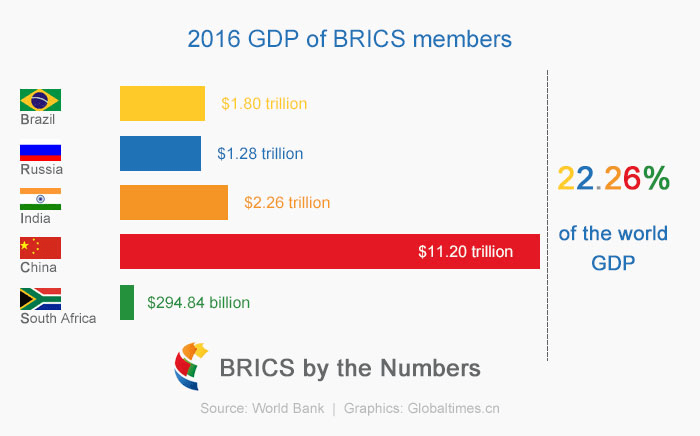
The combined GDP of the BRICS countries (Brazil, Russia, India, China and South Africa) will outpace the G20 countries prior to 2050, by the way.
Blame Russia!
Unfortunately, Russia-bashing is popular in some foreign capitals and it seems centred around Russia’s infinite resource wealth and jealousies over a total land area that makes it the largest country in the world by a significant margin.
Russia’s 17.1 million square kilometres easily make it the world’s largest by area. In fact, if Russia were to lop off 7 million square kilometers, it would still be the largest — and the lopped-off section would still rank seventh overall! — WorldAtlas.com
For those who complain about high military spending in Russia, it continues to run double-digit defence budgets (69 billion in 2016) while countries China runs triple digit-defence budgets (215 billion in 2016) and the United States runs triple-digit defence budgets (611 billion in 2016) even surpassing quadruple-digit defence budgets during the Iraq and Afghanistan wars.
 You will find more infographics at Statista
Vlad Putin’s Domestic Policy
His domestic policy has improved the lives of older Russians who suffered the hardships of two world wars, the Cold War, and the ever-present brutal weather, building Russia into what it is today. Yes, Russia’s senior citizens love Vladimir Putin who would vote him President for Life if it weren’t for the term limits on presidential office.
It’s a credit to Mr. Putin that he didn’t attempt to change the constitution of the Russian Federation in order to serve more than two consecutive terms as President, instead serving as the country’s Premier from 2008-2012 until he was once more eligible to run for the country’s highest office.
Even during the 2008 global recession and following an unprecedented downward spike in the global oil price, the Russian economy continues to perform better than expected and Putin has created hundreds of thousands of jobs across the country in almost every segment of the economy.
Any election where the incumbent wins 77% of the vote, that person can only be considered a hugely popular and unifying figure, and there is a bit of ‘Putin-mania’ during elections in Russia. The other candidates just can’t compete with that level of popularity even if they have decent or even enlightened policies on offer. Which says it all, doesn’t it?
Summary
The citizens of the relatively new Russian Federation (managed democracy) experiment and its predecessor the (communist) Soviet Union have lived an utterly different reality than the West since 1917. While Russians may look like us and even act like us, their society is different from Western society in many ways.
And that’s especially true during a crisis of any sort where Russians drop their differences no matter how strident their positions and view any outsider as an enemy of the state and as a deeply personal enemy.
It’s easy to see this in action. Every time someone in the West attacked Vlad Putin publicly, his popularity rose by another 10 per cent. Maybe Vlad will send his political enemies in the West a nice bottle of champagne to thank them.
But whether Western politicians are jealous of Putin’s constantly high polling numbers, his landslide election result, the size of the country he leads, or the astonishing resource wealth of the country, every politician in the world should breathe easier knowing that we’ll be dealing with the same Vladimir V. Putin for the next 6 years — and not someone unknown.
We know who Mr. Putin is and although we might not always agree, we know he doesn’t care to press nuclear buttons, or start brushfire wars in faraway places to boost his popularity.
Not that we should ever kowtow to Mr. Putin. But we know who we’re getting. And minor irritations aside, the West should breathe a huge sigh of relief and be thankful that a new Russian president didn’t arrive on the scene wanting to turn modern-day Russia into an amped-up Soviet Union — for just one example of how it could go bad for the West.
Congratulations to President Vladimir Putin on another successful run for presidential office, for knowing what is important to the people of Russia, and for working his pragmatic plan to give it to them. Три приветствия! (Three cheers!)

Brexit + Commonwealth & NAFTA Trade = Economic Powerhouse
Timid minds are wondering whether the UK should continue along the Brexit path that British voters approved in 2016.
But just imagine what kind of world it would be today if Winston Churchill had given in to timidity during WWII, or if Albert Einstein was too small a man for the job, or if Franklin Delano Roosevelt was too afraid of failing and thereby didn’t pursue his plan to ‘put a chicken in every pot’ in Depression-era America? We’d be living in a far different world now, wouldn’t we?
There is a thing about leaders and it’s this, if they don’t actually Lead they are useless baggage. And that’s all that needs to be said about that.
Prime Minister Theresa May was given a mandate by voters to take the UK out of the European Union, and whether it rains too hard on Sunday, or if Manchester United can’t seem to win a game, or even if the Russians are scaring us, Brexit must remain at the forefront of Britain’s To-Do List and everything else must be considered a distraction until the job is done.
How the UK can fulfill its proper role in the world
With a strong UK government the chips would fall into place rather quickly and completely bereft of excuses, the following would occur:
- Brexit (even a WTO or so-called ‘Hard Brexit’) or a sweet-for-both-sides Brexit would occur by the designated date of March 29, 2019.
- The UK would apply to join the (by then) recently renegotiated NAFTA accord — or perhaps all the parties would agree they’d be better served by partial UK membership in NAFTA. Hey, you never know until you try, but magic occurs when people of goodwill meet-up to plan mutual success!
- The UK would enter into trade negotiations with every Commonwealth member nation to see what the UK can offer those nations (expertise, financial services, high-tech) and what those nations can offer the UK (agricultural products, oil and gas, metals and minerals, perhaps even a source of low-cost seasonal labour for UK farms) and so much more! Again, you never know until you try!
- And remember, Theresa… the goal isn’t to say; “Well, at least we tried.” The goal is to secure a standardized free trade agreement, or a standardized low-tariff trade agreement with the Commonwealth nations and every non-Commonwealth nation — especially the NAFTA ones.
What’s to Gain?
By accomplishing those steps in the proper order, the UK economy would grow 5% over existing projections — or the government is doing it all wrong.
India alone will have 1.3 billion consumers by 2019, and the United States, the highest-consuming nation in the world, will have 331 million consumers by 2019.
Post-Brexit does not mean five or ten years after Brexit — it means one year after Brexit.
These goals are eminently achievable and there can be no excuses for not hitting these metrics by 2020.
Orchards full of apples will be missed for the sake of handfuls of grapes if the UK government is too ‘small’ for the job, or if it suffers from low ambition, or if because of timidity, it can’t grab the brass ring of destiny.
The time is now for the UK to take control of its future and to stop being distracted from the oft-stated goal of Building a Better Britain.
More power to Theresa May’s government for as many days, months or years they strive to meet the will of voters and continue to work to fulfill the UK’s rather obvious destiny!
 Letter to Britain