Home » Articles posted by Letter to Britain (Page 58)
Author Archives: Letter to Britain

Austerity Has Changed How the World Views the UK
Why, for the love of God, don’t governments utilize the most obvious solutions to solve their budgetary challenges whenever a global financial crisis hits, instead of defaulting to budget cuts that can appear either inept or mean-spirited?
Finance Ministers don’t set out to craft inept or mean-spirited policies during times of economic crisis, but that’s how it plays out in the media and in living rooms across the country or wherever people gather to discuss the economy.
In the UK, this manifests itself in the names that people call their political parties.
If government austerity cuts don’t affect you, you continue to call the Conservative Party by its rightful name. But if austerity hits you hard, then you’re one of those who’ve taken to calling the Conservatives ‘The Nasty Party’ — and they’ll never get your vote ever again, etc., etc. (Yes, I do empathize, BTW. But that’s not what this blog post is about)
It just depends upon which side austerity hits you.
And budget cuts (at least budget cuts perceived as unfair by a significant percentage of the population) almost always result in either a lost election or loss of parliamentary majority at the next election. Check out those stats! (You’ll see how true that statement is)
Theresa May’s ‘hung Parliament’ election result in June 2017 is 100% attributable to the UK austerity budgets that have been in effect since 2010, and hers is just one example out of many majority governments around the world that have suffered as a result of their austerity policies.
There IS a Better Way!
Due to market conditions, about every 25-years a recession comes along in the capitalist countries. You can almost set your clock by it. It’s the ‘nature of the beast — carry on’ is how recessions are described by economists, and nobody tries to prevent recessions, as such ‘resets’ help to prevent even worse economic crashes in the future.
Still, there’s a way for countries to survive economic downturns WITHOUT shooting themselves in the foot every day of the recession. (A novel idea!)
The public knows an economic downturn when they see it. In fact, they have enough experience in their own lives balancing family finances when times are good, let alone when domestic financial challenges appear such as a job loss or (suddenly) another mouth to feed. Therefore, they know the government must compensate whenever the country faces a financial challenge.
The question for governments is how to do it and not lose the next election. Or the one after that.
And the answer is; To do it fairly.
That is; Apply cuts that will be perceived as ‘fair’ by a majority of the public — instead of deep cuts to some departments while other departments see no cuts at all, or worse, are able to increase their spending.
Does it seem fair to you while in recession that Health or Education should receive deep cuts, while spending on the military or the environment is unaffected? (I’m just using hypotheticals here for an example. Every Briton knows their military is chronically underfunded and few begrudge the UK military being exempted from budget cuts)
Back to the subject at hand; Every department in practically any organization on the planet has 5% ‘fat’ built-in to it. It’s just the way of organizations.
Budgets tend to be tightly managed in the first few years, then, over time, surpluses accrue or unused properties aren’t sold off as quickly as they could be, or in other ways there’s potential for either budget savings or revenue increases. Or, depending on the department, perhaps a combination of selling off unused assets and departmental savings could meet the new budget targets set by the government.
If you’re a large organization like the UK government and you expect your revenue to fall by 7% (for example) here’s the way to do it fairly!
Simply inform your departments of the 7% budget exigency, and instead of arranging deep cuts for some departments and zero cuts to others which sets the seeds for future electoral defeat, inform all departments to cut their budget by 7% — or alternatively — tell them to find ways to increase their revenue by the shortfall amount.
Let me be clear, if former Chancellor of the Exchequer George Osborne had simply told every government department in 2010, “We’re facing a 7% (or whatever percentage) cut in revenue, therefore, each government department must cut 7% from their annual budget until further notice,” each department would’ve done exactly that and hardly anyone would’ve noticed. (Remember, every organization/department already has 5% ‘fat’ in their system, so only a 2% budget challenge remains in this hypothetical example. At that point, accounting for the final 2% equates to selling off surplus real estate assets until that amount is obtained)
On the other hand, some departments might be real estate ‘heavy’ and could counter their entire 7% budget challenge by simply unloading their surplus real estate, thereby meeting the government’s directives to cut costs by 7% or increase revenues by 7% (or any combination thereof) to hit their departmental budget targets.
Wouldn’t that have been much better than the pain inflicted on the bottom-two economic quintile people in Britain (and which cost Theresa May a parliamentary majority) all of which has conspired to cheapen the ‘British brand’ around the world?
Read here, in the New York Times just how ‘fairly’ or ‘unfairly’ (depending on your worldview) the United Kingdom’s austerity plan has been portrayed around the world.
A country’s fortunes (fairly or unfairly) can rise or fall based on the perceptions of large numbers of people. Let’s hope that future UK budget cuts will not only be fair, but be seen to be fair by large numbers of Britons and by people around the world.

Why the Commonwealth needs a space programme
Exploring space is fun, isn’t it?
From the Sputnik launch in 1957, to the Apollo mission putting man on the Moon in 1969, to the two Voyager spacecraft launched in 1977 that are now the farthest human-made objects to travel from Earth, to the Mars rovers ‘Spirit’ and ‘Opportunity’ and other great projects — all these programmes succeeded far beyond their designers best expectations.
The most recent space programmes concentrate on researching the nearest star, the Sun, which emits heat and light (and very dangerous) molten plasma that flies into space at thousands of miles per hour. These ‘Coronal Mass Ejections’ (CME) are ejected from the Sun and are occasionally 100-times the size of the Earth.
“NASA and the ESA are developing missions that will allow us to explore our own Sun like never before. These missions, NASA’s Parker Solar Probe and the ESA’s (the European Space Agency) Solar Orbiter, will explore closer to the Sun than any previous mission. In so doing, it is hoped that they will resolve decades-old questions about the inner workings of the Sun.
“These missions – which will launch in 2018 and 2020, respectively – will also have significant implications for life here on Earth. Not only is sunlight essential to life as we know it, solar flares can pose a major hazard for technology that humanity is becoming increasingly dependent on. This includes radio communications, satellites, power grids and human spaceflight. — Universe Today
Aside from the NASA and the ESA ‘Cool Science’ stuff – We Need to Track ‘Boring’ Objects on Collision-course with Earth
While all of the above is endlessly fascinating, the gaping hole in space exploration (which should concern everyone who lives on the planet) is the millions of space rocks (asteroids) and comets that pass by and sometimes hit the Earth.
The Earth is hit by meteorites (bits of space rock and ice) every day of the year. Most fall harmlessly into the world’s oceans as water covers 71% of the Earth’s surface, and thousands of them have been recovered from the ice sheets in Antarctica, Greenland and Siberia where they appear as small black rocks on the ice in plain view. You can pick up a handful of them in some parts of Antarctica in less than an hour.
Some asteroids are as large as 1/5th the size of the Moon (but those ones are easy to spot and have very stable orbits, meaning we don’t have to worry about them, ever) while millions of them are the size of the Empire State Building in New York and could wreak considerable damage if they were to impact the Earth at their usual 24,000 miles per hour impact speed.
If a skyscraper-sized object impacted Antarctica we’d barely know about it — but if one were to impact within 100 miles of any city we’d know! — the entire city might be destroyed especially if it hit the ocean near any coastal city, or if it hit a nuclear power station or even a hydro-electric dam where the impact could destroy the dam, causing severe flooding.
Read how asteroid impacts could harm humans living far from the impact site (The Express)
The thing is, we know the trajectories of only a fraction of them!
Yet, the dinosaurs were wiped out by a rock from space 65-million years ago, and only small mammals and birds that lived or nested underground (and some species of fish) were spared.
Few humans live underground it must be pointed out.
Which is exactly why we need a dedicated asteroid observatory in space to collect data on asteroids and comets in our neighbourhood!
Watch an actual GIF of “2010 WC9” as it passed by the Earth on May 15, 2018 (Slooh)
We Need a Geosynchronous Space Station to Track near-Earth Objects
While NASA and the ESA concentrate on the fascinating planets, various moons, and our Sun (and NASA’s Parker Solar Probe and the ESA’s Solar Orbiter will provide excellent realtime knowledge of the Sun and of CME’s that could potentially hit the Earth) and with both China and Japan mounting missions to the Moon a huge opportunity presents itself for the UK and its Commonwealth partners to save Earth from asteroidal or cometary impacts.
Although tiny groups of people are working to detect objects likely to impact us, typically they notify media outlets as the object passes or within a day or two of it passing the Earth — for the simple reason there are millions of asteroids in our space neighbourhood and they are difficult to spot, especially when black rocks are coming at us from black space with glare from the Sun blinding terrestrial observers.
Once they have passed by, we can more easily see them from the side that is illuminated by the Sun. But that would be much too late in the case of objects on a direct collision course with the Earth. We’d be hit before we could see them!
Such Extinction Level Events (ELE) are relatively uncommon, but a large asteroid or comet could hit us at any moment, or not for 100 years. Why sit around waiting for another ELE, when we may soon have the ability to deflect them from hitting our planet?
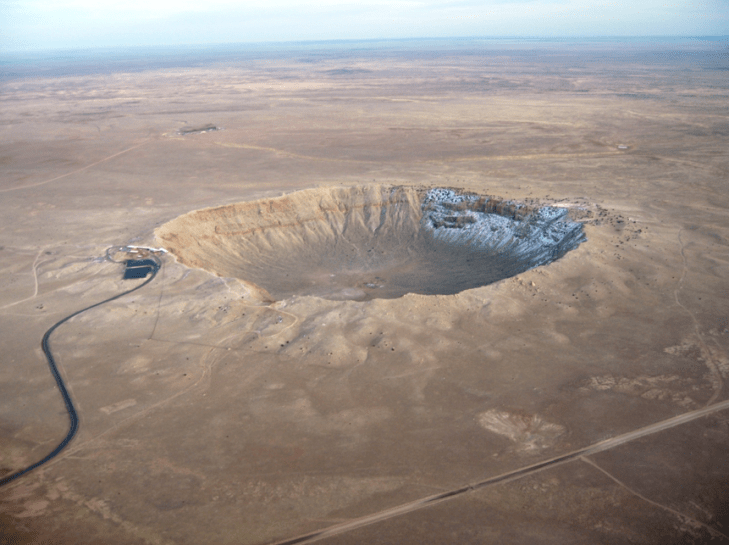
“Aerial view of Meteor Crater near Winslow, Arizona. This crater is ~1.2 km in diameter and ~170 meters deep. The crater is the result of an impact of a 40- to 50-meter iron-nickel asteroid roughly 50,000 years ago.” — NASA
Near-Earth asteroid “2010 WC9” that passed by our planet on May 15, 2018 is twice the size of the meteorite that created Meteor Crater in Winslow, Arizona.
For a direct comparison of the consequences of a Statue of Liberty-sized impactor, we need to consider the 1908 Tunguska Event which scientists say was caused by a meteorite of similar size to “2010 WC9”.
Read a great article about the Tunguska Event (NASA)
EXCERPT: “While testimonials may have at first been difficult to obtain, there was plenty of evidence lying around.
Eight hundred square miles of remote forest had been ripped asunder. Eighty million trees were on their sides, lying in a radial pattern.” — NASA
Using Parallax to Detect Objects in near-Earth Space
Many space objects pass by us without us knowing and it’s sheer dumb luck that we haven’t been wiped out by a large space rock as the dinosaurs were millions of years ago. In fact, there is evidence that there have been more than one mass-extinction event caused by asteroid impact in the Earth’s 4.5 billion year history, something that itself, is still being studied.
Trying to see black objects in black space heading toward us is folly
Even with our modern instrumentation and optics, we’re lucky to catch one-out-of-every-thousand of these wanderers. By setting up a permanent geosynchronous space station (geosynchronous means 22,236 miles above the Earth) the people in the space laboratory will see a much different view of objects hurtling through space on a collision-course with Earth.
At the geosynchronous orbit, such rocky loners would be much easier to spot and record, as they will be backlit by the Sun during part of their orbit around the inner solar system where we live.
It would cost billions of dollars to operate such a space station — yet the very survival of humankind could be at stake.
Whether it is 10-years or 100-years before our planet is hit by a major or medium-sized asteroid or comet now is the time to get ‘out there’ and get tracking all of these nearly invisible objects (from the view of the Earth) to determine which of them will hit us on their next pass.
India Advanced Rocket Programme + UK Advanced Payload Programme
India has a rocket programme advanced enough to allow the country to launch payloads to Mars.
Perhaps UK leaders could convince India to be partners in saving the Earth from asteroid impact and by splitting the costs among all Commonwealth of Nations countries, the Commonwealth could conceivably save all life from extinction.
If India provides the launch vehicle and launch facilities, other Commonwealth partners like the UK, Australia and New Zealand could supply the space station exoskeleton and the other technologies required for people to survive in a remote-ish space station.
Commonwealth partner Canada could supply a double-ended Canadarm (similar to what the NASA Space Shuttle delivered to the International Space Station) to facilitate movement of various space station modules and to assist resupply spacecraft docking at the Commonwealth space station, along with supplying sophisticated asteroidal and cometary identification and tracking technologies.
Non-Commonwealth countries may want to contribute to the asteroid/comet knowledge base — and some may offer to add their own modules and crews to the Commonwealth’s geosynchronous space station. Hey, the more the better!
For now, even an unmanned geosynchronous satellite designed to track potentially dangerous objects that could go up this year would be 1000-times more effective than the ‘system’ we have now for tracking potentially dangerous asteroids and comets. And in the future when we’ve studied these objects and understand them more fully, we will devise surefire ways to deflect them from impacting our planet.
Each year, more modules with greater capability could be added to the geosynchronous satellite, and within 5-years a permanently manned module could be attached.
ANYTHING is better than what we have now, which is almost nothing!
A Time to Lead
I respectfully urge the leaders of Commonwealth countries to make this dramatic and much-needed entrance into space for the greater good of humankind and to serve to further deepen the links between Commonwealth member nations.
So much good has come about from space exploration since 1957 and there is much more to come, but for that… we need to ensure the survival of the human race.
Therefore, let us go forward together on what may become perhaps the most important mission ever undertaken by our human civilization.
Visit www.asteroidday.org for more information about the asteroids in our solar system.

A New Era for the Commonwealth of Nations
As the United Kingdom leaves the European Union over the next few months, the historical and ongoing ties Britain has with the Commonwealth of Nations organization are expected to dramatically increase in importance.
In the decades since 1972 when the UK joined the European Community (EC) Britain’s primary engagement was with its EC partners, while its Commonwealth partnerships dwindled.
But a dramatic reversal is in the making.
The acting Queen of the United Kingdom and head of the Commonwealth, Elizabeth II recently approved her son Prince Charles to soon succeed her as the head of the Commonwealth of Nations organization, and also approved Prince Harry to be a Commonwealth youth ambassador.
Both appointments were warmly received by Commonwealth leaders at the recent Commonwealth Heads of Government (GHOGM) meeting in London in April 2018.
It shows that the organization still values the contribution of the British Royal Family and seemingly wants to increase trade and political ties to the UK — almost as much as the UK wants to get cracking on trade matters with the 2.5 billion member bloc.
Rarely is there such a clear case of ‘Win-Win’ convergence in geopolitics, but this is a relationship that was born to succeed.
More on Commonwealth matters next week!
A Royal (and Fun for Everyone!) Wedding Today at Windsor Castle
In the meantime; Heartfelt congratulations to Prince Harry and Meghan Markle who were married today at Windsor Castle. Harry now becomes the Duke of Sussex, while Meghan is henceforth the Duchess of Sussex.

The Royal Wedding of Prince Harry and American actress Meghan Markle at Windsor Castle on May 19, 2018.
They are a fascinating couple who are certain to make their very positive mark on the Commonwealth of Nations, on the United Kingdom, and on the rest of the Royal Family. Godspeed and good wishes to Harry and Meghan!
 Letter to Britain