Home » Articles posted by Letter to Britain (Page 56)
Author Archives: Letter to Britain
Brexiteers Davis and Johnson Abandon May’s ‘Soft Brexit’ Ship
Over the past 24-hours two senior officials in Theresa May’s government have resigned due to differences in what kind of Brexit each seeks.
And frankly, it’ll be a blessing. Far less paint will be peeled off the walls each week at 10 Downing Street if you catch my meaning.
Even though both David Davis and Boris Johnson were and are strong proponents of Brexit (which Prime Minister Theresa May also claims to be) governing the country becomes an impossible task when three people fight each other daily to steer the ship of state.
Every Prime Minister must tolerate some division within the party caucus to be sure. Less so, but still important is to allow a variety of views within Cabinet so that it doesn’t become a sterile place where ideas go to die. But there comes a point when too much division becomes the main issue — instead of the people’s business being the main issue.
Which is why it’s important Theresa May stuck to her guns and didn’t make any last-minute deals (of a kind that a lesser PM might have made) to keep the crew together. Not that Davis and Johnson are going anywhere as they’ll remain Conservative Party backbenchers.
Certainly, Margaret Thatcher would’ve told Davis and Johnson to ‘go fish’ some time ago and probably would have physically evicted them from the room. ;) (You never knew with Maggie!)
Whether You Agree with Davis and Johnson or Not, this Streamlines Whatever Brexit Modality Theresa May Pursues
While some would like the strongest possible Brexit — Britain’s future will be better with a Brexit agreement that doesn’t ruin relations with the EU, one that includes some kind of reasonable free trade deal, one that allows the UK and the EU to cooperate on a wide range of issues such as, but not limited to; A common rulebook where and when feasible, the Galileo project, the ECJ (where UK courts would include, but not be limited or bound by ECJ rulings and opinions) NATO, and agreeable relations or even membership with other important European institutions.
Theresa May’s sole goal (it seems) is to get a deal with the EU. Which is a noble goal in itself.
The flip side of that is when the agreement Theresa May intends to present is so diluted that her Cabinet walks out the door. Yet, the Prime Minister may still be proven right by events yet to unfold.
It’s obvious to all but the most politically tone-deaf that no matter what agreement is presented to the EU mandarins, it is likely to be swiftly rejected. Including Theresa May’s super-diplomatic, uber-polite and overly soft Brexit proposals.
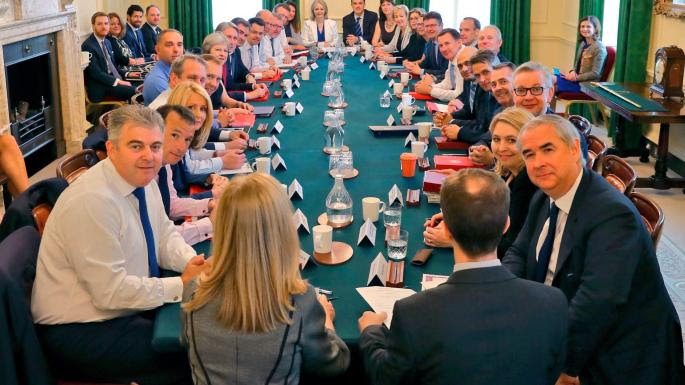
UK Prime Minister Theresa May sees off two Cabinet officials within 24-hours allowing her to get the team she needs for a Soft Brexit deal. Image courtesy GOV.uk
But if That’s the Case, Why Try at All?
As an experienced bureaucrat slogging it out in the Home Office for a decade Theresa May knows something that hardcore Brexiteers don’t. And that is, those who get ‘stuck with the bill’ wind up paying many times over.
Let’s look at three scenarios, and let’s see who gets stuck with the bill:
- Hard Brexit faction presents an uncompromising Brexit deal to the EU: The European Union declines the deal offered and the blame is on Britain ‘for being so unreasonable’ and from that point on… every single thing that ever goes wrong in Europe, the World, and the Solar System… will be the fault of *those* unreasonable Brexiteers. And it’s not that EU people are evil, it’s just human nature to feel that way when jilted.
- Soft Brexit faction presents a soft agreement for signing in Brussels which is accepted by the EU: It’s seen as a ‘Win-Win’ for both sides. But the EU ‘wins’ by a slight margin and when you’ve effectively ‘dumped your partner’ sometimes it’s a good thing to let them ‘win’ a little bit. The worst that can happen in such a case is that the next UK Prime Minister will try to improve the deal and may or may not succeed in that endeavor. Likely, as time rolls on, both sides will arrive at a better agreement and both can claim credit with their respective voters for any future agreements. Not a bad scenario at all.
- Soft Brexit faction presents a soft agreement for signing in Brussels which *isn’t* accepted by the EU: At that point, the British can walk away from the table knowing in their hearts and with the whole world as a witness that they ‘tried their best’ to accommodate the concerns of the people in Brussels but they just couldn’t strike a deal. (A sort of ‘no fault’ divorce) And Brexit proceeds on a WTO-style basis with a flurry of à la carte agreements signed following March 29, 2019 allowing EU cars to be sold in the UK and UK airlines to operate over continental Europe, for two examples.
In scenario #1: Britain and the Hard Brexiteers get stuck with the bill for about the next century. Maybe longer. ‘Those intransigent Brits! A bloody difficult people they are!’
In scenario #2: Britain gets stuck with the larger part of the bill and in the following years must work incrementally towards the final Brexit arrangements they were originally seeking. ‘Damn, Theresa, couldn’t you do any better? Oh well, we got a Brexit of sorts, you’re forgiven.’
In scenario #3: The EU gets stuck with the bill and the world decrying EU intransigence. And Theresa May *probably* gets re-elected in a landslide.
Summary
[Theresa May as Admiral Holdo, David Davis and Boris Johnson as Poe Dameron et al.]
The present Brexit moment is similar to those frantic scenes in Star Wars: The Last Jedi where Poe Dameron and his compadres tried and failed to stage a coup against Vice-Admiral Holdo (who didn’t have the best slate of options from which to choose, and consequently didn’t have the best plan, but in the end it was the only plan that could have worked) and essentially the people on good side of the Force got the result they wanted.
The lesson from this story is that when the chips are down and you *must* bring home a win *always* go with the plan that is *guaranteed to work*.
Which in the real world often isn’t the most glorious, most exciting, nor the most popular plan. Unfortunately.
But when a plan works, it’s a win. And beautiful or ugly, if the plan works that’s all that matters.
May the Force be with You, Theresa May!
Will a ‘No Deal’ Brexit Harm UK Manufacturing?
Certain pro-EU commentators paint a picture of either a catastrophic Brexit crash-out (Hard Brexit) or a ‘non-Brexit’ where the UK would retain few of the rights gained by a full Brexit but would still be chained to the responsibilities of EU membership (Soft Brexit) whether via the so-called ‘Norway’ model or the ‘Norway-plus’ model, or via any other model such as the ‘Canada’ model.
Those same commentators excitedly cite potential UK manufacturing job losses in the post-Brexit timeframe even though the UK is primarily a service based economy (80.2% in 2014 and rising) and they forget to factor-in the astonishing changes occurring every day in Britain’s manufacturing sector.
UK Manufacturing = Less Than 10% of GDP
Manufacturing in the UK accounts for less than 10% of GDP (2016) and provides jobs for 3.2 million workers (2016) but a recent PwC report says that by 2030 half of all UK manufacturing jobs could be automated. That’s less than 12-years from now. And it could happen much faster and on a much larger scale than that.
Repeat; Up to half of all UK manufacturing jobs will be lost within 12-years. It’s uncertain whether British workers are aware of these looming changes.

The economic impact of artificial intelligence on the UK economy. Image courtesy of PwC. Click on the image to view or download the PDF report.
What’s Great for UK Businesses Won’t be Great for Foreign Workers
In 2018, of the 3.1 million UK manufacturing workers (a stat that falls with each passing year as automation increases) we find that over half of manufacturing workers in the UK are citizens of other countries — primarily from eastern Europe, but also western Europe.
So, expect UK-based eastern European workers to be replaced by automation.
Increasing automation and Artificial Intelligence (AI) will cause UK companies to choose between UK-born workers and eastern European workers, and it’s likely that hundreds of thousands (perhaps millions) of eastern Europeans will be returning home with plenty of UK coin in their pocket. (And why not, they earned it)
I hope you didn’t expect the UK to lay-off its own British-born workers in order to protect the jobs of eastern European-born workers as automation proceeds, did you? Would EU companies show that level of courtesy to UK workers in the European Union, were the situation reversed?
Profits for UK manufacturing companies are projected to rise significantly as automation and AI become one with the system, while UK-born manufacturing workers should find themselves at 100% employment.
What’s not to like?
UK Manufacturing Job Losses Due to Automation – Not Brexit
If you’re one of the EU elites who fear that hundreds of thousands of eastern European workers in Britain will lose their UK manufacturing jobs due to Brexit you couldn’t be more wrong.
Let’s be perfectly clear; Half of all UK manufacturing jobs will be lost to automation by 2030 — and it won’t be on account of Brexit!
Summary
The narrative that says the UK economy will be severely damaged on account of manufacturing job losses due to a Hard Brexit is a complete and utter fantasy.
Every day from now until 2030, automation and AI will replace eastern European workers, Brexit or no Brexit. Meanwhile, British-born manufacturing workers will find themselves at full employment.
It’s all good!
Related Articles:
- How will artificial intelligence affect the UK economy? (PwC)
- The economic impact of artificial intelligence on the UK economy (PwC)
- What would be the cost to the UK of regulation by a foreign power and major competitor? (BrexitCentral.com)

Brexit Committee says ‘Not Enough Time to Execute Brexit’ by Target Date
“The Brexit Committee has warned that even under the most optimistic scenario, there may not be enough time to complete all necessary work before the UK is scheduled to leave the EU. The Brexit Committee report also calls for an extension to the exit timetable if a deal has not been finalised.” — The Express
What *Have* They Been Doing?
Two years on from the June 2016 Brexit referendum and with almost one more year to go before the stated target date of March 29, 2019 and the Brexit Committee says that “even under the most optimistic scenario, there may not be enough time to complete all the necessary work before the UK is scheduled to leave the EU.”
That’s the definition of ‘Low Ambition‘ right there.
Whether the fault lies in Brussels or at 10 Downing, or even because of the infighting that happens within the Conservative Party itself, governments need to remember that the people have spoken (and quite apart from that) sentiment continues to grow among the UK voting public for the government to ‘just get on with it’.
Even people who voted Remain now think the best thing for the country is for a quick and streamlined Brexit agreement — one that is fair to citizens and industry on both sides of the English Channel.
If two years and nine months isn’t enough time to get it done, what is?
Do the politicians in London and Brussels think they have carte blanche to spend the rest of the decade and part of the next to arrange a suitable Brexit deal? If so, that’s very telling… and not in a good way.
Citizens on both sides of Brexit need to know and industry needs to know what to expect so they can prepare for life after Brexit. And they needed to know a year ago.
How Hard Can it Be?
Most of the existing EU laws will simply continue unchanged following Brexit, therefore, more will stay the same than will change.
FISHERIES
It was originally thought that the UK would be leaving The Common Fisheries Agreement by March 29, 2019, or at the latest, by July 2019.
Therefore the UK had been negotiating with the EU in good faith so they could make some basic decisions about how to manage UK fisheries after Brexit. Micheal Gove is surely an able enough minister to easily handle it, yet, the EU indicated that the Common Fisheries Agreement will remain in place until 2020 and there will be no negotiation about it. And that was the end of that.
Read this important article about UK fisheries policy between March 29, 2019 and January 1, 2021: Brexit: Michael Gove shares fishing industry ‘disappointment’
Actually, the EU might’ve done the UK a favour by sidelining fisheries policy until after Brexit. Imagine that!
As off-putting as that sounds, it dramatically lightens the load of UK government negotiators because it’s one less sector that needs to be debated with EU negotiating teams. All of which should have conspired to put both the UK and EU six months *ahead* of schedule on the Brexit negotiation timeline!
So we can’t blame Brexit delays on Micheal Gove, the Common Fisheries agreement, or the EU for delays to that timeline.
DEFENCE
Both the UK and EU will remain members of NATO post-Brexit and as the UK already operates its own defence infrastructure there isn’t much change expected there.
Apart from arranging the return of any non-NATO-dedicated Royal Air Force jets presently in EU countries, or removing Royal Navy ships from EU waters (unless there by invitation of an EU country or while taking part in a NATO exercise) there isn’t much for Gavin Williamson the Secretary of State for Defence of the United Kingdom to handle for this part of Brexit. A few phone calls before the Brexit date should cover it.
So we can’t blame the lack of progress on Gavin Williamson or his EU defence counterparts for agreements not reached in time for Brexit.
CUSTOMS and SINGLE MARKET
Thus far, the EU seemed to be in denial that the UK was actually leaving the bloc, so quite logically from their point of view; Why would they want to entertain UK negotiations allowing the UK to leave the customs agreement and the EU’s single market architectures?
But now that the UK Parliament have voted in favour of the EU Withdrawal Bill you’d think the EU would accept the UK is leaving the bloc and that it is time to begin crafting an agreement setting the dates and terms to allow Britain to leave both the Customs Union and the Single Market.
But since the Withdrawal Bill passed last week, some in the EU suddenly began saying that negotiations with the UK can’t continue because the UK’s ruling Conservative party is ‘deeply divided’ and that ‘the EU can’t be certain who it is dealing with’ — yet, the UK government easily passed the EU Withdrawal Bill which it said it would do all along.
Full marks here to Prime Minister Theresa May for shepherding this bill through and making it look easy. Brilliant!
Read this important article about: How MP’s voted on the EU withdrawal bill amendments
Until the Withdrawal Bill was signed into law, any Brexit timeline delays were the fault of UK Conservative Party MP’s and the EU bore no particular blame for its lack of enthusiasm regarding the furtherance of Brexit negotiations.
However, now that the bill has been made into law, negotiations must begin in earnest.
FREE TRADE BETWEEN THE UK and THE EU POST-BREXIT
Almost everything that applies to the delays in the customs and single market negotiations (see above) applies here too.
To reiterate: Until the Withdrawal Bill was signed into UK law, delays to the negotiation timeline are to be blamed on the UK side and not on the EU side for the simple reason that until the UK side got serious about Brexit, why would the EU get serious about it?
Fortunately, and better late than never, PM Theresa May got the job done and now things must advance in the interests of industry and citizens on both sides of the Channel.
Not that the UK can suddenly afford to make Brexit ‘the EU’s emergency’ as the UK pursued the Withdrawal Bill in a most leisurely fashion over the past 32 months.
“A lack of planning on your part doesn’t necessarily constitute an emergency on my part.”
Yet because trading arrangements will benefit business on both sides of the Channel things must now move smartly along or delays will hurt business on both sides.
I wouldn’t want to be the German Chancellor or the British Prime Minister (for example) who failed to get a trade agreement ready in time for Brexit, or the leader who failed to make the necessary modifications to their respective departments to allow trade to continue uninterrupted.
IMMIGRATION and FREE MOVEMENT
It looks like this is a non-negotiable for the UK government. Too many British citizens spoke too loudly and too clearly for any UK Prime Minister to dare overrule their wishes.
Each EU citizen wishing to remain in the UK after Brexit will pay a nominal annual fee (about the price of a passport) and will be required to provide an up-to-date address and telephone number for the Home Office. Simple enough.
EU citizens wanting to move to the UK after Brexit will face the same requirements as EU citizens who’ve elected to stay on in Britain.
Non-EU citizens can probably expect about the same, although emigrating to the UK *after* Brexit will be much easier if you’re an EU citizen or Commonwealth citizen.
Now that the EU Withdrawal Bill Has Finally Passed It’s Time to Lift Those Anchors!
For industry, change is always negative but still doable. But late changes are lethal to business on both sides.
And UK leaders and EU27 leaders must remember that!
Industry needs clear and timely regulations (with a long lead time) that must rank higher than the ideological differences between the heads of European states (including the UK) higher than the (occasional) personality conflicts between politicians, and must always rank above the partisan politics within a country.
From the day the Withdrawal Bill was finally signed into law, every day must now count, be counted, and be accountable — or the UK and the EU27 will be racing with ‘their anchors still in the water’ against every other ‘ship of state’ in the world.
And that’s not how you win races, whether nautical or economic.
 Letter to Britain